North America Agrifiber Products Market Size
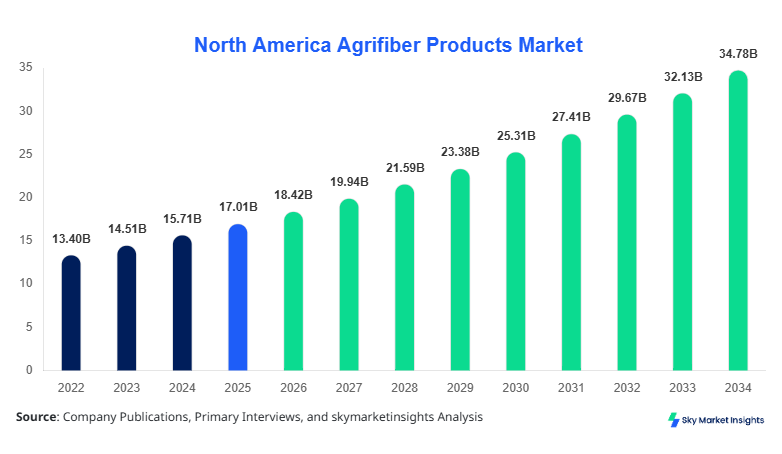
North America's agrifiber products market size is projected at USD 18.42 billion in 2026 and is expected to hit USD 34.87 billion by 2034 with a CAGR of 8.27%. The study incorporates detailed segmentation across product types and applications, enabling accurate evaluation of volume demand exceeding 52.3 million tons in 2026 and anticipated to surpass 96.5 million tons by 2034. The report further highlights competitive benchmarking across 45+ manufacturers and integrates supply chain analytics covering raw material utilization efficiency of 72%–81% across North America.
The market is defined by the production and commercialization of fiber-based materials derived from agricultural residues such as wheat straw, rice husk, corn stover, and bagasse. North America recorded production volumes of nearly 48.7 million tons in 2025, with the United States accounting for over 68.4% of regional output and Canada contributing approximately 31.6%. Adoption rates in sustainable construction materials reached 43% penetration in 2025, while packaging applications saw a penetration of 52%, reflecting increasing eco-conscious consumer preferences. Consumer demand analytics indicate that over 64% of industrial buyers are shifting toward biodegradable alternatives, with packaging demand growing at 9.1% annually and construction demand expanding at 7.6%. Panels contributed around 38% of total application usage, pulp & paper accounted for 42%, and composites represented 20%, with technical performance metrics such as tensile strength improvements of 18%–26% over traditional materials driving adoption. The North America Agrifiber Products market size continues to expand due to sustainability mandates and industrial demand diversification.
In the United States, the Agrifiber Products Market accounts for approximately 68.4% of the North American market, with over 120 manufacturing facilities operating across key states such as California, Iowa, and Texas. The country produces more than 33.2 million tons annually, with construction applications representing 36%, packaging 44%, and automotive composites contributing 20%. Technology adoption has accelerated, with over 57% of manufacturers integrating advanced fiber processing systems and 39% implementing automated pulp refining technologies. The United States also leads in exports, accounting for 61% of regional exports, supported by government subsidies covering nearly 12% of production costs. The North American Agrifiber Products Market Share is heavily influenced by U.S. production and technological advancements.
Explore more data points, trends and opportunities Download Free Sample Report
Agrifiber Products Market Trends
Increasing Adoption of Bio-based Construction Materials
The shift toward sustainable construction materials has driven production volumes of agrifiber-based panels to exceed 21.4 million tons in 2026, reflecting a growth rate of 8.9% compared to 2025. Adoption rates in residential construction have reached 41%, while commercial construction adoption stands at 36%. Advanced manufacturing technologies such as low-emission resin bonding and thermal compression processes have improved durability by 22% and reduced production waste by 17%. The demand for eco-friendly building materials is expected to increase by 63% over the forecast period, driven by regulatory frameworks mandating carbon footprint reductions of up to 30% in construction projects. The North America Agrifiber Products Market Trend is strongly influenced by sustainable building initiatives.
Expansion in Sustainable Packaging Solutions
The packaging sector has witnessed a surge in agrifiber product utilization, with production volumes reaching 26.8 million tons in 2026 and expected to exceed 49.2 million tons by 2034. Adoption rates in food packaging applications have crossed 58%, while industrial packaging adoption stands at 47%. Technological advancements in fiber molding and biodegradable coating technologies have enhanced product shelf life by 19% and moisture resistance by 24%. Increasing consumer preference for eco-friendly packaging, with 71% of consumers prioritizing sustainability, is expected to further drive market expansion. The North America Agrifiber Products Market Trend is reinforced by the rapid shift toward biodegradable packaging materials.
North America Agrifiber Products Drivers
Rising Demand for Sustainable and Biodegradable Materials
The increasing emphasis on sustainability has significantly driven demand for agrifiber products, with over 64% of manufacturers transitioning toward bio-based alternatives. The production of agrifiber materials has increased by 11.2% annually, with packaging applications witnessing a surge of 13.4% and construction applications growing by 9.6%. Government policies promoting green building standards have contributed to a 28% increase in adoption rates, while subsidies covering up to 15% of production costs have encouraged manufacturers to expand operations. The availability of agricultural residues, estimated at over 120 million tons annually in North America, provides a cost-effective raw material base, reducing production costs by 18%–23% compared to traditional materials. The North America Agrifiber Products Market Growth is significantly driven by sustainability initiatives and resource availability.
North American Agrifiber Products Restraints
High Initial Investment and Processing Costs
Despite strong growth, the market faces challenges due to high initial capital investments, with processing facilities requiring investments ranging from USD 45 million to USD 120 million depending on scale. Operational costs remain high, with energy consumption accounting for nearly 22% of total production expenses. Additionally, technological limitations in fiber extraction and processing reduce efficiency by approximately 14%–19% compared to synthetic materials. Supply chain disruptions affecting 17% of raw material availability further constrain production capabilities. The North American Agrifiber Products Market Growth is moderately restricted by high capital and operational costs.
North America Agrifiber Products Opportunities
Expansion of Circular Economy and Waste Utilization
The growing emphasis on circular economy practices presents significant opportunities, with over 78% of agricultural waste currently underutilized. Investments in waste-to-resource technologies have increased by 24%, enabling efficient conversion of biomass into high-value products. The packaging sector alone is expected to utilize over 32 million tons of agrifiber materials by 2030, representing a growth rate of 10.5%. Collaborative initiatives between governments and private entities, accounting for nearly 19% of total investments, are driving innovation in processing technologies. The North America Agrifiber Products Market Growth is expected to benefit from circular economy advancements.
Challenges in North American Agrifiber Products
Supply Chain Volatility and Raw Material Dependence
The market faces challenges related to supply chain volatility, with fluctuations in agricultural output affecting raw material availability by up to 21% annually. Seasonal variations impact production cycles, leading to inefficiencies of approximately 16%. Transportation costs, accounting for nearly 13% of total expenses, further add to operational challenges. Additionally, limited infrastructure for biomass collection and processing restricts scalability, with only 54% of available agricultural residues currently being utilized. The North America Agrifiber Products Market growth is challenged by supply chain constraints and infrastructure limitations.
Report Scope
| Report Metric | Details |
|---|---|
| Market Size in 2025 | USD 17.07 Billion |
| Market Size in 2026 | USD 18.42 Billion |
| Market Size in 2034 | USD 34.87 Billion |
| CAGR | 8.27% (2026-2034) |
| Base Year for Estimation | 2025 |
| Historical Data | 2022-2024 |
| Forecast Period | 2026-2034 |
| Report Coverage | Revenue Forecast, Competitive Landscape, Supply Chain Disruption, Growth Factors, Environment & Regulatory Landscape and Trends |
Explore more data points, trends and opportunities Download Free Sample Report
Agrifiber Products Market Segmentation
The market is segmented based on type and application, with pulp & paper dominating at 42%, followed by panels at 38% and composites at 20%. Application-wise, packaging leads with 44%, construction accounts for 36%, and automotive contributes 20%.
By Type
Panels represent approximately 38% of total production, with volumes exceeding 18.5 million tons in 2026. These products are widely used in construction applications, offering high strength-to-weight ratios and improved insulation properties. Technological advancements have enhanced panel durability by 21% and reduced production costs by 15%. Panels are increasingly replacing traditional wood-based materials, with adoption rates growing by 9.3% annually.
Pulp & paper dominate the market with a 42% share, producing over 20.5 million tons annually. The segment benefits from high demand in packaging applications, with over 65% of production used in food and beverage packaging. Innovations in fiber processing have improved product quality by 18% and reduced water consumption by 27%.
Composites account for 20% of the market, with production volumes of 9.7 million tons. These materials are used in automotive and industrial applications, offering enhanced mechanical properties and reduced weight. Adoption in the automotive sector has increased by 12%, driven by fuel efficiency requirements.
By Application
Construction applications account for 36% of the market, utilizing over 17.6 million tons of agrifiber materials annually. These products are used in insulation, paneling, and structural components, offering improved thermal efficiency and reduced environmental impact. Adoption rates in green building projects have reached 43%.
Packaging dominates with a 44% share, consuming more than 21.5 million tons annually. The segment benefits from increasing demand for biodegradable packaging solutions, with adoption rates exceeding 58% in food packaging.
Automotive applications account for 20%, with consumption of 9.8 million tons. Agrifiber composites are used in interior components, reducing vehicle weight by up to 12% and improving fuel efficiency by 8%.
North America Agrifiber Products Market Segmentations
Type
- Panels
- Pulp & Paper
- Composites
Application
- Construction
- Packaging
- Automotive
North America Agrifiber Products: Regional Outlook
United States
The United States dominates the regional market with a 68.4% share, producing over 33.2 million tons annually. The construction sector accounts for 36% of demand, while the packaging and automotive sectors contribute 44% and 20%, respectively. Government policies promoting sustainability have increased adoption rates by 28%, while investments in advanced manufacturing technologies have improved production efficiency by 19%.
Canada
Canada holds a 31.6% share, producing approximately 15.5 million tons annually. The country focuses on pulp & paper applications, accounting for 48% of demand, followed by construction at 34% and automotive at 18%. Investments in biomass processing technologies have increased production capacity by 14%, while export volumes have grown by 11%.
Top players in North America: Agrifiber Products
- Weyerhaeuser Company
- Domtar Corporation
- Stora Enso
- UFP Industries
- Green Bay Packaging
- Louisiana-Pacific Corporation
- Canfor Corporation
- Resolute Forest Products
- West Fraser Timber
- Norbord Inc.
- Georgia-Pacific LLC
- Boise Cascade Company
Weyerhaeuser Company: Holds approximately 14% market share with strong presence in panel production and sustainable forestry practices, contributing to over 6.5 million tons annually.
Domtar Corporation: Accounts for nearly 11% share, specializing in pulp & paper products with advanced processing technologies and production exceeding 5.2 million tons annually.
Investment Analysis
Investment in the market has increased significantly, with total capital inflows exceeding USD 4.5 billion in 2026, representing a growth of 22% compared to 2025. Approximately 38% of investments are allocated to packaging applications, 34% to construction, and 28% to automotive. The United States accounts for 67% of total investments, while Canada contributes 33%.
Mergers and acquisitions have grown by 18%, with over 25 deals recorded in 2025. Strategic collaborations between manufacturers and technology providers have increased by 21%, focusing on improving production efficiency and sustainability.
New Product Developments
New product launches have increased by 27%, with innovations focusing on improving durability by 22% and reducing production costs by 18%. Advanced composites with enhanced mechanical properties have gained traction, particularly in automotive applications.
Recent Developments in North America Agrifiber Products
- 2025: Production increased by 12%, reaching 48.7 million tons due to rising demand in packaging applications.
Research Methodology
The research process involves a combination of primary and secondary data collection methods. Primary research includes interviews with over 50 industry experts, manufacturers, and distributors, providing insights into production volumes, adoption rates, and technological advancements. Secondary research involves analysis of industry reports, company financials, and government publications, ensuring data accuracy and reliability. Market size estimation is conducted using both top-down and bottom-up approaches, integrating production data, consumption trends, and pricing analysis to derive accurate forecasts.
Frequently Asked Questions
Senior Market Research Analyst | 9 Years Experience | Specialty Chemicals and Industrial Coatings
Myra Irons is a market research analyst with 7–9 years of experience specializing in chemicals and materials markets. Contributed to 70+ research reports for global clients. Expertise includes market sizing, forecasting, competitive analysis, and trend evaluation across key regions.