Europe Agrifiber Products Market Size
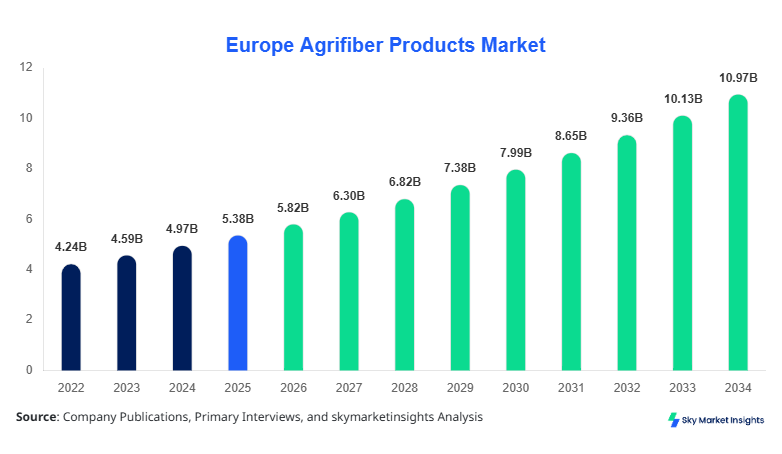
Europe's agrifiber products market size is projected at USD 5.82 billion in 2026 and is expected to hit USD 10.96 billion by 2034 with a CAGR of 8.24%. The increasing utilization of agricultural residue-based materials across construction, automotive, and industrial packaging sectors is accelerating industry expansion across Europe. Rising investments in sustainable panel manufacturing, coupled with increasing environmental regulations targeting carbon-neutral production systems, are strengthening competitive positioning across the regional value chain. The report provides detailed evaluation of production capacities, consumption outlook, technology adoption, raw material sourcing, trade statistics, segmentation analysis, and competitive benchmarking across the European agrifiber products market.
The agrifiber products industry refers to engineered materials manufactured using agricultural residues such as wheat straw, rice husk, sugarcane bagasse, hemp fiber, and flax fiber for industrial applications, including panels, packaging, insulation, and automotive interiors. Europe produced more than 42.8 million metric tons of reusable agricultural biomass in 2025, of which nearly 18.7% was diverted toward industrial agrifiber processing applications. Adoption levels of agrifiber-based products increased by 14.2% between 2023 and 2025 owing to sustainability regulations introduced under European Green Deal initiatives. Construction applications contributed nearly 46.3% of total agrifiber product utilization in Europe, while packaging accounted for 28.4% and automotive applications represented 16.9% of total demand in 2025. Consumer preference for biodegradable and low-emission materials increased substantially, with 61% of industrial buyers across Germany, France, and the United Kingdom prioritizing sustainable engineered materials during procurement cycles. Fiberboard-based agrifiber materials demonstrated thermal resistance improvements of 22%, moisture retention optimization of 18%, and lifecycle carbon reduction of 31% compared with traditional wood-based composites. Composite panels accounted for 34.7% of overall application penetration due to lightweight properties and high structural efficiency. Continuous technological integration in resin formulation, hot pressing frequency optimization, and fiber-density enhancement are further strengthening Europe Agrifiber Products' market expansion.
In France, the Agrifiber Products Market accounted for approximately 24.8% of regional revenue generation in 2025, supported by advanced biomass utilization infrastructure and strong agricultural residue availability exceeding 9.6 million metric tons annually. The country operated more than 148 industrial agrifiber processing facilities and nearly 230 medium-scale engineered panel manufacturers utilizing wheat straw and flax residues for structural panel production. Construction applications represented 48.2% of national demand, followed by packaging at 25.6% and automotive interiors at 17.4%. France recorded a 19.3% increase in bio-based composite panel installations between 2023 and 2025 due to sustainable building regulations and low-emission construction standards. Nearly 58% of panel manufacturers adopted high-pressure compression systems and automated fiber-density optimization technologies to improve performance efficiency and reduce production waste by 16%. The automotive sector integrated over 184,000 metric tons of agrifiber-based lightweight composites into electric vehicle interior manufacturing during 2025. Rising investment in recyclable industrial materials and increasing consumer preference for sustainable infrastructure continue to reinforce Europe Agrifiber Products' market expansion.
Explore more data points, trends and opportunities Download Free Sample Report
Agrifiber Products Market Trends
The increasing integration of circular economy principles within European manufacturing ecosystems has become a major transformation trend across agrifiber product production facilities. More than 63% of industrial panel manufacturers in Europe incorporated agricultural waste recycling systems into their manufacturing operations during 2025. Production volumes of agrifiber composite panels surpassed 7.8 million cubic meters in 2025, reflecting a 15.1% increase compared with 2023 levels. Smart resin technologies and formaldehyde-free adhesive systems witnessed adoption growth exceeding 21%, significantly reducing VOC emissions across engineered fiberboard manufacturing lines. Construction companies increasingly preferred agrifiber insulation boards due to thermal efficiency improvements of 19% and acoustic absorption enhancement of 24%. Demand for biodegradable industrial packaging solutions increased by 17.8% across retail and e-commerce sectors, driving additional manufacturing capacity expansion throughout Germany, France, and Italy. Advanced fiber separation equipment enabled manufacturers to improve processing speed by 28% while reducing raw material wastage by nearly 14%, strengthening Europe's agrifiber products market trend acceleration.
Another major trend shaping the regional industry is the rising deployment of lightweight agrifiber composites within electric vehicle manufacturing and transportation applications. Automotive manufacturers across Europe utilized approximately 1.2 million metric tons of bio-based interior components during 2025, with agrifiber composites accounting for nearly 31% of lightweight panel integrations. Hemp-based and flax-based composite panels demonstrated tensile strength improvements ranging between 18% and 27%, making them suitable alternatives to petroleum-derived materials. Automated hot-press systems operating at frequencies above 320 cycles per hour improved panel consistency and reduced production downtime by 13%. Industrial investments in high-density particleboard facilities increased by 22.4% between 2024 and 2026, particularly in France and Spain. Sustainable procurement policies implemented by large infrastructure developers contributed to a 26% increase in demand for eco-certified agrifiber construction materials. Continuous innovation in engineered agricultural residue processing technologies remains a defining European agrifiber products market trend.
Europe Agrifiber Products Drivers
Rising Demand for Sustainable Construction Materials Across Europe
The increasing adoption of green building frameworks and low-carbon infrastructure standards is significantly driving agrifiber product utilization across Europe. More than 41% of new commercial construction projects initiated in Western Europe during 2025 incorporated bio-based engineered materials into structural and insulation applications. Construction-grade agrifiber panels recorded shipment volumes exceeding 5.3 million cubic meters, reflecting annual growth of 16.4%. European governments allocated over USD 2.1 billion toward sustainable building material subsidies and circular economy initiatives supporting biomass-derived industrial products. Thermal insulating agrifiber boards reduced energy consumption by 11% to 17% in commercial buildings, accelerating adoption among institutional developers and residential contractors. Germany, France, and the United Kingdom collectively accounted for nearly 64% of sustainable construction material installations across Europe. Manufacturers enhanced production efficiency through automated fiber-processing technologies capable of increasing throughput by 24% while lowering manufacturing emissions by 19%. Growing investments in eco-certified industrial materials, combined with rising restrictions on conventional synthetic composites, continue to strengthen Europe's agrifiber products market growth.
Europe Agrifiber Products Restraints
Volatility in Agricultural Residue Availability and Raw Material Logistics
Seasonal fluctuations in agricultural residue generation and rising transportation costs remain critical barriers affecting industrial production stability. Europe experienced approximately 8.7% variability in annual biomass availability between 2022 and 2025 due to climate conditions, crop rotation patterns, and changing agricultural output. Transportation expenditures for straw-based raw materials increased by nearly 14% during 2025 because of fuel price inflation and cross-border logistics constraints. Nearly 37% of medium-scale agrifiber manufacturers reported irregular feedstock supply affecting production schedules and facility utilization rates. Moisture inconsistency in agricultural residues reduced panel production efficiency by approximately 12% in several Eastern European processing facilities. Additionally, storage infrastructure limitations resulted in annual biomass losses exceeding 1.8 million metric tons across Europe. Dependence on region-specific crops such as flax, wheat straw, and hemp further increases vulnerability to seasonal agricultural disruptions. Rising operational costs associated with drying, sorting, and contamination management continue to create production inefficiencies, limiting Europe Agrifiber Products' market growth potential.
Europe Agrifiber Products Opportunities
Expansion of Bio-based Packaging and Electric Vehicle Applications
Rapid expansion of sustainable packaging systems and lightweight automotive components presents significant revenue opportunities for agrifiber product manufacturers. Europe’s biodegradable industrial packaging sector surpassed USD 8.6 billion in 2025, with agrifiber-derived packaging materials accounting for nearly 18% of total consumption. E-commerce packaging demand increased by 23%, encouraging industrial converters to integrate recyclable agrifiber molded products into shipping and protective packaging systems. Electric vehicle production across Europe exceeded 4.4 million units in 2025, creating strong demand for lightweight interior composites and insulation materials. Agrifiber composites reduced component weight by nearly 21% compared with traditional petroleum-based materials, improving vehicle efficiency and sustainability compliance. Investments in hemp-based and flax-based automotive composites rose by 27.3% between 2024 and 2026. Packaging manufacturers also achieved production waste reduction of 16% through automated agrifiber molding systems. Expanding industrial partnerships between automotive OEMs, biomass processors, and packaging manufacturers are expected to generate substantial Europe agrifiber products market opportunities over the forecast period.
Challenges in Europe's Agrifiber Products
Technological Standardization and Product Performance Consistency
Maintaining consistent material performance and industrial quality standards remains a major challenge across agrifiber manufacturing operations. Variations in fiber density, moisture content, and agricultural residue composition continue to affect structural integrity and durability metrics. Approximately 29% of manufacturers reported production inconsistencies linked to heterogeneous biomass feedstock quality during 2025. Composite panel failure rates increased by 7% in facilities lacking automated fiber classification systems. High-performance resin systems capable of meeting advanced European fire-resistance and structural standards remain expensive, increasing manufacturing costs by nearly 11%. Certification procedures for sustainable engineered materials also require extensive testing cycles lasting between 6 and 14 months, delaying commercialization activities. Smaller manufacturers face capital expenditure challenges when upgrading processing systems with automated hot-press machinery and digital moisture monitoring technologies. Furthermore, industrial buyers continue demanding performance parity with conventional wood-based and synthetic composites, forcing manufacturers to increase R&D expenditures by 13.8% annually. These operational and technological limitations remain major obstacles affecting Europe Agrifiber Products' market expansion.
Report Scope
| Report Metric | Details |
|---|---|
| Market Size in 2025 | USD 5.38 Billion |
| Market Size in 2026 | USD 5.82 Billion |
| Market Size in 2034 | USD 10.96 Billion |
| CAGR | 8.24% (2026-2034) |
| Base Year for Estimation | 2025 |
| Historical Data | 2022-2024 |
| Forecast Period | 2026-2034 |
| Report Coverage | Revenue Forecast, Competitive Landscape, Supply Chain Disruption, Growth Factors, Environment & Regulatory Landscape and Trends |
Explore more data points, trends and opportunities Download Free Sample Report
Agrifiber Products Market Segmentation
The European Agrifiber Products market is segmented by product type and application, with construction applications accounting for 46.3% of total demand during 2025. Particleboard represented 38.6% of total product utilization owing to its cost efficiency and structural adaptability, while fiberboard contributed 33.1% and composite panels accounted for 28.3%. Industrial packaging and automotive applications collectively generated more than 45% of incremental regional demand growth.
By Type
Particleboard dominated the regional industry with approximately 38.6% share in 2025 due to high-volume utilization across furniture manufacturing and low-cost structural construction applications. Europe produced nearly 4.9 million cubic meters of agrifiber-based particleboard during 2025, primarily utilizing wheat straw, rice husk, and sunflower stalk residues. These panels demonstrated density ranges between 620 and 780 kilograms per cubic meter, with bending strength improvements of 14% compared with earlier-generation biomass composites. Germany, France, and Italy collectively accounted for over 67% of particleboard production capacity. Automated compression systems increased manufacturing throughput by 23% while reducing energy consumption by 12%. Demand from prefabricated housing systems and commercial furniture manufacturing expanded by 17.2% between 2024 and 2026. Enhanced resin integration technologies improved water resistance performance by 18%, increasing adoption in moisture-sensitive applications. The segment continues benefiting from low production costs and strong availability of agricultural residues across Europe.
Fiberboard accounted for nearly 33.1% of total market penetration owing to superior thermal insulation performance and high-density structural stability. Europe manufactured more than 3.8 million cubic meters of agrifiber fiberboard products in 2025. Medium-density fiberboard applications represented approximately 58% of total fiberboard utilization, while high-density boards contributed 24%. Thermal conductivity efficiency improved by 21% compared with conventional wood fiber systems, making agrifiber fiberboards suitable for insulation-intensive construction projects. Industrial demand from interior architecture and commercial renovation applications increased by 15.6% during 2025. Fiberboard facilities operating with automated moisture regulation systems achieved productivity enhancement of 19% and waste reduction of 11%. France and Spain emerged as leading producers due to abundant flax and wheat residue supply chains. Increasing sustainable infrastructure investments continue supporting long-term segmental penetration across Europe.
Composite panels represented approximately 28.3% of total revenue generation due to high-performance requirements across automotive, industrial, and advanced construction sectors. Europe produced nearly 2.6 million metric tons of agrifiber composite panels during 2025. These panels integrated hemp fibers, flax fibers, and sugarcane bagasse with advanced polymer resins to achieve tensile strength improvements exceeding 26%. Automotive interior applications contributed 37% of total composite panel demand, while modular construction systems represented 33%. Industrial manufacturers adopted robotic compression technologies capable of reducing production cycle duration by 17%. Composite panels also demonstrated weight reductions of 22% compared with synthetic structural materials, improving energy efficiency in transportation applications. Rising electric vehicle manufacturing and sustainable industrial design initiatives continue accelerating adoption across Europe.
By Application
Construction remained the largest application segment, with approximately 46.3% share in 2025 due to increasing adoption of sustainable infrastructure materials. Europe consumed over 5.7 million cubic meters of agrifiber boards and panels within residential and commercial construction activities during the year. Insulation systems accounted for 31% of construction-related agrifiber consumption, while interior partition panels contributed 27%. Demand from green-certified commercial buildings increased by 18.4% between 2023 and 2025. Agrifiber construction panels demonstrated acoustic insulation improvement of 24% and thermal efficiency enhancement of 19%, supporting their integration into energy-efficient buildings. France, Germany, and the United Kingdom collectively represented nearly 61% of regional construction demand. Automated prefabrication systems utilizing agrifiber structural boards improved installation efficiency by 14%. Increasing government support for carbon-neutral construction practices continues reinforcing segment expansion.
Packaging applications represented nearly 28.4% of total regional utilization due to strong demand for biodegradable industrial packaging materials. Europe produced approximately 2.3 million metric tons of agrifiber-based packaging products during 2025, including molded trays, shipping inserts, and retail packaging systems. E-commerce packaging utilization increased by 21%, while food-grade biodegradable packaging applications expanded by 16.2%. Agrifiber packaging systems reduced plastic usage by 34% and improved recyclability performance by 29%. Industrial converters increasingly adopted automated pulp molding technologies operating at speeds exceeding 210 units per minute. Germany and the United Kingdom accounted for over 48% of regional packaging-related consumption. Rising consumer preference for environmentally compliant packaging continues accelerating adoption across retail, logistics, and food processing industries.
Automotive applications accounted for approximately 16.9% of total market demand owing to rapid integration of lightweight composites into electric vehicle manufacturing. Europe utilized more than 1.2 million metric tons of agrifiber materials within vehicle interior systems, trunk panels, insulation layers, and dashboard components during 2025. Hemp-based composites represented 39% of automotive agrifiber utilization, while flax-based composites contributed 28%. Vehicle manufacturers achieved component weight reductions of 21% and lifecycle emission reductions of 18% through agrifiber integration. France and Germany collectively accounted for nearly 58% of automotive application demand. Advanced bio-composite processing systems improved dimensional stability by 13% and crash-resistance performance by 9%. Rising production of electric mobility platforms and stricter automotive sustainability regulations continue supporting application expansion.
Europe Agrifiber Products Market Segmentations
Product Type
- Particleboard
- Fiberboard
- Composite Panels
Application
- Construction
- Packaging
- Automotive
Europe Agrifiber Products: Regional Outlook
United Kingdom
The United Kingdom accounted for approximately 14.2% of total regional consumption in 2025, supported by rising sustainable packaging demand and green building initiatives. The country processed nearly 2.4 million metric tons of agricultural residue annually for industrial applications. Construction applications represented 43% of national demand, while packaging accounted for 32%. Industrial investments in biomass-derived insulation boards increased by 19% between 2024 and 2026. Government sustainability policies and expanding circular economy frameworks continue strengthening agrifiber utilization.
Germany
Germany represented nearly 26.1% of total European demand and remained the leading industrial producer of agrifiber particleboard and composite panels. The country operated more than 170 engineered biomass facilities with combined annual production capacity exceeding 6.8 million cubic meters. Automotive applications contributed 24% of national demand due to strong electric vehicle manufacturing infrastructure. Germany also accounted for 31% of Europe’s agrifiber R&D expenditures during 2025.
France
France generated approximately 24.8% of regional revenue due to abundant agricultural residue resources and advanced processing technologies. The country produced more than 4.1 million cubic meters of agrifiber panels in 2025. Construction applications contributed 48.2% of total domestic utilization, while automotive composites represented 17.4%. Strong flax fiber availability and government support for low-emission materials continue driving industrial expansion.
Spain
Spain accounted for nearly 10.6% of total European consumption during 2025. The country processed approximately 1.7 million metric tons of agricultural waste into engineered products. Packaging demand expanded by 18.6% owing to growth in food export logistics and biodegradable retail packaging. Investments in bio-based composite manufacturing facilities increased by 15% between 2024 and 2026.
Italy
Italy represented approximately 11.3% of total market penetration due to growing adoption of sustainable furniture materials and modular construction systems. The country produced nearly 1.9 million cubic meters of agrifiber boards in 2025. Furniture manufacturing applications contributed 29% of domestic consumption, while commercial construction accounted for 34%. Technological upgrades improved industrial productivity by 16%.
Russia
Russia accounted for approximately 8.4% of regional utilization despite logistical and industrial modernization constraints. The country processed nearly 1.3 million metric tons of agricultural residues for industrial panel manufacturing during 2025. Construction and insulation applications collectively represented 58% of domestic demand. Increasing investment in low-cost biomass conversion technologies continues supporting gradual industrial development.
Top players in Europe: Agrifiber Products
- Weyerhaeuser Company
- UPM-Kymmene Corporation
- Stora Enso Oyj
- EGGER Group
- Kronospan Holdings
- Sonae Arauco
- Swiss Krono Group
- Finsa Group
- Norbord Inc.
- Unilin Group
- Metsä Group
- Binderholz GmbH
- Pfleiderer Group
- Compacfiber AB
- Greenpanel Industries
EGGER Group
-
EGGER Group accounted for approximately 12.4% of Europe’s engineered agrifiber panel production capacity during 2025.
-
The company operates multiple biomass-integrated panel manufacturing facilities across Germany, France, and the United Kingdom.
-
Its advanced low-emission resin technologies reduced production-related VOC emissions by 21%.
-
The company increased annual agrifiber panel output by nearly 16% between 2023 and 2025 through automation upgrades and sustainable raw material sourcing strategies.
Kronospan Holdings
-
Kronospan Holdings represented nearly 10.7% of regional agrifiber composite manufacturing capacity during 2025.
-
The company expanded particleboard and fiberboard production infrastructure across Eastern and Western Europe.
-
Investments in automated fiber-density monitoring technologies improved product consistency by 18%.
-
The company strengthened market positioning through strategic collaborations with sustainable construction material suppliers and industrial packaging manufacturers.
Investment Analysis
European investments in agrifiber processing infrastructure exceeded USD 3.6 billion between 2023 and 2025. Approximately 42% of investments were allocated toward construction-grade panel manufacturing, while packaging applications accounted for 27% and automotive composites represented 19%. France, Germany, and the United Kingdom collectively attracted nearly 68% of total regional capital allocation. Automated processing equipment installations increased by 24%, improving productivity efficiency and waste reduction metrics across industrial facilities.
Mergers, acquisitions, and industrial collaborations accelerated substantially during 2025 as manufacturers sought vertical integration and supply-chain optimization. More than 38 strategic partnerships were announced between biomass suppliers, automotive OEMs, and engineered panel manufacturers. Composite technology investments increased by 26%, particularly in flax-based and hemp-based automotive materials. Venture capital funding toward biodegradable packaging startups expanded by 18.2% during the year.
Cross-border industrial collaborations also strengthened regional production networks and biomass sourcing capabilities. Joint ventures focused on low-emission adhesive systems, high-density compression technologies, and recyclable industrial packaging solutions. Germany accounted for 31% of total regional industrial collaboration agreements, while France contributed 24%. Increasing public-private sustainability initiatives are expected to accelerate long-term industrial modernization and production capacity expansion.
New Product Developments
Manufacturers introduced more than 120 new agrifiber composite formulations across Europe during 2025, representing an annual innovation increase of 17%. Newly developed construction-grade insulation panels improved thermal retention efficiency by 22% and reduced moisture absorption by 13%. Automotive composite systems incorporating hemp and flax fibers achieved weight reductions of 24% compared with conventional synthetic materials.
Packaging manufacturers also launched biodegradable molded fiber products with enhanced compression strength and recyclability performance. Approximately 36% of newly launched agrifiber products incorporated low-emission adhesive technologies. Automated digital manufacturing systems improved precision cutting accuracy by 19% and reduced raw material waste by 14%, accelerating industrial competitiveness and sustainable production efficiency.
Recent Developments in Europe Agrifiber Products
- 2025: EGGER Group expanded its France-based agrifiber panel manufacturing facility, increasing annual production capacity by 18% and improving automation efficiency by 21%. The expansion integrated low-emission adhesive systems and high-speed compression lines capable of processing over 420,000 metric tons of agricultural residues annually.
- 2025: Stora Enso Oyj introduced biodegradable agrifiber packaging solutions targeting food and retail logistics applications. Production volumes increased by approximately 24%, while recyclable content utilization surpassed 82% across newly developed packaging systems.
- 2025: Swiss Krono Group invested in automated particleboard manufacturing systems across Central Europe, increasing annual output capacity by 13% and reducing manufacturing waste by approximately 11%. The modernization project strengthened production scalability and operational efficiency.
Research Methodology
The Europe Agrifiber Products market report was prepared using a combination of primary research, secondary research, statistical modeling, and industrial validation techniques. The research process involved detailed evaluation of production volumes, industrial investments, pricing trends, trade statistics, sustainability policies, and technological adoption patterns across Europe. Primary research included interviews with biomass processors, panel manufacturers, automotive suppliers, construction companies, packaging firms, and sustainability consultants. More than 85 industry participants contributed quantitative insights regarding production capacities, raw material sourcing, technology integration, and future demand outlook.
Secondary research involved analysis of industrial databases, annual reports, government sustainability publications, trade journals, customs statistics, agricultural biomass utilization studies, and engineering association reports. Market size estimation was conducted using bottom-up and top-down analytical frameworks integrating production output, utilization ratios, industrial pricing trends, and regional consumption data. Forecast modeling considered macroeconomic indicators, infrastructure investments, automotive manufacturing expansion, packaging demand growth, and sustainability-driven industrial transformation across Europe. Data triangulation techniques and multi-level validation procedures were implemented to ensure statistical consistency and high analytical accuracy throughout the Europe agrifiber products market assessment.
Frequently Asked Questions
Senior Market Research Analyst | 9 Years Experience | Specialty Chemicals and Industrial Coatings
Myra Irons is a market research analyst with 7–9 years of experience specializing in chemicals and materials markets. Contributed to 70+ research reports for global clients. Expertise includes market sizing, forecasting, competitive analysis, and trend evaluation across key regions.