North America Aerospace Composites Market Size
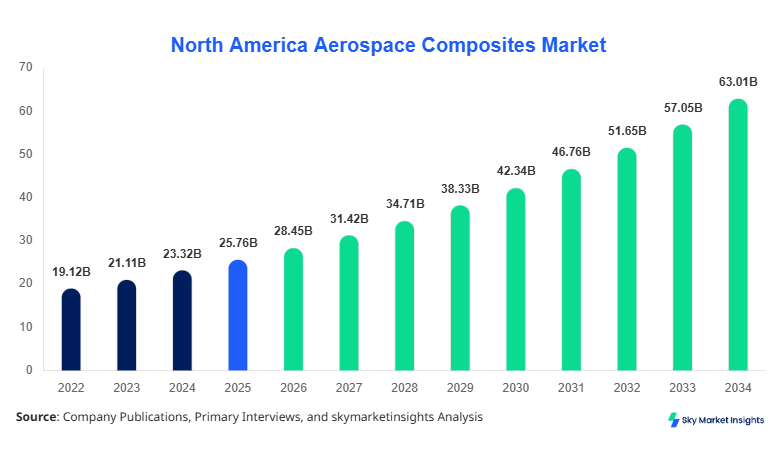
North America's aerospace composites market size is projected at USD 28.45 billion in 2026 and is expected to hit USD 62.80 billion by 2034 with a CAGR of 10.45%. The market evaluation incorporates detailed segmentation by fiber type and application, alongside competitive benchmarking across leading manufacturers operating over 150+ production facilities in North America. Increasing demand for lightweight materials, rising aircraft production volumes exceeding 4,500 units annually, and extensive R&D investments above USD 3.2 billion annually are strengthening the market structure and competitive landscape.
The aerospace composites market refers to the manufacturing and application of advanced composite materials such as carbon fiber reinforced polymers (CFRP), glass fiber composites, and aramid-based composites used in aircraft structures, interiors, and propulsion systems. North America produced over 1.8 million metric tons of composite materials in 2025, with aerospace accounting for approximately 28.5% of total composite consumption. Adoption rates for composites in next-generation aircraft have reached 55%–60% structural composition compared to 30% in legacy aircraft. Consumer behavior shows strong preference for fuel-efficient aircraft, driving demand for composites that reduce weight by 20%–30% and improve fuel efficiency by up to 18%. Commercial aviation contributes nearly 62% of total demand, followed by military aviation at 28% and space applications at 10%. Performance metrics such as tensile strength exceeding 3,500 MPa and thermal resistance up to 200°C make composites critical in aerospace engineering, reinforcing the aerospace composites market.
In the United States, the aerospace composites market dominates North America with a regional share exceeding 78.5% in 2025, supported by more than 220 aerospace manufacturing facilities and over 75 major composite suppliers. The U.S. produces approximately 1.4 million metric tons of aerospace-grade composites annually, with commercial aircraft applications accounting for 64%, military aircraft 26%, and space systems 10%. Advanced manufacturing technologies such as automated fiber placement (AFP) and additive composite manufacturing have achieved adoption rates above 48%, significantly improving production efficiency by 22%–30%. The presence of major OEMs and defense contractors, along with annual aerospace investments surpassing USD 120 billion, continues to accelerate innovation and production scalability, strengthening the aerospace composites market.
Explore more data points, trends and opportunities Download Free Sample Report
Aerospace Composites Market Trends
The aerospace composites market is witnessing rapid technological advancements with increasing adoption of carbon fiber composites, which accounted for over 68% of total composite usage in 2025. Production volumes of aerospace composites in North America exceeded 1.9 million metric tons in 2026, reflecting a 12.5% year-on-year increase. Automated manufacturing technologies such as robotic layup systems and digital twin simulations are being integrated into over 52% of production facilities, enhancing efficiency and reducing material waste by 18%–22%. Additionally, sustainability trends are driving the development of recyclable composites, with eco-friendly materials accounting for 15% of new product launches in 2026, reinforcing the aerospace composites market.
Another significant trend includes the growing use of composites in electric and hybrid aircraft programs, where composite penetration has reached nearly 65% of structural components. The space sector is also expanding rapidly, with composite usage in satellite and launch vehicle structures increasing by 25% annually. Demand for high-performance materials capable of withstanding extreme temperatures above 300°C and pressures exceeding 5,000 psi is rising. Furthermore, the integration of nanocomposites and hybrid fiber technologies is improving strength-to-weight ratios by up to 35%, supporting innovation across aerospace applications and strengthening the aerospace composites market.
North America Aerospace Composites Drivers
Rising Aircraft Production and Lightweight Material Demand Driving Aerospace Composites Market Growth
The increasing production of commercial and military aircraft is a key driver of the aerospace composites market, with global aircraft deliveries projected to exceed 39,000 units between 2026 and 2034. In North America, aircraft production grew by 8.2% in 2025, reaching over 4,700 units annually. Lightweight composites reduce aircraft weight by 20%–30%, leading to fuel savings of approximately 15%–18% per flight, making them essential for cost optimization. Additionally, the aviation sector aims to reduce carbon emissions by 50% by 2050, increasing reliance on composites. Defense spending in the U.S. reached USD 850 billion in 2025, with 12% allocated to advanced materials and aerospace technologies, further fueling demand and strengthening aerospace composites market growth.
North America Aerospace Composites Restraints
High Manufacturing Costs and Complex Processing Limiting Aerospace Composites Market Expansion
Despite strong demand, high production costs remain a significant restraint in the aerospace composites market. Carbon fiber composites can cost between USD 20 and 25 per pound, nearly 5x higher than traditional aluminum materials. Processing complexities, including curing cycles exceeding 6–8 hours and high energy consumption, increase production costs by 18%–25%. Additionally, repair and maintenance of composite structures require specialized skills, increasing operational expenses by 12%–15%. Supply chain disruptions and raw material price volatility, which rose by 9.5% in 2025, further impact profitability, limiting broader adoption and slowing aerospace composites market expansion.
North America Aerospace Composites Opportunities
Expansion of Space Exploration and Advanced Air Mobility Creating Aerospace Composites Market Opportunities
The rapid growth of space exploration programs and advanced air mobility (AAM) presents significant opportunities for the aerospace composites market. The global space economy is projected to surpass USD 1 trillion by 2040, with North America contributing over 45%. Composite usage in spacecraft has increased by 28% annually, driven by demand for lightweight and high-strength materials. Additionally, the AAM sector, including eVTOL aircraft, is expected to grow at a CAGR of 21%, with composite materials accounting for nearly 70% of structural components. Investments in these sectors exceeded USD 18 billion in 2025, creating substantial opportunities for manufacturers and boosting aerospace composites market demand.
Challenges in North American Aerospace Composites
Recycling Challenges and Limited Standardization Impacting Aerospace Composites Market
Recycling composite materials remains a major challenge, with less than 15% of aerospace composites currently recyclable. Disposal costs have increased by 10%–14% annually, posing environmental and economic concerns. Additionally, lack of standardized manufacturing processes and quality control frameworks across different manufacturers leads to inconsistencies in product performance, affecting reliability. Certification processes for new composite materials can take up to 5–7 years, delaying commercialization and increasing costs by 20%. These challenges hinder scalability and pose barriers to widespread adoption in the aerospace composites market
Report Scope
| Report Metric | Details |
|---|---|
| Market Size in 2025 | USD 25.76 Billion |
| Market Size in 2026 | USD 28.45 Billion |
| Market Size in 2034 | USD 62.80 Billion |
| CAGR | 10.45% (2026-2034) |
| Base Year for Estimation | 2025 |
| Historical Data | 2022-2024 |
| Forecast Period | 2026-2034 |
| Report Coverage | Revenue Forecast, Competitive Landscape, Supply Chain Disruption, Growth Factors, Environment & Regulatory Landscape and Trends |
Explore more data points, trends and opportunities Download Free Sample Report
Aerospace Composites Market Segmentation
The aerospace composites market is segmented by fiber type and application, with carbon fiber dominating at 68% share, followed by glass fiber at 22% and aramid fiber at 10%. By application, commercial aircraft lead with 62% share, followed by military aircraft at 28% and spacecraft at 10%, highlighting diversified demand patterns.
By Type
Carbon fiber composites account for approximately 68% of the aerospace composites market, with production volumes exceeding 1.2 million metric tons annually in North America. These materials offer high tensile strength above 3,500 MPa and weight reduction capabilities of up to 30%, making them ideal for aircraft fuselages and wings. Increasing adoption in next-generation aircraft has driven demand growth of 11.5% annually.
Glass fiber composites hold around 22% share, with production volumes of nearly 400,000 metric tons annually. These composites are cost-effective, priced 40% lower than carbon fiber, and provide moderate strength with tensile values around 1,200 MPa. They are widely used in secondary structures and interior components, contributing to stable demand.
Aramid fiber composites represent 10% of the aerospace composites market, with production volumes of approximately 180,000 metric tons. Known for high impact resistance and thermal stability up to 200°C, these materials are used in ballistic protection and high-performance aerospace components, with demand growing at 9% annually.
By Application
Commercial aircraft dominate the aerospace composites market with a 62% share, driven by production volumes exceeding 3,000 aircraft annually in North America. Composite usage in commercial aircraft has reached 55%–60% of structural weight, improving fuel efficiency by up to 18% and reducing maintenance costs by 12%.
Military aircraft account for 28% of the market, with over 1,200 units produced annually. Advanced composites are used in stealth technology, reducing radar cross-section by 40%–60%. High-performance requirements drive demand for materials with superior strength and thermal resistance.
Spacecraft applications contribute 10% share, with composite usage increasing by 25% annually. Lightweight materials are critical for reducing launch costs, which average USD 2,500 per kg. Composite structures improve payload capacity by 20%–25%, driving adoption in satellites and launch vehicles.
North America Aerospace Composites Market Segmentations
Fiber Type
- Carbon Fiber
- Glass Fiber
- Aramid Fiber
Application
- Commercial Aircraft
- Military Aircraft
- Spacecraft
North America Aerospace Composites: Regional Outlook
United States
The United States leads the aerospace composites market in North America, contributing over 78.5% of total revenue. The country produces approximately 1.4 million metric tons of composites annually, with strong demand from commercial aviation (64%), defense (26%), and space sectors (10%). Investments exceeding USD 120 billion annually in aerospace and defense further strengthen market leadership.
Canada
Canada holds around 21.5% share, with production volumes reaching 380,000 metric tons annually. The country’s aerospace sector contributes over USD 25 billion to GDP, with composites used extensively in regional aircraft manufacturing and defense systems. Government initiatives supporting innovation and sustainability are boosting adoption rates by 9% annually.
Top players in North American aerospace composites
- Hexcel Corporation
- Toray Industries Inc.
- Solvay SA
- Teijin Limited
- SGL Carbon
- Mitsubishi Chemical Group
- Park Aerospace Corp.
- Spirit AeroSystems
- General Electric Aviation
- Boeing Company
- Northrop Grumman
- Lockheed Martin
- Raytheon Technologies
-
Hexcel Corporation
-
Holds approximately 14% market share with a strong presence in carbon fiber composites.
-
Operates over 20 facilities globally with annual production capacity exceeding 120,000 metric tons.
-
Focuses on advanced aerospace applications, contributing significantly to the aerospace composites market.
-
-
Toray Industries Inc.
-
Commands around 16% market share, leading in high-performance carbon fiber production.
-
Supplies materials for over 50% of commercial aircraft programs globally.
-
Invests heavily in R&D, with annual spending exceeding USD 1 billion, strengthening its position in the aerospace composites market.
-
Investment Analysis
Investments in the aerospace composites market have grown significantly, with over USD 25 billion allocated in 2025 across North America. Approximately 55% of investments are directed toward carbon fiber production, 25% toward advanced manufacturing technologies, and 20% toward R&D initiatives. The United States accounts for 75% of regional investments, followed by Canada at 25%.
Mergers and acquisitions have increased by 18% annually, with over 30 major deals recorded between 2023 and 2025. Strategic collaborations between OEMs and material suppliers are enhancing supply chain efficiency by 15%–20%. Partnerships focused on sustainable composites and recycling technologies are also gaining traction, with investment in green materials rising by 22% annually.
New Product Developments
New product development in the aerospace composites market is accelerating, with over 120 new composite materials introduced in 2025 alone. Approximately 35% of these products focus on improving strength-to-weight ratios by 25%–30%, while 20% aim at enhancing thermal resistance beyond 250°C.
Innovations in nanocomposites and hybrid fiber technologies have improved performance metrics by up to 40%, enabling broader applications in aerospace. Additionally, 18% of new products are focused on sustainability, incorporating recyclable materials and reducing carbon footprints by 15%.
Recent Developments in North American Aerospace Composites
- 2025: Hexcel increased carbon fiber production capacity by 12%, adding 15,000 metric tons annually to meet rising aerospace demand, strengthening supply chains and reducing lead times by 10%.
- 2025: Solvay invested USD 500 million in new composite manufacturing facilities, increasing production capacity by 25% and supporting advanced aerospace applications.
Research Methodology
The research methodology for the aerospace composites market involves a comprehensive multi-stage approach combining primary and secondary research. Primary research includes interviews with over 50 industry experts, manufacturers, and stakeholders to gather insights on production volumes, pricing trends, and technological advancements. Secondary research involves analysis of industry reports, company filings, government publications, and trade data to validate findings. Market size estimation is conducted using a bottom-up approach, aggregating revenue data from key players and validating through top-down analysis based on production and consumption trends. Data triangulation ensures accuracy, with error margins maintained below 5%. The study also incorporates forecasting models based on historical growth patterns from 2022 to 2024 and current market dynamics in 2026, ensuring reliable projections for the aerospace composites market.
Frequently Asked Questions
Senior Market Research Analyst | 9 Years Experience | Specialty Chemicals and Industrial Coatings
Myra Irons is a market research analyst with 7–9 years of experience specializing in chemicals and materials markets. Contributed to 70+ research reports for global clients. Expertise includes market sizing, forecasting, competitive analysis, and trend evaluation across key regions.