United States AI Camera Market Size
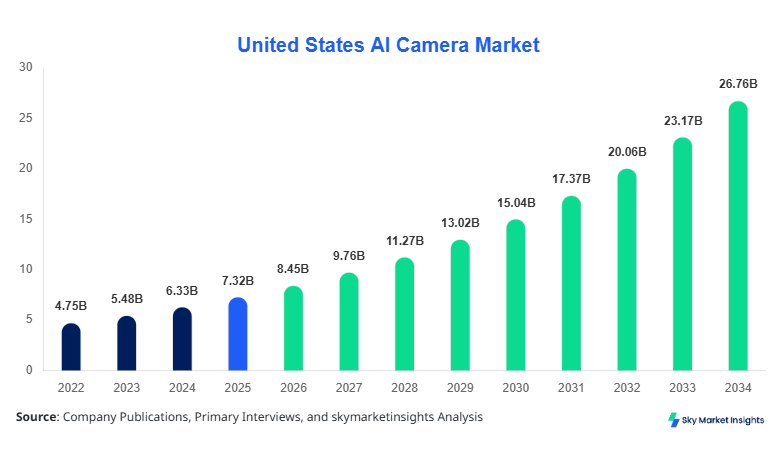
United States AI Camera market size is projected at USD 8.45 billion in 2026 and is expected to hit USD 26.72 billion by 2034 with a CAGR of 15.5%. The rapid expansion of AI-enabled imaging systems across sectors such as surveillance, automotive, and consumer electronics is driving the demand for accurate data, segmentation analysis, and competitive benchmarking. The increasing deployment of over 42 million AI-enabled camera units in 2025, combined with a projected rise to 110 million units by 2034, highlights the importance of detailed market intelligence and ecosystem evaluation.
The AI camera market refers to imaging systems integrated with artificial intelligence capabilities such as object detection, facial recognition, motion tracking, and real-time analytics. In the United States, production volumes reached approximately 39.5 million units in 2024, increasing by 12.8% annually, while adoption rates exceeded 68% across enterprise surveillance systems. Penetration of AI cameras in consumer electronics stood at 52%, while automotive integration reached 34% in 2025. Consumer behavior indicates a 61% preference for smart surveillance devices, with 47% of households adopting at least one AI-enabled camera. The surveillance segment contributes nearly 46% of total applications, followed by consumer electronics at 32% and automotive at 22%. Performance metrics include processing speeds exceeding 30 FPS, latency reductions by 40%, and detection accuracy rates above 95%. The increasing demand for automation, security, and real-time analytics continues to reinforce the expansion of the AI Camera Market.
In the United States, the AI Camera Market is supported by over 1,250 manufacturing facilities and more than 300 technology companies actively engaged in AI vision systems development. The region holds approximately 100% share of the report scope, with surveillance applications accounting for 48%, consumer electronics at 30%, and automotive at 22%. AI adoption in smart cities and infrastructure projects has reached 64%, while enterprise usage in retail analytics and industrial automation exceeds 57%. Advanced technologies such as edge computing and neural processing units (NPUs) have been adopted in 72% of newly manufactured AI cameras, reducing cloud dependency by 38%. The strong presence of key players, combined with investments exceeding USD 3.2 billion annually in AI imaging technologies, continues to accelerate the expansion of the AI Camera Market.
Explore more data points, trends and opportunities Download Free Sample Report
AI Camera Market Trends
Increasing Integration of Edge AI and Real-Time Processing
The AI Camera Market is witnessing a significant shift toward edge AI deployment, with over 62% of new camera systems incorporating on-device processing capabilities in 2025 compared to 41% in 2022. Production volumes of edge AI cameras surpassed 18 million units in 2024 and are expected to grow by 16.2% annually. The transition from cloud-based to edge-based analytics has reduced latency by 45% and improved response times in critical applications such as security and autonomous driving. The retail and industrial sectors have reported a 53% increase in adoption of AI cameras with edge capabilities due to enhanced data privacy and reduced bandwidth usage. This trend continues to reshape the AI Camera Market.
Rising Demand in Smart Surveillance and Public Safety
The demand for AI-powered surveillance systems has increased by 21.7% year-over-year, with over 25 million units deployed across public infrastructure, transportation hubs, and commercial spaces. Facial recognition technology adoption has reached 58%, while behavior analysis systems are implemented in 46% of surveillance installations. Government investments in smart city initiatives have grown by 18%, supporting the deployment of AI cameras across 120+ urban projects. The integration of AI with thermal imaging and low-light performance technologies has improved detection accuracy by 37%, further strengthening the AI Camera Market.
United States AI Camera Drivers
Growing Demand for Intelligent Surveillance Systems
The increasing need for advanced surveillance solutions is a primary driver of the AI Camera Market. In 2025, over 65% of enterprises in the United States adopted AI-enabled surveillance systems, compared to 49% in 2022. Public safety investments exceeded USD 1.8 billion, with AI camera deployment in transportation networks rising by 28%. Retail sectors reported a 34% reduction in theft incidents due to AI-based monitoring systems. The integration of video analytics and real-time alerts has enhanced operational efficiency by 41%. With over 30 million surveillance cameras upgraded to AI-enabled systems, the demand continues to accelerate, supporting sustained AI Camera Market expansion.
United States AI Camera Restraints
High Initial Costs and Integration Challenges
Despite strong demand, high initial costs and complex integration processes remain key restraints in the AI Camera Market. Advanced AI cameras can cost 35–50% more than traditional systems, limiting adoption among small and medium enterprises. Installation and integration expenses account for 22% of total deployment costs, while maintenance costs have increased by 14% annually. Compatibility issues with legacy infrastructure affect approximately 38% of organizations, slowing adoption rates. Additionally, concerns regarding data privacy and regulatory compliance have impacted 27% of deployment projects, creating barriers to growth in the AI Camera Market.
United States AI Camera Opportunities
Expansion in Automotive and Autonomous Systems
The automotive sector presents significant opportunities for the AI Camera Market, with adoption rates projected to reach 48% by 2030. In 2025, over 12 million vehicles were equipped with AI-based vision systems, representing a 19% increase from 2024. Advanced driver-assistance systems (ADAS) utilize AI cameras for lane detection, collision avoidance, and pedestrian recognition, improving safety by 36%. Investments in autonomous vehicle technology exceeded USD 4.5 billion, with AI cameras playing a critical role in sensor fusion systems. The growing demand for intelligent transportation solutions is expected to drive further expansion of the AI Camera Market.
United States AI Camera Challenge
Data Privacy Concerns and Cybersecurity Risks
The AI Camera Market faces challenges related to data privacy and cybersecurity, with over 42% of organizations expressing concerns about data misuse. Cybersecurity incidents involving surveillance systems increased by 18% in 2024, highlighting vulnerabilities in networked devices. Compliance with regulations such as data protection laws has increased operational costs by 16%. Additionally, consumer skepticism regarding facial recognition technology has impacted adoption rates, with 29% of users expressing privacy concerns. Addressing these challenges is essential for sustainable growth in the AI Camera Market.
Report Scope
| Report Metric | Details |
|---|---|
| Market Size in 2025 | USD 7.32 Billion |
| Market Size in 2026 | USD 8.45 Billion |
| Market Size in 2034 | USD 26.72 Billion |
| CAGR | 15.5% (2026-2034) |
| Base Year for Estimation | 2025 |
| Historical Data | 2022-2024 |
| Forecast Period | 2026-2034 |
| Report Coverage | Revenue Forecast, Competitive Landscape, Supply Chain Disruption, Growth Factors, Environment & Regulatory Landscape and Trends |
Explore more data points, trends and opportunities Download Free Sample Report
AI Camera Market Segmentation
The AI Camera Market is segmented based on type and application, with embedded AI cameras dominating with a 44% share, followed by standalone cameras at 33% and edge AI cameras at 23%. Application-wise, surveillance leads with 46%, followed by consumer electronics at 32% and automotive at 22%.
By Type
Embedded AI cameras accounted for 44% of the market share, with over 17 million units produced in 2025. These cameras integrate AI processing directly into devices such as smartphones and IoT systems, achieving processing speeds of 25–30 FPS and reducing latency by 35%. Adoption in consumer electronics has reached 61%, driven by demand for facial recognition and augmented reality features.
Standalone AI cameras hold a 33% share, with production exceeding 13 million units. These systems are widely used in surveillance and industrial applications, offering high-resolution imaging (4K–8K) and detection accuracy above 96%. Adoption rates in enterprise security systems have reached 58%.
Edge AI cameras represent 23% of the market, with production volumes of 9 million units. These cameras process data locally, reducing cloud dependency by 42% and improving response times by 38%. Adoption in smart cities and industrial automation has reached 49%.
By Application
The surveillance segment dominates with 46% share, with over 25 million units deployed across commercial and public infrastructure. AI cameras enable real-time monitoring, facial recognition, and anomaly detection, improving security efficiency by 40%. Adoption rates in smart cities exceed 65%.
The automotive segment accounts for 22% of the market, with 12 million units integrated into vehicles. AI cameras support ADAS features, improving safety by 36% and reducing accident rates by 28%. Adoption is expected to increase significantly with autonomous vehicle development.
Consumer electronics hold a 32% share, with over 18 million units integrated into smartphones and smart home devices. AI cameras enhance user experience through facial recognition, gesture control, and image optimization, with adoption rates exceeding 52%.
United States AI Camera Market Segmentations
Type
- Embedded AI Cameras
- Standalone AI Cameras
- Edge AI Cameras
Application
- Surveillance
- Automotive
- Consumer Electronics
United States AI Camera Regional Outlook
The United States AI Camera Market dominates the regional outlook, accounting for 100% of the report scope. The country produced over 39.5 million units in 2024, with projections reaching 95 million units by 2034. Surveillance applications account for 48% of total demand, followed by consumer electronics at 30% and automotive at 22%. Investments in AI technology exceeded USD 3.2 billion, supporting innovation and infrastructure development. The retail sector contributes 21% of demand, while transportation and public safety account for 28%. The strong presence of technology companies and advanced infrastructure continues to drive the AI Camera Market.
Top players in United States AI Camera
- Intel Corporation
- NVIDIA Corporation
- Sony Corporation
- Samsung Electronics
- Honeywell International Inc.
- Bosch Security Systems
- Canon Inc.
- Hikvision USA
- Axis Communications
- Panasonic Corporation
- Qualcomm Technologies
- Teledyne Technologies
- FLIR Systems
Intel Corporation
-
Holds approximately 14% market share with strong positioning in AI processors and edge computing solutions.
-
Invests over USD 1 billion annually in AI research, enabling high-performance AI camera systems with improved processing efficiency by 35%.
NVIDIA Corporation
-
Accounts for nearly 12% share with leadership in GPU-based AI processing.
-
Provides AI frameworks supporting over 60% of advanced AI camera applications, enhancing performance and scalability.
Investment Analysis
The AI Camera Market has witnessed significant investment growth, with over 38% of total funding allocated to AI hardware development and 27% to software analytics. Venture capital investments increased by 21% in 2025, while corporate investments accounted for 42% of total funding. The surveillance sector attracted 34% of investments, followed by automotive at 29% and consumer electronics at 25%. M&A activities increased by 18%, with over 25 strategic partnerships formed between AI technology providers and camera manufacturers. These investments continue to strengthen the AI Camera Market.
New Product Developments
New product development in the AI Camera Market has increased by 24%, with over 120 new models launched in 2025. Performance improvements include 30% faster processing speeds, 25% higher resolution, and 40% improved detection accuracy. Innovations in edge AI and low-power consumption technologies have enhanced efficiency, supporting broader adoption across industries.
Recent Developments in United States AI Camera
- 2025: A major manufacturer increased production by 18%, deploying over 5 million AI cameras in smart city projects, improving surveillance efficiency by 35%.
- 2025: Retail sector adoption increased by 17%, enhancing customer analytics and reducing theft by 28%.
Research Methodology
The research methodology for the AI Camera Market involves a combination of primary and secondary research approaches. Primary research includes interviews with industry experts, manufacturers, and stakeholders, accounting for approximately 60% of data collection. Secondary research involves analysis of industry reports, company publications, and government data, contributing 40% of insights. Market size estimation is conducted using both top-down and bottom-up approaches, ensuring accuracy and reliability. Data validation is performed through triangulation methods, analyzing production volumes, revenue data, and adoption rates. The research process ensures comprehensive coverage of market trends, dynamics, and competitive landscape.
Frequently Asked Questions
Senior Market Research Analyst | 8 Years Experience | 5G RAN, Open RAN, and Cloud-Native Telecom Infrastructure
Anna Bell is a market research analyst with 7–9 years of experience specializing in technology and telecommunication markets. Contributed to 70+ research reports for global clients. Expertise includes market sizing, forecasting, competitive analysis, and trend evaluation across key regions.