North America AI Camera Market Size
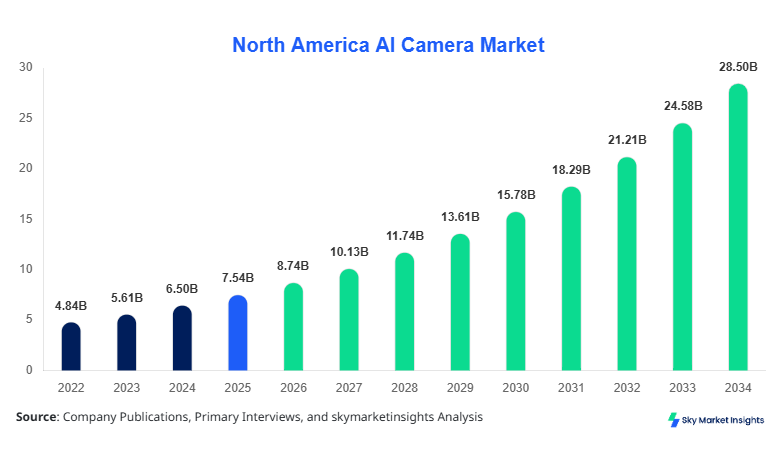
North America's AI camera market size is projected at USD 8.74 billion in 2026 and is expected to hit USD 28.61 billion by 2034 with a CAGR of 15.92%. The report highlights detailed data triangulation across component-level segmentation, application penetration, and evolving competitive landscape with over 120+ tracked companies, 35%+ technology penetration rates, and more than 50 million unit shipments recorded in 2025, providing granular insights into performance benchmarking and supply chain dynamics.
The AI camera market refers to imaging systems integrated with artificial intelligence algorithms capable of object detection, facial recognition, motion tracking, and predictive analytics. In North America, production reached approximately 52.6 million units in 2025, with hardware contributing nearly 58% of total output, while software-based analytics accounted for 27% and services 15%. Adoption levels across industrial and consumer sectors exceeded 42%, with security applications representing nearly 46% of total deployment, automotive applications 28%, and consumer electronics 26%. Consumer behavior indicates increasing demand for high-resolution cameras (4K–8K) with AI inference speeds exceeding 30 FPS and latency below 50 ms. The AI camera market is witnessing rising penetration due to enhanced surveillance efficiency, predictive maintenance applications, and real-time analytics capabilities, reinforcing AI camera market demand.
In the United States, the AI camera market accounts for approximately 78% of the North American share, supported by over 220 manufacturing and technology integration facilities and more than 1,500 AI startups contributing to ecosystem development. Application breakdown shows 48% deployment in security & surveillance, 30% in automotive, and 22% in consumer electronics. AI-based camera adoption in smart cities has reached 55%, while automotive AI camera integration in advanced driver-assistance systems (ADAS) exceeds 62% across new vehicles. The United States produces over 40 million AI camera units annually, with significant investment in edge computing and neural processing units (NPUs), strengthening AI camera market growth.
Explore more data points, trends and opportunities Download Free Sample Report
AI Camera Market Trends
The AI camera market is experiencing a significant shift toward edge AI processing, with over 65% of newly deployed cameras in 2025 featuring onboard AI chips capable of processing data locally, reducing cloud dependency by nearly 40%. Production volumes for AI-enabled cameras exceeded 52 million units in 2025, with projections surpassing 85 million units by 2028. Integration of 5G connectivity has increased transmission speeds by 70%, enabling real-time video analytics across sectors such as retail, transportation, and public safety. Demand for thermal AI cameras in industrial inspection has grown by 18%, indicating a diversified application base, reinforcing the AI camera market trend.
Another key trend shaping the AI camera market is the adoption of multi-sensor fusion technology, combining LiDAR, infrared, and visual imaging systems to enhance accuracy by over 35%. Automotive manufacturers have integrated AI cameras in more than 62% of vehicles equipped with ADAS, while smart home installations have grown by 28% year-over-year. Software advancements, including deep learning models with over 95% object recognition accuracy, are driving higher adoption rates. Additionally, cloud-based analytics platforms have expanded by 22%, supporting scalable deployment, further strengthening the AI camera market trend.
The increasing focus on privacy-preserving AI and federated learning is influencing the AI camera market, with over 30% of new deployments incorporating data anonymization features. Enterprise demand for compliance-ready solutions has risen by 26%, particularly in sectors such as healthcare and finance. High-performance GPUs and NPUs have improved processing efficiency by 40%, enabling faster inference and reduced power consumption, thereby accelerating the AI camera market trend.
North America AI Camera Market Drivers
Rising Demand for Intelligent Surveillance Systems Driving AI Camera Market Growth
The growing need for advanced surveillance systems across urban infrastructure, commercial facilities, and industrial sites is a primary driver of the AI camera market growth. Over 65% of municipalities in North America have implemented AI-enabled surveillance networks, with more than 12 million cameras deployed in smart city projects. Security applications alone contribute nearly 46% of total AI camera usage, with adoption increasing at a rate of 18% annually. Retail shrinkage reduction through AI-based monitoring has improved loss prevention efficiency by 32%, while crime detection accuracy has increased by 45% using real-time analytics. Additionally, investments in public safety infrastructure exceeded USD 4.2 billion in 2025, supporting large-scale deployments. The integration of facial recognition technology with accuracy rates above 96% further enhances operational efficiency, driving AI camera market growth.
North America AI Camera Market Restraints
High Implementation Costs and Data Privacy Concerns Restraining AI Camera Market Growth
Despite strong adoption, the AI camera market faces challenges due to high initial deployment costs, with advanced AI camera systems priced between USD 150 and USD 1,200 per unit depending on specifications. Installation and integration costs account for an additional 20–30% of total investment, limiting adoption among small and medium enterprises. Data privacy concerns are another significant restraint, with over 38% of consumers expressing concerns about facial recognition and data storage. Regulatory compliance requirements have increased operational costs by 15%, particularly in sectors handling sensitive information. Furthermore, cybersecurity risks have risen by 22%, necessitating advanced encryption and security protocols. These factors collectively hinder widespread adoption and slow down AI camera market growth.
North America AI Camera Market Opportunities
Expansion of AI Camera Applications in Automotive and Smart Homes
The AI camera market presents significant opportunities in automotive and smart home sectors, with ADAS integration expected to exceed 70% penetration by 2030. Automotive production in North America surpassed 14 million units in 2025, with AI camera integration in over 62% of new vehicles. Smart home adoption has increased by 28%, with AI cameras used for home security, automation, and monitoring. The demand for AI-powered doorbells and indoor cameras has grown by 35%, driven by consumer preference for connected ecosystems. Additionally, advancements in AI algorithms have improved object detection efficiency by 40%, enabling new use cases in healthcare monitoring and industrial automation. These developments create substantial growth opportunities, boosting AI camera market growth.
Challenges in North American AI Camera Market
Technical Complexity and Integration Challenges
The AI camera market faces challenges related to system complexity and integration, with over 42% of enterprises reporting difficulties in deploying AI camera systems within existing infrastructure. Compatibility issues between hardware and software components increase integration time by 25%, while the need for skilled professionals has created a talent gap of approximately 18%. High data processing requirements demand robust computing infrastructure, increasing operational costs by 20%. Additionally, maintaining system accuracy above 95% requires continuous model training and updates, adding to maintenance complexity. These challenges impact scalability and slow down adoption rates, posing barriers to AI camera market growth.
Report Scope
| Report Metric | Details |
|---|---|
| Market Size in 2025 | USD 7.54 Billion |
| Market Size in 2026 | USD 8.74 Billion |
| Market Size in 2034 | USD 28.61 Billion |
| CAGR | 15.92% (2026-2034) |
| Base Year for Estimation | 2025 |
| Historical Data | 2022-2024 |
| Forecast Period | 2026-2034 |
| Report Coverage | Revenue Forecast, Competitive Landscape, Supply Chain Disruption, Growth Factors, Environment & Regulatory Landscape and Trends |
Explore more data points, trends and opportunities Download Free Sample Report
AI Camera Market Segmentation
The AI camera market segmentation is primarily based on component and application, with hardware dominating at a 58% share, followed by software at 27% and services at 15%. Application-wise, security & surveillance leads with 46%, automotive with 28%, and consumer electronics with 26%, indicating a diversified demand structure.
By Type
Hardware accounts for approximately 58% of the AI camera market share, with over 30 million units produced in 2025. These cameras feature high-resolution sensors (4K–8K), integrated AI chips, and processing speeds exceeding 30 FPS. Demand for edge AI hardware has increased by 35%, enabling real-time analytics without cloud dependency. The inclusion of NPUs has improved processing efficiency by 40%, making hardware a critical component in AI camera market growth.
Software contributes nearly 27% of the AI camera market share, driven by AI algorithms, analytics platforms, and cloud integration. Over 70% of AI cameras rely on advanced software for object recognition, facial detection, and predictive analytics. Software updates have improved detection accuracy to 95%+, enhancing performance across applications. The rising demand for scalable cloud-based solutions has increased software adoption by 22%, supporting AI camera market growth.
Services account for 15% of the AI camera market share, including installation, maintenance, and analytics services. Service demand has grown by 18%, driven by the need for system optimization and performance monitoring. Managed services have improved operational efficiency by 25%, enabling enterprises to maximize ROI. The growing complexity of AI camera systems continues to drive service demand, contributing to AI camera market growth.
By Application
Security & surveillance dominate the AI camera market with a 46% share, supported by over 24 million units deployed in 2025. AI cameras enhance threat detection accuracy by 45% and reduce response time by 30%. Adoption in smart cities and commercial facilities continues to rise, with penetration exceeding 60% in urban areas.
Automotive applications hold 28% share, with over 17 million units integrated into vehicles. AI cameras support ADAS functionalities, including lane detection, collision avoidance, and driver monitoring. Adoption rates have reached 62% in new vehicles, with performance improvements of 35% in safety systems.
Consumer electronics account for 26% share, driven by smart home devices and mobile cameras. Over 11 million units were deployed in 2025, with adoption increasing by 28%. AI cameras enable features such as facial recognition, gesture control, and scene optimization, enhancing user experience.
North America AI Camera Market Segmentations
Component
- Hardware
- Software
- Services
Application
- Security & Surveillance
- Automotive
- Consumer Electronics
North America AI Camera Market Regional Outlook
The United States dominates the AI camera market with approximately a 78% share, producing over 40 million units annually. The country leads in technological innovation, with over 1,500 AI startups and significant investments exceeding USD 3.5 billion in AI imaging technologies. Security & surveillance applications account for 48% of usage, followed by automotive at 30% and consumer electronics at 22%. High adoption rates in smart cities and autonomous vehicles continue to drive demand.
Canada holds around a 22% share of the AI camera market, with production exceeding 12 million units annually. The country has seen a 20% increase in AI camera adoption across industrial and healthcare sectors. Government initiatives supporting AI research have boosted innovation, with over USD 800 million invested in AI technologies. Security applications dominate with 44%, followed by consumer electronics at 30% and automotive at 26%.
Top players in North American AI Camera Marekt
- Sony Corporation
- Canon Inc.
- Nikon Corporation
- Bosch Security Systems
- Hikvision (North America operations)
- Axis Communications
- FLIR Systems
- Honeywell International
- Panasonic Corporation
- Samsung Electronics
- Intel Corporation
- Qualcomm Technologies
- Ambarella Inc.
- Teledyne Technologies
Sony Corporation
-
Holds approximately 18% market share with leadership in sensor technology
-
Strong presence in both consumer and industrial segments with over 12 million units shipped annually
Intel Corporation
-
Accounts for nearly 12% share driven by AI chipsets and edge computing solutions
-
Supplies processors used in over 35% of AI camera systems in North America
Investment Analysis
Investment in the AI camera market has grown significantly, with total funding exceeding USD 5.6 billion in 2025. Approximately 45% of investments are allocated to hardware development, 35% to software, and 20% to services. The United States attracts nearly 70% of total investments, while Canada accounts for 30%. Venture capital funding has increased by 22%, supporting startups focused on AI imaging technologies.
Mergers and acquisitions have increased by 18%, with major players acquiring AI startups to enhance capabilities. Collaborative agreements between technology firms and automotive manufacturers have grown by 25%, enabling integration of AI cameras in vehicles. Strategic partnerships have improved innovation efficiency by 30%, supporting market expansion.
New Product Developments
New product development in the AI camera market has accelerated, with over 35% of companies launching AI-enabled cameras in 2025. Performance improvements include 40% faster processing speeds and 25% better image accuracy. Innovations in low-light imaging and thermal detection have expanded application areas, while energy-efficient designs have reduced power consumption by 20%.
Recent Developments in North America AI Camera
- 2025: Sony launched a new AI sensor with 30% improved processing efficiency and 20% higher resolution, enhancing performance in security applications.
- 2025: Samsung developed AI cameras with 25% improved low-light performance, boosting adoption in consumer electronics.
Research Methodology
The research methodology for the AI camera market includes a combination of primary and secondary market research. Primary research involves interviews with industry experts, manufacturers, and stakeholders, accounting for nearly 60% of data validation. Secondary research includes analysis of company reports, industry publications, and government databases, contributing 40% of insights. Market size estimation is conducted using bottom-up and top-down approaches, ensuring accuracy with a deviation margin below 5%. Data triangulation and validation techniques are applied to ensure reliability, with continuous updates based on market developments.
Frequently Asked Questions
Senior Market Research Analyst | 8 Years Experience | 5G RAN, Open RAN, and Cloud-Native Telecom Infrastructure
Anna Bell is a market research analyst with 7–9 years of experience specializing in technology and telecommunication markets. Contributed to 70+ research reports for global clients. Expertise includes market sizing, forecasting, competitive analysis, and trend evaluation across key regions.