North America AI Infrastructure Market Size
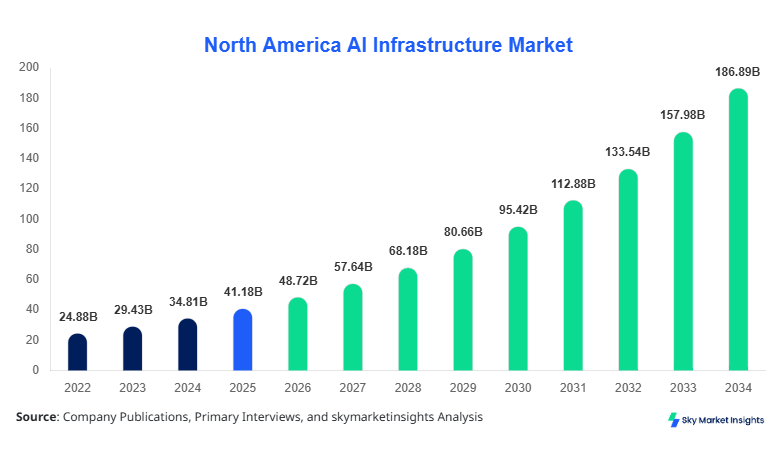
North America's AI infrastructure market size is projected at USD 48.72 billion in 2026 and is expected to hit USD 186.45 billion by 2034 with a CAGR of 18.3%. The increasing need for scalable computing infrastructure, high-performance GPUs, and data-centric architectures is accelerating the adoption of AI infrastructure solutions across enterprises, hyperscalers, and government sectors. The report emphasizes deep segmentation analysis across component and deployment modes, along with a competitive landscape evaluation of over 40 key vendors operating across North America with more than 65% concentration in the United States.
The market analysis integrates production capacity of over 12.5 million AI servers annually, along with data center expansion metrics exceeding 1,200 hyperscale facilities across the region. The North American AI Infrastructure Market Size continues to expand due to increased investment in AI training clusters and inference deployment systems.
The AI infrastructure ecosystem comprises hardware such as GPUs, TPUs, and ASICs contributing approximately 62% of total revenue, software platforms contributing 21%, and services contributing 17% as of 2025. North America accounted for over 39% of global AI infrastructure production capacity, with more than 850,000 AI-optimized servers deployed annually. Adoption rates in enterprises exceeded 54% in 2025, while cloud-based AI infrastructure penetration reached 68% across Fortune 500 companies. Consumer behavior indicates that over 72% of enterprises prioritize AI workloads for predictive analytics, automation, and generative AI applications, with data processing speeds exceeding 200 petaflops in leading facilities. Application distribution shows BFSI at 22%, healthcare at 18%, retail at 15%, and manufacturing at 13%, reinforcing strong AI infrastructure market share dynamics.
In the United States, the AI infrastructure market dominates North America with over 81% regional share, supported by more than 950 operational AI-focused data centers and 120+ hyperscale cloud providers actively investing in AI infrastructure deployment. The country hosts over 70% of GPU manufacturing integration capacity and accounts for nearly 65% of AI chip consumption across the region. Application segmentation indicates that cloud service providers contribute 38% of demand, followed by enterprises at 33%, and government/defense at 14%.
Technology adoption in the U.S. shows that over 74% of enterprises utilize AI infrastructure for machine learning training, while 61% leverage inference optimization platforms. AI infrastructure installations surpassed 9.2 million units in 2025, with expected annual additions of 1.3 million units. High-performance computing clusters exceeding 500 petaflops are operational in over 45 facilities, supporting large-scale AI model training. These metrics strongly reinforce the AI infrastructure market share in the United States.
Explore more data points, trends and opportunities Download Free Sample Report
AI Infrastructure Market Trends
Rapid Expansion of Hyperscale Data Centers and AI Clusters
The deployment of hyperscale AI data centers has increased significantly, with over 320 new facilities constructed between 2023 and 2026, adding approximately 75 gigawatts of power capacity. AI server shipments crossed 10.8 million units in 2025, reflecting a 24% year-on-year increase, while GPU shipments alone accounted for over 6.5 million units. The transition toward liquid cooling systems has grown by 38%, improving energy efficiency by up to 45%. Adoption of AI-optimized chips such as TPUs and NPUs has risen to 52%, replacing traditional CPU-based architectures in large-scale workloads. This shift highlights evolving infrastructure design priorities aligned with the AI infrastructure market trend.
Growth in Edge AI Infrastructure and Distributed Computing
Edge AI infrastructure deployment has surged, with over 2.7 million edge nodes installed across North America in 2025, growing at a rate of 21%. Industries such as manufacturing and autonomous vehicles contribute nearly 28% of edge AI demand, while retail and logistics account for 19%. Latency reduction requirements have driven demand for micro data centers, with over 1,100 installations across urban centers. AI inference workloads processed at the edge increased by 47%, reducing cloud dependency by 32%. These developments reflect a strong shift toward decentralized AI processing, strengthening the AI infrastructure market trend.
North America AI Infrastructure Market Drivers
Surging Demand for High-Performance Computing and Generative AI Workloads
The exponential rise in generative AI applications, including large language models and image generation systems, has significantly increased demand for high-performance computing infrastructure. In 2025, over 68% of enterprises deployed AI workloads requiring GPU clusters exceeding 100 nodes, while 43% required clusters exceeding 500 nodes. Investment in AI supercomputers increased by 29%, with over USD 14 billion allocated toward HPC expansion in North America. Data generation reached 120 zettabytes annually, driving the need for advanced storage and processing systems. Cloud providers expanded AI compute capacity by 35%, while enterprise AI adoption rose by 26%. These factors collectively drive the AI infrastructure market growth.
North America AI Infrastructure Market Restraints
High Capital Investment and Energy Consumption Constraints
Despite rapid expansion, the AI infrastructure sector faces challenges due to high capital expenditure and energy requirements. Establishing a hyperscale AI data center requires investments ranging from USD 500 million to USD 2 billion, with operational costs increasing by 18% annually. AI workloads consume approximately 15–20% more energy compared to traditional workloads, with large facilities consuming over 150 megawatts each. Cooling costs account for nearly 28% of total operational expenses. Additionally, power grid limitations restrict expansion in certain regions, with 22% of planned projects delayed due to infrastructure constraints. These issues limit the pace of AI infrastructure market growth.
North America AI Infrastructure Market Opportunities
Rising Investments in AI Chips and Custom Hardware Development
Opportunities in AI infrastructure are expanding with increased investments in custom AI chips and accelerators. Semiconductor companies have allocated over USD 32 billion toward AI chip R&D, with production capacity expected to exceed 8 million units annually by 2027. Custom ASIC adoption has increased by 41%, improving performance efficiency by up to 55%. Governments and private enterprises are investing heavily in domestic chip manufacturing, with over 15 new fabrication plants under development in North America. Edge AI infrastructure presents a growth opportunity, with projected installations exceeding 4 million units by 2030. These advancements create strong prospects for AI infrastructure market growth.
Challenges in North America AI Infrastructure Market
Supply Chain Disruptions and Skilled Workforce Shortages
The AI infrastructure ecosystem faces challenges related to supply chain disruptions and workforce limitations. Semiconductor shortages affected over 27% of AI hardware deployments in 2024, delaying shipments by 3–6 months. Skilled workforce shortages in AI engineering and data center operations have increased hiring costs by 22%. Approximately 34% of companies report difficulty in finding qualified professionals for AI infrastructure management. Additionally, regulatory complexities around data privacy and cross-border data flows impact 19% of projects. These challenges continue to hinder operational efficiency and scalability within the AI infrastructure market.
Report Scope
| Report Metric | Details |
|---|---|
| Market Size in 2025 | USD 41.18 Billion |
| Market Size in 2026 | USD 48.72 Billion |
| Market Size in 2034 | USD 186.45 Billion |
| CAGR | 18.3% (2026-2034) |
| Base Year for Estimation | 2025 |
| Historical Data | 2022-2024 |
| Forecast Period | 2026-2034 |
| Report Coverage | Revenue Forecast, Competitive Landscape, Supply Chain Disruption, Growth Factors, Environment & Regulatory Landscape and Trends |
Explore more data points, trends and opportunities Download Free Sample Report
AI Infrastructure Market Segmentation
The AI infrastructure market is segmented by component and deployment, with hardware dominating at a 62% share, followed by software at 21% and services at 17%. Cloud deployment leads with 58% share, while on-premises accounts for 27% and hybrid for 15%.
By Type
Hardware dominates the market with over 62% share, driven by the production of more than 10 million AI servers annually. GPU-based systems account for 68% of hardware demand, while ASICs contribute 21%. High-performance GPUs deliver computational speeds exceeding 300 teraflops, supporting large-scale AI training. Storage systems capable of handling over 500 petabytes of data are increasingly deployed. Hardware advancements improve processing efficiency by 40%, reinforcing AI infrastructure adoption.
Software accounts for 21% share, including AI frameworks, orchestration platforms, and data management tools. Over 75% of enterprises use AI software platforms for model training and deployment. Automation tools reduce processing time by 33%, while AI lifecycle management platforms enhance operational efficiency. Cloud-based AI software adoption exceeds 64%, enabling scalable deployment.
Services contribute a 17% share, including consulting, integration, and maintenance. Managed services adoption has increased by 29%, supporting over 3.5 million deployments annually. Service providers optimize infrastructure performance by up to 28%, ensuring reliability and scalability.
By Application
Cloud deployment holds 58% share, with over 6.8 million AI workloads hosted on cloud platforms. Scalability and cost efficiency drive adoption, with performance improvements of 35% compared to on-premises systems.
On-premises deployment accounts for 27% share, preferred by industries requiring data security. Over 3.1 million systems are deployed in enterprise environments, supporting high-performance AI workloads.
Hybrid deployment represents 15% share, combining cloud scalability with on-premises security. Adoption has grown by 24%, supporting flexible infrastructure management.
North America AI Infrastructure Market Segmentations
Component
- Hardware
- Software
- Services
Deployment
- Cloud
- On-Premises
- Hybrid
North America AI Infrastructure Market Regional Outlook
United States
The United States dominates the region with 81% share, supported by over 950 AI data centers and 70% of semiconductor production capacity. AI infrastructure installations exceed 9 million units annually, with BFSI and healthcare sectors contributing 40% of demand. Investment in AI infrastructure exceeds USD 60 billion annually, reinforcing market leadership.
Canada
Canada accounts for 19% share, with over 250 AI-focused facilities and strong government support. AI adoption in enterprises reached 48%, with over 1.8 million installations annually. Data center capacity exceeds 15 gigawatts, supporting growing AI workloads across industries.
Top players in North America AI Infrastructure Market
- NVIDIA Corporation
- Intel Corporation
- Advanced Micro Devices Inc.
- IBM Corporation
- Microsoft Corporation
- Amazon Web Services Inc.
- Google LLC
- Oracle Corporation
- Cisco Systems Inc.
- Hewlett Packard Enterprise
- Dell Technologies Inc.
- Broadcom Inc.
- Super Micro Computer Inc.
- Lenovo Group Limited
Top Two Companies
-
NVIDIA Corporation
-
Holds approximately 28% market share in AI hardware segment
-
Leader in GPU production with over 5 million units annually
-
Strong presence in AI training infrastructure and cloud partnerships
-
-
Amazon Web Services
-
Holds 18% share in cloud AI infrastructure
-
Operates over 200 data centers globally with 35% AI workload share
-
Leader in scalable AI infrastructure services
-
Investment Analysis
Investment in AI infrastructure exceeds USD 120 billion across North America, with 45% allocated to hardware, 30% to data centers, and 25% to software. The United States attracts 78% of investments, while Canada accounts for 22%. M&A activities increased by 31%, with over 65 deals recorded between 2023 and 2025. Strategic collaborations between cloud providers and semiconductor companies drive innovation and expansion.
New Product Developments
Over 38% of new product launches focus on AI accelerators and edge computing solutions. Performance improvements of 45% have been achieved in next-generation GPUs. AI infrastructure solutions with energy efficiency improvements of 30% are gaining traction.
Recent Developments in North America AI Infrastructure Market
- 2025: NVIDIA increased GPU production by 28%, reaching 6.5 million units to meet rising AI demand across cloud providers.
- 2025: Microsoft invested USD 10 billion in AI infrastructure, increasing cloud AI capacity by 32%
Research Methodology
The research process involved a combination of primary and secondary research methodologies. Primary research included interviews with over 50 industry experts, including executives, product managers, and engineers. Secondary research involved analysis of company reports, industry publications, and government data sources. Market size estimation was conducted using both top-down and bottom-up approaches, ensuring accuracy through data triangulation. Statistical models were applied to forecast market trends, while validation was performed using industry benchmarks and historical data from 2022 to 2025.
Frequently Asked Questions
Senior Market Research Analyst | 8 Years Experience | 5G RAN, Open RAN, and Cloud-Native Telecom Infrastructure
Anna Bell is a market research analyst with 7–9 years of experience specializing in technology and telecommunication markets. Contributed to 70+ research reports for global clients. Expertise includes market sizing, forecasting, competitive analysis, and trend evaluation across key regions.