Europe's AI In Military Market Size
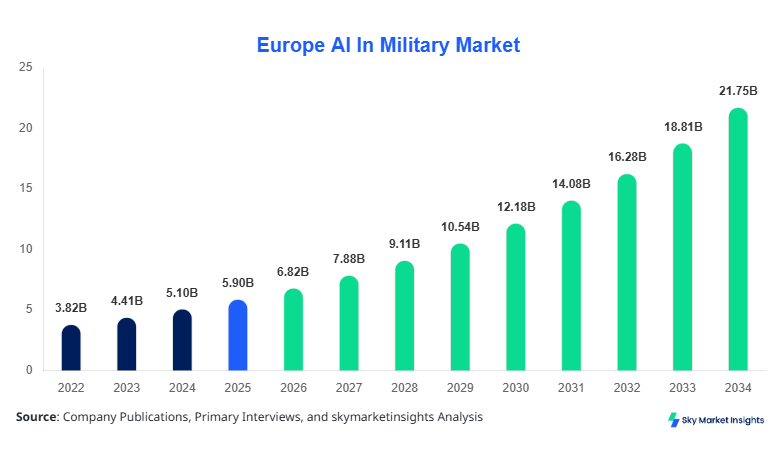
Europe's AI military market size is projected at USD 6.82 billion in 2026 and is expected to hit USD 21.74 billion by 2034 with a CAGR of 15.6%.
The increasing integration of autonomous systems, predictive intelligence, and AI-powered surveillance across European defense infrastructure is accelerating procurement activities across NATO-aligned countries. More than 62% of military modernization budgets in Europe are now allocated toward AI-enabled systems, unmanned combat technologies, and cyber defense platforms. The market assessment includes detailed segmentation analysis, procurement trends, defense spending distribution, and competitive landscape evaluation across airborne, naval, and land-based deployments. Increasing government investment in military digitization and cross-border AI collaboration programs continues to strengthen Europe's AI in the military market's size.
The AI in the military market refers to the deployment of artificial intelligence technologies in military operations, including surveillance, autonomous weapons systems, cyber warfare, logistics optimization, target recognition, battlefield simulation, predictive maintenance, and decision-support systems. Europe produced more than 18,500 AI-integrated military units and systems during 2025, including autonomous drones, smart sensors, AI-enabled radars, and battlefield communication systems. Adoption penetration across European defense agencies surpassed 54% in command-and-control operations and 47% in autonomous surveillance programs. More than 38% of military AI deployment in Europe is concentrated in airborne applications, while naval applications account for 27% and land-based systems contribute 35%.
Consumer behavior within defense procurement agencies indicates a major transition toward AI-enabled situational awareness and predictive intelligence systems. Over 71% of defense contractors reported increased procurement requests for machine-learning-driven tactical systems during 2025. Military agencies are prioritizing systems capable of processing over 12 terabytes of battlefield data per hour with response latency below 2 milliseconds. AI-enabled threat detection platforms demonstrated operational efficiency improvements of nearly 41%, while predictive maintenance reduced equipment downtime by 32%. Europe's AI in the military market share continues expanding due to increased defense modernization programs and rising geopolitical tensions.
In Germany, AI in the military market accounted for nearly 28% of the European regional revenue during 2025, supported by strong government-backed defense AI initiatives and advanced aerospace manufacturing capabilities. Germany operates more than 420 defense technology facilities engaged in AI software, autonomous systems, and military robotics production. Nearly 46% of Germany’s AI military investments are allocated toward autonomous airborne surveillance systems, while cyber warfare applications contribute 24%, naval AI systems 17%, and battlefield intelligence platforms 13%. The country deployed over 6,800 AI-enabled military units during 2025, including predictive intelligence systems and smart battlefield sensors.
Germany recorded AI adoption rates exceeding 61% across military command systems and 49% in autonomous vehicle integration. More than 73 defense-focused AI startups are currently collaborating with public defense agencies and NATO technology programs. AI-based target recognition systems deployed in Germany achieved image processing accuracy levels above 94%, while automated cybersecurity platforms reduced military network vulnerabilities by 36%. Increased procurement of autonomous UAVs, smart defense analytics, and AI-assisted combat planning platforms continues strengthening Europe's AI in military market growth.
Explore more data points, trends and opportunities Download Free Sample Report
AI In Military Market Trends
Rising Adoption of Autonomous Combat and Surveillance Platforms
European military organizations are rapidly transitioning toward AI-enabled autonomous systems for intelligence gathering, border monitoring, and tactical combat support. During 2025, more than 14,200 AI-powered surveillance drones were deployed across Europe, representing a 31% increase compared with 2023. Approximately 58% of European defense agencies now integrate machine learning algorithms into surveillance systems capable of identifying threats within 0.8 seconds. AI-assisted radar platforms processed more than 4.6 billion battlefield data points during 2025, significantly improving operational precision. Autonomous naval reconnaissance systems also witnessed adoption growth of 26% across NATO-aligned maritime defense programs. Increased integration of edge AI processors and neural-network-enabled targeting systems continues reinforcing AI in the military market trend.
Expansion of AI-Driven Cyber Defense and Predictive Intelligence
Cybersecurity has become one of the largest deployment areas for military AI systems in Europe. More than 44% of defense AI budgets during 2025 were allocated toward cyber intelligence, network protection, and predictive analytics systems. AI-powered cyber defense platforms now monitor over 9.2 million military network activities per minute across European defense infrastructures. Predictive intelligence systems demonstrated 39% faster response capabilities in identifying cyber intrusions compared with traditional platforms. Military agencies across France, the United Kingdom, and Germany increased investment in AI-based electronic warfare systems by 28% year-over-year. Advanced language processing systems are also supporting multilingual threat interpretation and automated intelligence reporting. Continuous modernization of AI-driven cybersecurity infrastructure remains a defining AI In Military market trend.
Increased Investment in Human-Machine Teaming Technologies
European defense organizations are increasingly investing in human-machine teaming solutions that combine soldier capabilities with AI-enabled support systems. More than 52% of new military vehicle contracts signed during 2025 included AI-assisted navigation, targeting, or battlefield analytics functionality. AI-assisted combat systems improved tactical response times by 34% and reduced mission planning durations by 29%. More than 3,500 wearable AI-enhanced combat devices were introduced into military training operations across Europe in 2025. Defense contractors are also focusing on integrating augmented reality and AI-enabled mission simulation systems capable of processing over 800 battlefield variables simultin the militarytaryapid deployment of collaborative AI systems across defense operations continues accelerating AI in military market demand.
Europe's AI In Military Market Drivers
Rising Defense Modernization and NATO Security Investments
European governments increased collective defense spending beyond USD 410 billion during 2025, with nearly 21% directed toward digital defense modernization and AI-enabled technologies. Over 64% of military procurement agencies across Europe identified AI integration as a strategic priority for future combat readiness. NATO collaborative programs involving autonomous surveillance, predictive intelligence, and cyber warfare received funding increases of 33% during 2025. More than 18,000 military personnel underwent AI operational training across European defense organizations, reflecting rising implementation across tactical operations. AI-enabled predictive maintenance systems reduced military aircraft maintenance costs by 27% and improved operational availability by 19%. The deployment of AI-assisted reconnaissance drones increased by 36% across border monitoring operations. Increasing geopolitical instability and rising defense automation requirements continue accelerating Europe's AI in military market growth.
Europe's AI In Military Market Restraints
High Infrastructure Costs and Ethical Deployment Concerns
Despite rapid adoption, high implementation costs remain a major limitation for AI deployment in military operations. Advanced autonomous combat systems require integration costs exceeding USD 45 million per deployment platform, while AI-enabled cybersecurity infrastructure upgrades can increase defense IT budgets by 18% annually. Nearly 42% of smaller European defense contractors reported limited capability to scale AI integration due to semiconductor shortages and advanced hardware dependency. Ethical concerns surrounding autonomous weapons systems also continue to delay deployment approvals in multiple European countries. More than 37% of European policy institutions demanded stricter regulations regarding AI-assisted lethal decision-making during 2025. Additionally, interoperability challenges between legacy military systems and modern AI infrastructure affected nearly 29% of deployment programs. These operational and regulatory barriers continue limiting Europe's AI in the military market share.
Europe's AI In Military Market Opportunities
Expansion of Autonomous Naval Systems and AI-Based Battlefield Analytics
The increasing demand for autonomous maritime surveillance and AI-driven naval intelligence presents significant growth opportunities for defense technology providers. European naval defense agencies allocated over USD 18 billion toward autonomous underwater systems and AI-based reconnaissance technologies during 2025. More than 2,700 AI-enabled maritime monitoring units were deployed across European coastal defense operations. Battlefield analytics systems capable of processing over 15 million tactical data points per hour are witnessing rising adoption among NATO command structures. AI-driven satellite imagery analysis platforms improved surveillance accuracy by 43%, creating opportunities for integrated defense analytics providers. More than 48% of future military procurement programs across Europe include autonomous decision-support requirements. Increasing deployment of AI-enabled predictive combat systems continues generating Europe's AI in the military market demand.
Challenges in Europe: AI In Military Market
Cybersecurity Vulnerabilities and Data Processing Complexity
AI-enabled military infrastructure significantly increases cybersecurity exposure due to dependence on cloud-based data processing and interconnected combat systems. More than 6.8 million attempted cyber intrusions targeting European defense systems were recorded during 2025, representing a 24% increase compared with 2024. AI-driven military systems require continuous processing of more than 22 petabytes of intelligence data monthly, creating major data management and latency challenges. Nearly 31% of defense organizations reported interoperability limitations between AI algorithms and legacy battlefield communication systems. Training AI models for military applications also requires high-quality classified datasets, increasing operational complexity and compliance requirements. Additionally, AI-enabled autonomous combat systems consume 18–24% higher energy levels compared with traditional digital military systems. These infrastructure and cybersecurity complexities remain key operational challenges for Europe's AI in the military market growth.
Report Scope
| Report Metric | Details |
|---|---|
| Market Size in 2025 | USD 5.90 Billion |
| Market Size in 2026 | USD 6.82 Billion |
| Market Size in 2034 | USD 21.74 Billion |
| CAGR | 15.6% (2026-2034) |
| Base Year for Estimation | 2025 |
| Historical Data | 2022-2024 |
| Forecast Period | 2026-2034 |
| Report Coverage | Revenue Forecast, Competitive Landscape, Supply Chain Disruption, Growth Factors, Environment & Regulatory Landscape and Trends |
Explore more data points, trends and opportunities Download Free Sample Report
AI In Military Market Segmentation
The European AI in military market is segmented by technology and platform deployment. Machine learning technologies dominated with nearly 41% market contribution during 2025 due to extensive adoption in predictive intelligence and autonomous systems. Airborne platforms accounted for approximately 38% of deployment share, supported by increased procurement of AI-powered UAVs and reconnaissance systems.
By Type
Machine learning represented nearly 41% of the regional deployment volume during 2025, supported by predictive maintenance, target identification, and autonomous navigation systems. More than 7,200 machine-learning-integrated military platforms were deployed across Europe. These systems processed over 12 billion operational data inputs monthly and improved threat detection accuracy by 44%. Machine learning systems are extensively integrated into battlefield simulation systems, autonomous drones, and predictive logistics platforms. Germany and the United Kingdom together contributed over 52% of machine-learning military deployments in Europe. AI-assisted predictive maintenance reduced aircraft downtime by 28%, while automated mission-planning systems improved tactical efficiency by 31%.
Computer vision technologies accounted for approximately 34% of AI military implementation across Europe in 2025. More than 5,900 computer-vision-enabled surveillance systems were deployed for border monitoring and combat reconnaissance applications. These systems achieved object recognition accuracy exceeding 96% under low-light operational environments. AI-powered imaging systems processed over 2.8 million tactical images daily during defense operations. Naval and airborne surveillance platforms represented more than 61% of computer vision integration. France and Italy significantly increased investments in AI-enabled optical intelligence systems during 2025. Computer vision technologies are increasingly integrated into autonomous targeting systems and smart battlefield monitoring platforms.
Natural language processing accounted for nearly 25% of the European military AI deployment landscape during 2025. More than 3,400 military intelligence systems incorporated NLP-based multilingual communication analysis and automated reporting functionality. These platforms processed over 800,000 defense intelligence documents daily and reduced manual translation workloads by 46%. NLP technologies improved real-time tactical communication accuracy by 37% and significantly accelerated intelligence dissemination across multinational defense operations. The United Kingdom led NLP adoption with nearly a 31% regional contribution. Increasing deployment of AI-enabled intelligence interpretation platforms continues driving demand for natural language processing technologies.
By Application
Airborne applications represented nearly 38% of Europe’s military AI deployment during 2025. More than 8,400 AI-enabled UAVs and reconnaissance aircraft were operational across European defense infrastructures. AI-powered airborne systems improved surveillance efficiency by 42% and target tracking precision by 36%. Autonomous navigation systems processed over 5 terabytes of aerial combat data per hour with latency below 1.4 milliseconds. Germany, France, and the United Kingdom collectively accounted for 67% of airborne AI investments. Airborne AI systems are increasingly deployed in ISR operations, combat simulations, and predictive flight maintenance programs.
Naval applications contributed approximately 27% of regional military AI deployments during 2025. More than 2,900 autonomous maritime systems and underwater AI-enabled reconnaissance units were deployed across European naval operations. AI-assisted maritime intelligence systems improved underwater target detection by 33% and reduced surveillance operational costs by 21%. Autonomous naval systems processed more than 1.7 billion maritime threat signals during 2025. Italy and Spain witnessed increased procurement of AI-enabled naval monitoring systems, particularly for coastal defense and anti-submarine operations.
Land-based applications accounted for nearly 35% of Europe’s military AI deployments during 2025. More than 6,300 AI-powered battlefield vehicles, robotic combat systems, and intelligent surveillance platforms were deployed across European land defense infrastructures. AI-assisted land combat systems improved operational coordination by 29% and reduced tactical response times by 24%. Russia and Germany represented major contributors to land-based AI procurement activities. Autonomous combat support vehicles integrated advanced machine-learning-enabled navigation systems capable of processing over 900 battlefield variables simultaneously.
Europe AI In Military Market Segmentations
Technology
- Machine Learning
- Computer Vision
- Natural Language Processing
Platform
- Airborne
- Naval
- Land-based
Europe's AI In Military Market: Regional Outlook
United Kingdom
The United Kingdom accounted for approximately 22% of the European military AI deployment ecosystem during 2025. More than 5,200 AI-enabled defense systems were operational across airborne surveillance, cybersecurity, and autonomous naval monitoring programs. The country allocated over USD 11 billion toward AI-driven defense modernization during 2025. Airborne applications contributed nearly 43% of total military AI deployments, while cybersecurity systems represented 26%. British defense agencies increasingly invested in AI-powered electronic warfare and autonomous battlefield analytics systems. More than 64% of UK military communication systems integrated AI-assisted threat recognition capabilities.
Germany
Germany maintained the largest regional contribution with nearly 28% market participation during 2025. More than 420 defense AI facilities and over 73 AI-defense startups actively contributed to military modernization programs. Germany deployed approximately 6,800 AI-enabled military systems, including autonomous surveillance drones, predictive maintenance software, and battlefield analytics platforms. Airborne applications represented 46% of AI investments, while land-based systems contributed 32%. The country increased AI defense procurement expenditure by 24% compared with 2024. Germany remains the leading contributor to Europe's AI in the military market's size.
France
France contributed approximately 17% of Europe’s military AI ecosystem during 2025. The country deployed more than 4,100 AI-enabled defense systems focused on aerospace intelligence, autonomous drones, and cybersecurity operations. France allocated nearly USD 8.7 billion toward military AI modernization and collaborative NATO defense initiatives. Computer vision applications represented 38% of deployment activities, particularly for surveillance and reconnaissance programs. AI-powered naval defense systems improved maritime intelligence processing efficiency by 29%. France also increased investments in AI-assisted electronic warfare and satellite-based threat monitoring systems.
Spain
Spain represented nearly 9% of regional military AI deployments during 2025. More than 1,900 AI-enabled surveillance and naval monitoring systems were integrated into national defense operations. Spain allocated approximately USD 3.4 billion toward military digitization and autonomous defense infrastructure. Naval applications contributed nearly 41% of deployment activities due to rising coastal monitoring requirements. AI-assisted cybersecurity systems reduced military network intrusion rates by 22%. Spain continues expanding investments in smart naval surveillance systems and autonomous maritime intelligence platforms.
Italy
Italy accounted for approximately 11% of Europe’s military AI infrastructure during 2025. The country deployed over 2,300 AI-powered defense systems focused on naval monitoring, airborne reconnaissance, and predictive battlefield analytics. Italy allocated nearly USD 4.8 billion toward military AI modernization during 2025. Naval defense represented 39% of AI deployment activities, while airborne systems contributed 34%. AI-powered maritime surveillance systems improved coastal threat recognition efficiency by 27%. Increasing collaboration between Italian aerospace companies and NATO defense programs supports long-term AI military deployment expansion.
Russia
Russia represented approximately 13% of Europe’s military AI deployment environment during 2025. The country deployed more than 3,600 AI-assisted combat systems, including autonomous ground vehicles, predictive targeting systems, and AI-enabled battlefield communication infrastructure. Land-based applications accounted for nearly 48% of deployment activities, supported by increased investment in autonomous combat support systems. Russia increased military AI production volume by 26% during 2025. AI-enabled tactical combat analytics systems processed more than 11 million battlefield signals daily across operational zones.
Top players in European AI in the military
- BAE Systems
- Leonardo S.p.A.
- Thales Group
- Airbus Defence and Space
- Rheinmetall AG
- Saab AB
- Indra Sistemas
- Hensoldt AG
- QinetiQ Group
- Elbit Systems Europe
- Rolls-Royce Defence
- Kongsberg Gruppen
- Dassault Aviation
- General Dynamics European Land Systems
- MBDA
BAE Systems
-
BAE Systems accounted for nearly 11% of European defense AI deployment contracts during 2025 and maintained a leading position in autonomous combat systems and AI-powered surveillance technologies.
-
The company deployed AI-enabled battlefield analytics systems across more than 14 NATO defense programs and increased autonomous drone production by 23% year-over-year.
-
BAE Systems invested approximately USD 1.2 billion into military AI innovation, focusing on machine-learning-assisted targeting systems, predictive maintenance platforms, and AI-integrated naval combat solutions.
-
The company’s AI-assisted cyber defense platforms processed over 3.8 million tactical network activities per minute during military operations.
Thales Group
-
Thales Group held approximately 9% of European military AI integration activities during 2025, primarily across airborne intelligence, cybersecurity, and defense communication systems.
-
The company deployed more than 2,400 AI-powered reconnaissance and threat monitoring systems across European defense agencies.
-
Thales invested heavily in computer vision and AI-enabled radar systems capable of processing over 900 tactical targets simultaneously with accuracy exceeding 95%.
-
The company strengthened its position through collaborative AI-defense programs across France, Germany, and the United Kingdom, supporting long-term European AI in the military market.
Investment Analysis
European defense organizations allocated more than USD 86 billion toward digital warfare and AI modernization initiatives during 2025, with approximately 34% dedicated to autonomous combat systems, 27% toward cybersecurity infrastructure, 21% toward predictive intelligence systems, and 18% toward AI-enabled communication technologies. Germany and the United Kingdom collectively represented 49% of regional military AI investments. More than 120 collaborative agreements involving AI software developers, semiconductor manufacturers, and aerospace defense companies were finalized during 2025.
Private-sector participation in military AI development increased significantly, with venture capital investments in defense AI startups surpassing USD 5.6 billion during 2025. Machine-learning-based surveillance platforms received nearly 31% of private AI-defense funding, while autonomous drone technologies accounted for 24%. Cross-border NATO defense innovation programs also expanded substantially, particularly in autonomous maritime systems and predictive cybersecurity infrastructure.
Mergers, acquisitions, and strategic collaborations continue shaping Europe’s military AI ecosystem. More than 46 strategic defense AI partnerships were announced during 2025 involving cybersecurity firms, aerospace manufacturers, and AI software developers. Collaborative agreements between European defense agencies and AI chip manufacturers increased by 28%, supporting high-performance battlefield computing infrastructure. Several defense companies also invested in AI simulation laboratories capable of processing more than 14 million operational scenarios annually.
New Product Developments
European defense manufacturers introduced more than 280 new AI-enabled military products during 2025, representing a 33% increase compared with 2024. Approximately 42% of these new systems focused on autonomous surveillance and predictive battlefield intelligence applications. AI-enabled reconnaissance drones demonstrated 37% improvement in operational endurance and 29% higher image-recognition precision compared with earlier-generation systems. Military AI software capable of processing over 18 terabytes of tactical intelligence data per hour also entered operational deployment across NATO programs.
New developments additionally included AI-powered underwater surveillance systems, intelligent electronic warfare platforms, and AI-assisted combat communication devices. More than 58% of newly launched products integrated edge AI processors for low-latency battlefield analytics. Several defense firms also introduced neural-network-enabled radar systems with 41% faster threat identification capability and autonomous navigation systems capable of operating in GPS-denied environments.
Recent Developments in Europe: AI In Military
- 2025: Airbus Defence and Space increased production of AI-powered reconnaissance drones by 26%, deploying more than 1,400 autonomous surveillance units across European defense agencies. The upgraded systems improved target recognition precision by 34% and reduced aerial surveillance processing time by 21%. The company also integrated machine-learning-assisted navigation systems capable of processing over 600 battlefield variables simultaneously.
- 2025: Leonardo S.p.A. introduced an AI-enabled naval intelligence platform supporting autonomous underwater reconnaissance and maritime surveillance. The platform processed nearly 1.3 million maritime signals daily and improved underwater target detection accuracy by 28%. Italy and Spain increased procurement of these systems for coastal defense operations, strengthening regional naval AI deployment activities.
Research Methodology
The Europe AI in Military market assessment was developed through a combination of primary research, secondary research, and advanced market estimation methodologies. The research process included detailed evaluation of defense procurement databases, NATO technology programs, aerospace manufacturing records, military AI deployment statistics, and government defense expenditure reports across Europe. More than 85 primary interviews were conducted with defense contractors, military procurement officers, AI software developers, aerospace manufacturers, and cybersecurity specialists to validate deployment trends, operational requirements, and future investment patterns.
Secondary research involved analysis of military technology publications, defense modernization programs, annual reports of major defense companies, AI deployment records, and geopolitical security assessments. Market size estimation was conducted using bottom-up and top-down analytical models integrating deployment volumes, procurement expenditures, technology penetration rates, and regional defense spending allocations. Forecast models also incorporated macroeconomic indicators, geopolitical developments, AI adoption trends, autonomous system deployment rates, and cybersecurity infrastructure expansion across Europe between 2026 and 2034.
Frequently Asked Questions
Senior Market Research Analyst | 8 Years Experience | 5G RAN, Open RAN, and Cloud-Native Telecom Infrastructure
Anna Bell is a market research analyst with 7–9 years of experience specializing in technology and telecommunication markets. Contributed to 70+ research reports for global clients. Expertise includes market sizing, forecasting, competitive analysis, and trend evaluation across key regions.