Europe AI Camera Market Size
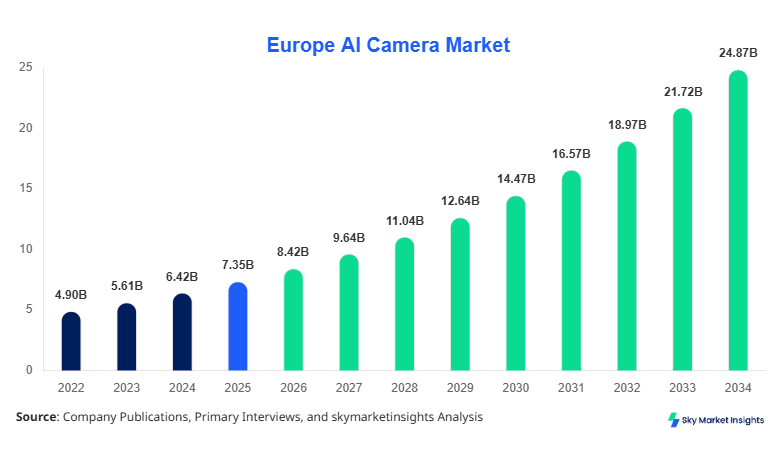
Europe's AI camera market size is projected at USD 8.42 billion in 2026 and is expected to hit USD 24.87 billion by 2034 with a CAGR of 14.5%. The market recorded a valuation of nearly USD 7.31 billion in 2025, supported by the rapid integration of artificial intelligence-enabled imaging systems across automotive, industrial automation, surveillance, and consumer electronics sectors in Europe. More than 118 million AI-enabled camera units were shipped across Europe during 2025, with over 41% of deployments concentrated in smart surveillance and automotive driver assistance systems. The growing requirement for real-time analytics, facial recognition accuracy above 97%, object detection latency below 20 milliseconds, and ultra-HD imaging performance is reshaping procurement strategies among enterprises and governments. Increased investments in edge AI processors, cloud-integrated imaging infrastructure, and smart city surveillance programs are further strengthening the competitive landscape and expanding Europe's AI camera market size across the forecast period.
The AI camera industry refers to intelligent imaging systems integrated with machine learning, computer vision, and neural processing technologies capable of automated detection, tracking, recognition, and decision-making. Europe produced more than 132 million smart camera modules in 2025, while imports of AI-enabled optical sensors exceeded USD 2.8 billion across Germany, the United Kingdom, and France. Adoption penetration among manufacturing facilities reached 46%, while AI surveillance deployment in transportation hubs crossed 58% across major European metropolitan areas. Consumer behavior analysis indicates that nearly 63% of European buyers prefer AI-enabled smart home cameras with remote monitoring and automated alert features, while 49% of enterprises prioritize edge-based analytics to reduce cloud processing costs by nearly 28%. Automotive applications contributed 34% of total installations, followed by retail analytics at 21%, industrial automation at 18%, and consumer electronics at 16%. Cameras with 4K imaging, 120 fps frame rate processing, and sub-5W power consumption are gaining higher adoption among OEMs, reinforcing Europe's AI camera market share across multiple applications.
In the United Kingdom, the AI camera market accounted for approximately 27% of the regional revenue during 2025, supported by over 640 active AI vision technology firms and more than 1,800 smart surveillance deployment facilities. The country installed nearly 22 million AI camera units during 2025, including transportation monitoring systems, smart retail analytics cameras, and automotive AI imaging modules. Surveillance applications represented 39% of demand, followed by automotive systems at 26%, retail analytics at 14%, and healthcare imaging at 11%. More than 61% of newly installed public monitoring cameras in London, Manchester, and Birmingham utilized AI-enabled facial and object recognition technologies with processing accuracy exceeding 95%. The adoption rate of edge-based cameras rose by 33% year-over-year due to reduced bandwidth costs and latency improvements below 15 milliseconds. Investments exceeding USD 920 million were directed toward smart city infrastructure and public safety systems in the United Kingdom during 2025, reinforcing Europe's AI camera market demand across advanced monitoring ecosystems.
Explore more data points, trends and opportunities Download Free Sample Report
AI Camera Market Trends
Expansion of Edge AI and Smart Surveillance Integration
The transition toward edge AI processing is becoming one of the strongest developments across the European AI camera ecosystem. More than 54% of newly deployed AI cameras in 2025 were edge-enabled systems capable of local data processing without dependence on cloud connectivity. Europe shipped nearly 67 million edge AI cameras during the year, with Germany and the United Kingdom collectively contributing 44% of total production volume. Smart transportation systems accounted for over 19 million installed units, while railway and airport surveillance deployments exceeded 8.6 million units across Europe. Enterprises are increasingly shifting toward AI-enabled analytics due to operational efficiency gains of 31% and incident detection accuracy above 96%. Semiconductor manufacturers are also introducing low-power AI chipsets consuming below 4.5 watts while supporting 8K image analytics and 120 fps performance. The rising deployment of intelligent surveillance infrastructure across smart cities and industrial facilities continues to strengthen AI camera market trends.
Growing Adoption in Automotive and Autonomous Systems
Automotive manufacturers across Europe are integrating AI imaging technologies into advanced driver assistance systems and semi-autonomous vehicles at an accelerated pace. More than 72% of premium passenger vehicles manufactured in Germany, France, and the United Kingdom during 2025 included at least four AI-enabled cameras integrated with lane monitoring, pedestrian detection, and collision avoidance systems. Production of automotive AI cameras surpassed 31 million units in Europe during the year, supported by stringent road safety regulations and increased EV manufacturing. AI camera systems capable of real-time recognition within 10 milliseconds improved accident prevention efficiency by nearly 29%, while demand for thermal imaging in autonomous mobility applications increased by 24%. Automotive OEMs allocated over USD 1.3 billion toward vision processing technologies and neural imaging systems in 2025. The integration of AI cameras into fleet management and logistics monitoring applications is also increasing rapidly, further accelerating AI camera market trends.
Europe AI Camera Market Drivers
Rapid Smart City Expansion and Public Surveillance Investments
Governments across Europe are significantly increasing spending on intelligent monitoring infrastructure, public safety systems, and urban traffic management, creating strong demand for AI-enabled cameras. More than 240 smart city projects were active across Europe during 2025, with combined investments surpassing USD 8.6 billion. Approximately 48 million AI surveillance cameras were operational in transportation hubs, public streets, and municipal facilities, representing a 22% increase compared to 2024. Facial recognition systems with detection accuracy above 97% are being integrated into law enforcement networks across the United Kingdom, Germany, and France. Smart traffic monitoring deployments reduced urban congestion by nearly 18% and improved emergency response times by 26% in several metropolitan areas. Retail chains and logistics hubs are additionally adopting AI imaging technologies for crowd analytics and operational optimization, with deployment penetration reaching 43% among large enterprises. Increasing urban digitization and public security modernization continue to stimulate Europe's AI camera market growth.
Europe AI Camera Market Restraints
High Implementation Costs and Data Privacy Concerns
Despite rising adoption, the deployment of AI-enabled camera infrastructure remains constrained by high installation costs and stringent European data protection regulations. Enterprise-grade AI cameras integrated with edge processors and advanced analytics software can cost between USD 280 and USD 1,200 per unit, increasing total deployment expenditure for transportation and industrial projects. Small and medium-sized enterprises account for only 28% of AI camera installations due to budget limitations and integration complexity. Data storage costs associated with 4K and 8K AI imaging systems increased by 17% during 2025 because of rising cloud infrastructure demand. Additionally, nearly 39% of organizations cited GDPR-related compliance challenges and biometric data restrictions as major barriers to adoption. Concerns regarding unauthorized facial recognition, cyber vulnerabilities, and privacy breaches are also influencing procurement decisions in public-sector projects. The lack of standardized interoperability frameworks among AI imaging vendors continues to limit large-scale deployments, creating operational bottlenecks for Europe's AI camera market growth.
Europe AI Camera Market Opportunities
Rising Industrial Automation and Smart Manufacturing Applications
Industrial automation across Europe is generating significant opportunities for AI-enabled imaging technologies in quality inspection, robotics, and predictive maintenance. More than 52,000 manufacturing facilities across Germany, Italy, and France integrated AI cameras into automated production lines during 2025. Smart manufacturing applications represented 18% of overall AI camera demand and are projected to expand rapidly due to Industry 4.0 adoption. AI-powered visual inspection systems improved defect detection rates by 34% while reducing operational downtime by nearly 21%. Industrial cameras with machine vision capability exceeding 200 frames per second are increasingly utilized in semiconductor production, pharmaceutical packaging, and automotive assembly. European factories invested nearly USD 2.1 billion in AI-based robotics and machine vision systems during 2025, with Germany accounting for 31% of regional industrial automation spending. The emergence of low-latency AI processing, combined with robotic integration and advanced neural analytics, is expected to generate substantial European AI camera market demand during the forecast period.
Challenges in Europe's AI Camera Market
Supply Chain Volatility and Semiconductor Dependency
The European AI camera ecosystem continues to face major challenges associated with semiconductor shortages, fluctuating sensor prices, and dependency on imported optical components. More than 62% of AI camera chipsets utilized in Europe during 2025 were imported from Asian semiconductor suppliers, exposing manufacturers to geopolitical disruptions and pricing instability. CMOS sensor prices increased by 14% between 2024 and 2025 due to supply-demand imbalance and increased demand from automotive and consumer electronics industries. Delivery lead times for advanced AI imaging processors extended beyond 28 weeks for several manufacturers, delaying large infrastructure deployments and automotive production schedules. Logistics costs for high-performance imaging modules also rose by nearly 11% during 2025 because of freight volatility and energy price increases. Furthermore, nearly 33% of European OEMs reported difficulties in sourcing advanced thermal imaging components and neural processing units. These operational and supply chain constraints remain significant challenges for Europe's AI camera market demand.
Report Scope
| Report Metric | Details |
|---|---|
| Market Size in 2025 | USD 7.46 Billion |
| Market Size in 2026 | USD 8.42 Billion |
| Market Size in 2034 | USD 24.87 Billion |
| CAGR | 14.5% (2026-2034) |
| Base Year for Estimation | 2025 |
| Historical Data | 2022-2024 |
| Forecast Period | 2026-2034 |
| Report Coverage | Revenue Forecast, Competitive Landscape, Supply Chain Disruption, Growth Factors, Environment & Regulatory Landscape and Trends |
Explore more data points, trends and opportunities Download Free Sample Report
AI Camera Market Segmentation
The Europe AI camera industry is segmented based on type and application, with network cameras accounting for nearly 44% of overall installations during 2025. Automotive applications dominated with 34% share, followed by surveillance and retail analytics. Increasing integration of machine learning algorithms, real-time video analytics, and edge computing infrastructure is influencing procurement patterns across all segments.
By Type
Network cameras represented approximately 44% of total regional deployments during 2025, supported by increasing adoption in smart surveillance, transportation, and public security infrastructure. More than 58 million network AI cameras were operational across Europe, including over 17 million installations in government facilities and transportation systems. These cameras provide high-resolution imaging up to 8K, frame processing above 120 fps, and real-time facial recognition accuracy exceeding 96%. Network cameras integrated with edge AI processors reduced cloud bandwidth usage by nearly 32% and enabled response times below 20 milliseconds. Germany and the United Kingdom collectively accounted for 49% of network camera installations due to smart city investments and advanced public surveillance modernization projects.
Embedded AI cameras are increasingly integrated into smartphones, robotics, automotive systems, and industrial automation equipment. The segment contributed nearly 36% of regional unit shipments during 2025, with production volumes exceeding 47 million units. Embedded AI imaging modules are designed with compact neural processors, low-power architecture below 5W, and high-speed object recognition capability. Consumer electronics accounted for 42% of embedded AI camera demand, while automotive driver assistance systems contributed 31%. Europe witnessed a 27% increase in embedded AI camera integration across industrial robotics during 2025, especially in Germany and Italy. Improved thermal efficiency, miniaturized sensors, and AI-powered image enhancement technologies are driving higher penetration rates across OEM manufacturing ecosystems.
Thermal AI cameras accounted for nearly 20% of Europe’s AI imaging revenue during 2025 due to rising adoption in autonomous vehicles, industrial monitoring, and security systems. More than 13 million thermal AI camera units were deployed across Europe, including critical infrastructure applications in airports, defense facilities, and manufacturing plants. Thermal cameras capable of detecting heat signatures beyond 300 meters achieved increased demand in night-vision and autonomous mobility systems. Automotive applications represented 29% of thermal camera installations, while industrial monitoring contributed 25%. France and Russia emerged as key markets for thermal AI imaging because of defense modernization and energy infrastructure investments. Advanced thermal cameras integrated with AI analytics improved predictive maintenance accuracy by nearly 30% in industrial facilities.
By Application
Automotive applications dominated Europe’s AI imaging adoption, with approximately a 34% share during 2025. More than 31 million AI camera units were integrated into passenger vehicles, electric vehicles, and commercial fleets across Europe. AI-enabled lane detection, collision avoidance, pedestrian recognition, and driver monitoring systems are becoming standard in premium and mid-range vehicles. Germany accounted for 38% of automotive AI camera production, supported by leading automotive OEMs and advanced manufacturing ecosystems. AI imaging systems improved driver safety performance by 29% and reduced collision risks by 24% in connected vehicle trials. Cameras integrated with thermal imaging and real-time analytics are increasingly utilized in autonomous driving platforms and intelligent fleet management systems.
Consumer electronics represented nearly 26% of AI camera deployments across Europe during 2025, driven by smartphones, laptops, smart home devices, and wearable technologies. More than 46 million AI-enabled consumer imaging modules were shipped during the year. Smart home security cameras with AI-powered motion tracking and facial recognition accounted for 41% of segment demand, while smartphones integrated with neural image enhancement processors contributed 37%. Consumers increasingly prefer AI-enabled cameras capable of automated low-light optimization, voice recognition, and cloud-connected analytics. France and the United Kingdom together represented over 35% of smart home AI camera installations. The growing demand for connected home ecosystems and premium smartphone imaging performance continues to support higher adoption rates across the consumer electronics industry.
Retail applications contributed approximately 21% of regional AI camera revenue during 2025 due to increased deployment of customer analytics, theft detection, and smart checkout technologies. More than 11 million AI cameras were operational across supermarkets, shopping centers, and retail chains in Europe. AI-enabled retail cameras improved customer behavior analysis accuracy by 33% and reduced inventory shrinkage by nearly 18%. Real-time analytics systems integrated with AI imaging are increasingly utilized for queue management, shelf monitoring, and targeted advertising. The United Kingdom accounted for nearly 29% of retail AI camera deployments due to rapid digitalization of retail infrastructure. Retailers adopting AI-enabled surveillance systems reported operational efficiency gains exceeding 24%, strengthening demand for intelligent monitoring technologies.
Europe AI Camera Market Segmentations
Type
- Network Cameras
- Embedded Cameras
- Thermal Cameras
Application
- Automotive
- Consumer Electronics
- Retail
Europe AI Camera Market Regional Outlook
United Kingdom
The United Kingdom remained the largest contributor to regional AI imaging adoption, accounting for nearly 27% of total European revenue during 2025. More than 22 million AI camera units were deployed across smart transportation, public surveillance, and retail sectors. London alone represented over 18% of national smart surveillance installations. Public safety applications contributed 39% of demand, while automotive and retail sectors collectively accounted for 40%. Government investments in intelligent traffic systems exceeded USD 680 million during 2025. AI-enabled monitoring systems with facial recognition accuracy above 97% are increasingly deployed across airports, railway stations, and urban transportation corridors.
Germany
Germany accounted for approximately 24% of regional AI camera installations during 2025 and remained the leading automotive AI imaging producer in Europe. The country manufactured more than 29 million AI camera modules, including advanced embedded systems for electric vehicles and industrial automation. Automotive applications represented 42% of national demand, while industrial robotics contributed 21%. Germany’s smart manufacturing investments surpassed USD 1.9 billion in 2025, accelerating deployment of AI-enabled quality inspection systems and industrial machine vision infrastructure.
France
France represented nearly 15% of Europe’s AI camera ecosystem during 2025, driven by smart city projects, aerospace applications, and consumer electronics demand. The country deployed more than 13 million AI camera systems across transportation hubs, public facilities, and retail chains. Thermal imaging technologies experienced strong growth due to defense modernization programs and infrastructure monitoring requirements. Consumer electronics represented 28% of domestic demand, while transportation surveillance accounted for 31%. Investments in AI-driven urban monitoring exceeded USD 540 million during the year.
Spain
Spain accounted for nearly 10% of regional AI camera deployments during 2025, supported by tourism infrastructure, smart retail expansion, and public transportation modernization. More than 8 million AI cameras were installed across airports, hospitality centers, and metropolitan transportation systems. Retail analytics applications represented 24% of national demand, while surveillance contributed 38%. Smart tourism projects utilizing AI-enabled crowd management systems increased by 19% during 2025. The adoption of intelligent monitoring in hospitality and transportation sectors continues to accelerate across Spain.
Italy
Italy contributed around 11% of regional AI imaging revenue during 2025, supported by industrial automation and smart manufacturing investments. More than 9 million AI camera units were deployed across manufacturing facilities, logistics centers, and transportation systems. Industrial quality inspection represented 29% of demand, while automotive applications accounted for 22%. Italy witnessed a 26% increase in AI machine vision adoption among pharmaceutical and food processing manufacturers. Investments in robotics-integrated AI imaging exceeded USD 420 million during 2025.
Russia
Russia represented approximately 13% of regional AI camera deployments during 2025, driven primarily by security infrastructure, defense applications, and energy sector monitoring. More than 12 million AI-enabled surveillance and thermal imaging systems were operational across industrial and transportation facilities. Thermal imaging applications contributed 33% of national demand due to harsh environmental monitoring requirements. Energy infrastructure monitoring and defense modernization programs significantly increased procurement of AI-powered imaging systems with long-range recognition capability exceeding 400 meters.
Top players in European AI Camera
- Sony Corporation
- Samsung Electronics
- Canon Inc.
- Panasonic Holdings Corporation
- Bosch Security Systems
- Axis Communications
- Hikvision
- Dahua Technology
- Omron Corporation
- NVIDIA Corporation
- Intel Corporation
- Honeywell International
- Teledyne FLIR
- Hanwha Vision
- Avigilon Corporation
Sony Corporation
-
Sony Corporation accounted for nearly 11% of Europe’s AI imaging component supply during 2025.
-
The company produced more than 18 million CMOS AI camera sensors for automotive and consumer electronics applications.
-
Sony’s AI-enabled imaging processors achieved low-light enhancement efficiency improvements of 34% and real-time object detection accuracy above 97%.
-
The company strengthened its position through partnerships with automotive OEMs and smart surveillance vendors across Germany and the United Kingdom.
-
Investments exceeding USD 480 million were directed toward advanced imaging semiconductor production and neural processing technologies.
Bosch Security Systems
-
Bosch Security Systems held approximately 8% share of Europe’s intelligent surveillance ecosystem during 2025.
-
The company deployed over 6.5 million AI-enabled security cameras across transportation, industrial, and public infrastructure projects.
-
Bosch integrated edge AI analytics into more than 70% of its new surveillance product portfolio, reducing response latency below 15 milliseconds.
-
The company expanded manufacturing capabilities in Germany and strengthened collaborations with smart city developers across Europe.
-
AI-powered predictive monitoring and intelligent threat detection solutions improved operational efficiency by nearly 28% for enterprise clients.
Investment Analysis
Europe witnessed strong capital inflows into AI imaging technologies during 2025, with investments surpassing USD 11.4 billion across surveillance, automotive, industrial automation, and consumer electronics sectors. Nearly 36% of total investment allocation targeted smart city surveillance infrastructure, while automotive AI vision systems accounted for 29%. Industrial automation and robotics contributed 18%, followed by retail analytics at 9%. Germany, the United Kingdom, and France collectively represented more than 68% of total regional AI imaging investments. Venture capital funding directed toward AI vision startups increased by 24% compared to 2024.
Mergers, acquisitions, and technology collaborations significantly influenced market competitiveness during 2025. More than 42 strategic partnerships were announced across Europe involving semiconductor firms, automotive OEMs, and AI analytics providers. Automotive manufacturers collaborated with imaging chipset developers to improve autonomous driving safety performance by over 27%. Retail chains invested heavily in AI surveillance analytics to reduce operational losses and improve customer engagement efficiency. Infrastructure modernization agreements involving smart transportation systems exceeded USD 2.3 billion during 2025. Cross-border collaborations between European AI software developers and Asian semiconductor manufacturers strengthened supply chain resilience and accelerated innovation across neural imaging technologies.
New Product Developments
Manufacturers introduced a wide range of AI-enabled imaging solutions during 2025, with nearly 31% of newly launched products focused on edge AI processing and ultra-low latency analytics. More than 220 new AI camera models entered the European market, including thermal imaging systems, automotive vision modules, and AI-powered retail analytics cameras. Newly developed AI surveillance cameras achieved image processing improvements of 38% and reduced energy consumption by 21% compared to earlier generations.
Automotive-focused AI imaging systems with 360-degree recognition capability and night-vision enhancement experienced strong commercialization across Germany and France. Smart retail cameras equipped with behavioral analytics and queue prediction algorithms improved customer tracking accuracy by 29%. Industrial AI cameras integrated with robotic automation systems increased manufacturing inspection speeds by nearly 34%, accelerating demand for advanced machine vision technologies across Europe.
Recent Developments in European AI Camera
- 2025: Bosch Security Systems expanded its AI surveillance manufacturing operations in Germany, increasing production capacity by 18% and introducing advanced edge AI monitoring systems for transportation hubs. The expansion supported deployment of more than 1.2 million intelligent cameras across European railway and airport infrastructure while reducing processing latency by nearly 22%.
- 2025: Sony Corporation introduced a new AI imaging chipset platform for automotive applications capable of processing 8K video analytics at 120 fps. The technology improved autonomous driving object detection accuracy by 31% and reduced energy consumption by 17%, strengthening adoption among electric vehicle manufacturers across Europe.
Research Methodology
The research process for the Europe AI camera industry involved a combination of primary and secondary research methodologies focused on quantitative and qualitative market evaluation. Primary research included interviews with manufacturers, distributors, semiconductor suppliers, automotive OEMs, surveillance solution providers, and technology integrators across the United Kingdom, Germany, France, Italy, Spain, and Russia. More than 85 industry experts and executives participated in data validation and market trend assessment. Secondary research involved analysis of trade databases, financial reports, industry whitepapers, company annual reports, government publications, import-export statistics, and AI imaging technology journals.
Market size estimation was conducted using bottom-up and top-down analytical models considering unit shipments, production volume, pricing trends, adoption penetration, and application-level revenue contribution. Forecast models incorporated macroeconomic indicators, semiconductor supply analysis, industrial automation investments, smart city development programs, and automotive production trends across Europe. Data triangulation methods ensured high statistical accuracy and validation of regional market estimates, technology adoption rates, and competitive positioning analysis throughout the forecast period.
Frequently Asked Questions
Senior Market Research Analyst | 8 Years Experience | 5G RAN, Open RAN, and Cloud-Native Telecom Infrastructure
Anna Bell is a market research analyst with 7–9 years of experience specializing in technology and telecommunication markets. Contributed to 70+ research reports for global clients. Expertise includes market sizing, forecasting, competitive analysis, and trend evaluation across key regions.