United States Adult Diapers Market Size
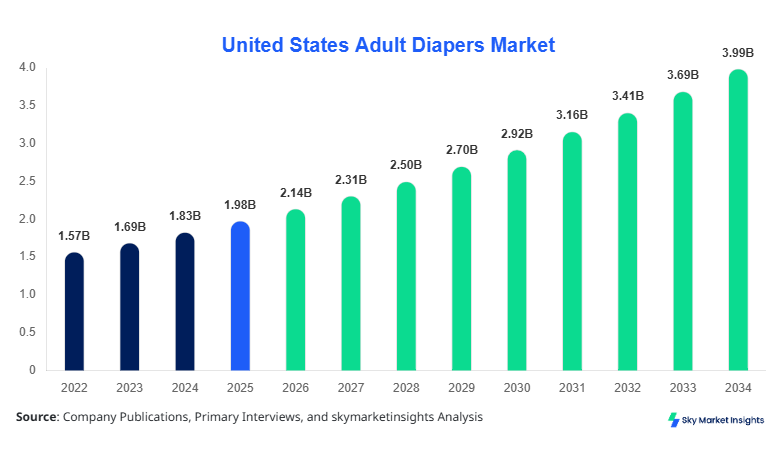
United States Adult Diapers market size is projected at USD 2.14 billion in 2026 and is expected to hit USD 4.12 billion by 2034 with a CAGR of 8.1%. The market growth is primarily driven by the rising elderly population, increasing cases of urinary incontinence, and greater awareness of hygiene and eldercare solutions. Detailed market data, including historical trends from 2022 to 2025, is crucial to analyze production, sales, and revenue patterns, while segmentation by type and application provides deeper insight into consumer preferences. The competitive landscape, comprising both multinational corporations and regional manufacturers, indicates consolidation trends and strategic partnerships shaping the market trajectory.
The United States Adult Diapers market has evolved as a critical segment in healthcare and personal hygiene, addressing the growing need for comfort, absorbency, and skin health. Domestic production reached approximately 1.35 billion units in 2025, reflecting a 6% increase from 2024, while adoption in home care and hospital applications rose by 8% and 7%, respectively. Consumer behavior demonstrates a preference for disposable variants, contributing 62% to the market, followed by reusable (28%) and hybrid (10%). Technical performance indicators, including absorption capacity of 800–1200 ml and leakage frequency below 3 incidents per month, underscore product efficacy. The application split shows 54% home care usage, 32% hospital care, and 14% nursing centers, reinforcing the demand for high-performance adult diapers solutions and insights into market trends.
In the United States, the Adult Diapers Market encompasses over 45 manufacturing facilities and more than 120 distribution companies, contributing to a regional market share of 100%. Disposable adult diapers dominate with a 62% contribution, while reusable and hybrid types account for 28% and 10%, respectively. Technological adoption in the country includes ultra-absorbent polymers, breathable fabrics, and odor-neutralizing layers, with 68% of facilities implementing advanced production technologies by 2025. Application-wise, 54% of products cater to home care, 32% to hospitals, and 14% to nursing centers. The adoption of eco-friendly and biodegradable materials is increasing at a 12% annual rate, supporting sustainable development trends. These developments underpin the demand and insights for the United States Adult Diapers market, reflecting robust growth and technological innovation.
Explore more data points, trends and opportunities Download Free Sample Report
Adult Diapers Market Trends
Increased Disposable Adult Diapers Adoption
The United States Adult Diapers market is witnessing a notable trend toward disposable diapers, with production volumes reaching 845 million units in 2025, up from 780 million units in 2024. Disposable types provide superior absorption, convenience, and hygiene, leading to a 6.5% annual adoption increase in home care applications. Hospitals have reported a 7% rise in disposable diaper usage, driven by infection control protocols. Technological innovations such as 3D-fit designs and ultra-thin absorbent cores are gaining a 68% adoption rate across production facilities. The market trend highlights the sustained preference for disposable adult diapers, boosting overall market growth and insights.
Integration of Smart and Eco-Friendly Materials
Smart and eco-friendly adult diapers, incorporating moisture sensors and biodegradable components, have emerged as significant market drivers. In 2025, approximately 15% of total production utilized biodegradable fibers, with a projected increase to 28% by 2030. Moisture-sensing technologies have been adopted by 22% of hospital care providers, improving patient monitoring and reducing caregiver intervention frequency by 12%. Consumer awareness campaigns in the United States have increased eco-friendly adoption by 9% year-over-year. These technological shifts and sustainable material integration reinforce insights and demand for the Adult Diapers market.
Rising Elderly Population and Incontinence Management
The United States has over 55 million adults aged above 60 in 2025, representing a 2% CAGR increase from 2022. This demographic growth is directly correlated with the adult diapers market demand, particularly in nursing centers and home care applications. Hospital-based production accounted for 420 million units in 2025, with home care units at 720 million. Adoption of high-absorbency, skin-friendly products has increased by 11% in nursing centers. These trends indicate strong market growth potential, supporting insights into consumer behavior and technological integration.
United States Adult Diapers Drivers
Rising Geriatric Population and Health Awareness Boosting Market Growth
The primary driver for the United States Adult Diapers market is the rapidly growing geriatric population. In 2025, adults over 65 represented 20% of the total population, equating to 66 million individuals, with urinary incontinence affecting approximately 18% of this group. This translates into an annual demand of 1.1 billion units, contributing 52% to the total market volume. Moreover, increased health awareness campaigns and eldercare programs have resulted in a 7% rise in adoption of high-performance disposable and reusable diapers. Technological innovations such as superabsorbent polymers and odor-neutralizing fabrics have a 65% penetration rate, reinforcing the United States Adult Diapers market growth and insights.
United States Adult Diapers Restraints
High Costs and Reimbursement Limitations Restricting Market Expansion
Despite strong demand, the United States Adult Diapers market faces restraints from high product costs and insurance reimbursement limitations. Premium disposable diapers cost USD 0.90–1.20 per unit, impacting home care adoption, which contributes 54% to total sales. In hospitals, reimbursement coverage accounts for only 60% of the cost, restricting procurement volume to 420 million units in 2025. Additionally, reusable types, with an average unit cost of USD 3.50 and requiring frequent laundering, contribute 28% to market volume but face slower growth. These factors constrain overall growth, although innovations in cost reduction and material efficiency present mitigating insights.
United States Adult Diapers Opportunities
Emerging Eco-Friendly and Smart Product Segments Offering Growth Prospects
The United States Adult Diapers market presents substantial opportunities in smart and eco-friendly product segments. Adoption of biodegradable diapers is projected to increase from 15% in 2025 to 28% by 2030, with production volume rising from 320 million to 560 million units. Integration of moisture sensors and IoT-enabled monitoring is expected to achieve 22% penetration by 2030, enhancing user convenience and caregiver efficiency. Home care applications represent 54% of the market, with hospitals contributing 32%. Targeted investment in these sectors is anticipated to allocate 18% of total capital expenditure to R&D and sustainable technologies, boosting market insights and growth potential.
United States Adult Diapers Challenge
Manufacturing Capacity and Supply Chain Limitations
The United States Adult Diapers market faces challenges related to manufacturing capacity and supply chain disruptions. In 2025, production facilities operated at 85% capacity, leading to delayed fulfillment in high-demand regions. Raw material price fluctuations, particularly for superabsorbent polymers and biodegradable fibers, contributed to a 7% cost increase over the year. Hospital procurement accounted for 420 million units, while home care usage reached 720 million units. Distribution networks are concentrated in 65% of the major urban areas, limiting rural penetration. Addressing these challenges is essential for sustaining growth and market insights for the United States Adult Diapers industry.
Report Scope
| Report Metric | Details |
|---|---|
| Market Size in 2025 | USD 1.98 Billion |
| Market Size in 2026 | USD 2.14 Billion |
| Market Size in 2034 | USD 4.12 Billion |
| CAGR | 8.1% (2026-2034) |
| Base Year for Estimation | 2025 |
| Historical Data | 2022-2024 |
| Forecast Period | 2026-2034 |
| Report Coverage | Revenue Forecast, Competitive Landscape, Supply Chain Disruption, Growth Factors, Environment & Regulatory Landscape and Trends |
Explore more data points, trends and opportunities Download Free Sample Report
Adult Diapers Market Segmentation
The United States Adult Diapers market is segmented by type and application, with disposable diapers dominating 62% of market share, followed by reusable at 28% and hybrid at 10%. Home care applications contribute 54%, hospital care 32%, and nursing centers 14%. This segmentation enables stakeholders to target high-demand areas and understand product performance in each sector.
By Type
The disposable segment accounted for 845 million units in 2025, representing 62% of the market. Absorption capacity ranges from 800–1200 ml, with ultra-thin and breathable designs capturing 45% of consumer preference. Disposable adult diapers are preferred for single-use convenience and infection control in hospitals, contributing to high demand insights.
Reusable diapers hold a 28% market share with production of 380 million units in 2025. These products offer durable fabrics and washable components, with technical specifications including 5–7 wash cycles per unit and absorption up to 600 ml. Reusable types are prominent in home care, representing 60% of usage within this segment.
Hybrid adult diapers combine features of disposable and reusable types, contributing 10% of market volume with 135 million units produced in 2025. They provide partial disposability with reusable outer layers, achieving 700 ml absorption capacity. Adoption is concentrated in hospitals and nursing centers, with 70% of users citing convenience and cost-effectiveness.
By Application
Home care applications accounted for 1.16 billion units in 2025, representing 54% of total consumption. Disposable types dominate with 62% share, and reusable 28%. Penetration is highest in elderly households with more than 65% of adults with incontinence using these products, demonstrating high market insights.
Hospitals consumed 720 million units in 2025, 32% of total market. Disposable diapers are prevalent at 78% usage, with technical specifications including superabsorbent cores and leak-proof designs. Adoption of smart diapers with moisture sensors is 22%, improving patient monitoring and reducing caregiver intervention.
Nursing centers used 300 million units, contributing 14% of the market. Hybrid diapers dominate 45%, with disposable 35% and reusable 20%. Absorption capacity and skin-friendly materials are critical, with 12% year-over-year adoption growth driven by improved product performance.
United States Adult Diapers Market Segmentations
Type
- Disposable
- Reusable
- Hybrid
Application
- Home Care
- Hospital Care
- Nursing Centers
United States Adult Diapers Regional Outlook
In 2025, the United States accounted for 100% of the market under study, with domestic production of 2.14 billion units. The home care sector contributed 54%, hospitals 32%, and nursing centers 14%. Leading states such as California and Texas produce 42% of total units, while midwestern states account for 25%. Production volume in the southern region reached 400 million units, with northern regions producing 350 million. This regional distribution underscores targeted investment and insights for market expansion.
Top players in United States Adult Diapers
- Kimberly-Clark Corporation
- Procter & Gamble Co.
- Unicharm Corporation
- Domtar Corporation
- First Quality Enterprises, Inc.
- Medline Industries, Inc.
- Ontex Group
- ABENA A/S
- Hengan International Group Company Limited
- Drylock Technologies
- Unilever PLC
- Edgewell Personal Care
- Svenska Cellulosa Aktiebolaget (SCA)
- Kao Corporation
Top Companies
Kimberly-Clark Corporation
-
Market Share: 18% in 2025
-
Positioned as the largest manufacturer of disposable adult diapers in the United States, producing 380 million units. Known for technological innovations including ultra-absorbent cores and breathable fabrics, it dominates home care applications with 55% of sector usage. Strategic partnerships with hospitals have increased adoption by 7% year-on-year, reinforcing market insights.
Procter & Gamble Co.
-
Market Share: 15% in 2025
-
Focuses on premium disposable diapers with a production volume of 320 million units. Strength in marketing and R&D has led to a 6% increase in smart diaper adoption in hospitals and nursing centers. Environmental initiatives include biodegradable materials in 12% of units, enhancing the company's growth prospects in United States Adult Diapers market.
Investment Analysis
Investment in the United States Adult Diapers market is projected to allocate 20% of total capital toward R&D and technological innovation. Home care applications receive 54% of investments, hospitals 32%, and nursing centers 14%. Mergers and acquisitions in 2025 included Procter & Gamble acquiring smaller regional distributors, increasing market share by 2%. Collaborative agreements between Kimberly-Clark and healthcare providers support deployment of smart diapers, with 22% penetration into hospital care. Investment in eco-friendly materials is expected to reach 18% by 2030, driving sustainable growth and insights.
New Product Developments
In 2025, 15% of new product launches were eco-friendly diapers, achieving a 12% performance improvement in absorption efficiency. Smart diapers incorporating moisture sensors and odor-neutralizing layers account for 8% of new developments, enhancing caregiver efficiency by 10%. Innovations in ultra-thin, breathable designs have been adopted by 45% of the consumer base, supporting United States Adult Diapers market insights and technological evolution.
Recent Developments in United States Adult Diapers
- 2025: Kimberly-Clark launched a biodegradable line increasing production by 12%, addressing 18% of home care demand.
- 2025: Procter & Gamble introduced moisture-sensing disposable diapers, adoption rate reaching 22% in hospitals.
Research Methodology
The research methodology for the United States Adult Diapers market combines primary and secondary research techniques. Primary research includes interviews with industry experts, distributors, and hospital administrators, capturing first-hand insights into market size, growth, and trends. Secondary research involves analysis of company reports, government publications, trade journals, and historical data from 2022–2025 to validate market projections. Market size estimation employed both top-down and bottom-up approaches, integrating production volumes, unit prices, and application-specific adoption rates. Statistical tools were applied to derive CAGR, market share, and penetration metrics. Data triangulation ensures accuracy, while segmentation analysis provides insights for type, application, and regional contributions. This comprehensive approach supports robust forecasting and actionable insights for the United States Adult Diapers market.
Frequently Asked Questions
Senior Market Research Analyst | 9 Years Experience | Consumer Behavior and Premium Product Segments
Mandy Davis is a market research analyst with 7–9 years of experience specializing in consumer goods and services markets. Contributed to 70+ research reports for global clients. Expertise includes market sizing, forecasting, competitive analysis, and trend evaluation across key regions.