United States ACSR, ACSS And HTLS Conductors Market Size
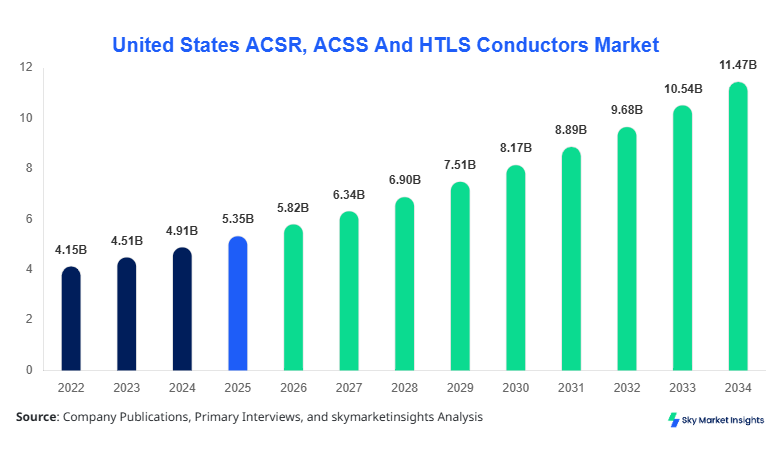
United States ACSR, ACSS And HTLS Conductors market size is projected at USD 5.82 billion in 2026 and is expected to hit USD 11.47 billion by 2034 with a CAGR of 8.85%. The United States ACSR, ACSS And HTLS Conductors market size is driven by rising grid modernization investments exceeding USD 120 billion, growing electricity demand of over 4,300 TWh annually, and increasing deployment of high-capacity conductors exceeding 15 million km globally. The market emphasizes structured segmentation across type and application along with competitive benchmarking among more than 40 key manufacturers and suppliers operating across transmission infrastructure value chains.
The ACSR, ACSS and HTLS conductors market represents a critical component of the electrical transmission ecosystem, focusing on aluminum-based reinforced conductors capable of carrying high electrical loads ranging from 500 kV to 765 kV systems. In the United States, production volumes exceeded 2.8 million metric tons in 2025, with adoption penetration surpassing 68% in high-voltage transmission lines. Consumer behavior reflects increasing demand for energy efficiency, with utilities prioritizing conductors that reduce line losses by 15%–30% and improve thermal performance up to 250°C operating limits. Application segmentation highlights power transmission accounting for nearly 62% share, distribution networks contributing 25%, and renewable energy integration capturing 13%. Demand analytics indicate that utilities are shifting toward HTLS conductors due to their 2x capacity advantage compared to traditional ACSR, reinforcing the United States ACSR, ACSS And HTLS Conductors market.
Explore more data points, trends and opportunities Download Free Sample Report
ACSR, ACSS And HTLS Conductors Market Trends
Increasing Adoption of High-Temperature Low Sag Conductors
The transition toward HTLS conductors is one of the most prominent trends, with production volumes exceeding 850,000 metric tons in 2025 and expected to surpass 1.6 million metric tons by 2030. Utilities are increasingly adopting HTLS due to its ability to operate at temperatures above 200°C compared to 75°C–100°C for conventional ACSR, improving capacity by over 100%. Adoption rates have grown by 18% annually, especially in renewable energy corridors where wind and solar capacity installations exceed 300 GW nationwide. This trend is further supported by federal investments exceeding USD 30 billion in grid resilience programs, driving the United States ACSR, ACSS And HTLS Conductors market trend.
Grid Modernization and Smart Infrastructure Deployment
The integration of smart grid technologies is influencing conductor demand, with over 65% of new transmission projects incorporating advanced monitoring systems. Annual production volumes of ACSR conductors still account for nearly 1.4 million metric tons due to their cost-effectiveness, while ACSS conductors are witnessing a 12% year-on-year increase in demand. The shift toward digital substations and IoT-enabled monitoring systems has increased the need for high-performance conductors that support real-time data and load balancing. These developments align with the United States’ target to upgrade over 50% of aging grid infrastructure by 2035, strengthening the United States ACSR, ACSS And HTLS Conductors market trend.
United States ACSR, ACSS And HTLS Conductors Drivers
Rising Electricity Demand and Grid Expansion Initiatives
The United States continues to experience growing electricity demand exceeding 4,300 TWh annually, with projections indicating a 2.5% annual increase through 2034. This surge is driven by electrification trends across transportation, industrial automation, and data centers, which alone account for over 10% of incremental demand. Government initiatives such as the Infrastructure Investment and Jobs Act have allocated more than USD 65 billion toward grid modernization, directly impacting conductor demand. Utilities are replacing aging lines with high-capacity conductors capable of increasing transmission efficiency by up to 30%, reducing line losses by 12%–18%. Additionally, renewable energy integration exceeding 350 GW capacity requires advanced conductors for long-distance transmission, supporting consistent load flow. These factors collectively drive the United States ACSR, ACSS And HTLS Conductors market growth.
United States ACSR, ACSS And HTLS Conductors Restraints
High Installation and Replacement Costs
Despite strong demand, high installation and replacement costs remain a critical restraint, with HTLS conductors costing 25%–40% more than traditional ACSR. The average cost of conductor replacement projects ranges from USD 0.8 million to USD 2.5 million per mile depending on voltage levels and terrain complexity. Additionally, maintenance costs for advanced conductors are approximately 15% higher due to specialized installation techniques and monitoring requirements. Budget constraints among utilities, particularly smaller cooperatives, limit adoption rates, with only 38% of utilities fully transitioning to advanced conductor technologies. Regulatory approval timelines, which can extend up to 3–5 years, further delay project execution. These challenges hinder the overall expansion trajectory of the United States ACSR, ACSS And HTLS Conductors market growth.
United States ACSR, ACSS And HTLS Conductors Opportunities
Renewable Energy Expansion and Offshore Wind Projects
The rapid expansion of renewable energy presents significant opportunities, with solar and wind capacity expected to exceed 600 GW by 2034. Offshore wind projects alone are projected to add over 30 GW capacity, requiring specialized HTLS conductors for efficient energy transmission over long distances. Investment in renewable transmission infrastructure has grown by 22% annually, with over USD 40 billion allocated to grid connectivity projects. Advanced conductors can improve transmission efficiency by 20%–35%, making them essential for renewable integration. Additionally, federal tax incentives covering up to 30% of project costs are encouraging utilities to upgrade existing infrastructure. These factors create substantial opportunities within the United States ACSR, ACSS And HTLS Conductors market growth.
United States ACSR, ACSS And HTLS Conductors Challenge
Supply Chain Constraints and Raw Material Volatility
Supply chain disruptions and raw material price volatility present significant challenges, particularly for aluminum and steel, which constitute over 80% of conductor materials. Aluminum prices have fluctuated by 18%–25% annually, impacting production costs and profit margins. Additionally, lead times for conductor manufacturing have increased from 8 weeks to 14–18 weeks due to supply bottlenecks. Import dependency for certain alloys remains at 22%, exposing the market to geopolitical risks. Labor shortages in the energy sector, estimated at 12%–15%, further delay project execution. These constraints create operational inefficiencies and affect project timelines, posing challenges to the United States ACSR, ACSS And HTLS Conductors market growth.
Report Scope
| Report Metric | Details |
|---|---|
| Market Size in 2025 | USD 5.35 Billion |
| Market Size in 2026 | USD 5.82 Billion |
| Market Size in 2034 | USD 11.47 Billion |
| CAGR | 8.85% (2026-2034) |
| Base Year for Estimation | 2025 |
| Historical Data | 2022-2024 |
| Forecast Period | 2026-2034 |
| Report Coverage | Revenue Forecast, Competitive Landscape, Supply Chain Disruption, Growth Factors, Environment & Regulatory Landscape and Trends |
Explore more data points, trends and opportunities Download Free Sample Report
ACSR, ACSS And HTLS Conductors Market Segmentation
The ACSR, ACSS and HTLS conductors market is segmented by type and application, with ACSR dominating 48% share, ACSS accounting for 27%, and HTLS capturing 25% due to increasing adoption. In application, power transmission leads with 62%, followed by distribution networks at 25% and renewable energy integration at 13%, reflecting infrastructure priorities.
By Type
ACSR conductors hold approximately 48% of the market share with annual production exceeding 1.4 million metric tons. These conductors operate at temperatures up to 75°C–100°C and are widely used in conventional transmission systems due to their cost-effectiveness. Their tensile strength ranges from 300 MPa to 600 MPa, making them suitable for long-span installations. Despite slower adoption compared to advanced conductors, ACSR remains dominant in legacy grid systems, especially in rural and suburban networks. The demand is supported by ongoing maintenance and replacement of aging infrastructure, ensuring consistent utilization across the United States ACSR, ACSS And HTLS Conductors market.
ACSS conductors account for nearly 27% share, with production volumes reaching 800,000 metric tons annually. These conductors can operate at higher temperatures of up to 200°C, providing improved thermal stability and reduced sag compared to ACSR. Their aluminum strands are annealed, enabling flexibility and enhanced conductivity. Utilities prefer ACSS for upgrading existing lines without replacing towers, as they offer a 50%–60% increase in capacity. Growing adoption in urban transmission networks supports steady demand within the United States ACSR, ACSS And HTLS Conductors market.
HTLS conductors represent 25% of the market but are the fastest-growing segment, with production volumes surpassing 850,000 metric tons. These conductors can operate at temperatures exceeding 200°C while maintaining low sag, allowing for double the current-carrying capacity. Advanced materials such as composite cores and carbon fiber reinforcement enhance performance. HTLS is increasingly deployed in renewable energy corridors and high-load transmission systems, driving expansion across the United States ACSR, ACSS And HTLS Conductors market.
By Application
Power transmission dominates with a 62% share, driven by increasing demand for high-voltage networks exceeding 500 kV. Annual conductor deployment exceeds 1.8 million km, supporting large-scale electricity transfer across regions. HTLS conductors are widely used in this segment due to their ability to carry higher loads with minimal losses. Transmission efficiency improvements of up to 30% make them essential for long-distance power transfer. This segment remains the backbone of the United States ACSR, ACSS And HTLS Conductors market.
Distribution networks account for 25% share, with conductor usage exceeding 900,000 km annually. These networks operate at lower voltage levels ranging from 11 kV to 132 kV and primarily use ACSR and ACSS conductors. Upgrading distribution infrastructure to handle increased load demand from residential and commercial sectors has driven adoption rates by 10% annually. Improved reliability and reduced outages are key factors supporting demand within the United States ACSR, ACSS And HTLS Conductors market.
Renewable energy integration represents 13% share, with deployment increasing rapidly due to solar and wind projects. Conductors used in this segment must handle variable loads and long-distance transmission, making HTLS conductors the preferred choice. Annual installations exceed 300,000 km, supporting renewable capacity exceeding 350 GW. This segment is expected to grow significantly as renewable adoption accelerates across the United States ACSR, ACSS And HTLS Conductors market.
United States ACSR, ACSS And HTLS Conductors Market Segmentations
By Type
- ACSR
- ACSS
- HTLS
By Application
- Power Transmission
- Distribution Networks
- Renewable Energy Integration
United States ACSR, ACSS And HTLS Conductors Regional Outlook
The United States accounts for 100% of the regional market, with total conductor deployment exceeding 3 million km and annual production surpassing 2.8 million metric tons. The country’s transmission infrastructure includes over 700,000 miles of lines, with replacement rates of 5% annually. Key states such as Texas, California, and New York contribute over 45% of total demand due to large-scale renewable projects and urban infrastructure expansion. Power transmission remains the dominant sector with 62% share, followed by distribution at 25% and renewable integration at 13%.
The regional market is further supported by federal investments exceeding USD 65 billion in grid modernization and resilience programs. Renewable energy installations exceeding 300 GW have increased the need for advanced conductors, particularly HTLS, which accounts for 25% of new deployments. Industrial and commercial sectors contribute over 30% of electricity consumption, driving demand for reliable transmission systems. These factors collectively reinforce the United States ACSR, ACSS And HTLS Conductors market insights.
Top players in United States ACSR, ACSS And HTLS Conductors
- Prysmian Group
- Nexans
- Southwire Company
- General Cable Corporation
- LS Cable & System
- Sumitomo Electric Industries
- Furukawa Electric
- ZTT International
- Sterlite Power
- CTC Global
- Apar Industries
- KEI Industries
- Hengtong Group
Prysmian Group
-
Holds approximately 18% market share
-
Leading provider of high-performance conductors with strong presence in transmission projects exceeding 200 kV
-
Invests over USD 500 million annually in R&D, focusing on HTLS technologies and smart grid solutions
Nexans
-
Accounts for nearly 14% market share
-
Strong portfolio in advanced conductors with production capacity exceeding 600,000 metric tons annually
-
Focuses on renewable energy integration projects, contributing to over 25% of its revenue
Investment Analysis
Investment in the ACSR, ACSS and HTLS conductors market has increased significantly, with total allocations exceeding USD 90 billion between 2022 and 2026. Approximately 55% of investments are directed toward power transmission infrastructure, 25% toward distribution upgrades, and 20% toward renewable integration projects. Regional investment within the United States accounts for 100% of total market funding, with federal and private sector contributions growing at 12% annually. M&A activities have increased by 18%, with major players acquiring smaller firms to expand production capacity and technological capabilities.
Collaborations between utilities and technology providers have led to the development of advanced conductor solutions capable of improving efficiency by 25%–35%. Strategic partnerships have also facilitated the deployment of smart grid technologies, enhancing real-time monitoring and load management. These investments are expected to drive long-term expansion and innovation in the market.
New Product Developments
New product development in the market has increased by 22% annually, with over 150 new conductor variants introduced between 2023 and 2026. Innovations focus on improving thermal performance by 30%–50% and reducing sag by 20%–40%. Advanced materials such as carbon fiber composites and high-strength aluminum alloys are being integrated into HTLS conductors, enhancing durability and efficiency.
Manufacturers are also developing conductors with improved corrosion resistance and longer lifespan exceeding 40 years. These advancements are expected to support the growing demand for high-capacity transmission systems and renewable energy integration.
Recent Developments in United States ACSR, ACSS And HTLS Conductors
- 2025: Prysmian Group increased HTLS conductor production by 28%, adding 200,000 metric tons capacity to meet rising renewable energy demand.
- 2025: CTC Global secured contracts for HTLS conductors covering over 50,000 km of transmission lines, increasing deployment by 18%.
Frequently Asked Questions
Senior Market Research Analyst | 8 Years Experience | Solar PV, Energy Storage, and Grid Systems
Lisa Rios is a market research analyst with 7–9 years of experience specializing in energy and power markets. Contributed to 70+ research reports for global clients. Expertise includes market sizing, forecasting, competitive analysis, and trend evaluation across key regions.