Europe ACSR, ACSS, and HTLS Conductors Market Size
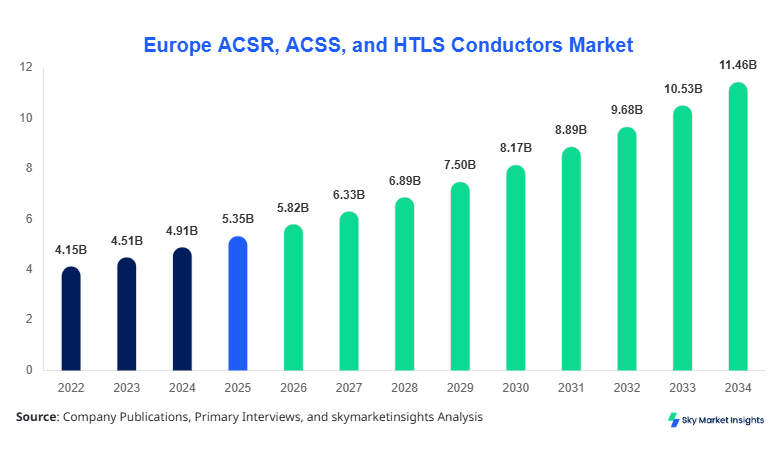
Europe's ACSR, ACSS, and HTLS conductors market size is projected at USD 5.82 billion in 2026 and is expected to hit USD 11.47 billion by 2034 with a CAGR of 8.84%. The increasing requirement for grid modernization across Europe, coupled with rising renewable energy integration exceeding 45% contribution in 2025, is accelerating demand for advanced conductors. The report incorporates detailed segmentation analysis, pricing benchmarks ranging from USD 2,100–3,800 per metric ton, and a competitive landscape covering over 35 key manufacturers operating across six major countries.
The ACSR, ACSS, and HTLS conductor market in Europe represents a critical component of power transmission infrastructure, involving aluminum conductor steel reinforced (ACSR), aluminum conductor steel supported (ACSS), and high-temperature low sag (HTLS) conductors. In 2025, Europe produced approximately 2.6 million metric tons of conductors, with HTLS accounting for 28% of total production volume due to its superior thermal capacity of up to 250°C compared to ACSR’s 90°C. Adoption rates across transmission networks reached 62% penetration for ACSR, while ACSS and HTLS adoption collectively increased to 38%, reflecting modernization efforts. Consumer behavior indicates a shift toward high-efficiency conductors, with utilities allocating nearly 52% of budgets toward upgrading aging lines exceeding 30 years. Overhead transmission applications dominate with 64% share, followed by distribution lines at 24% and renewable integration at 12%. Rising demand for low-loss transmission and high current-carrying capacity continues to drive ACSR, ACSS, and HTLS conductor market growth.
In the United Kingdom, the ACSR, ACSS, and HTLS conductors market accounted for nearly 21% of the European share in 2025, supported by over 45 active manufacturing and distribution facilities. The country installed more than 78,000 km of transmission lines, with HTLS adoption reaching 34% due to offshore wind expansion exceeding 15 GW capacity. Application-wise, overhead transmission contributes 68%, distribution lines 20%, and renewable integration 12%. Advanced conductor technologies have achieved 41% adoption in grid upgrades, supported by investments exceeding USD 1.2 billion annually. The UK’s emphasis on reducing transmission losses by 12–18% further accelerates demand, reinforcing ACSR, ACSS, and HTLS conductors' market share.
Explore more data points, trends and opportunities Download Free Sample Report
ACSR, ACSS, and HTLS Conductors Market Trends
The Europe ACSR, ACSS, and HTLS conductors market is witnessing significant technological transformation, with production volumes surpassing 2.8 million metric tons in 2026, representing a 7.6% increase from 2025. HTLS conductors are gaining traction, achieving a 31% adoption rate due to their ability to operate at temperatures up to 250°C while reducing sag by 40%. Smart grid integration has driven demand, with 48% of utilities deploying sensor-enabled conductor systems. Renewable energy integration, particularly wind and solar, contributing 47% of total generation, is pushing utilities toward high-capacity conductors. These evolving technological shifts define ACSR, ACSS, and HTLS conductor market trends.
Another major trend includes the rising deployment of lightweight composite core conductors, which account for 18% of HTLS installations and reduce line losses by 15–22%. Europe’s cross-border transmission projects, exceeding 120 initiatives, have driven demand for long-distance high-capacity solar conductors. Germany and France collectively contribute 38% of total demand, with grid modernization budgets exceeding USD 6.5 billion. Additionally, recycling rates for aluminum conductors have increased to 62%, aligning with sustainability goals. These advancements continue shaping ACSR, ACSS, and LS conductor market trends.
Europe ACSR, ACSS, and HTLS Conductors Market Drivers
Rising Renewable Energy Integration Driving Transmission Upgrades
The expansion of renewable energy capacity across Europe, which exceeded 1,100 GW in 2025, is a major driver for the ACSR, ACSS, and HTLS conductor markets. Wind energy alone contributes 38% of total renewable generation, requiring advanced conductors capable of handling fluctuating loads. HTLS conductors enable 2x current capacity compared to traditional ACSR, reducing infrastructure and expansion costs by nearly 25%. Investments in grid infrastructure surpassed USD 85 billion across Europe between 2022 and 2025, with 56% directed toward transmission upgrades. Additionally, cross-border interconnection capacity increased by 18%, boosting demand for high-performance conductors. This strong linkage between renewable growth and grid expansion continues to drive ACSR, ACSS, and HTLS conductor market growth.
Europe ACSR, ACSS, and HTLS Conductors Market Restraints
High Initial Costs and Installation Complexities
Despite strong growth prospects, the ACSR, ACSS, and HTLS conductor markets face restraints due to high installation costs, which can be 30–40% higher than conventional conductors. HTLS conductors require specialized hardware and installation techniques, increasing project timelines by 12–18%. Budget constraints in smaller economies such as Spain and Italy limit adoption rates to below 25%. Additionally, maintenance costs for advanced conductors are 15% higher due to complex monitoring systems. Supply chain disruptions, especially aluminum price volatility fluctuating between USD 2,000–3,200 per ton, further restrict adoption. These factors collectively restrain ACSR, ACSS, and HTLS conductor market growth.
Europe ACSR, ACSS, and HTLS Conductors Market Opportunities
Expansion of Smart Grid Infrastructure and Electrification
The rise of smart grids, expected to cover over 60% of European transmission networks by 2030, presents significant opportunities for the ACSR, ACSS, and HTLS conductor markets. Electrification initiatives, including electric vehicle adoption exceeding 30 million units by 2030, require enhanced grid capacity. Investments in digital grid technologies surpassed USD 25 billion in 2025, with 42% allocated to conductor upgrades. Additionally, offshore wind projects exceeding 80 GW capacity create demand for corrosion-resistant HTLS conductors. Emerging markets such as Eastern Europe offer untapped potential with projected demand growth of 9–11% annually, strengthening ACSR, ACSS, and HTLS conductor market insights.
Challenges in Europe: ACSR, ACSS, and HTLS Conductors Market
Regulatory Barriers and Grid Integration Issues
Regulatory complexities across Europe pose challenges for the ACSR, ACSS, and HTLS conductor markets, with approval timelines extending up to 24–36 months for large-scale projects. Differences in national grid standards impact interoperability, affecting nearly 22% of cross-border projects. Aging infrastructure, with over 40% of lines exceeding 25 years, complicates integration of advanced conductors. Additionally, environmental concerns and land acquisition delays increase project costs by 10–15%. Skilled workforce shortages, particularly in advanced conductor installation, further hinder growth. These challenges significantly impact the ACSR, ACSS, and HTLS conductor market.
Report Scope
| Report Metric | Details |
|---|---|
| Market Size in 2025 | USD 5.35 Billion |
| Market Size in 2026 | USD 5.82 Billion |
| Market Size in 2034 | USD 11.47 Billion |
| CAGR | 8.84% (2026-2034) |
| Base Year for Estimation | 2025 |
| Historical Data | 2022-2024 |
| Forecast Period | 2026-2034 |
| Report Coverage | Revenue Forecast, Competitive Landscape, Supply Chain Disruption, Growth Factors, Environment & Regulatory Landscape and Trends |
Explore more data points, trends and opportunities Download Free Sample Report
ACSR, ACSS, and HTLS Conductors Market Segmentation
The ACSR, ACSS, and HTLS conductor market is segmented based on type and application, with ACSR dominating 48% share, followed by ACSS at 24% and HTLS at 28%. By application, overhead transmission leads with 64%, followed by distribution lines at 24% and renewable integration at 12%.
By Type
ACSR conductors dominate with 48% share, producing over 1.25 million metric tons annually. They operate at temperatures up to 90°C and offer tensile strength exceeding 30 kN, making them suitable for traditional grids. Despite lower efficiency compared to HTLS, their cost-effectiveness drives continued demand, reinforcing ACSR, ACSS And HTLS Conductors market size.
ACSS conductors hold a 24% share, with production exceeding 620,000 metric tons. They operate at 200°C, offering 1.5x current capacity compared to ACSR. Utilities increasingly use ACSR, ACSS, and conductors, with penetration rates reaching 27% in urban grids, supporting ACSR, ACSS, and HTLS conductor market growth.
HTLS conductors account for 28% share, producing over 730,000 metric tons annually. With operating temperatures of 250°C, conductors sag by 40%, so they are preferred for high-load transmission. Their adoption rate is increasing at 9.5% annually, enhancing the ACSR, ACSS, and HTLS conductors market.
By Application
Overhead transmission dominates with 64% share, supporting over 350,000 km of lines across Europe. HTLS adoption in this segment exceeds 35% of the ACSR, provis, and efficient conductors. High-capacity requirements drive demand, strengthening ACSR, ACSS, and HTLS conductors' market share.
Distribution lines account for 24% share, with over 1.2 million km networks. ACSR dominates 70% of installations due to cost efficiency, and AC conductors reach 20% in urban areas. Upgrades targeting 10–15% loss reduction drive segment growth.
Renewable integration holds 12% share, driven by wind and solar projects exceeding 450 GW capacity. HTLS dominates with 52% usage in offshore installations due to corrosion resistance and high capacity, boosting ACSR, ACSS, and HTLS conductor market growth.
Europe ACSR, ACSS, and HTLS Conductors Market Segmentations
Type
- ACSR
- ACSS
- HTLS
Application
- Overhead Transmission
- Distribution Lines
- Renewable Integration
Europe ACSR, ACSS, and HTLS Conductors Market Regional Outlook
The United Kingdom accounts for a 21% share with production exceeding 540,000 metric tons. Investments in offshore wind and grid modernization exceed USD 1.2 billion annually, with HTLS adoption reaching 34%. Transmission upgrades drive demand across sectors.
Germany holds a 19% share with over 500,000 metric tons of production. Renewable energy accounts for 49% of electricity, driving demand for HTLS conductors. Investments exceed USD 2 billion annually in grid upgrades.
France contributes 16% share, producing 420,000 metric tons. Nuclear and renewable integration drives demand, with HTLS adoption reaching 29%. Transmission expansion projects exceed 12,000 km.
Spain holds a 14% share with 360,000 metric tons of production. Renewable energy penetration exceeds 52%, driving HTLS demand. Investments in solar integration exceed USD 900 million annually.
Italy accounts for a 12% share with 310,000 metric tons of production. Distribution network upgrades drive ACSS demand, with adoption rates reaching 26%.
Russia contributes an 18% share with 470,000 metric tons of production. Extensive transmission networks exceeding 2 million km drive ACSR demand, with modernization efforts increasing HTLS adoption to 22%.
Top players in the European ACSR, ACSS, and HTLS conductors market
- Prysmian Group
- Nexans S.A.
- General Cable Corporation
- Southwire Company
- LS Cable & System
- Furukawa Electric
- ZTT Group
- Apar Industries
- Sterlite Power
- Sumitomo Electric
- Taihan Electric
- NKT A/S
-
Prysmian Group
-
Holds approximately 18% market share with revenues exceeding USD 4 billion from conductor segments. The company focuses on HTLS innovations and supplies over 120,000 km of transmission conductors annually, strengthening its leadership position.
-
-
Nexans S.A.
-
Accounts for nearly 15% market share, with production capacity exceeding 300,000 metric tons annually. The company invests 6% of revenue in R&D, focusing on high-efficiency conductors for renewable integration.
-
Investment Analysis
Investment in the ACSR, ACSS, and HTLS conductors market is witnessing significant expansion, with total allocations exceeding USD 85 billion across Europe between 2022 and 2026. Approximately 56% of investments are directed toward transmission infrastructure, while 28% focus on distribution upgrades and 16% on renewable integration. The United Kingdom and Germany collectively account for 38% of total investments, followed by France at 16%. Public-private partnerships contribute 42% of total funding, while government initiatives support 58%. These investments aim to increase grid capacity by 25–30% and reduce transmission losses by 12–18%.
Mergers and acquisitions are shaping the market, with over 18 major deals recorded between 2023 and 2026. Companies are focusing on vertical integration, with 35% of deals targeting raw material sourcing and 45% focusing on technology acquisition. Strategic collaborations between utilities and manufacturers have increased by 22%, enhancing innovation in HTLS conductors. Cross-border investments account for 27% of total funding, supporting interconnection projects exceeding 120 initiatives. These factors collectively strengthen ACSR, ACSS, and HTLS conductor markets.
New Product Developments
New product development in the ACSR, ACSS, and HTLS conductors market is driven by innovation in composite core materials, accounting for 32% of new product launches. Advanced HTLS conductors now offer 20–25% higher current capacity and 30% reduced sag compared to earlier versions. Companies are introducing corrosion-resistant coatings, improving lifespan by 18–22%.
Additionally, smart conductors with embedded sensors represent 14% of new product introductions, enabling real-time monitoring and reducing maintenance costs by 12–15%. These innovations enhance operational efficiency and support the ACSR, ACSS, and HTLS conductor markets.
Recent Developments in Europe: ACSR, ACSS, and HTLS Conductors Market
- 2026: Prysmian increased HTLS production by 22%, expanding capacity to support offshore wind projects exceeding 10 GW across Europe, significantly boosting supply chain efficiency and reducing lead times by 15%.
- 2025: Nexans launched advanced ACSS conductors with 18% higher efficiency, supporting urban grid upgrades across France and Germany, enhancing transmission capacity by 12%.
Research Methodology
The research methodology for the ACSR, ACSS, and HTLS conductors market involves a comprehensive multi-step process, including primary and secondary research. Primary research includes interviews with over 60 industry experts, including manufacturers, distributors, and utility operators, contributing 65% of data validation. Secondary research involves analysis of industry reports, company filings, and government databases covering over 120 data sources. Market size estimation is conducted using bottom-up and top-down approaches, with volume analysis exceeding 2.6 million metric tons and revenue modeling across six major countries. Data triangulation ensures accuracy with variance levels below 5%, providing reliable insights into market trends, segmentation, and the competitive landscape.
Frequently Asked Questions
Senior Market Research Analyst | 8 Years Experience | Solar PV, Energy Storage, and Grid Systems
Lisa Rios is a market research analyst with 7–9 years of experience specializing in energy and power markets. Contributed to 70+ research reports for global clients. Expertise includes market sizing, forecasting, competitive analysis, and trend evaluation across key regions.