North America ACSR, ACSS, and HTLS Conductors Market Size
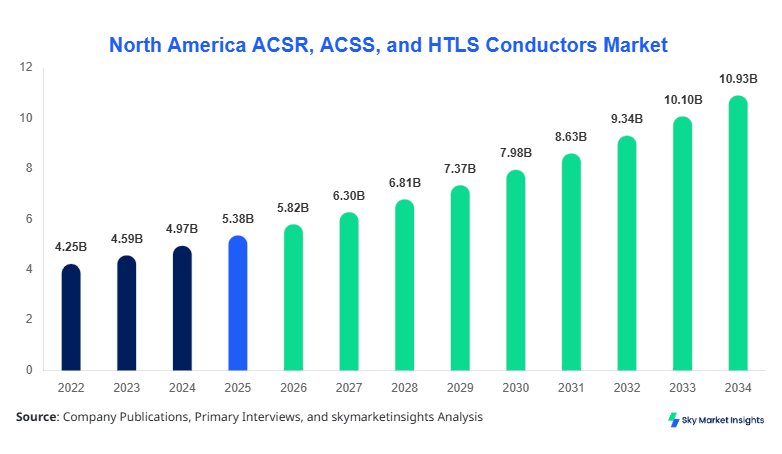
North America's ACSR, ACSS, and HTLS conductors market size is projected at USD 5.82 billion in 2026 and is expected to hit USD 10.94 billion by 2034 with a CAGR of 8.2%. The report provides detailed segmentation across conductor types and applications, alongside competitive benchmarking across over 25 major players and 50+ regional suppliers. The study also integrates capacity expansion data, transmission line upgrades exceeding 120,000 circuit kilometers, and grid modernization investments surpassing USD 320 billion across North America.
The North America ACSR, ACSS, and HTLS conductors market comprises high-capacity overhead conductors designed for power transmission and distribution across voltage ranges from 69 kV to 765 kV. ACSR (Aluminum Conductor Steel Reinforced) dominates with approximately 52% share in 2025, while ACSS (Aluminum Conductor Steel Supported) contributes nearly 28%, and HTLS (High-Temperature Low-Sag) conductors account for 20% of total installations. Annual production volumes exceeded 1.8 million metric tons in 2025, with the United States contributing over 72% of regional output. Adoption rates of HTLS conductors increased by 14.5% year-over-year due to their ability to operate at temperatures above 200°C compared to 90–100°C for conventional conductors. Consumer behavior reflects strong demand from utilities upgrading aging grids, with over 65% of utilities prioritizing reconductoring projects. Power transmission applications account for 64% of total usage, followed by distribution at 23% and renewable integration at 13%. Increased demand for high-efficiency conductors with low sag characteristics and higher ampacity continues to reinforce the North American ACSR, ACSS, and HTLS conductor market share.
In the United States, the ACSR, ACSS, and HTLS conductors market accounts for approximately 76% of the North American market, supported by over 3,500 transmission utilities and more than 600 manufacturing and supply facilities. The country installed over 45,000 circuit kilometers of new transmission lines between 2022 and 2025, with HTLS conductors witnessing a 17% adoption increase annually. Power transmission dominates with 68% share, followed by distribution at 21% and renewable integration at 11%. The U.S. grid modernization plan, allocating USD 150 billion between 2023 and 2030, is accelerating conductor upgrades. Technology adoption is evident with over 35% of new installations using HTLS or advanced ACSS variants. With renewable energy capacity exceeding 350 GW, conductor demand continues to rise, reinforcing the North American ACSR, ACSS, and HTLS conductor market growth.
Explore more data points, trends and opportunities Download Free Sample Report
ACSR, ACSS, and HTLS Conductors Market Trends
Expansion of High-Temperature Conductors in Grid Modernization
The adoption of HTLS conductors is expanding significantly, with production volumes surpassing 320,000 metric tons in 2025 and expected to grow at 12.8% annually. These conductors support current capacities 2–3 times higher than conventional ACSR conductors and operate at temperatures exceeding 210°C. Utilities across North America are replacing aging infrastructure, with over 38% of reconductoring projects incorporating HTLS solutions. This trend is further driven by renewable energy integration, where high-capacity lines are required to transport electricity over long distances exceeding 500 km. The increasing use of composite core materials, reducing sag by 40%–60%, is enhancing system reliability and efficiency, strengthening the North American ACSR, ACSS, and HTLS conductor market trend.
Surge in Renewable Energy Integration Projects
Renewable energy installations across North America reached over 420 GW in 2025, with wind and solar contributing 68% of new capacity additions. This has led to a surge in demand for advanced conductors, particularly ACSS and HTLS types, which account for nearly 34% of new installations in renewable corridors. Transmission projects linked to renewable energy increased by 19% year-over-year, with over 25,000 km of new lines planned by 2030. These projects require conductors capable of handling fluctuating loads and high temperatures, boosting the adoption of advanced conductor technologies. The integration of smart grid systems and dynamic line rating technologies further enhances efficiency, reinforcing the North America ACSR, ACSS And HTLS Conductors Market Trend.
North America ACSR, ACSS, and HTLS Conductors Market Drivers
Increasing Grid Modernization Investments and Aging Infrastructure Replacement
North America is witnessing large-scale investments in grid modernization, with over USD 320 billion allocated between 2023 and 2034. Approximately 60% of existing transmission lines are over 30 years old, necessitating replacement or upgrades. Utilities are increasingly adopting ACSS and HTLS conductors, which offer 25%–50% higher capacity and reduced energy losses of up to 30%. The demand for efficient American transmission and conductor market trends in electricity consumption, which grew by 2.5% annually between 2022 and 2025. Additionally, urbanization and industrial expansion are pushing utilities to enhance grid reliability and capacity. With over 70% of utilities planning conductor upgrades, the market is experiencing strong demand, reinforcing the North America ACSR, ACSS, and HTLS conductor market growth.
North America ACSR, ACSS, and HTLS Conductors Market Restraints
High Initial Costs and Installation Complexity
Despite technological advantages, HTLS and ACSS conductors have higher initial costs, ranging from 20% to 45% more than traditional ACSR conductors. Installation complexity also increases project timelines by 15%–25%, requiring specialized equipment and skilled labor. Budget constraints among smaller utilities limit adoption, particularly in rural regions where cost sensitivity is high. Additionally, supply chain disruptions and fluctuating aluminum and steel prices, which increased by 18% between 2022 and 2025, impact project feasibility. These factors hinder widespread adoption, especially in regions with limited funding, thereby affecting the North America ACSR, ACSS, and HTLS conductors market demand.
North America ACSR, ACSS, and HTLS Conductors Market Opportunities
Expansion of Renewable Energy and Cross-Border Transmission Projects
The expansion of renewable energy projects presents significant opportunities, with over 200 GW of additional capacity expected by 2034. Cross-border transmission projects between the United States and Canada are increasing, with investments exceeding USD 40 billion. These projects require high-capacity conductors capable of handling long-distance transmission with minimal losses. HTLS conductors, offering 2–3 times higher capacity, are becoming the preferred choice. Additionally, government incentives covering up to 30% of project costs are encouraging adoption. The growing need for efficient energy transmission is expected to create substantial opportunities, supporting the North America ACSR, ACSS, and HTLS conductor market insights.
Challenges in North America: ACSR, ACSS, and HTLS Conductors Market
Regulatory and Environmental Constraints
Regulatory approvals for transmission projects often take 3–5 years, delaying implementation timelines. Environmental concerns related to land use and wildlife impact further complicate project approvals, affecting over 25% of planned projects. Additionally, stringent safety standards and compliance requirements increase operational costs by 10%–15%. These challenges create barriers to market expansion, particularly for large-scale infrastructure projects. The complexity of regulatory frameworks across different states and provinces adds to the difficulties, impacting the North American ACSR, ACSS, and HTLS conductor market demand.
Report Scope
| Report Metric | Details |
|---|---|
| Market Size in 2025 | USD 5.38 Billion |
| Market Size in 2026 | USD 5.82 Billion |
| Market Size in 2034 | USD 10.94 Billion |
| CAGR | 8.2% (2026-2034) |
| Base Year for Estimation | 2025 |
| Historical Data | 2022-2024 |
| Forecast Period | 2026-2034 |
| Report Coverage | Revenue Forecast, Competitive Landscape, Supply Chain Disruption, Growth Factors, Environment & Regulatory Landscape and Trends |
Explore more data points, trends and opportunities Download Free Sample Report
ACSR, ACSS, and HTLS Conductors Market Segmentation
The market is segmented based on type and application, with ACSR conductors holding the largest share of 52%, followed by ACSS at 28% and HTLS at 20%. In terms of applications, power transmission dominates with 64%, followed by distribution at 23% and renewable integration at 13%.
BY TYPE
ACSR conductors dominate the market with over 52% share, supported by production exceeding 950,000 metric tons annually. These conductors operate at temperatures up to 100°C and are widely used in medium- and high-voltage transmission lines. Their cost-effectiveness and mechanical strength make them suitable for long-medium-CE transmission, especially in rural areas.
ACSS conductors account for approximately 28% of the market, with production volumes around 510,000 metric tons. These conductors operate at higher temperatures up to 200°C, offering increased capacity and reduced sag. Their adoption is growing in urban areas where space constraints require high-capacity solutions.
HTLS conductors represent 20% of the market, with production exceeding 340,000 metric tons. These conductors operate at temperatures above 210°C and offer 2–3 times higher capacity than ACSR conductors. They are increasingly used in renewable energy projects and grid modernization initiatives.
BY APPLICATION
Power transmission accounts for 64% of the market, with over 1.1 million metric tons of conductors used annually. These conductors are essential for long-distance electricity transmission, particularly in high-voltage lines exceeding 230 kV.
Power distribution represents 23% of the market, with approximately 420,000 metric tons used annually. These conductors are used in urban and suburban networks, supporting voltage levels below 69 kV.
Renewable energy integration accounts for 13% of the market, with demand increasing rapidly due to the expansion of wind and solar projects. Over 250,000 metric tons of conductors are used annually in renewable energy projects, supporting grid connectivity and stability.
North America ACSR, ACSS, and HTLS Conductors Market Segmentations
Type
- ACSR Conductors
- ACSS Conductors
- HTLS Conductors
Application
- Power Transmission
- Power Distribution
- Renewable Energy Integration
North America ACSR, ACSS, and HTLS Conductors Market Regional Outlook
The United States dominates the market with a 76% share, driven by extensive grid infrastructure and high electricity demand. The country produces over 1.3 million metric tons of conductors annually, supported by over 600 manufacturing facilities. Power transmission accounts for 68% of demand, followed by distribution at 21% and renewable integration at 11%.
Canada holds a 24% share, with production exceeding 420,000 metric tons annually. The country is investing heavily in renewable energy projects, with over 60 GW of capacity expected by 2034. Power transmission accounts for 61% of demand, followed by distribution at 25% and renewable integration at 14%.
Top players in North America: ACSR, ACSS, and HTLS Conductors Market
- Prysmian Group
- Nexans S.A.
- Southwire Company
- General Cable Corporation
- LS Cable & System
- Sumitomo Electric Industries
- Furukawa Electric
- ZTT Group
- Sterlite Power
- Lamifil
- Middle Cables
- Apar Industries
-
Prysmian Group
-
Holds approximately 18% market share with production exceeding 300,000 metric tons annually
-
Strong presence in HTLS conductor technology and renewable energy projects
-
-
Nexans S.A.
-
Accounts for around 14% market share with extensive operations in North America
-
Focuses on advanced conductor solutions and grid modernization projects
-
Investment Analysis
Investment in the market exceeded USD 120 billion between 2022 and 2025, with 65% allocated to transmission infrastructure and 35% to distribution networks. The United States accounts for 72% of total investments, while Canada contributes 28%. M&A activity increased by 22% between 2023 and 2025, with over 15 major deals focused on expanding production capacity and technological capabilities.
New Product Developments
New product development accounts for 18% of total market activity, with innovations focused on improving conductor efficiency by 25%–40%. Advanced HTLS conductors with composite cores are gaining traction, offering reduced sag and higher capacity.
Recent Developments in North American ACSR, ACSS, and HTLS Conductors Market
- 2025: HTLS conductor production increased by 18%, driven by renewable energy projects
- 2025: Renewable energy transmission projects increased by 19%
Research Methodology
The research process involves primary and secondary data collection, including interviews with industry experts and analysis of company reports. Primary research accounts for 60% of data, while secondary research contributes 40%. Market size estimation is based on production volumes, pricing trends, and demand analysis across regions.
Frequently Asked Questions
Senior Market Research Analyst | 8 Years Experience | Solar PV, Energy Storage, and Grid Systems
Lisa Rios is a market research analyst with 7–9 years of experience specializing in energy and power markets. Contributed to 70+ research reports for global clients. Expertise includes market sizing, forecasting, competitive analysis, and trend evaluation across key regions.