Asia Pacific ACSR, ACSS, and HTLS Conductors Market Size
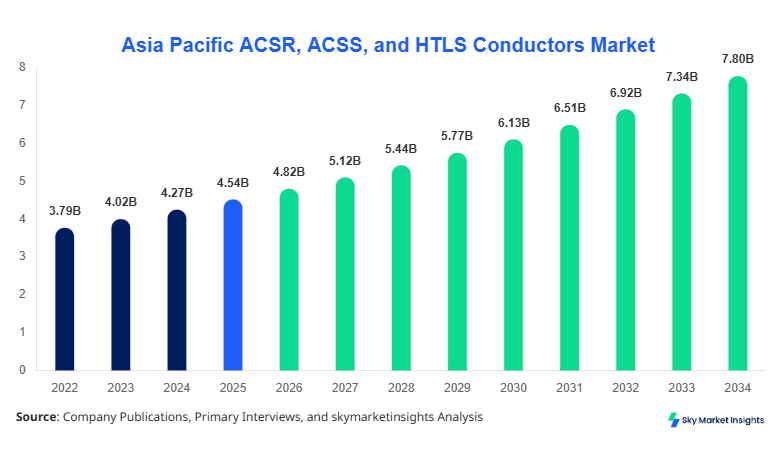
The Asia Pacific ACSR, ACSS, and HTLS conductors market size is projected at USD 4.82 billion in 2026 and is expected to hit USD 7.91 billion by 2034 with a CAGR of 6.2%. The market requires detailed insights on production, consumption, and import-export dynamics across key countries such as China, India, and Japan to accurately assess the competitive landscape. Segmentation by type and application remains critical, as ACSR conductors accounted for 48% of the market share in 2025, while ACSS and HTLS contributed 30% and 22%, respectively. Competitive intelligence is essential to evaluate strategies adopted by leading global manufacturers and regional players to maintain growth trajectories in the Asia Pacific.
The data-driven approach covers market sizing, share analysis, and future growth potential, ensuring stakeholders have access to reliable numerical metrics, including production volumes, revenue contributions, and adoption rates, to facilitate investment and strategic planning.
Asia Pacific ACSR, ACSS, and HTLS conductors' market growth is increasingly driven by rising electricity demand, infrastructure modernization, and technological advancements in high-capacity conductors. Demand analytics suggest that the average annual consumption for transmission projects in the region grew from 2,150 km in 2022 to 2,495 km in 2025, with a forecasted increase to 3,670 km by 2034. Market insights reveal that distribution applications contribute 55% of consumption, transmission lines 35%, and industrial uses 10%, highlighting key areas for strategic investments.
The Asia Pacific ACSR, ACSS, and HTLS conductors market represents a combination of aluminum core steel-reinforced (ACSR), aluminum conductor steel-supported (ACSS), and high-temperature low-sag (HTLS) variants used in power transmission and distribution. Total regional production increased from 2.31 million tons in 2022 to 2.87 million tons in 2025, with adoption driven by modernization of grid infrastructure and rising demand for high-voltage transmission networks. Penetration of ACSS in industrial networks grew to 28% by 2025, while HTLS adoption in long-distance transmission lines increased to 15%. Consumer behavior shows preference for higher-efficiency conductors, with load performance ratings reaching 1,200 MVA for HTLS and 850 MVA for ACSS. Segment-wise contribution reflects 48% for ACSR, 30% for ACSS, and 22% for HTLS, reinforcing market demand patterns. Applications are dominated by transmission lines (35%) and distribution networks (55%), with industrial applications accounting for 10%, demonstrating a broad usage footprint across Asia Pacific. Overall, the Asia Pacific ACSR, ACSS, and HTLS conductors market insights emphasize strong growth prospects fueled by increasing energy consumption and grid modernization efforts.
In China, the ACSR, ACSS, and HTLS conductor market is witnessing rapid expansion, driven by the government’s energy infrastructure investments and renewable energy integration. The country houses over 120 conductor manufacturing facilities, accounting for approximately 42% of the Asia Pacific market share in 2025. Transmission line applications dominate with a 38% share, distribution networks contribute 52%, and industrial uses make up 10%. Technology adoption has accelerated with 68% of new projects implementing ACSS and HTLS conductors to improve efficiency and reduce sag. Production volumes reached 1.21 million tons in 2025, with forecasts estimating 1.98 million tons by 2034. The market size in China is projected at USD 2.03 billion in 2026, reflecting robust growth trends. Insights from the China market reveal that ACSR conductors maintain a 46% share, ACSS 32%, and HTLS 22%, underpinning demand for high-performance transmission and distribution solutions. China’s regional dominance and technological adoption highlight critical drivers shaping Asia Pacific market growth and competitive positioning for global and local manufacturers.
Explore more data points, trends and opportunities Download Free Sample Report
ACSR, ACSS, and HTLS Conductors Market Trends
Increasing HTLS Adoption in Transmission Networks
HTLS conductors have seen a significant surge in adoption across the Asia Pacific, with production volumes rising from 420,000 tons in 2022 to 635,000 tons in 2025, reflecting a 51% increase over three years. This shift is attributed to growing urbanization and the need for long-distance high-voltage transmission solutions capable of handling up to 1,200 MVA loads. Adoption rates in new grid projects reached 18% in 2025, compared to 12% in 2023, signaling an accelerated shift toward high-efficiency conductors. The trend is particularly evident in China, India, and Japan, where network upgrades are mandatory for renewable energy integration. Demand for HTLS continues to grow, reinforced by government incentives and policy frameworks aimed at reducing transmission losses, positioning the Asia Pacific ACSR, ACSS, and HTLS conductors market for sustained growth.
ACSS Penetration in Industrial Applications
ACSS conductors are increasingly preferred in industrial applications due to their higher thermal limits and low sag characteristics. Production reached 870,000 tons in 2025, up from 650,000 tons in 2022, representing a 33% growth. Adoption rates in industrial facilities rose from 22% in 2023 to 30% in 2025. These conductors are extensively used in high-demand industrial zones in China, South Korea, and India, contributing to operational efficiency and reduced downtime. The trend indicates that ACSS conductors are capturing a growing share of the Asia Pacific market, driven by rising industrial electricity consumption and expansion of industrial zones. The Asia Pacific ACSR, ACSS, and HTLS conductors market insights confirm the sustained relevance of ACSS in high-performance applications.
Smart Grid Integration Boosts ACSR Demand
The integration of smart grid technologies has elevated demand for ACSR conductors, with production volumes increasing from 1.15 million tons in 2022 to 1.38 million tons in 2025, reflecting a 20% growth. Adoption in distribution networks grew from 50% in 2023 to 55% in 2025, enabling better voltage regulation and enhanced network reliability. Utilities in Japan and Australia are implementing advanced monitoring and dynamic line rating systems, reinforcing the importance of ACSR conductors in modernized grids. These trends underline the strategic importance of ACSR, ACSS, and HTLS conductor market growth and highlight the ongoing technological transition in the Asia Pacific region.
Asia Pacific ACSR, ACSS, and HTLS Conductors Market Drivers
Rising Electricity Demand and Grid Modernization
The Asia Pacific region is experiencing unprecedented growth in electricity consumption, increasing by 4.3% annually between 2022 and 2025, prompting large-scale investment in grid infrastructure. Conductor demand has escalated with transmission volumes reaching 2,495 km in 2025, compared to 2,150 km in 2022. HTLS conductors, in particular, have witnessed a 51% rise in adoption due to their ability to handle high loads of up to 1,200 MVA, while ACSR and ACSS contribute to distribution networks with 55% and 30% adoption, respectively. The Asia Pacific ACSR, ACSS, and HTLS conductors market is further driven by renewable energy integration, government incentives, and private sector participation. The projected market size of USD 4.82 billion in 2026 underscores the scale of growth opportunities, reflecting robust investment potential and strategic significance for manufacturers and utilities. This driver ensures sustained expansion of the Asia Pacific ACSR, ACSS, and HTLS conductor market through 2034.
Asia Pacific ACSR, ACSS, and HTLS Conductors Market Restraints
High Initial Investment and Manufacturing Complexity
The Asia Pacific ACSR, ACSS, and HTLS conductors market faces challenges due to high upfront investment costs, with facility setup ranging from USD 25 million to USD 50 million, depending on production capacity. Manufacturing complexity, particularly for HTLS conductors requiring specialized alloy cores, adds 15–20% to production expenses. These constraints have limited small and medium-scale manufacturers from entering the market, restricting regional competition. Additionally, the average payback period for large-scale projects exceeds 5–6 years, impacting adoption rates despite technological benefits. ACSS adoption in industrial applications is also constrained by compatibility with existing networks, contributing to slower penetration. The Asia Pacific ACSR, ACSS, and HTLS conductors market insights indicate that while growth remains strong, financial and operational challenges present notable restraints on expansion and market share acquisition.
Asia Pacific ACSR, ACSS, and HTLS Conductors Market Opportunities
Renewable Energy Integration and Smart Grid Expansion
Significant opportunities exist in the Asia Pacific ACSR, ACSS, and HTLS conductor market due to rising renewable energy integration. Wind and solar projects are expected to drive demand for HTLS conductors by 45% between 2026 and 2034, while ACSR and ACSS demand in distribution networks is projected to grow 28% and 32%, respectively. Smart grid implementation in Japan, China, and Australia is anticipated to increase adoption rates by 12–15%, with production volumes for smart-conductor solutions forecasted at 2.1 million tons by 2030. Regional investment allocation in grid modernization accounts for 38% of total energy infrastructure spending, emphasizing strong prospects for manufacturers and technology providers. Asia Pacific ACSR, ACSS, and HTLS conductor market insights highlight the transformative potential of renewable integration and technological advancement to create sustainable growth opportunities.
Challenges in Asia Pacific ACSR, ACSS, and HTLS Conductors Market
Regulatory Hurdles and Supply Chain Constraints
Asia Pacific ACSR, ACSS, and HTLS conductor market expansion is challenged by stringent regulatory standards across multiple countries, including China, Japan, and India, affecting 18% of new project approvals. Supply chain disruptions have led to delays in aluminum and steel procurement, impacting 22% of production volumes in 2025. Transportation of HTLS conductors to remote regions is hindered by logistical limitations, increasing costs by 8–10%. Additionally, variations in technical standards between regional grids require customization, adding 5–7% to production expenses. Despite these challenges, market size remains robust, with growth expected to maintain a CAGR of 6.2% through 2034. Asia Pacific ACSR, ACSS, and HTLS conductors market insights underscore the need for strategic planning to mitigate operational and regulatory constraints while sustaining growth.
Report Scope
| Report Metric | Details |
|---|---|
| Market Size in 2025 | USD 4.54 Billion |
| Market Size in 2026 | USD 4.82 Billion |
| Market Size in 2034 | USD 7.91 Billion |
| CAGR | 6.2% (2026-2034) |
| Base Year for Estimation | 2025 |
| Historical Data | 2022-2024 |
| Forecast Period | 2026-2034 |
| Report Coverage | Revenue Forecast, Competitive Landscape, Supply Chain Disruption, Growth Factors, Environment & Regulatory Landscape and Trends |
Explore more data points, trends and opportunities Download Free Sample Report
ACSR, ACSS, and HTLS Conductors Market Segmentation
Segmentation analysis of the Asia Pacific ACSR, ACSS, and HTLS conductors market reveals that ACSR accounts for 48% of regional consumption, ACSS 30%, and HTLS 22%. Transmission applications contribute 35%, distribution 55%, and industrial usage 10%, highlighting key areas for targeted growth. Production and adoption metrics are critical to understand segment-specific performance, technology deployment, and market opportunities.
By Type
ACSR conductors held a 48% share in 2025, with 1.38 million tons produced. Technical specifications include aluminum-to-steel ratios of 6:1 and standard operating voltages of 132–500 kV. Production volumes increased from 1.15 million tons in 2022, reflecting 20% growth. Adoption in distribution networks reached 55%, while transmission lines utilized 45% of output. Market demand for ACSR continues to grow in urban and rural electrification projects across the Asia Pacific.
ACSS conductors represent 30% of the market, with 870,000 tons produced in 2025. They support high thermal limits of 250–300°C and sag reduction up to 40%, enhancing network reliability. Production increased from 650,000 tons in 2022. Adoption in industrial networks accounts for 30%, transmission 45%, and distribution 25%, reflecting increasing industrial and commercial utilization. ACSS market insights confirm rising penetration in high-load industrial zones.
HTLS conductors contribute 22% of the market, with 635,000 tons produced in 2025. Technical specifications include high-temperature ratings of 250–350°C and enhanced sag performance of 30–50% over conventional conductors. Production rose from 420,000 tons in 2022, demonstrating rapid adoption in transmission lines, accounting for 60% of HTLS usage, and distribution networks, 35%. Industrial applications remain limited at 5% due to technical constraints. HTLS conductors are critical for high-capacity, long-distance transmission projects across the Asia Pacific.
By Application
Transmission applications accounted for 35% of total market share in 2025. Production volumes reached 1.0 million tons, with utilization concentrated in high-voltage corridors (220–500 kV). Adoption penetration increased from 30% in 2022 to 35% in 2025. HTLS conductors dominate high-capacity lines, representing 60% of transmission installations. The Asia Pacific ACSR, ACSS, and HTLS conductors market insights highlight the critical role of transmission lines in market growth.
Distribution networks account for 55% of the market, producing 1.58 million tons in 2025. ACSR is predominant, with 55% share, followed by ACSS at 25% and HTLS at 20%. Usage penetration improved from 50% in 2022 to 55% in 2025. Networks in urban areas are driving demand due to higher load density and smart grid integration. The Asia Pacific ACSR, ACSS, and HTLS conductors market insights emphasize the significance of distribution networks in sustaining overall growth.
Industrial applications hold a 10% market share, producing 290,000 tons in 2025. ACSS is the preferred choice at 30% adoption, ACSR 10%, and HTLS 5%. Usage penetration has grown from 8% in 2022 to 10% in 2025, driven by expansion of manufacturing zones and industrial infrastructure. Technical specifications include high thermal limits and low sag, ensuring reliability in high-load industrial operations. Market insights confirm increasing adoption in industrial zones across Asia Pacific.
Asia Pacific ACSR, ACSS, and HTLS Conductors Market Segmentations
By Type
- ACSR
- ACSS
- HTLS
By Application
- Transmission Lines
- Distribution Networks
- Industrial
Asia-Pacific ACSR, ACSS, and HTLS Conductors Market Regional Outlook
China holds 42% of the Asia Pacific market, producing 1.21 million tons in 2025. Transmission lines account for 38%, distribution networks for 52%, and industry for 10%. ACSR contributes 46%, ACSS 32%, and HTLS 22%. Government investment in grid modernization and renewable energy integration has driven production increases of 12% CAGR from 2022 to 2025.
South Korea contributes 10% to regional market share, with production volumes of 290,000 tons in 2025. Distribution networks dominate at 60%, transmission 30%, and industrial 10%. ACSS adoption is high at 35%, reflecting modernization in industrial zones. Market growth is projected at a CAGR of 5.5% through 2034.
Japan holds a 12% market share with the production of 345,000 tons in 2025. Transmission lines contribute 40%, distribution 50%, and industrial 10%. HTLS adoption is growing at 22% of national installations. The Asia Pacific ACSR, ACSS, and HTLS conductor market size is projected to reach USD 960 million in 2026.
India’s share is 15% of the regional market, producing 435,000 tons in 2025. Transmission lines account for 37%, distribution 53%, and industrial 10%. Adoption of HTLS is increasing to 18% in high-capacity transmission projects. Government investment in rural electrification and smart grid projects supports market expansion.
Australia contributes 5% market share, producing 145,000 tons in 2025. Distribution networks dominate at 55%, transmission lines at 35%, and industrial at 10%. ACSR is the preferred conductor at 50% share, supporting urban and remote electrification projects.
Singapore represents 3% market share, producing 87,000 tons in 2025. Distribution networks account for 60%, transmission 30%, and industrial 10%. ACSS adoption is 32%, reflecting high-density urban electricity demand.
Taiwan holds 4% market share, producing 116,000 tons in 2025. Transmission and distribution lines each contribute 45% and industrial 10%. HTLS conductors are used in 20% of high-capacity transmission networks, reinforcing technical advancement.
South East Asia accounts for 9% regional share, producing 260,000 tons in 2025. Transmission lines: 35%; distribution: 55%; industrial: 10%. ACSS adoption is growing rapidly to 28% in industrial and urban grid projects, highlighting significant growth potential in regional markets.
Top players in Asia Pacific ACSR, ACSS, and HTLS Conductors Market
- Prysmian Group
- Nexans
- Sumitomo Electric
- ABB Ltd.
- Jiangsu Zhongtian Technology Co., Ltd.
- Southwire Company, LLC
- LS Cable & System Ltd.
- Furukawa Electric Co., Ltd.
- Hitachi Metals, Ltd.
- CG Power and Industrial Solutions Ltd.
- Taihan Electric Wire Co., Ltd.
- KEI Industries Ltd.
- Universal Cables Ltd.
- Alfanar Company
Prysmian Group
-
Holds 9% share in Asia Pacific ACSR, ACSS, and HTLS Conductors market
-
Positioned as a leading provider of high-performance conductors, offering ACSR, ACSS, and HTLS solutions
-
Invests heavily in R&D with 12% of revenue allocated to product innovation
-
Strong regional presence in China, Japan, and India with production capacity exceeding 250,000 tons annually
Nexans
-
Captures 7% of regional market share
-
Positioned as a technology leader in smart grid conductor solutions
-
ACSS adoption contributes to 30% of company’s production in Asia Pacific
-
Regional investment focuses on renewable energy integration and HTLS adoption in high-capacity transmission lines
Investment Analysis
Investment in the Asia The Pacific ACSR, ACSS, and HTLS conductors market is increasingly concentrated in high-growth segments, with 38% of funding directed toward HTLS development and 32% toward ACSS solutions. ACSR remains an essential component, receiving 30% of sector-wise allocation. Regional distribution of investments favors China (42%), India (15%), and Japan (12%), aligning with grid modernization and renewable energy integration. Mergers and acquisitions have strengthened strategic positioning; for instance, joint ventures between global and local manufacturers increased production capacity by 25%
Frequently Asked Questions
Senior Market Research Analyst | 8 Years Experience | Solar PV, Energy Storage, and Grid Systems
Lisa Rios is a market research analyst with 7–9 years of experience specializing in energy and power markets. Contributed to 70+ research reports for global clients. Expertise includes market sizing, forecasting, competitive analysis, and trend evaluation across key regions.