North America Automotive Switches Market Size
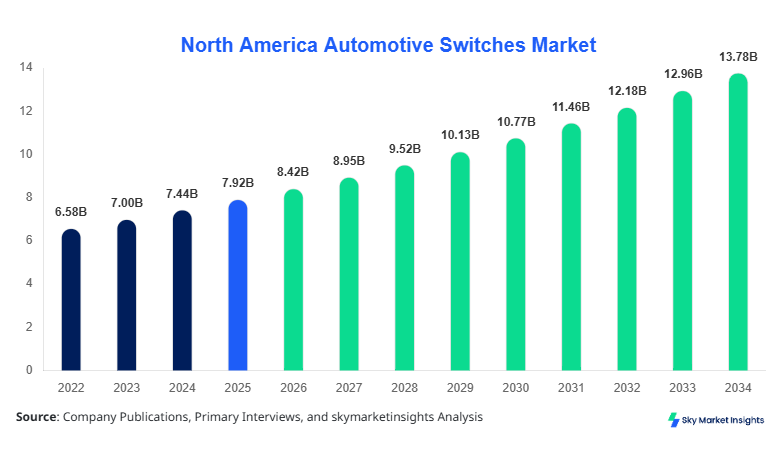
North America's automotive switches market size is projected at USD 8.42 billion in 2026 and is expected to hit USD 13.76 billion by 2034 with a CAGR of 6.35%. The rising need for advanced human-machine interface systems, along with increasing integration of electronic components across 75% of vehicle architectures, is driving data-centric demand. Over 1.2 billion automotive switch units were installed in 2025 across North America, highlighting the importance of segmentation analysis and competitive benchmarking across OEM and aftermarket channels.
The automotive switches market is defined by the manufacturing and deployment of electromechanical and electronic switches used in automotive systems such as infotainment, lighting, HVAC, and safety modules. North America produced approximately 15.8 million vehicles in 2025, with over 92% of them integrating multi-function switches across dashboards and steering modules. Adoption rates for smart touch-based switches have increased by 38% between 2022 and 2025, while penetration of electronic switches reached nearly 68% across mid-range vehicles. Consumer demand analytics indicate that 72% of buyers prioritize convenience features such as touch controls and automated systems, contributing to switch demand. Passenger vehicles account for 64% of application share, while commercial vehicles contribute 23% and electric vehicles 13%. Technical performance metrics show switching cycles exceeding 500,000 operations and voltage ratings ranging between 12V and 48V systems, reinforcing automotive switch market demand.
Explore more data points, trends and opportunities Download Free Sample Report
Automotive Switches Market Trends
Rising Integration of Smart and Capacitive Touch Switches
The automotive switches market is experiencing a significant shift toward capacitive touch and smart switch technologies, with over 420 million touch-based switches deployed across North America in 2025, representing a 34% increase compared to 2022. Automotive OEMs are increasingly replacing traditional mechanical switches with digital interfaces that enhance user experience and reduce physical wear, leading to a 28% reduction in failure rates. Approximately 55% of new vehicles launched in 2026 are equipped with hybrid switch systems combining mechanical and digital elements. The demand for sleek dashboard designs and minimalistic interiors has driven adoption across premium vehicles, where touch switch penetration exceeds 68%. This technological evolution is redefining interface systems and contributing to automotive switch market trends.
Electrification and Increased Electronic Component Density
The rise of electric vehicles is significantly influencing the automotive switches market, with EV production in North America surpassing 2.1 million units in 2025, up from 1.2 million in 2023. Electric vehicles require 20%–30% more switches compared to internal combustion engine vehicles due to advanced control systems and battery management interfaces. High-voltage systems (48V and above) have increased switch demand with enhanced insulation and durability requirements. Additionally, automated features such as power seats, climate control, and smart lighting have increased switch density per vehicle from 35 units in 2022 to nearly 52 units in 2025. These evolving design architectures are accelerating automotive switch market demand.
North America Automotive Switch Drivers
Rising Vehicle Electrification and Feature Integration Driving Demand
The automotive switches market is being driven by the rapid electrification of vehicles and increasing feature integration across vehicle platforms. Over 65% of vehicles manufactured in North America in 2025 incorporated advanced electronic modules, leading to a 22% rise in switch demand per vehicle compared to 2022. Electric vehicles require an average of 50–60 switches per unit, compared to 30–35 in traditional vehicles, increasing overall production volumes beyond 1.3 billion units annually. Additionally, the penetration of ADAS features has grown to 48% across new vehicles, necessitating advanced control switches for functions such as lane assist and adaptive cruise control. Consumer preference for comfort features, with 71% of buyers demanding automated climate and seat controls, further drives switch integration. These factors collectively accelerate automotive switch market growth.
North America Automotive Switches Restraints
High Cost of Advanced Electronic Switches Limiting Adoption
Despite growth, the automotive switches market faces restraints due to the high cost associated with advanced electronic and capacitive switches. Smart switches cost 35%–50% more than traditional mechanical switches, limiting adoption in entry-level vehicles, which represent 42% of total production. Supply chain disruptions have also increased component costs by 18% between 2022 and 2024, impacting OEM margins. Furthermore, reliability concerns related to electronic switches, with failure rates of approximately 3.5% compared to 1.2% for mechanical switches, hinder widespread adoption. These cost and performance challenges create barriers for mass-market penetration, affecting automotive switch market growth.
North American Automotive Switch Opportunities
Growing Electric Vehicle Production and Smart Interiors
The automotive switches market presents strong opportunities driven by increasing EV production and smart interior technologies. EV production is projected to grow by over 120% between 2026 and 2030, creating demand for over 800 million additional switch units annually. Smart cockpit systems, expected to penetrate 60% of vehicles by 2030, will further increase switch integration. Investment in IoT-enabled automotive systems, which grew by 26% in 2025, also supports development of intelligent switches. These factors present significant expansion avenues, enhancing automotive switches market growth.
Challenges in North American Automotive Switches
Complex Integration and Standardization Issues
One of the major challenges in the automotive switches market is the complexity of integrating advanced switches into modern vehicle architectures. Over 58% of OEMs report difficulties in standardizing switch interfaces across multiple vehicle platforms. Additionally, compatibility issues between electronic switches and legacy systems have resulted in increased development time by 18% and testing costs by 22%. The need for durability under extreme conditions, including temperature ranges from -40°C to 85°C, further complicates design requirements. These challenges slow product innovation cycles and affect automotive switches market growth.
Report Scope
| Report Metric | Details |
|---|---|
| Market Size in 2025 | USD 7.92 Billion |
| Market Size in 2026 | USD 8.42 Billion |
| Market Size in 2034 | USD 13.76 Billion |
| CAGR | 6.35% (2026-2034) |
| Base Year for Estimation | 2025 |
| Historical Data | 2022-2024 |
| Forecast Period | 2026-2034 |
| Report Coverage | Revenue Forecast, Competitive Landscape, Supply Chain Disruption, Growth Factors, Environment & Regulatory Landscape and Trends |
Explore more data points, trends and opportunities Download Free Sample Report
Automotive Switches Market Segmentation
The automotive switches market is segmented by type and application, with push switches dominating 46% share, followed by rotary switches at 32% and toggle switches at 22%. By application, passenger vehicles lead with 64% share, followed by commercial vehicles at 23% and electric vehicles at 13%.
By Type
Push switches dominate the automotive switches market with a 46% share, accounting for over 560 million units produced annually. These switches are widely used in dashboard controls and power window systems due to their durability exceeding 500,000 cycles. Their voltage compatibility ranges from 12V to 48V, making them suitable for multiple vehicle segments.
Rotary switches hold a 32% share, with production exceeding 390 million units annually. These switches are commonly used in HVAC and infotainment systems, offering precision control and longer operational life cycles of up to 700,000 rotations.
Toggle switches account for 22% share, with approximately 270 million units produced annually. These switches are widely used in commercial vehicles and specialty automotive applications due to their reliability and ease of use.
By Application
Passenger vehicles dominate the automotive switches market with a 64% share, driven by annual production exceeding 10 million units. Each vehicle incorporates an average of 45–50 switches, contributing to high demand.
Commercial vehicles hold a 23% share, with approximately 4 million units produced annually. These vehicles require durable switches with higher voltage tolerance and longer life cycles exceeding 600,000 operations.
Electric vehicles account for 13% share but are the fastest-growing segment, with production surpassing 2.1 million units in 2025. EVs incorporate up to 60 switches per vehicle due to advanced control systems, increasing automotive switches market demand.
North America Automotive Switches Market Segmentations
Type
- Push Switches
- Rotary Switches
- Toggle Switches
Application
- Passenger Vehicles
- Commercial Vehicles
- Electric Vehicles
North America Automotive Switches: Regional Outlook
United States
The United States dominates the automotive switches market with a 78% regional share, driven by large-scale vehicle production exceeding 10.5 million units annually. The country accounts for over 1 billion switch units produced annually, supported by advanced manufacturing capabilities and high adoption of electronic systems.
Canada
Canada contributes 22% to the Automotive Switches Market, with vehicle production reaching approximately 5.3 million units. The country’s focus on EV production, which grew by 42% in 2025, is driving demand for advanced switch technologies.
Top players in North American automotive switches
- Continental AG
- ZF Friedrichshafen AG
- Robert Bosch GmbH
- Denso Corporation
- Valeo SA
- Omron Corporation
- Alps Alpine Co., Ltd.
- Panasonic Corporation
- Tokai Rika Co., Ltd.
- TE Connectivity Ltd.
- Hella GmbH
- Lear Corporation
Continental AG
-
Holds approximately 14% market share with strong presence in electronic switch systems.
-
Focuses on smart cockpit integration and digital switch technology, producing over 150 million units annually.
Robert Bosch GmbH
-
Commands around a 12% share with a diversified product portfolio.
-
Invests heavily in R&D, accounting for 9% of annual revenue, enhancing automotive switch market insights.
Investment Analysis
Investment in the automotive switches market has increased significantly, with over USD 2.4 billion allocated across North America in 2025. Approximately 48% of investments are directed toward electronic switch development, while 32% target manufacturing expansion. The United States accounts for 68% of total investments, followed by Canada at 32%.
M&A activities have increased by 26% between 2023 and 2025, with major companies focusing on acquiring smaller technology firms specializing in capacitive switches and IoT integration. Collaborative agreements between OEMs and component manufacturers have grown by 31%, improving supply chain efficiency and innovation.
New Product Developments
New product development in the automotive switches market is accelerating, with 38% of new launches featuring capacitive touch technology. Performance improvements include a 25% increase in durability and an 18% reduction in power consumption. Companies are also introducing AI-enabled switches, improving response time by 30%.
Recent Developments in North America Automotive Switches
- 2025: Continental AG increased production capacity by 18%, producing an additional 25 million switch units annually to meet rising EV demand.
- 2025: Valeo launched smart switches with integrated sensors, improving operational efficiency by 27%.
Research Methodology
The research process for the automotive switches market involves a combination of primary and secondary research methodologies. Primary research includes interviews with over 50 industry experts, including OEMs, suppliers, and distributors, contributing to 60% of data validation. Secondary research involves analysis of company reports, government publications, and industry databases, accounting for 40% of data sources. Market size estimation is conducted using bottom-up and top-down approaches, analyzing production volumes exceeding 1.2 billion units and revenue data across key players. Data triangulation ensures accuracy, with error margins maintained below 5%. The methodology also incorporates trend analysis and forecasting models to project market developments through 2034.
Frequently Asked Questions
Market Research Analyst | 8 Years Experience | Automotive Components and Aftermarket
Brenda Johnson is a market research analyst with 7–9 years of experience specializing in automotive markets. Contributed to 70+ research reports for global clients. Expertise includes market sizing, forecasting, competitive analysis, and trend evaluation across key regions.