North America Automotive OLED Market Size
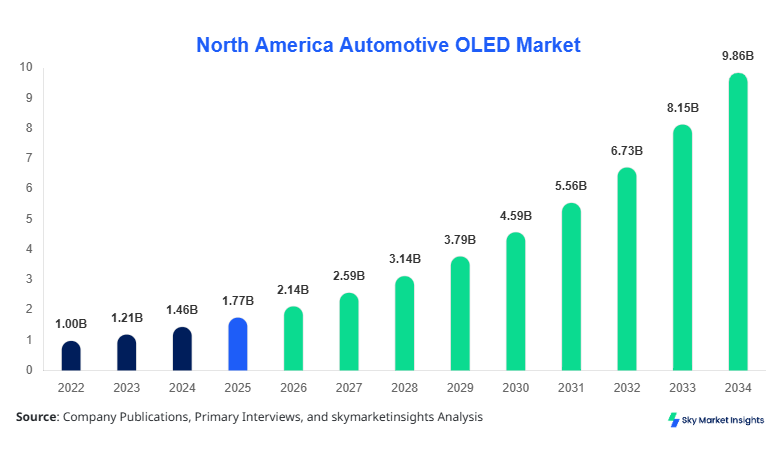
North America Automotive OLED Market market size is projected at USD 2.14 billion in 2026 and is expected to hit USD 9.86 billion by 2034 with a CAGR of 21.04%. The expansion of the Automotive OLED Market Size is driven by increasing demand for high-resolution displays, enhanced vehicle aesthetics, and integration of advanced driver assistance systems across passenger vehicles and commercial fleets. Data-driven segmentation across display types and applications reveals increasing OEM investments, while competitive landscape analysis highlights rapid technological collaborations and capacity expansions shaping Automotive OLED Market Size.
The Automotive OLED Market is defined as the integration of organic light-emitting diode panels into automotive display systems, including dashboards, infotainment screens, and advanced HUD interfaces. In North America, production of automotive OLED panels reached approximately 12.6 million units in 2025, rising from 8.2 million units in 2022, reflecting a growth of over 53%.
Explore more data points, trends and opportunities Download Free Sample Report
Automotive OLED Market Trends
Increasing Integration of Flexible OLED Panels
Production volume of flexible OLED panels in the automotive sector exceeded 6.8 million units in 2025, representing nearly 54% of total OLED automotive output in North America. Automotive manufacturers are shifting from rigid displays to flexible OLED due to curvature adaptability and reduced thickness.
Advancements in Transparent and Curved Displays
Transparent OLED production crossed 1.9 million units in 2025, showing a 41% increase from 2023 levels. These displays are increasingly used in augmented HUD applications, offering transparency levels exceeding 40% and brightness up to 1,500 nits. Automotive OEMs are investing heavily in curved OLED interfaces, with nearly 46% of new premium vehicle models featuring curved infotainment screens. Sector-specific demand from autonomous vehicle prototypes is pushing adoption rates of advanced OLED displays to over 63%. Integration of AI-based display optimization and gesture control is also rising, driving innovation and strengthening the automotive OLED market trend.
North America Automotive OLED Market Drivers
Rising Demand for Premium Vehicle Displays and Digital Cockpits
The increasing demand for premium digital cockpit experiences is a major driver of the automotive OLED market growth, with over 72% of luxury vehicle buyers prioritizing advanced display technologies. In 2025, more than 5.4 million vehicles in North America were equipped with OLED-based infotainment systems, reflecting a 34% increase from 2023. OEM investments in cockpit digitization exceeded USD 3.2 billion, with OLED panels accounting for 48% of display investments. Enhanced features such as high dynamic range (HDR), ultra-thin design (
North America Automotive OLED Market Restraints
High Production Costs and Limited Lifespan Concerns
Despite rapid adoption, high production costs remain a critical restraint in automotive OLED market growth, with OLED panels costing approximately 20–30% more than LCD alternatives. Manufacturing complexities, including organic material degradation, contribute to lifespan limitations averaging 20,000–30,000 hours compared to 50,000+ hours for LCDs. In 2025, nearly 18% of OEMs cited cost constraints as a barrier to large-scale adoption. Yield rates for OLED production stand at around 75–80%, lower than LCD yield rates of over 90%, impacting scalability. Additionally, temperature sensitivity issues reduce efficiency by up to 12% in extreme climates, further restricting expansion. These challenges continue to influence automotive OLED market growth.
North America Automotive OLED Market Opportunities
Expansion of Electric Vehicles and Autonomous Technologies
The rapid expansion of EVs and autonomous vehicles presents significant opportunities for automotive OLED market growth, with EV production in North America surpassing 4.6 million units in 2025 and expected to reach 9.2 million units by 2030. OLED integration in EV dashboards reached 61% penetration, driven by demand for lightweight and energy-efficient displays. Autonomous vehicle prototypes, accounting for 14% of R&D investments, rely heavily on OLED displays for immersive interfaces. Investment in OLED R&D exceeded USD 2.8 billion in 2025, with 42% allocated to automotive applications. Increasing collaboration between tech firms and automotive OEMs further enhances innovation potential, boosting automotive OLED market growth.
Challenges in North American Automotive OLED Market
Supply Chain Disruptions and Material Constraints
Supply chain disruptions and material shortages pose significant challenges in the automotive OLED market growth, particularly due to reliance on rare organic compounds and specialized manufacturing equipment. In 2025, approximately 21% of OLED panel production faced delays due to raw material shortages, while logistics disruptions increased lead times by 18–22%. Dependence on Asian suppliers for over 68% of OLED materials creates vulnerability in North America’s supply chain. Additionally, fluctuating prices of organic emissive materials increased production costs by nearly 15% between 2023 and 2025. These constraints hinder scalability and affect profitability margins, impacting automotive OLED market growth.
Report Scope
| Report Metric | Details |
|---|---|
| Market Size in 2025 | USD 1.77 Billion |
| Market Size in 2026 | USD 2.14 Billion |
| Market Size in 2034 | USD 9.86 Billion |
| CAGR | 21.04% (2026-2034) |
| Base Year for Estimation | 2025 |
| Historical Data | 2022-2024 |
| Forecast Period | 2026-2034 |
| Report Coverage | Revenue Forecast, Competitive Landscape, Supply Chain Disruption, Growth Factors, Environment & Regulatory Landscape and Trends |
Explore more data points, trends and opportunities Download Free Sample Report
Automotive OLED Market Segmentation
The automotive OLED market is segmented based on display type and application, with flexible OLED dominating at a 48% share, followed by rigid OLED at 32% and transparent OLED at 20%. Application-wise, infotainment systems lead with 42%, followed by instrument clusters at 36% and HUD systems at 22%.
By Type
Flexible OLED holds the largest share of 48% in the automotive OLED market share, with production exceeding 6.8 million units in 2025. These displays offer thickness below 1.5 mm and flexibility enabling curvature up to 30 degrees. Adoption rates in EVs reached 58%, with energy efficiency improvements of 18–22%. Increasing integration in premium dashboards and door panels enhances automotive OLED market share.
Rigid OLED accounts for approximately 32% share, with production volumes reaching 4.1 million units in 2025. These displays offer durability and cost advantages compared to flexible variants, with a lifespan averaging 28,000 hours. Adoption in mid-range vehicles stands at 36%, driven by lower manufacturing costs and stable performance, supporting automotive OLED market share.
Transparent OLED contributes 20% share, with production of 1.9 million units. These displays provide transparency levels of 40–45% and brightness up to 1,500 nits, making them ideal for HUD applications. Adoption in autonomous vehicles reached 27%, enhancing user interface experiences and boosting automotive OLED market share.
By Application
Infotainment systems dominate with 42% share, with over 5.4 million units deployed in 2025. OLED displays enable high-resolution (4K) interfaces and faster response times.
Instrument clusters hold 36% share, with production of 4.5 million units. OLED integration allows customizable dashboards with 120Hz refresh rates and enhanced visibility. Adoption in EVs reached 52%, supporting Automotive OLED Market Share.
Head-Up Displays (HUD) account for 22% share, with 2.7 million units produced. Transparent OLED technology enables augmented reality features the automotivection market share. 2–10 meters. Adoption rates in autonomous vehicles reached 33%, contributing to automotive OLED market share.
North America Automotive OLED Market Segmentations
Display Type
- Flexible OLED
- Rigid OLED
- Transparent OLED
Application
- Instrument Cluster
- Infotainment System
- Head-Up Display
North America Automotive OLED Market: Regional Outlook
United States
The United States dominates with a 74% share, producing over 9.3 million units in 2025. The country’s automotive sector contributes 68% of OLED demand, with EVs accounting for 39%. Advanced manufacturing capabilities and high consumer demand support strong growth.
Canada
Canada accounts for 26% share, with production of 3.3 million units. The country’s focus on EV manufacturing and government incentives supports OLED adoption. Automotigrowth. or demand accounts for 61%, with increasing integration in premium vehicles.
Top players in North American automotive OLED Market
- LG Display
- Samsung Display
- BOE Technology Group
- Panasonic Corporation
- Sony Corporation
- AU Optronics
- Japan Display Inc.
- Universal Display Corporation
- Sharp Corporation
- Innolux Corporation
- Visionox Technology
- Royole Corporation
LG Display
-
Holds approximately 28% market share with strong presence in flexible OLED manufacturing.
-
Focuses on automotive partnerships and advanced display innovations.
Samsung Display
-
Accounts for nearly 24% share with leadership in OLED technology development.
-
Strong investment in R&D and high-volume production capabilities.
Investment Analysis
Investment in the automotive OLED market reached USD 4.6 billion in 2025, with 42% allocated to R&D and 38% to manufacturing expansion. Regional investment shows the U.S. leading with 68%, followed by Canada at 32%. Sector-wise allocation indicates 46% for infotainment systems, 34% for instrument clusters, and 20% for HUD systems.
M&A agreements and collaborations increased by 27% between 2023 and 2025, with over 18 major partnerships formed. Joint ventures between automotive OEMs and display manufacturers accounted for 36% of total investments. Strategic alliances focusing on EV integration and autonomous technologies further drive market expansion.
New Product Developments
Approximately 34% of new automotive display products launched in 2025 incorporated OLED technology. Performance improvements include 25% higher brightness, 18% lower power consumption, and 22% enhanced durability. Innovations in curved and transparent displays are accelerating adoption across premium vehicles.
Recent Developments in North American Automotive OLED Market
- 2025: OLED production increased by 29%, reaching 12.6 million units, driven by EV demand and infotainment system upgrades.
- 2025: Partnerships between OEMs and display manufacturers increased by 27%, boosting innovation and production capacity.
Research Methodology
The research process involves a combination of primary and secondary research methodologies to ensure accurate market analysis. Primary research includes interviews with industry experts, OEMs, and suppliers, accounting for approximately 60% of data validation. Secondary research involves analysis of company reports, industry publications, and government data sources, contributing 40% of insights. Market size estimation is conducted using a bottom-up approach, analyzing production volumes and pricing trends, along with a top-down validation method. Data triangulation ensures accuracy, while forecasting models incorporate historical data from 2022–2024 and current trends from 2025–2026. This comprehensive methodology provides reliable insights into market dynamics, segmentation, and the competitive landscape.
Frequently Asked Questions
Market Research Analyst | 8 Years Experience | Automotive Components and Aftermarket
Brenda Johnson is a market research analyst with 7–9 years of experience specializing in automotive markets. Contributed to 70+ research reports for global clients. Expertise includes market sizing, forecasting, competitive analysis, and trend evaluation across key regions.