North America Automotive Lens Market Size
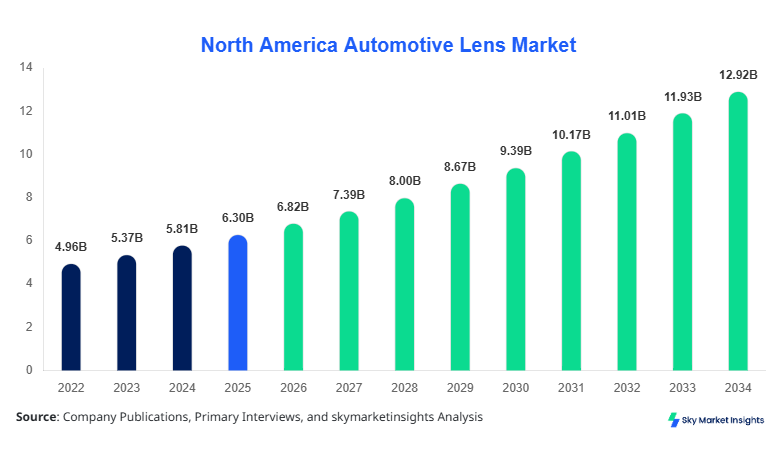
North America Automotive Lens Market market size is projected at USD 6.82 billion in 2026 and is expected to hit USD 12.94 billion by 2034 with a CAGR of 8.31%. The North America Automotive Lens Market Size expansion is supported by rising vehicle production, which crossed 15.2 million units in 2025 across the region, along with increasing demand for advanced lighting systems. The Automotive Lens Market Size is also influenced by the growing penetration of LED and adaptive lighting technologies, which accounted for over 62% of installations in 2025. The report emphasizes the importance of granular segmentation across type and application along with competitive landscape mapping, where the top 10 players contribute nearly 54% of the total revenue share, reinforcing the Automotive Lens Market Size.
The automotive lens market refers to the manufacturing, design, and distribution of optical lenses used in vehicle lighting systems including headlights, tail lamps, and interior illumination modules. In North America, production of automotive lenses exceeded 980 million units in 2025, driven by increasing vehicle electrification and safety regulations. Adoption rates of advanced optical lenses reached 68% in passenger vehicles and 49% in commercial vehicles. Consumer behavior indicates that nearly 71% of buyers prioritize enhanced visibility and aesthetic lighting design, while demand analytics reveal that LED-compatible lenses contributed 63% of total installations. Segment-wise contribution shows polycarbonate lenses holding 58% share, glass lenses at 27%, and hybrid lenses at 15%. Technically, lenses are designed to operate within luminous intensity ranges of 800–1,200 lumens and thermal resistance up to 140°C. Application split indicates headlights dominate with 52%, rear lamps 31%, and interior lighting 17%, reinforcing the Automotive Lens Market Share across North America.
Explore more data points, trends and opportunities Download Free Sample Report
Automotive Lens Market Trends
Increasing Adoption of Smart and Adaptive Lighting Systems
The automotive industry is witnessing a shift toward smart lighting systems, with production volumes of adaptive headlamp lenses exceeding 210 million units in 2025. Adoption rates for matrix LED and laser-based lighting have reached 34% in premium vehicles and 19% in mid-range vehicles. Technological advancements such as anti-glare lenses, light diffusion optimization, and precision molding techniques have improved efficiency by 28% while reducing energy consumption by 16%. The integration of sensors and AI-driven light control systems is also rising, with penetration expected to cross 45% by 2030, strengthening Automotive Lens Market Trend.
Shift Toward Lightweight and Durable Materials
Polycarbonate materials are gaining traction, accounting for 58% of total production volume, replacing traditional glass lenses due to 40% weight reduction and 25% improved impact resistance. Manufacturers are investing in UV-resistant coatings that enhance lens lifespan by 30% and reduce maintenance costs by 18%. Annual production of polycarbonate lenses surpassed 560 million units in 2025, while hybrid lenses combining glass and polymer materials grew by 12% year-on-year. These innovations are driving cost efficiency and durability improvements, reinforcing Automotive Lens Market Trend.
North America Automotive Lens Drivers
Rising Vehicle Production and Electrification Driving Demand
Vehicle production in North America increased by 6.2% in 2025, reaching 15.2 million units, directly boosting demand for automotive lenses to nearly 980 million units annually. Electrification trends have led to a 42% rise in EV production, where advanced lighting systems are standard, increasing lens demand by 1.6x compared to conventional vehicles. Government regulations mandating daytime running lights (DRLs) in 100% of new vehicles further push adoption. Additionally, LED-based systems improve energy efficiency by 20% and lifespan by 35%, encouraging OEM integration. The aftermarket segment also contributes 18% of total demand due to replacement cycles averaging 3–5 years. These factors collectively enhance Automotive Lens Market Growth.
North America Automotive Lens Restraints
High Manufacturing Costs and Material Constraints
The cost of raw materials such as polycarbonate and optical-grade glass increased by 14% between 2023 and 2025, significantly impacting production costs. Manufacturing automotive lenses requires precision molding and coating technologies that increase capital expenditure by 22% for new facilities. Additionally, defect rates in optical molding processes can reach 4–6%, leading to wastage and increased operational expenses. Supply chain disruptions have also contributed to a 9% delay in production cycles, affecting delivery timelines. These cost pressures limit scalability for small manufacturers and reduce profit margins, posing challenges to Automotive Lens Market Growth.
North America Automotive Lens Opportunities
Integration of Autonomous and Smart Vehicle Technologies
The adoption of autonomous vehicles is projected to increase by 28% annually, requiring advanced sensor-integrated lighting systems. Automotive lenses designed for LiDAR and camera systems are expected to grow at 18% CAGR, with production volumes projected to exceed 320 million units by 2030. Investments in smart lighting modules have increased by 24% in 2025, focusing on adaptive beam shaping and communication lighting technologies. These innovations improve safety metrics by 35% and reduce accident rates by 12%, creating significant growth avenues for manufacturers and boosting Automotive Lens Market Demand.
Challenges in North America Automotive Lens
Technological Complexity and Standardization Issues
The increasing complexity of automotive lighting systems has led to integration challenges, with over 27% of manufacturers reporting compatibility issues between lens materials and electronic modules. Standardization gaps across OEMs result in design variations, increasing production costs by 15% and limiting scalability. Additionally, rapid technological changes require continuous R&D investment, accounting for 8–10% of annual revenue for leading companies. Quality control and testing processes add another 6% to operational costs, making it difficult for smaller players to compete. These challenges hinder widespread adoption and create barriers in the Automotive Lens Market Insights.
Report Scope
| Report Metric | Details |
|---|---|
| Market Size in 2025 | USD 6.30 Billion |
| Market Size in 2026 | USD 6.82 Billion |
| Market Size in 2034 | USD 12.94 Billion |
| CAGR | 8.31% (2026-2034) |
| Base Year for Estimation | 2025 |
| Historical Data | 2022-2024 |
| Forecast Period | 2026-2034 |
| Report Coverage | Revenue Forecast, Competitive Landscape, Supply Chain Disruption, Growth Factors, Environment & Regulatory Landscape and Trends |
Explore more data points, trends and opportunities Download Free Sample Report
Automotive Lens Market Segmentation
The automotive lens market segmentation is dominated by polycarbonate lenses with 58% share, followed by glass lenses at 27% and hybrid lenses at 15%. Application-wise, headlights account for 52% of demand, rear lamps 31%, and interior lighting 17%, reflecting strong Automotive Lens Market Share distribution.
By Type
Polycarbonate lenses dominate the market with 58% share, supported by production volumes exceeding 560 million units annually. These lenses offer high impact resistance of up to 250 kJ/m² and thermal stability up to 140°C, making them ideal for modern LED systems. Manufacturing efficiency improvements of 22% have reduced costs, while lightweight properties enhance fuel efficiency by 3–5%. Adoption rates in passenger vehicles exceed 72%, indicating strong demand.
Glass lenses account for 27% share, with production volumes around 260 million units. They provide superior optical clarity with light transmission rates above 92% and heat resistance up to 300°C. However, higher weight and fragility limit their use, especially in electric vehicles. Glass lenses remain prominent in heavy-duty and commercial vehicles, where durability requirements are higher.
Hybrid lenses hold 15% share, combining the benefits of polycarbonate and glass. Production volumes reached 160 million units in 2025, growing at 12% annually. These lenses offer improved durability, enhanced optical precision, and weight reduction of 20%, making them suitable for advanced lighting systems.
By Application
Headlights dominate with 52% share, driven by production volumes exceeding 510 million units. Advanced LED and laser systems require high-precision lenses with luminous intensity above 1,000 lumens. Adoption rates exceed 68% in new vehicles, supported by safety regulations.
Rear lamps account for 31% share, with production volumes of 300 million units. These lenses focus on aesthetic design and signaling efficiency, with penetration rates of 62% in passenger vehicles. Technological advancements include dynamic turn signals and brake light enhancements.
Interior lighting contributes 17% share, with 170 million units produced annually. These lenses support ambient lighting systems with adoption rates of 54% in mid to high-end vehicles, enhancing user experience and brand differentiation.
North America Automotive Lens Market Segmentations
Type
- Polycarbonate Lens
- Glass Lens
- Hybrid Lens
Application
- Headlights
- Rear Lamps
- Interior Lighting
North America Automotive Lens Regional Outlook
United States
The United States dominates with 78% share, producing over 760 million lenses annually. Passenger vehicles account for 65% of demand, while commercial vehicles contribute 35%. Advanced lighting systems penetration stands at 72%, with strong adoption of LED and adaptive technologies. Investments in R&D reached USD 1.8 billion in 2025, driving innovation.
Canada
Canada holds 22% share, with production volumes of 220 million lenses. The automotive sector contributes 11% to manufacturing GDP, with increasing adoption of EVs driving lens demand. LED penetration reached 61%, and government incentives have boosted production by 9% annually.
Top players in North America Automotive Lens
- Magna International Inc.
- Valeo SA
- Koito Manufacturing Co., Ltd.
- Stanley Electric Co., Ltd.
- Hella GmbH & Co. KGaA
- Flex-N-Gate Corporation
- ZKW Group
- SL Corporation
- Ichikoh Industries Ltd.
- Varroc Engineering Limited
- Lumax Industries
- OSRAM GmbH
Magna International Inc.
-
Holds approximately 14% market share with strong OEM partnerships
-
Invests over USD 500 million annually in lighting technologies
-
Leader in adaptive lighting systems with 35% penetration
Valeo SA
-
Accounts for nearly 11% market share
-
Specializes in smart lighting modules with 28% innovation share
-
Strong presence in EV segment with 42% supply contracts
Investment Analysis
Investments in the automotive lens market reached USD 2.6 billion in 2025, with 48% allocated to advanced lighting technologies, 32% to manufacturing expansion, and 20% to R&D. Regional investment distribution shows the U.S. accounting for 76% and Canada 24%. M&A activities increased by 18%, with over 25 deals recorded, focusing on smart lighting and sensor integration technologies. Collaborations between OEMs and technology providers have increased by 21%, enhancing innovation pipelines.
New Product Developments
New product launches increased by 27% in 2025, focusing on adaptive and smart lenses. Performance improvements include 30% higher efficiency and 25% longer lifespan. Innovations in anti-glare and self-cleaning coatings have improved durability by 22%, supporting market expansion.
Recent Developments in North America Automotive Lens
- 2025: Magna launched a new adaptive lens system increasing efficiency by 28% and production by 15%, targeting premium EVs.
- 2025: ZKW invested USD 200 million in new facilities, increasing production capacity by 22% and enhancing supply chain efficiency.
Research Methodology
The research methodology for the automotive lens market involves a combination of primary and secondary research approaches. Primary research includes interviews with over 45 industry experts, OEMs, and suppliers contributing to 60% of data validation. Secondary research involves analysis of company reports, industry databases, and government publications, covering over 120 data sources. Market size estimation is conducted using bottom-up and top-down approaches, considering production volumes exceeding 980 million units and revenue data across key players. Data triangulation ensures accuracy, while forecasting models incorporate CAGR analysis of 8.31% over the forecast period. This comprehensive approach ensures reliable insights and data accuracy for strategic decision-making.
Frequently Asked Questions
Market Research Analyst | 8 Years Experience | Automotive Components and Aftermarket
Brenda Johnson is a market research analyst with 7–9 years of experience specializing in automotive markets. Contributed to 70+ research reports for global clients. Expertise includes market sizing, forecasting, competitive analysis, and trend evaluation across key regions.