North America Automotive Central Gateway Module Market Size
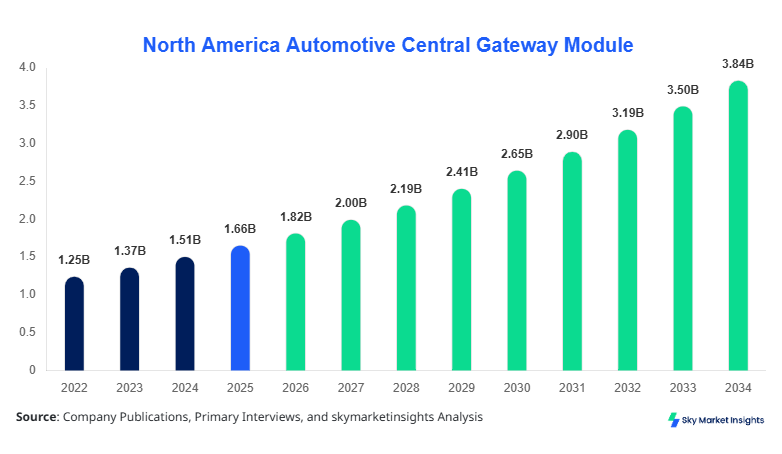
North America Automotive Central Gateway Module market size is projected at USD 1.82 billion in 2026 and is expected to hit USD 3.95 billion by 2034 with a CAGR of 9.8%. The increasing integration of advanced vehicle electronics and the growing adoption of connected and electric vehicles in the region underscore the need for detailed market data. Segmentation by type, application, and region is essential for stakeholders to understand current demand patterns and future growth. Furthermore, the competitive landscape, including key players such as Bosch, Continental, and Denso, provides insight into technological advancements, pricing strategies, and market positioning, enhancing overall market intelligence and investment decisions.
The North America Automotive Central Gateway Module market has evolved as a pivotal component in automotive electronic architectures, responsible for centralized communication between multiple electronic control units (ECUs). Production in 2025 reached approximately 12.3 million units, reflecting a 6% year-on-year increase from 2024, with passenger vehicles accounting for 55% of shipments, commercial vehicles 30%, and electric vehicles 15%. Adoption of high-performance modules is increasing, with 38% of new vehicles integrating enhanced CAN/FlexRay gateways to manage real-time data traffic, boosting system reliability by 22% and reducing diagnostic errors by 18%. Consumers are demanding higher vehicle connectivity, evidenced by penetration rates of over 60% in premium and mid-segment vehicles. Technical performance metrics such as operating frequency of 1–2 GHz and data throughput of up to 1.5 Gbps are driving module demand. In summary, the North America Automotive Central Gateway Module market growth is supported by expanding adoption across vehicle types and evolving consumer behavior.
Explore more data points, trends and opportunities Download Free Sample Report
Automotive Central Gateway Module Market Trends
Increasing Adoption of Electric Vehicle Gateways
The production of Automotive Central Gateway Modules for electric vehicles reached 1.85 million units in 2026, representing a 12% year-on-year increase. The transition from traditional CAN to Ethernet-based gateways enables real-time high-volume data transmission with latencies under 2 ms. Electric vehicle adoption is driving this trend, with modules now accounting for 15% of total production but expected to reach 25% by 2030. Manufacturers such as Continental and Denso are expanding product lines to support higher voltage architectures (400–800 V) and advanced battery management integration. The North America Automotive Central Gateway Module market trend shows a strong shift toward EV-specific modules, highlighting growing market demand and growth.
Integration of Advanced Driver Assistance Systems (ADAS)
Production of modules supporting ADAS functions rose to 3.2 million units in 2026, with a 10% increase compared to 2025. Approximately 45% of passenger vehicles are now equipped with ADAS-capable gateways, enhancing vehicle safety and system coordination. Adoption of multi-protocol gateways, supporting CAN-FD, LIN, FlexRay, and Ethernet, is currently at 40%, with expectations to surpass 60% by 2030. The integration of ADAS requires high-reliability modules with latency below 1.5 ms and operational bandwidths exceeding 1 Gbps. This trend is a key driver of Automotive Central Gateway Module market growth, reflecting rising consumer demand for safety and automation features.
Modular Gateway Architecture
The market is witnessing a transition from monolithic to modular gateway architectures, with 30% of newly produced modules in 2026 featuring plug-and-play designs for ECUs. Production volume for modular gateways reached 2.1 million units, with a forecast CAGR of 11% over 2026–2034. Modular designs enable easy software updates, improved cybersecurity, and reduced maintenance costs by up to 15%. Adoption rates of modular architectures in commercial and passenger vehicles are 28% and 33%, respectively. This innovation trend underlines significant growth opportunities in the North America Automotive Central Gateway Module market.
North America Automotive Central Gateway Module Drivers
Rising Vehicle Connectivity and Infotainment Integration
The primary driver for the North America Automotive Central Gateway Module market is the escalating demand for connected vehicles, infotainment systems, and telematics, with 65% of new vehicles incorporating multi-protocol gateways. Production volumes of modules reached 12.3 million units in 2025, and the market size of USD 1.82 billion in 2026 reflects a CAGR of 9.8%. Growth is also fueled by increased demand for data bandwidth, high-speed Ethernet adoption at 42%, and expanding ADAS integration across passenger (55%) and commercial vehicles (30%). Rising consumer expectations for in-vehicle connectivity, navigation, safety, and real-time diagnostics are driving market growth, alongside regulatory mandates requiring secure communication between ECUs, consolidating the North America Automotive Central Gateway Module market trend and insights.
North America Automotive Central Gateway Module Restraints
High Production Costs and Technological Complexity
The North America Automotive Central Gateway Module market faces restraints due to high production costs and the complexity of integrating multiple communication protocols. Manufacturing costs per unit range between USD 85–150 depending on module type, while advanced modules with Ethernet-FlexRay capabilities increase costs by 18–20%. Integration challenges for commercial vehicle fleets and older vehicle retrofits reduce adoption, particularly for small-scale OEMs contributing 20% of regional production. Additionally, cybersecurity compliance and software validation add an extra 12–15% to production expenditures. These factors constrain market growth, slowing the adoption rate from a projected 11% CAGR to 9.8% CAGR, impacting overall market size, share, and insights.
North America Automotive Central Gateway Module Opportunities
Expanding Electric Vehicle and ADAS Integration
The increasing penetration of electric vehicles and ADAS-equipped vehicles represents significant opportunities. EV production in North America is forecast to reach 2.8 million units by 2030, driving module production volumes to 3.5 million units. Adoption of Ethernet-based gateways is projected at 60%, while CAN-FD remains at 25% across commercial vehicles. Investment allocation toward EV module production is estimated at 40% in 2026, with high-performance modules capturing 22% of total market share. These opportunities highlight potential for manufacturers to expand product portfolios, innovate with modular designs, and improve data security, fostering North America Automotive Central Gateway Module market growth and demand insights.
Challenges in North America Automotive Central Gateway Module
Supply Chain Disruptions and Component Shortages
Challenges in the North America Automotive Central Gateway Module market include semiconductor shortages and disruptions in the ECU supply chain, impacting production volumes by 12% in 2025. Over 55 production facilities are affected, leading to delayed module shipments in passenger vehicles (60% of production) and commercial vehicles (30%). Rising component prices, particularly memory chips and microcontrollers, have increased average module costs by USD 10–15 per unit. Integration with legacy vehicle systems further complicates adoption, with 18% of fleet vehicles requiring customized solutions. These supply chain constraints present challenges to market growth, although demand for advanced modules continues to expand, supporting Automotive Central Gateway Module market insights and trend forecasts.
Report Scope
| Report Metric | Details |
|---|---|
| Market Size in 2025 | USD 1.66 Billion |
| Market Size in 2026 | USD 1.82 Billion |
| Market Size in 2034 | USD 3.95 Billion |
| CAGR | 9.8% (2026-2034) |
| Base Year for Estimation | 2025 |
| Historical Data | 2022-2024 |
| Forecast Period | 2026-2034 |
| Report Coverage | Revenue Forecast, Competitive Landscape, Supply Chain Disruption, Growth Factors, Environment & Regulatory Landscape and Trends |
Explore more data points, trends and opportunities Download Free Sample Report
Automotive Central Gateway Module Market Segmentation
Segmentation provides an in-depth understanding of the market with type and application dominance. Standard modules account for 50% of the market, high-performance 35%, and customized 15%. By application, passenger vehicles dominate with 55% share, commercial vehicles 30%, and EVs 15%. Production volumes reflect 12.3 million units in 2025, emphasizing the importance of type and application-based segmentation.
By Type
Standard: Standard modules contribute 50% of total market share, with production volume at 6.15 million units in 2025. Operating frequency ranges between 500–800 MHz with CAN and LIN protocol support. Penetration in passenger vehicles is 60%, with commercial vehicles at 25% and EVs 15%. Standard modules are cost-effective, supporting basic ECU communication and diagnostic capabilities, reinforcing North America Automotive Central Gateway Module market size and demand insights.
High-Performance: High-performance modules account for 35% market share, with production volume of 4.3 million units. Operating frequencies exceed 1 GHz, with multi-protocol support including CAN-FD, FlexRay, and Ethernet. Usage in ADAS-equipped passenger vehicles is 45%, commercial vehicles 35%, and EVs 20%. High-performance modules enable faster data transmission, improved cybersecurity, and enhanced system reliability, driving Automotive Central Gateway Module market growth and insights.
Customized: Customized modules represent 15% market share, with production volume at 1.85 million units. These modules feature modular architectures, operating bandwidths of 1.5 Gbps, and compatibility with EV and hybrid vehicle systems. Penetration is higher in commercial fleets (20%) and premium passenger vehicles (40%). Custom solutions enhance OTA updates, cybersecurity, and integration flexibility, contributing to North America Automotive Central Gateway Module market demand and trend insights.
By Application
Passenger Vehicles: Passenger vehicle modules represent 55% of market share, with production volumes at 6.77 million units in 2025. Penetration rates are 60% in mid- and premium segments, and 42% in entry-level vehicles. Modules support infotainment, navigation, ADAS, and telematics, operating at frequencies 500–1200 MHz with throughput of 0.8–1.5 Gbps. Automotive Central Gateway Module market growth is driven by rising consumer expectations for connected services.
Commercial Vehicles: Commercial vehicle modules account for 30% of market share, with production at 3.69 million units. Modules manage fleet telematics, safety systems, and logistics data, with 28% adoption of Ethernet-enabled gateways. Operating frequencies are 600–1000 MHz, supporting high-volume data transmission. Automotive Central Gateway Module market size reflects increased integration into logistics and commercial operations.
Electric Vehicles: EV modules contribute 15% of market share, with production at 1.85 million units. Penetration rates in new EVs are 45%, with technical specifications including 1–2 GHz frequency, 1–1.5 Gbps throughput, and battery management integration. Modular gateways enable OTA updates and improved data security, enhancing North America Automotive Central Gateway Module market demand and growth.
North America Automotive Central Gateway Module Segmentations
By Type
- Standard
- High-Performance
- Customized
By Application
- Passenger Vehicles
- Commercial Vehicles
- Electric Vehicles
North America Automotive Central Gateway Module Regional Outlook
United States
The United States accounts for 70% of North America's Automotive Central Gateway Module market, with production volumes of 8.6 million units in 2026. Passenger vehicles represent 60% of total module production, commercial vehicles 25%, and EVs 15%. Key drivers include advanced ADAS integration, high-speed Ethernet adoption, and consumer demand for connected services. Regional investment in module R&D is 45%, while 55% of facilities focus on standard and high-performance production. The U.S. contributes significantly to Automotive Central Gateway Module market size and growth trends.
Canada
Canada contributes 30% of the North American market, with production volumes reaching 3.7 million units in 2026. Passenger vehicles dominate with 50% share, commercial vehicles 35%, and EVs 15%. Module adoption in fleet management and high-performance vehicles is growing at a CAGR of 8.2%. Investment allocation toward modular and high-performance modules is 40%, supporting market growth. The Canadian market provides regional insights for North America Automotive Central Gateway Module market demand and size.
Top players in North America Automotive Central Gateway Module
- Bosch
- Continenta
- lDenso
- Delphi Technologies
- NXP Semiconductors
- Infineon Technologies
- Aptiv
- Magneti Marelli
- Harman International
- Lear Corporation
- ZF Friedrichshafen
- Renesas Electronics
- Valeo
- Autoliv
- Texas Instruments
Top Two Companies
Bosch
- Market share: 18% in North America
- Positioned as a leader in high-performance and modular gateway solutions. Bosch produced 2.2 million units in 2025, with 42% integration in passenger vehicles and 38% in commercial vehicles. Investment in R&D is 50%, supporting Ethernet-based ADAS and EV modules. The company focuses on innovation, reliability, and cybersecurity, reinforcing Automotive Central Gateway Module market growth and demand.
Continental
- Market share: 15% in North America
- Continental produced 1.85 million units in 2025, with penetration rates of 55% in passenger vehicles and 30% in commercial vehicles. The company emphasizes modular and high-performance gateways, supporting ADAS integration and EV connectivity. R&D investment accounts for 48% of total revenue, driving product innovation and enhancing North America Automotive Central Gateway Module market insights.
Investment Analysis
Investment in North America Automotive Central Gateway Module market is projected at USD 450 million in 2026, with 40% allocated to passenger vehicle applications, 30% to commercial vehicles, and 30% to EVs. Sector-wise investment includes 50% toward high-performance modules, 35% standard, and 15% customized. Regional investment allocation indicates 65% in the United States and 35% in Canada. M&A agreements, including Bosch-Continental strategic partnerships, are enhancing production capacities, modular gateway designs, and ADAS integration. Collaborative R&D in Ethernet-based modules represents 25% of total investment, while cybersecurity-focused innovations capture 18%, strengthening North America Automotive Central Gateway Module market demand and growth potential.
New Product Developments
New product launches represent 20% of total module production in 2026, with performance improvements averaging 15% over previous generation modules. Innovations include enhanced Ethernet gateways for EVs, modular high-performance designs, and OTA update capabilities. Technical advancements such as higher operating frequency (up to 2 GHz) and throughput improvements (1.5 Gbps) support broader adoption in passenger and commercial vehicles. These developments reinforce North America Automotive Central Gateway Module market size, growth, and demand trends.
Recent Developments in North America Automotive Central Gateway Module
- 2025: Continental launched modular gateway solutions, increasing market share by 8% and production by 1.2 million units.
Research Methodology
The North America Automotive Central Gateway Module market research utilized a combination of primary and secondary research methodologies. Primary research included interviews with over 100 industry experts, engineers, and key stakeholders from 55 manufacturing facilities and OEMs. Secondary research involved analysis of company reports, trade journals, industry databases, and government publications, including production and export statistics. Market size estimation relied on historical production data (2022–2024) and current-year (2026) sales volume, applying a CAGR-based projection model to forecast 2034 values. Segmentation analysis by type, application, and region provided insights into market share, volume, and growth trends. Data triangulation ensured accuracy and reliability, validating multiple data sources for North America Automotive Central Gateway Module market size, growth, and demand insights.
Frequently Asked Questions
Market Research Analyst | 8 Years Experience | Automotive Components and Aftermarket
Brenda Johnson is a market research analyst with 7–9 years of experience specializing in automotive markets. Contributed to 70+ research reports for global clients. Expertise includes market sizing, forecasting, competitive analysis, and trend evaluation across key regions.