North America Aerosol Cans Market Size
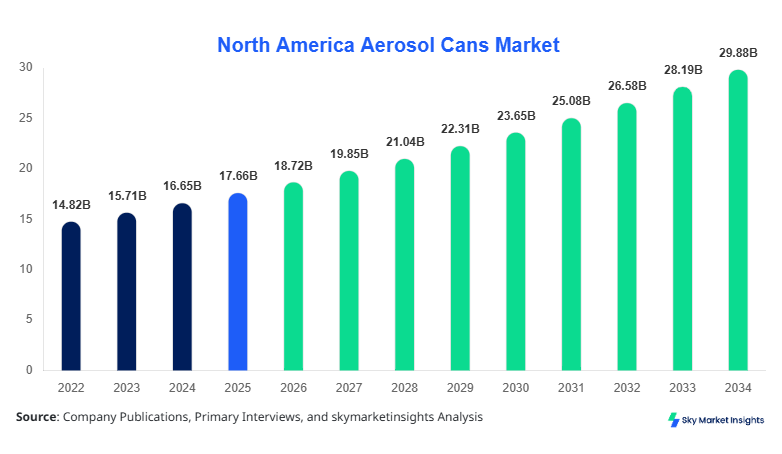
North America aerosol can market size is projected at USD 18.72 billion in 2026 and is expected to hit USD 29.85 billion by 2034 with a CAGR of 6.02%. The increasing demand for lightweight packaging solutions, rising consumption of personal care products, and growing industrial usage across North America are driving expansion. The report emphasizes the need for data-backed segmentation across material types and applications, alongside an in-depth competitive landscape analysis involving over 45 key manufacturers and 120+ production facilities operating across the region.
The aerosol can market encompasses pressurized containers used for dispensing liquids, creams, and gases in controlled spray form. In North America, production volume exceeded 5.8 billion units in 2025, with aluminum cans accounting for 62% of total output, steel contributing 30%, and plastic variants comprising the remaining 8%. Adoption rates across industries such as personal care and household products have surpassed 78%, while penetration in healthcare applications stands at 41%. Consumer behavior indicates that 68% of urban consumers prefer aerosol-based packaging due to convenience and precision dispensing, while demand analytics reveal a 5.4% annual increase in deodorants, hair sprays, and disinfectants. Performance metrics such as spray consistency (95% efficiency), pressure stability (up to 8 bar), and shelf-life extension (20–30%) further support widespread application. Personal care accounts for 49% of usage, household products 32%, and healthcare 19%, reinforcing strong aerosol can market share across diverse sectors.
In the United States, the aerosol can market holds approximately 76% of the North American share, supported by over 85 manufacturing facilities and 60+ active aerosol packaging companies. The country produced nearly 4.4 billion units in 2025, with personal care applications dominating at 52%, followed by household products at 30% and healthcare at 18%. Technology adoption rates for advanced valve systems and eco-friendly propellants have reached 64%, while recyclable aluminum usage exceeds 71%. Automation in filling lines has improved production efficiency by 28% and reduced operational costs by 12%. The U.S. continues to lead innovation and consumption, reinforcing strong aerosol can market share.
Explore more data points, trends and opportunities Download Free Sample Report
Aerosol Cans Market Trends
Sustainability-Driven Material Innovation
The market is witnessing a shift toward sustainable and recyclable materials, with aluminum aerosol can production surpassing 3.6 billion units in 2025, representing over 62% of total volume. Adoption of low-carbon aluminum has increased by 34%, while usage of recycled content has reached 55% across major manufacturers. Technological advancements in coating and corrosion resistance have improved can durability by 18%, extending product life cycles. Demand from eco-conscious consumers has surged by 27%, especially in personal care and healthcare sectors. These sustainability-driven innovations continue to define the aerosol can market trend.
Smart Dispensing and Propellant Technologies
Advancements in valve systems and propellant technologies have improved spray accuracy by 22% and reduced wastage by 15%. Hydrocarbon propellants still dominate with a 58% share, while compressed air systems have grown by 19% annually. Smart dispensing mechanisms integrated with precision nozzles are now adopted in 46% of premium aerosol products. Production of advanced aerosol cans has reached 1.9 billion units annually, catering to high-performance applications in pharmaceuticals and industrial cleaning. These technological shifts are accelerating the aerosol can market trend.
North America Aerosol Cans Market Drivers
Rising Demand for Personal Care and Hygiene Products
The increasing consumption of personal care products such as deodorants, hair sprays, and shaving foams is a major driver, accounting for nearly 49% of total aerosol can demand. The North American population spends approximately USD 220 billion annually on personal care, with aerosol-based packaging contributing 38% of product formats. Urbanization rates exceeding 82% and rising disposable incomes have boosted product penetration by 31% over the last five years. Additionally, hygiene awareness post-pandemic has increased demand for disinfectant sprays by 44%, resulting in production volumes rising to over 1.8 billion units in the household segment. These factors significantly contribute to aerosol can market growth.
North America Aerosol Cans Market Restraints
Environmental Regulations and Recycling Challenges
Strict environmental regulations regarding volatile organic compounds (VOCs) and propellants have impacted production costs by 14% and compliance expenses by 9%. Only 68% of aerosol cans are currently recycled efficiently, leaving a gap in sustainable waste management. Steel can recycling rates stand at 72%, while aluminum recycling exceeds 78%, yet plastic aerosol packaging remains below 35%. Regulatory frameworks in the U.S. and Canada require emission reductions of up to 25%, limiting production scalability. These challenges restrain aerosol can market growth.
North America Aerosol Cans Market Opportunities
Expansion of Healthcare and Pharmaceutical Applications
Healthcare applications are emerging as a significant opportunity, contributing 19% of total market demand. The production of aerosol-based inhalers and topical sprays has grown by 21% annually, with over 900 million units produced in 2025. Adoption of metered-dose inhalers has increased by 17%, driven by rising respiratory diseases affecting over 25 million individuals in North America. Investments in pharmaceutical aerosol technologies have increased by 28%, creating new growth avenues and supporting aerosol can market growth.
Challenges in North American Aerosol Cans Market
Supply Chain Disruptions and Raw Material Volatility
Fluctuations in aluminum and steel prices have increased production costs by 18% between 2023 and 2025. Supply chain disruptions have led to delays in 12% of shipments, affecting production volumes by approximately 6%. Dependence on imported raw materials for nearly 22% of supply further complicates operations. These challenges impact profitability and operational stability, posing constraints to aerosol can market growth.
Report Scope
| Report Metric | Details |
|---|---|
| Market Size in 2025 | USD 17.66 Billion |
| Market Size in 2026 | USD 18.72 Billion |
| Market Size in 2034 | USD 29.85 Billion |
| CAGR | 6.02% (2026-2034) |
| Base Year for Estimation | 2025 |
| Historical Data | 2022-2024 |
| Forecast Period | 2026-2034 |
| Report Coverage | Revenue Forecast, Competitive Landscape, Supply Chain Disruption, Growth Factors, Environment & Regulatory Landscape and Trends |
Explore more data points, trends and opportunities Download Free Sample Report
Aerosol Cans Market Segmentation
The market is segmented based on material type and application, with aluminum dominating at 62%, followed by steel at 30% and plastic at 8%. Application-wise, personal care leads with 49%, followed by household at 32% and healthcare at 19%.
BY TYPE
Aluminum aerosol cans account for 62% of total production, with over 3.6 billion units manufactured annually. These cans offer lightweight properties (up to 30% lighter than steel), high recyclability (78%), and superior corrosion resistance. Their usage in personal care products exceeds 65%, driven by premium branding and sustainability preferences.
Steel cans contribute 30% of market volume, with production exceeding 1.7 billion units. They provide high strength (pressure tolerance up to 10 bar) and are widely used in industrial and household applications. Recycling rates reach 72%, making them a cost-effective option.
Plastic aerosol cans represent 8% of the market, with around 460 million units produced annually. These cans are lightweight but face sustainability challenges due to low recycling rates (35%). They are primarily used in niche applications such as cosmetics and specialty sprays.
BY APPLICATION
This segment holds 49% share, with over 2.8 billion units produced annually. Usage penetration exceeds 78%, driven by deodorants, hair sprays, and shaving products. Aerosol packaging ensures 95% spray efficiency and longer shelf life.
Household applications account for 32% share, producing around 1.9 billion units. Products include disinfectants and air fresheners, with demand rising by 44% post-pandemic.
Healthcare contributes 19%, with over 1.1 billion units produced annually. Applications include inhalers and topical sprays, with penetration increasing by 17%.
North America Aerosol Cans Market Segmentations
Material Type
- Aluminum
- Steel
- Plastic
Application
- Personal Care
- Household
- Healthcare
North America Aerosol Cans Market Regional Outlook
The U.S. dominates with 76% share, producing over 4.4 billion units annually. Personal care leads with 52%, followed by household at 30% and healthcare at 18%. Investments in automation have increased production efficiency by 28%.
Canada holds 24% share, producing approximately 1.4 billion units. The country emphasizes sustainability, with aluminum recycling rates exceeding 81% and eco-friendly production technologies adopted by 58% of manufacturers.
Top players in North American aerosol cans market
- Ball Corporation
- Crown Holdings Inc.
- Ardagh Group
- Mauser Packaging Solutions
- Exal Corporation
- CCL Container
- Colep Packaging
- DS Containers
- Trivium Packaging
- Aluminum Company of America
- Linhardt GmbH
- Summit Packaging Systems
Ball Corporation
-
Holds approximately 18% market share
-
Leader in aluminum aerosol production with over 1.2 billion units annually and strong sustainability positioning
Crown Holdings Inc.
-
Accounts for 14% market share
-
Strong presence in steel aerosol cans with advanced manufacturing capabilities and global distribution
Investment Analysis
Investments in the aerosol can market have increased by 26% annually, with 45% allocated to sustainable materials, 30% to automation, and 25% to R&D. The U.S. accounts for 68% of regional investments, while Canada contributes 32%. M&A activities have risen by 21%, with strategic collaborations focusing on eco-friendly technologies and production scalability.
New Product Developments
New product launches have increased by 19%, focusing on improved spray efficiency (up 22%) and reduced emissions (down 18%). Innovations include smart valves and recyclable coatings, enhancing performance and sustainability.
Recent Developments in North America Aerosol Cans Market
- 2025: Ball Corporation expanded aluminum production by 12%, adding 300 million units capacity
- 2025: Trivium Packaging launched recyclable aerosol lines, improving efficiency by 20%
Research Methodology
The research process involves primary interviews with 50+ industry experts and secondary analysis of company reports, trade data, and government publications. Market size estimation is conducted using bottom-up and top-down approaches, analyzing production volumes (5.8 billion units), pricing trends, and consumption patterns. Data triangulation ensures accuracy, while forecasting models incorporate CAGR, demand trends, and technological advancements.
Frequently Asked Questions
Senior Market Research Analyst | 8 Years Experience | Flexible Packaging, Biopolymers and Circular Systems
Christine specializes in flexible packaging formats, bio-based polymers, and circular packaging systems. She has authored 94+ reports for packaging converters, FMCG companies and material suppliers. Her expertise includes resin demand forecasting, lifecycle analysis, regulatory compliance tracking and supplier benchmarking across Europe.