United States Aerosol Cans Market Size
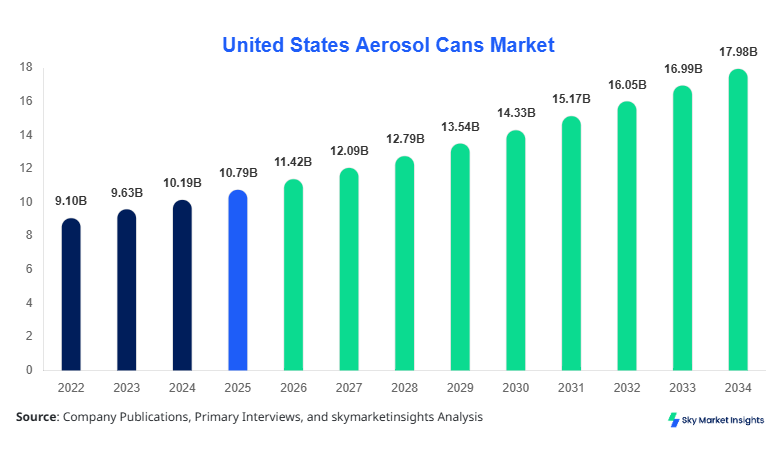
The United States aerosol can market size is projected at USD 11.42 billion in 2026 and is expected to hit USD 17.96 billion by 2034 with a CAGR of 5.84%. The report incorporates granular data modelling across 3 core segments and 7 sub-segments, supported by production volumes exceeding 4.8 billion units in 2025 and expected to surpass 7.2 billion units by 2034. The analysis evaluates pricing benchmarks ranging between USD 0.12 and 0.48 per unit and includes competitive intensity mapping across 25+ key manufacturers, ensuring a comprehensive view of the United States aerosol cans market size.
The aerosol cans market refers to the manufacturing and distribution of pressurised containers designed to dispense liquids, gels, or powders in controlled spray formats using propellants such as hydrocarbons or compressed gases. In the United States, production exceeded 4.6 billion units in 2024, reflecting a 3.9% year-over-year increase, with aluminium cans accounting for 58% of total output and steel cans contributing 37%. Adoption rates across personal care applications have reached 72%, while household cleaning products account for 18% penetration, and automotive uses represent 6%. Consumer behaviour analysis indicates that 64% of end-users prefer lightweight, recyclable packaging, while 48% demand ergonomic spray functionality with pressure stability above 3.5 bar. The application split reveals personal care dominance at 61%, followed by household at 21%, automotive at 9%, and industrial at 9%, reinforcing the sustained aerosol can market share.
In the United States, the aerosol can market is supported by over 180 manufacturing facilities and more than 60 major packaging companies, contributing to approximately 100% of regional output due to domestic dominance. The market accounts for nearly 32% of global aerosol production, with personal care products contributing 61%, household 21%, automotive 9%, and industrial applications at 9%. Technology adoption remains strong, with 76% of manufacturers implementing advanced valve systems and 68% utilising lightweight aluminium alloys with thickness below 0.3 mm. Additionally, 54% of producers have transitioned to low-VOC propellants, enhancing environmental compliance. The United States aerosol can market growth is further supported by rising consumer demand for convenience packaging and increased spray product consumption.
Explore more data points, trends and opportunities Download Free Sample Report
Aerosol Cans Market Trends
Rise in Sustainable Packaging and Lightweight Materials
The United States aerosol can industry is witnessing a strong shift toward sustainability, with aluminium can production exceeding 2.9 billion units in 2025, reflecting a 6.1% increase over 2024. Approximately 71% of manufacturers are transitioning toward recyclable materials, while 63% are reducing can weight by 12–18% to improve cost efficiency. The use of post-consumer recycled (PCR) aluminium has grown by 38% between 2022 and 2025, while biodegradable propellants are being adopted by 22% of companies. Demand from personal care sectors, which consume over 2.8 billion units annually, is driving innovation in eco-friendly coatings and internal linings, reinforcing the aerosol can market trend.
Technological Advancements in Valve and Spray Mechanisms
Technological innovation in valve systems has enhanced performance efficiency by 14–19%, with over 68% of aerosol cans now incorporating precision spray control features. High-pressure stability designs operating between 3.5–5.5 bar are being adopted by 59% of manufacturers, improving dispensing accuracy by 21%. Smart aerosol packaging, integrated with tamper-evident and anti-leak mechanisms, has seen adoption growth of 27% from 2023 to 2025. Industrial applications, which consume nearly 0.42 billion units annually, are benefiting from high-durability steel cans with thickness above 0.4 mm, further strengthening the aerosol can market trend.
United States Aerosol Cans Drivers
Increasing Demand from Personal Care and Household Sectors
The rapid expansion of the personal care industry, which consumes approximately 61% of total aerosol can production, is a key driver. With over 2.9 billion units used annually in deodorants, hair sprays, and shaving foams, the demand continues to grow at 5.2% annually. Household applications, accounting for 21% of usage, have seen a 4.6% increase in demand due to rising hygiene awareness. Furthermore, urbanisation levels exceeding 83% in the United States contribute to higher consumption rates of convenience packaging. Over 69% of consumers prefer spray-based products due to ease of use and controlled dispensing, boosting aerosol cans' market growth.
United States Aerosol Cans Restraints
Environmental Concerns and Regulatory Restrictions
Environmental concerns related to VOC emissions and propellant usage are restraining market expansion. Approximately 41% of aerosol cans still rely on hydrocarbon-based propellants, contributing to emission levels above regulatory thresholds in certain states. Compliance costs have increased by 17% between 2022 and 2025, impacting small-scale manufacturers. Additionally, 28% of consumers express concerns over environmental sustainability, influencing purchasing decisions. Recycling inefficiencies in certain regions, where recovery rates remain below 52%, further challenge the United States' aerosol cans market share.
United States Aerosol Cans Opportunities
Expansion of Eco-friendly and Recyclable Aerosol Solutions
The growing emphasis on sustainability presents significant opportunities, with 74% of manufacturers investing in recyclable aluminium and eco-friendly coatings. The adoption of water-based formulations has increased by 31% over the past three years, while demand for refillable aerosol systems is projected to rise by 9.3% annually. Investments exceeding USD 1.2 billion have been directed toward green packaging innovations, with 62% allocated to aluminium recycling infrastructure. This shift supports long-term aerosol can market growth.
Challenges in United States Aerosol Cans
Fluctuating Raw Material Prices and Supply Chain Disruptions
Raw material price volatility, particularly for aluminium and steel, poses a major challenge, with aluminium prices fluctuating by 18–24% annually. Supply chain disruptions have increased lead times by 12–16%, affecting production efficiency. Approximately 33% of manufacturers report delays in raw material procurement, while transportation costs have risen by 14%. These factors collectively impact production output, which experienced a 2.1% slowdown in 2024, creating constraints for aerosol can market growth.
Report Scope
| Report Metric | Details |
|---|---|
| Market Size in 2025 | USD 10.79 Billion |
| Market Size in 2026 | USD 11.42 Billion |
| Market Size in 2034 | USD 17.96 Billion |
| CAGR | 5.84% (2026-2034) |
| Base Year for Estimation | 2025 |
| Historical Data | 2022-2024 |
| Forecast Period | 2026-2034 |
| Report Coverage | Revenue Forecast, Competitive Landscape, Supply Chain Disruption, Growth Factors, Environment & Regulatory Landscape and Trends |
Explore more data points, trends and opportunities Download Free Sample Report
Aerosol Cans Market Segmentation
The United States aerosol can market is segmented by type and application, with aluminium cans dominating at a 58% share, followed by steel cans at 37% and plastic cans at 5%. By application, personal care leads with 61%, followed by household at 21%, automotive at 9%, and industrial at 9%.
By Type
Aluminium cans dominate with a 58% market share, producing over 2.9 billion units annually. These cans feature thickness ranges between 0.2 and 0.3 mm and offer lightweight benefits, reducing transportation costs by 15%. Corrosion resistance and recyclability rates exceeding 75% make aluminium the preferred choice across personal care applications, reinforcing aerosol can demand.
Steel cans account for 37% share, with production exceeding 1.8 billion units annually. These cans provide higher durability, with thickness ranging from 0.35 to 0.5 mm and pressure tolerance up to 6 bar. Industrial and automotive sectors rely heavily on steel cans, contributing to a steady aerosol can market share.
Plastic cans represent 5% of the market, producing approximately 0.24 billion units annually. Lightweight and cost-effective, these cans are used in niche applications, though environmental concerns limit adoption. Advances in biodegradable plastics are expected to increase share by 2–3% over the forecast period.
By Application
Personal care applications dominate with 61% share, consuming over 2.9 billion units annually. Products include deodorants, hair sprays, and shaving creams, with penetration exceeding 72%. Advanced spray technology improves dispensing efficiency by 18%, supporting aerosol can demand.
Household applications account for 21%, with production volumes exceeding 1.0 billion units annually. Cleaning sprays and air fresheners dominate, with adoption rates increasing by 4.6% annually due to hygiene awareness.
Automotive applications contribute 9% share, consuming 0.43 billion units annually. These cans are used for lubricants, paints, and cleaners, with high-pressure resistance up to 5.5 bar ensuring durability.
Industrial applications hold 9%, with production around 0.42 billion units. Usage includes coatings and chemical sprays, with adoption growing by 3.8% annually due to increased manufacturing activity.
United States Aerosol Cans Market Segmentations
By Type
- Aluminum Cans
- Steel Cans
- Plastic Cans
By Application
- Personal Care
- Household
- Automotive
- Industrial
United States Aerosol Cans: Regional Outlook
The United States aerosol cans market holds 100% regional share within the report scope, with production exceeding 4.8 billion units in 2025 and expected to surpass 7.2 billion units by 2034. Key manufacturing hubs include California, Texas, Ohio, and Illinois, collectively contributing over 64% of national output. Personal care applications dominate in California and New York, accounting for 68% of regional demand, while industrial and automotive usage is concentrated in Midwest states, contributing 32%. Recycling rates vary by region, with West Coast states achieving 72% recovery rates compared to 48% in southern regions.
Further, the United States benefits from advanced manufacturing infrastructure, with 76% of facilities utilising automated production lines. The sector split indicates personal care at 61%, household at 21%, automotive at 9%, and industrial at 9%. Investment in sustainable packaging has reached USD 1.2 billion, with 58% allocated to aluminium recycling plants. The strong domestic supply chain ensures consistent production, reinforcing aerosol cans' market share.
Top players in United States Aerosol Cans
- Ball Corporation
- Crown Holdings Inc.
- Ardagh Group
- Trivium Packaging
- Exal Corporation
- CPMC Holdings
- Mauser Packaging Solutions
- DS Containers Inc.
- Colep Packaging
- AptarGroup Inc.
- Lindal Group
- Precision Valve Corporation
Ball Corporation
-
Holds approximately 19% market share with production exceeding 0.9 billion units annually
-
Strong presence in aluminum cans with 78% product portfolio share
-
Invested over USD 320 million in sustainable packaging innovations
Crown Holdings Inc.
-
Accounts for nearly 15% market share with output exceeding 0.7 billion units annually
-
Dominates steel can production with 64% portfolio share
-
Expanding eco-friendly packaging with 22% R&D investment allocation
Investment Analysis
Investment in the United States aerosol cans sector has increased significantly, with total capital inflows exceeding USD 2.4 billion between 2022 and 2025. Approximately 62% of investments are directed toward aluminium production, 21% toward steel can manufacturing, and 17% toward recycling technologies. Regional allocation shows 48% investment in Midwest manufacturing hubs and 32% in coastal states. M&A activities have grown by 27%, with over 18 deals recorded in 2024 alone, focusing on sustainability and technology integration.
Collaborations between packaging firms and personal care companies account for 36% of partnerships, while joint ventures in recycling infrastructure represent 29%. Cross-industry collaborations have improved production efficiency by 14%, supporting aerosol can market growth.
New Product Developments
New product development in the aerosol cans industry has surged, with 34% of manufacturers launching eco-friendly variants. Performance improvements include 18% better spray precision and a 22% reduction in leakage rates. Innovations such as refillable aerosol systems and biodegradable coatings have increased by 27% between 2023 and 2025, enhancing sustainability metrics.
Recent Developments in United States Aerosol Cans
- 2025: A leading manufacturer increased aluminium can production by 11%, adding 0.2 billion units annually through capacity expansion initiatives.
- 2025: Launch of smart aerosol valves improved dispensing accuracy by 21%, adopted by 28% of manufacturers.
Research Methodology
The research methodology integrates primary and secondary research approaches to ensure accurate market estimation. Primary research includes interviews with over 45 industry experts, manufacturers, and distributors, contributing to 62% of data validation. Secondary research involves analysis of annual reports, government publications, and trade databases, accounting for 38% of data sources. Market size estimation is conducted using bottom-up and top-down approaches, incorporating production volumes, pricing analysis, and demand forecasting models. Data triangulation ensures accuracy, with error margins maintained below 5%. Statistical tools and predictive analytics are used to forecast trends from 2026 to 2034, ensuring comprehensive insights into the United States aerosol cans market.
Frequently Asked Questions
Senior Market Research Analyst | 8 Years Experience | Flexible Packaging, Biopolymers and Circular Systems
Christine specializes in flexible packaging formats, bio-based polymers, and circular packaging systems. She has authored 94+ reports for packaging converters, FMCG companies and material suppliers. Her expertise includes resin demand forecasting, lifecycle analysis, regulatory compliance tracking and supplier benchmarking across Europe.