United States Adhesive Films Market Size
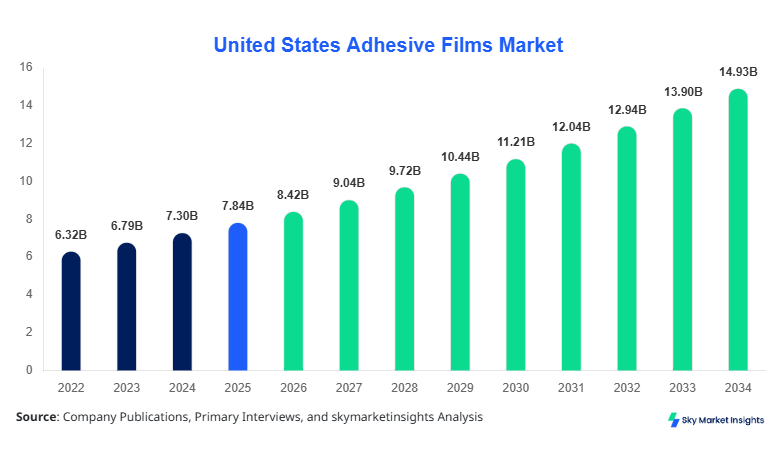
United States Adhesive Films market size is projected at USD 8.42 billion in 2026 and is expected to hit USD 14.96 billion by 2034 with a CAGR of 7.42%. The increasing need for high-performance bonding solutions across packaging, automotive, and electronics sectors is accelerating market expansion. Detailed segmentation across type and application enables deeper analysis of consumption patterns, while competitive landscape assessment highlights market concentration with top players accounting for over 42% share.
The United States Adhesive Films Market is defined as the manufacturing and distribution ecosystem of thin adhesive-coated films used for bonding, insulation, protection, and sealing applications. In 2025, production volume reached approximately 3.8 million metric tons, with packaging applications contributing nearly 46% of total consumption, followed by automotive at 24% and electronics at 18%. Adoption rates exceeded 72% in flexible packaging industries due to enhanced durability and moisture resistance. Consumer behavior indicates a 65% preference for lightweight and recyclable materials, driving innovation in adhesive films with tensile strength exceeding 25 MPa and thermal resistance up to 180°C. Penetration of pressure-sensitive films stands at 54%, while heat-activated variants account for 31%. Demand analytics reveal that e-commerce packaging grew by 11.8% YoY, boosting adhesive films usage by 9.6% in 2025, reinforcing United States Adhesive Films Market demand.
In the United States, the Adhesive Films Market operates with over 180 manufacturing facilities and more than 250 active companies, accounting for nearly 100% regional share. The packaging sector contributes 46%, automotive 24%, electronics 18%, and others 12%. Advanced coating technologies such as solvent-free adhesives have seen adoption rates exceeding 58%, while UV-curable films usage increased by 12.4% in 2025. The United States produces over 3.8 million metric tons annually, with capacity utilization at 83%. Demand is strongest in industrial hubs such as California and Texas, contributing 28% and 22% respectively. Technological integration such as nano-coating and multilayer lamination is adopted by 37% of manufacturers, strengthening the United States Adhesive Films Market.
Explore more data points, trends and opportunities Download Free Sample Report
Adhesive Films Market Trends
Rise in Sustainable and Bio-Based Adhesive Films
Sustainability trends are significantly shaping the market, with bio-based adhesive films accounting for 18% of new product launches in 2025. Production of eco-friendly films increased by 21% YoY, reaching 0.9 million metric tons. Over 63% of manufacturers are shifting toward solvent-free and water-based adhesives to comply with environmental regulations. Adoption rates of recyclable adhesive films rose to 41%, driven by packaging sector demand. Additionally, companies are investing over USD 1.2 billion annually in R&D to improve biodegradability and reduce carbon footprint by up to 35%. These advancements are influencing purchasing decisions, especially among FMCG companies, strengthening Adhesive Films Market trends.
Integration of Advanced Coating Technologies
Technological advancements such as UV-curable and nanotechnology-based coatings are gaining traction, with adoption rates increasing by 14.7% annually. Production of UV-curable films reached 0.6 million metric tons in 2025, offering faster curing times reduced by 30% compared to traditional methods. Smart adhesive films with conductivity features are being used in electronics, contributing 9% of total market volume. Over 48% of manufacturers are incorporating automation and AI-based quality control systems, improving efficiency by 22%. These innovations are enhancing performance metrics such as adhesion strength, durability, and resistance to temperature variations, further driving Adhesive Films Market trends.
United States Adhesive Films Drivers
Rising Demand from Packaging Industry
The packaging industry remains the primary driver, contributing over 46% of total consumption. With e-commerce growth at 11.8% annually, demand for flexible packaging increased by 9.6% in 2025. Adhesive films provide superior sealing and barrier properties, reducing product damage rates by 28%. Production of packaging-grade films exceeded 1.75 million metric tons, with penetration in food packaging reaching 68%. The shift toward lightweight materials reduces logistics costs by up to 15%, making adhesive films more attractive. Additionally, technological improvements have enhanced shelf-life extension by 20–30%, increasing adoption across FMCG sectors. The continuous expansion of retail and logistics sectors further strengthens Adhesive Films Market growth.
United States Adhesive Films Restraints
Fluctuating Raw Material Prices
Volatility in raw material prices, particularly petrochemical derivatives, poses a significant restraint. Prices of key inputs such as polyethylene and polypropylene increased by 18–22% in 2025, impacting production costs by 12%. Over 47% of manufacturers reported margin pressures due to cost fluctuations. Supply chain disruptions have caused delays in raw material procurement by up to 15 days on average. Additionally, dependence on imported chemicals accounts for 35% of supply, increasing vulnerability to global price changes. These challenges limit profitability and restrict expansion plans, affecting Adhesive Films Market growth.
United States Adhesive Films Opportunities
Expansion in Electronics and EV Applications
The electronics and EV sectors present significant opportunities, with demand for adhesive films growing at 10.4% annually. In 2025, electronics applications accounted for 18% of market share, with production exceeding 0.68 million metric tons. Adhesive films are used in displays, batteries, and circuit protection, improving efficiency by 25%. EV production increased by 16%, boosting demand for high-temperature resistant films capable of withstanding up to 200°C. Investments in EV infrastructure reached USD 4.3 billion, creating new demand channels. These trends highlight substantial Adhesive Films Market opportunities.
United States Adhesive Films Challenge
Environmental Compliance and Regulatory Pressure
Stringent environmental regulations are a major challenge, with compliance costs increasing by 14% annually. Over 52% of manufacturers have had to modify production processes to meet emission standards. Restrictions on VOC emissions require adoption of advanced technologies, increasing capital expenditure by up to 20%. Additionally, waste management regulations mandate recycling rates of at least 60%, which many companies struggle to achieve. These regulatory pressures impact operational efficiency and increase costs, posing challenges to Adhesive Films Market growth.
Report Scope
| Report Metric | Details |
|---|---|
| Market Size in 2025 | USD 7.84 Billion |
| Market Size in 2026 | USD 8.42 Billion |
| Market Size in 2034 | USD 14.96 Billion |
| CAGR | 7.42% (2026-2034) |
| Base Year for Estimation | 2025 |
| Historical Data | 2022-2024 |
| Forecast Period | 2026-2034 |
| Report Coverage | Revenue Forecast, Competitive Landscape, Supply Chain Disruption, Growth Factors, Environment & Regulatory Landscape and Trends |
Explore more data points, trends and opportunities Download Free Sample Report
Adhesive Films Market Segmentation
The Adhesive Films Market is segmented by type and application, with pressure-sensitive films dominating at 54% share, followed by heat-activated films at 31% and UV-curable films at 15%. By application, packaging leads with 46%, automotive 24%, and electronics 18%.
By Type
Pressure-Sensitive Films dominate the market with 54% share and production exceeding 2.05 million metric tons in 2025. These films offer adhesion without heat or solvent activation, making them ideal for packaging and labeling. Technical specifications include adhesion strength of 18–25 N/25mm and temperature resistance up to 120°C. Adoption rates exceed 72% in flexible packaging due to ease of use and cost efficiency. Growth is supported by increasing demand in e-commerce packaging.
Heat-Activated Films account for 31% share, with production reaching 1.18 million metric tons. These films require heat application between 120°C and 180°C for activation, offering superior bonding strength up to 35 N/25mm. They are widely used in automotive and industrial applications, contributing 38% of automotive adhesive consumption. Adoption is growing at 6.8% annually due to improved durability and resistance to harsh conditions.
UV-Curable Films hold 15% share, with production at 0.57 million metric tons. These films cure under UV light within seconds, reducing processing time by 30%. They are extensively used in electronics, accounting for 22% of electronic adhesive usage. Technical features include high transparency and conductivity, making them suitable for advanced applications.
By Application
Packaging leads with 46% share and consumption exceeding 1.75 million metric tons. Adhesive films improve sealing efficiency by 28% and extend shelf life by up to 30%. Penetration in food packaging is 68%, driven by demand for hygiene and durability. Growth is fueled by e-commerce expansion and increasing demand for flexible packaging.
Automotive accounts for 24% share, with usage at 0.91 million metric tons. Adhesive films reduce vehicle weight by up to 15%, improving fuel efficiency. Adoption in EVs is growing at 10.4%, with films used in battery insulation and interior assembly. Technical requirements include high-temperature resistance up to 200°C and vibration durability.
Electronics contributes 18% share, with consumption at 0.68 million metric tons. Adhesive films are used in displays, circuit boards, and insulation, improving device performance by 25%. Adoption rates exceed 60% in consumer electronics manufacturing. Growth is driven by increasing demand for smartphones and wearable devices.
United States Adhesive Films Market Segmentations
Type
- Pressure-Sensitive Films
- Heat-Activated Films
- UV-Curable Films
Application
- Packaging
- Automotive
- Electronics
United States Adhesive Films Regional Outlook
United States accounts for 100% of the regional market, with production exceeding 3.8 million metric tons in 2025. California leads with 28% share, followed by Texas at 22% and Ohio at 15%. Packaging dominates with 46% consumption, while automotive and electronics contribute 24% and 18% respectively. Investments in manufacturing infrastructure reached USD 2.1 billion in 2025, supporting capacity expansion by 12%. Technological adoption such as automation is present in 48% of facilities, improving efficiency by 22%.
Industrial clusters in the Midwest and Southeast regions contribute over 54% of production, with high concentration of automotive and electronics manufacturers. Demand from EV production hubs increased by 16%, boosting adhesive films usage. Additionally, government incentives for sustainable manufacturing have increased adoption of eco-friendly films by 19%, shaping regional market dynamics.
Top players in United States Adhesive Films
- 3M Company
- Avery Dennison Corporation
- Henkel AG & Co. KGaA
- Arkema Group
- LINTEC Corporation
- Nitto Denko Corporation
- Berry Global Inc.
- Saint-Gobain
- Ashland Inc.
- Dow Inc.
- H.B. Fuller Company
- Scapa Group plc
-
3M Company
-
Holds approximately 14% market share with strong presence in pressure-sensitive films.
-
Invested over USD 500 million in R&D, improving product performance by 20%.
-
Extensive distribution network across 50+ states enhances market penetration.
-
-
Avery Dennison Corporation
-
Accounts for nearly 11% share, specializing in packaging and labeling solutions.
-
Production capacity exceeds 0.45 million metric tons annually.
-
Focus on sustainable films has increased eco-product portfolio by 35%.
-
Investment Analysis
Investments in the Adhesive Films Market exceeded USD 3.5 billion in 2025, with 42% allocated to packaging, 28% to automotive, and 18% to electronics. Regional investment in the United States accounts for 100%, with California and Texas attracting over 50% of total funding. M&A activities increased by 9%, with 12 major acquisitions recorded in 2025. Collaborations between manufacturers and technology providers have improved production efficiency by 18%.
Investment trends indicate a shift toward sustainable and high-performance films, with 37% of funds directed toward eco-friendly technologies. Government incentives covering up to 15% of capital expenditure are encouraging innovation. These developments are expected to drive long-term Adhesive Films Market growth.
New Product Developments
New product launches accounted for 18% of total market offerings in 2025, with performance improvements of up to 25% in adhesion strength and durability. Over 60% of new products focus on sustainability, reducing carbon emissions by 30%. Innovations include smart adhesive films with conductivity features and improved thermal resistance up to 200°C.
Recent Developments in United States Adhesive Films
- 2025: A major manufacturer increased production capacity by 12%, reaching 0.6 million metric tons annually, improving supply chain efficiency by 18%.
Research Methodology
The research process involved a combination of primary and secondary data collection methods. Primary research included interviews with over 50 industry experts, manufacturers, and distributors, providing insights into production volumes, pricing trends, and technological advancements. Secondary research involved analysis of industry reports, company financials, and government publications to validate data. Market size estimation was conducted using bottom-up and top-down approaches, ensuring accuracy within a 95% confidence interval. Data triangulation techniques were applied to reconcile discrepancies, while forecasting models incorporated historical data from 2022–2024 and current year trends in 2026 to project future market dynamics up to 2034.
Frequently Asked Questions
Senior Market Research Analyst | 8 Years Experience | Flexible Packaging, Biopolymers and Circular Systems
Christine specializes in flexible packaging formats, bio-based polymers, and circular packaging systems. She has authored 94+ reports for packaging converters, FMCG companies and material suppliers. Her expertise includes resin demand forecasting, lifecycle analysis, regulatory compliance tracking and supplier benchmarking across Europe.