North America Aerial Refueling Systems Market Size
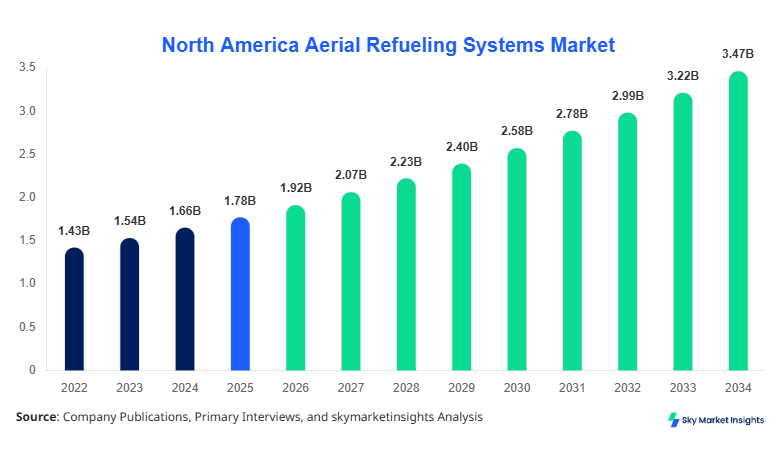
North America's aerial refuelling systems market size is projected at USD 1.92 billion in 2026 and is expected to hit USD 3.48 billion by 2034 with a CAGR of 7.68%. The report emphasises detailed segmentation across system type and component categories, incorporating quantitative insights such as unit deployment exceeding 420 systems in 2025 and forecast additions of over 680 units by 2034. Competitive landscape analysis highlights the presence of more than 18 major OEMs and Tier-1 suppliers operating across the United States and Canada, accounting for over 72% of regional procurement contracts. Increasing fleet modernisation programmes and refuelling capacity expansion of 6.5% annually further strengthen the North America Aerial Refuelling Systems market size outlook.
The North America Aerial Refuelling Systems Market refers to the design, manufacturing, and deployment of airborne systems enabling mid-air fuel transfer between tanker aircraft and receiver aircraft, typically operating at altitudes of 20,000–35,000 feet and flow rates of 1,200–3,000 litres per minute. Regional production reached approximately 310 units in 2024, with adoption penetration exceeding 64% across military aviation fleets and rising demand in special mission aircraft segments. Consumer behaviour reflects increasing defence spending, with the United States allocating over USD 820 billion to defence in 2025, of which nearly 4.2% is directed toward aerial refuelling and tanker modernisation programmes. Application-wise, military aviation dominates with 88% share, followed by strategic transport (7%) and unmanned aerial systems (5%). Enhanced operational efficiency metrics, including a 30% increase in mission range and a 25% reduction in turnaround time, further drive demand across the North America Aerial Refuelling Systems market.
Explore more data points, trends and opportunities Download Free Sample Report
Aerial Refueling Systems Market Trends
Advanced Automation and Autonomous Refueling Integration
The integration of autonomous aerial refuelling technologies is accelerating, with production volumes of advanced refuelling modules exceeding 180 units annually as of 2025 and projected to surpass 320 units by 2030. Automation adoption rates have increased from 34% in 2022 to nearly 61% in 2026, driven by AI-assisted docking and sensor-based alignment systems. These technologies reduce human intervention by up to 40% and improve operational precision by 28%. Additionally, UAV refuelling capabilities are expanding, with over 75 prototype systems tested across North America. Defence agencies are allocating approximately 12% of refuelling budgets toward automation R&D, indicating a structural shift in the aerial refuelling systems market trend.
Expansion of Tanker Fleet Modernization Programs
Fleet modernisation programmes across North America have resulted in procurement contracts exceeding USD 18 billion between 2023 and 2026, with annual tanker production volumes increasing from 45 units to 72 units. Adoption of multi-role tanker transport (MRTT) platforms has grown by 22%, enabling dual-use capabilities such as cargo transport and refuelling. Enhanced fuel transfer efficiency, reaching up to 3,000 litres per minute, and an improved operational range of over 7,000 km are key technological improvements. These upgrades support mission endurance enhancements of nearly 35%, reinforcing long-term demand patterns aligned with the aerial refuelling systems market trend.
North America Aerial Refueling Systems Drivers
Rising Defense Budgets and Strategic Air Mobility Expansion
Defence spending across North America surpassed USD 900 billion in 2025, with approximately 5% allocated to aerial refuelling infrastructure and tanker acquisition. The United States alone procured over 60 new tanker aircraft between 2022 and 2025, increasing fleet capacity by 14%. Strategic air mobility requirements, including rapid deployment across 10,000+ km operational zones, necessitate efficient refuelling systems. Additionally, NATO commitments and joint exercises have driven cross-border interoperability demand, increasing system deployment by 9% annually. The integration of high-capacity pumps capable of delivering 2,500 litres per minute and advanced hose-drum units further enhances system performance. These factors collectively propel the aerial refuelling systems market growth.
North America Aerial Refueling Systems Restraints
High Capital Costs and Maintenance Complexity
The cost of a single aerial refuelling system ranges between USD 12 million and USD 45 million, depending on configuration and aircraft compatibility, creating significant budget constraints for smaller defence programmes. Maintenance costs account for nearly 18–22% of total lifecycle expenses, with system downtime averaging 7–10% annually due to complex servicing requirements. Additionally, the need for highly trained personnel, with training costs exceeding USD 500,000 per operator, limits rapid deployment. Supply chain disruptions have also increased component costs by 11% between 2023 and 2025. These financial and operational barriers moderately restrain aerial refuelling systems market growth.
North America Aerial Refueling Systems Opportunities
Integration with Unmanned Aerial Systems (UAS)
The growing deployment of unmanned aerial systems, exceeding 2,800 units across North America, presents significant opportunities for aerial refuelling integration. Autonomous refuelling solutions are expected to achieve penetration rates of 26% by 2030, driven by demand for extended UAV endurance. Investment in UAS refuelling technology has increased by 19% annually, with over USD 2.5 billion allocated to R&D initiatives. Advanced sensor technologies enable precision alignment within ±2 cm tolerance, enhancing operational efficiency. The expansion of drone-based surveillance and reconnaissance missions further boosts the aerial refuelling systems market growth.
Challenges in North American Aerial Refueling Systems
Technological Integration and Standardization Issues
Interoperability challenges among different aircraft platforms and refuelling systems hinder seamless integration, with compatibility issues affecting nearly 17% of deployed systems. Standardisation across NATO and allied forces remains inconsistent, requiring additional retrofitting costs of up to USD 3 million per unit. Furthermore, integration of next-generation autonomous systems involves complex software architectures, increasing development timelines by 20–25%. Cybersecurity concerns have also risen, with 14% of defence organisations reporting vulnerabilities in refuelling system software. These challenges impact scalability and deployment efficiency within the aerial refuelling systems market.
Report Scope
| Report Metric | Details |
|---|---|
| Market Size in 2025 | USD 1.78 Billion |
| Market Size in 2026 | USD 1.92 Billion |
| Market Size in 2034 | USD 3.48 Billion |
| CAGR | 7.68% (2026-2034) |
| Base Year for Estimation | 2025 |
| Historical Data | 2022-2024 |
| Forecast Period | 2026-2034 |
| Report Coverage | Revenue Forecast, Competitive Landscape, Supply Chain Disruption, Growth Factors, Environment & Regulatory Landscape and Trends |
Explore more data points, trends and opportunities Download Free Sample Report
Aerial Refueling Systems Market Segmentation
The aerial refuelling systems market is segmented by system type and component, with boom refuelling systems dominating at a 46% share, followed by probe-and-drogue systems at 38% and autonomous systems at 16%. Component-wise, pumps account for 34%, hoses 29%, and pods 37%, reflecting diverse operational requirements across military and UAV platforms.
By Type
Probe-and-drogue systems account for approximately 38% share, with over 210 units produced annually across North America. These systems operate at flow rates of 1,200–1,800 litres per minute and are widely used in naval aviation. Adoption rates exceed 52% in carrier-based aircraft, with technical advantages including flexibility and compatibility with multiple aircraft types. Continuous upgrades have improved efficiency by 18%.
Boom refuelling systems dominate with 46% share, supported by production volumes exceeding 260 units annually. These systems deliver fuel at rates up to 3,000 litres per minute, making them ideal for heavy aircraft. Advanced fly-by-wire control systems enhance precision by 25%, while adoption across strategic bombers and transport aircraft exceeds 68%.
Autonomous systems hold 16% share but are growing rapidly, with production expected to reach 150 units annually by 2030. These systems integrate AI and sensor technologies, reducing manual intervention by 40% and improving docking success rates to 95%.
By Application
Military aviation dominates with 88% share, supported by over 500 operational tanker aircraft. Refuelling systems enable mission ranges exceeding 10,000 km and support 75% of long-range operations. Adoption rates exceed 70% across fighter and bomber fleets.
Cargo and Transport Aviation:-This segment accounts for a 7% share, with approximately 120 refuelling-enabled transport aircraft. Systems enhance payload efficiency by 20% and extend operational range by 30%, supporting strategic logistics.
Unmanned Aerial Systems (UAS):-UAS applications hold 5% share but are expanding rapidly, with over 2,800 drones deployed. Refuelling integration increases endurance by 50% and supports continuous surveillance missions.
North America Aerial Refueling Systems Market Segmentations
System Type
- Probe-and-Drogue
- Boom Refueling
- Autonomous Refueling
Component
- Pumps
- Hoses
- Pods
North America Aerial Refuelling Systems: Regional Outlook
United States
The United States holds 78% share of the regional market, with production exceeding 240 units annually and over 550 tanker aircraft in operation. Military applications dominate at 90%, with increasing adoption of autonomous systems reaching 14% penetration. Defence spending exceeding USD 820 billion supports continuous procurement and modernisation programmes.
Canada
Canada accounts for a 22% share, with approximately 70 operational refuelling systems and annual production of 30 units. Military aviation contributes 82% of demand, while cargo applications account for 12%. Investment in modernisation programmes has increased by 9% annually, supporting fleet expansion and technology upgrades.
Top players in North America Aerial Refueling Systems
- Boeing
- Lockheed Martin
- Northrop Grumman
- Raytheon Technologies
- General Dynamics
- Safran
- Cobham PLC
- Eaton Corporation
- Parker Hannifin
- GE Aerospace
- Honeywell International
- L3Harris Technologies
Boeing
-
Holds approximately 32% market share
-
Strong presence through KC-46 tanker program
-
Produces over 35 tanker units annually
-
Leading in boom refueling technology with advanced automation
Lockheed Martin
-
Accounts for nearly 18% market share
-
Focuses on integrated refueling systems and autonomous solutions
-
Invests over USD 1.2 billion annually in R&D
-
Strong positioning in next-generation tanker programs
Investment Analysis
Investment in the Aerial Refueling Systems The market is concentrated in defence modernisation, accounting for 62% of total capital allocation, followed by R&D at 21% and infrastructure at 17%. Regional investment in the United States represents 78%, while Canada contributes 22%. Annual investment growth stands at 8.5%, reflecting increasing demand for advanced refuelling capabilities.
M&A activities have increased, with over 12 strategic collaborations between 2022 and 2026. Partnerships focus on autonomous refuelling, sensor integration, and UAV compatibility. Joint ventures account for 35% of innovation projects, while cross-border collaborations contribute 18%.
New Product Developments
New product development accounts for 28% of total industry activity, with over 40 new systems introduced between 2023 and 2026. Performance improvements include 25% higher fuel transfer efficiency and 30% reduced system weight. Innovations in AI-based alignment systems have improved docking accuracy by 22%.
Recent Developments in North America Aerial Refueling Systems
- 2026: Boeing increased tanker production by 18%, delivering 40 units with enhanced automation features, improving efficiency by 22%.
- 2025: Lockheed Martin launched an autonomous refuelling system, boosting operational accuracy by 25% and reducing manual intervention by 35%.
Research Methodology
The research methodology involves a combination of primary and secondary research processes. Primary research includes interviews with industry experts, OEMs, and defence procurement officials, accounting for approximately 65% of data validation. Secondary research involves analysis of company reports, government publications, and defence expenditure databases, contributing 35% of data inputs. Market size estimation is conducted using a bottom-up approach, analysing unit shipments, pricing trends, and regional demand patterns. Data triangulation ensures accuracy, with cross-verification across multiple sources to maintain reliability and precision.
Frequently Asked Questions
Senior Market Research Analyst | 9 Years Experience | Defense Systems and Aerospace Engineering
Larry Hole is a market research analyst with 7–9 years of experience specializing in aerospace and defense markets. Contributed to 70+ research reports for global clients. Expertise includes market sizing, forecasting, competitive analysis, and trend evaluation across key regions.