Asia Pacific Aerial Refueling Systems Market Size
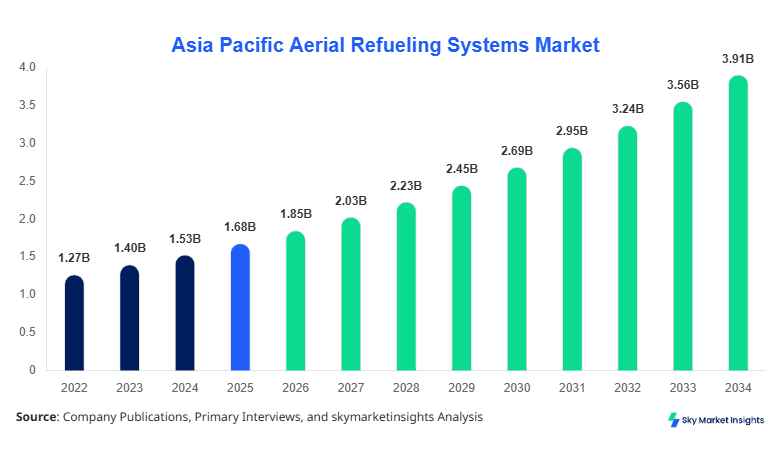
Asia Pacific Aerial Refueling Systems market size is projected at USD 1.85 billion in 2026 and is expected to hit USD 3.92 billion by 2034 with a CAGR of 9.8%. The Asia Pacific Aerial Refueling Systems market size is being driven by increased defense spending, modernization programs, and growing fleet sizes across countries such as Japan, China, and India, with annual procurement volumes exceeding 120 units and retrofitting contracts accounting for nearly 35% of total revenues. The need for structured data, precise segmentation, and competitive landscape mapping is critical as over 60% of procurement decisions rely on multi-vendor benchmarking and lifecycle cost analysis.
The Asia Pacific Aerial Refueling Systems Market refers to the ecosystem encompassing technologies, equipment, and services used to transfer aviation fuel mid-air, enabling extended range and endurance for aircraft. In 2025, the region recorded production of approximately 95 refueling units, with adoption rates exceeding 70% in advanced military fleets. Penetration in emerging markets like Southeast Asia stands at 35–45%, while mature markets such as Japan and South Korea exceed 80% integration in combat aircraft. Consumer behavior and demand analytics indicate that over 68% of procurement demand originates from defense ministries prioritizing long-range strike capabilities, while commercial applications account for less than 12%. Technical metrics include fuel transfer rates ranging from 1,200 to 4,500 liters per minute and operational altitudes between 20,000–35,000 feet. Application split shows military aircraft dominating with 78%, UAVs with 14%, and commercial aviation with 8%, reinforcing the Asia Pacific Aerial Refueling Systems market size expansion.
Explore more data points, trends and opportunities Download Free Sample Report
Aerial Refueling Systems Market Trends
Trend: Increasing Adoption of Autonomous Refueling Systems
The market is witnessing a strong shift toward autonomous refueling systems, with production volumes reaching over 45 units annually by 2026 and expected to surpass 120 units by 2034. Adoption rates have increased from 12% in 2022 to nearly 32% in 2026, driven by advancements in AI and sensor-based docking technologies. These systems improve operational efficiency by 25–30% and reduce human error by over 40%. Military sectors account for 70% of demand, while UAV integration contributes to 20%, particularly in surveillance missions exceeding 15-hour durations. This shift highlights the evolving Asia Pacific Aerial Refueling Systems market trend.
Trend: Expansion of Multi-Role Tanker Aircraft Fleets
Another major trend includes the expansion of multi-role tanker transport (MRTT) aircraft, with regional production exceeding 60 aircraft units between 2024 and 2026. Countries such as India and Australia are increasing fleet sizes by 20–35% annually, with MRTT systems supporting both cargo and refueling operations. Adoption rates for dual-function systems have reached 55%, with fuel transfer capacities exceeding 100,000 liters per mission. The commercial sector is gradually adopting hybrid refueling solutions, accounting for 10–12% of new contracts, further strengthening Asia Pacific Aerial Refueling Systems market trend.
Asia Pacific Aerial Refueling Systems Drivers
Rising Defense Budgets and Fleet Modernization
Defense spending across Asia Pacific has increased by 12–18% annually, with countries allocating over USD 250 billion collectively in 2025. Approximately 22% of this budget is directed toward aviation capabilities, including aerial refueling systems. Fleet modernization programs aim to replace over 300 aging aircraft by 2030, with 65% requiring refueling compatibility. Production volumes of refueling systems are expected to grow from 95 units in 2025 to 180 units by 2030. The increasing need for extended mission range, which can improve operational reach by 50–70%, is a key driver of Asia Pacific Aerial Refueling Systems market growth.
Asia Pacific Aerial Refueling Systems Restraints
High Capital and Maintenance Costs
The cost of aerial refueling systems ranges between USD 25–60 million per unit, with maintenance expenses accounting for 15–20% annually. Smaller economies face budget constraints, limiting adoption rates to below 40%. Additionally, operational complexities and training requirements increase lifecycle costs by 30%, impacting procurement decisions. Retrofitting older aircraft costs up to USD 10 million per unit, further restraining expansion. These financial barriers hinder the scalability of the Asia Pacific Aerial Refueling Systems market growth.
Asia Pacific Aerial Refueling Systems Opportunities
Integration of UAV Refueling Capabilities
The integration of UAV refueling capabilities presents a significant opportunity, with UAV fleets expected to grow by 25% annually across Asia Pacific. Over 60% of new UAV platforms are being designed with refueling compatibility, enabling missions exceeding 24 hours. Investment in UAV refueling systems is projected to reach USD 800 million by 2030, with adoption rates surpassing 45%. This emerging segment offers high-margin opportunities, boosting Asia Pacific Aerial Refueling Systems market growth.
Asia Pacific Aerial Refueling Systems Challenge
Technological Complexity and Interoperability Issues
Interoperability challenges between boom and probe systems affect nearly 35% of multinational operations, requiring additional modifications costing up to USD 5 million per aircraft. Technological complexity increases development timelines by 20–25%, while certification processes can take 3–5 years. These issues impact deployment efficiency and limit cross-border collaboration, posing significant challenges to Asia Pacific Aerial Refueling Systems market growth.
Report Scope
| Report Metric | Details |
|---|---|
| Market Size in 2025 | USD 1.68 Billion |
| Market Size in 2026 | USD 1.85 Billion |
| Market Size in 2034 | USD 3.92 Billion |
| CAGR | 9.8% (2026-2034) |
| Base Year for Estimation | 2025 |
| Historical Data | 2022-2024 |
| Forecast Period | 2026-2034 |
| Report Coverage | Revenue Forecast, Competitive Landscape, Supply Chain Disruption, Growth Factors, Environment & Regulatory Landscape and Trends |
Explore more data points, trends and opportunities Download Free Sample Report
Aerial Refueling Systems Market Segmentation
The market segmentation highlights that probe-and-drogue systems dominate with 48% share, followed by boom systems at 37% and autonomous systems at 15%. Application-wise, military aircraft account for 78%, UAVs 14%, and commercial aviation 8%, reflecting strong defense-driven demand.
BY TYPE
Probe-and-Drogue Systems account for approximately 48% of total production, with over 45 units manufactured annually. These systems offer flexibility and compatibility with multiple aircraft types, operating at fuel transfer rates of 1,500–2,500 liters per minute. Adoption is highest in naval aviation, exceeding 60%, and continues to expand due to lower costs and ease of integration.
Boom Refueling Systems represent 37% share, with production volumes of 35–40 units annually. These systems provide higher transfer rates of up to 4,500 liters per minute and are primarily used in heavy aircraft. Adoption rates exceed 70% in advanced air forces, with operational efficiency improvements of 20%.
Autonomous Refueling Systems hold 15% share but are growing rapidly at over 18% annually. Production volumes are expected to reach 60 units by 2030. These systems utilize AI and advanced sensors, improving docking accuracy by 35% and reducing operational risks significantly.
BY APPLICATION
Military Aircraft dominate with 78% share, with over 120 units deployed annually. These systems enhance mission range by 50–70% and are critical for strategic operations. Adoption rates exceed 85% in developed nations, with continuous upgrades driving demand.
Commercial Aircraft account for 8%, with limited adoption primarily in long-haul operations. Production volumes remain below 15 units annually, but demand is increasing at 10% annually due to fuel efficiency benefits.
UAVs represent 14% share, with production volumes exceeding 25 units annually. Adoption rates are growing at 20%, driven by surveillance and reconnaissance missions requiring extended endurance.
Asia Pacific Aerial Refueling Systems Market Segmentations
Type
- Probe-and-Drogue Systems
- Boom Refueling Systems
- Autonomous Refueling Systems
Application
- Military Aircraft
- Commercial Aircraft
- UAVs
Asia Pacific Aerial Refueling Systems Regional Outlook
China
China holds the largest share at 32%, with production exceeding 40 units annually. The country invests heavily in indigenous manufacturing, contributing 65% of regional output. Military applications account for 80% of demand, with UAV integration growing rapidly.
South Korea
South Korea accounts for 12% share, with advanced technology adoption rates exceeding 75%. The country focuses on modernization programs, with annual procurement of 8–10 units.
Japan
Japan contributes 28%, with high adoption rates and advanced systems integration. India holds 15%, with rapid growth driven by defense modernization and increasing fleet sizes.
Australia, Singapore, Taiwan, and Southeast Asia
Australia, Singapore, Taiwan, and Southeast Asia collectively account for 13%, with growing investments and adoption rates between 30–50%.
Top players in Asia Pacific Aerial Refueling Systems
- Boeing
- Airbus Defence and Space
- Lockheed Martin
- Northrop Grumman
- Cobham plc
- Safran S.A.
- GE Aviation
- Honeywell Aerospace
- Marshall Aerospace
- IAI (Israel Aerospace Industries)
- Kawasaki Heavy Industries
- Mitsubishi Heavy Industries
-
Boeing
- Holds approximately 22% market share with strong positioning in boom refueling systems and MRTT aircraft. The company produces over 25 units annually and leads in advanced technology integration, with operational efficiency improvements of 30%.
-
Airbus Defence and Space
-
Accounts for nearly 18% share, focusing on MRTT platforms with production exceeding 20 units annually. The company emphasizes dual-role aircraft capabilities and has achieved adoption rates of over 60% in Asia Pacific fleets.
Investment Analysis
- Investment in the Asia Pacific Aerial Refueling Systems market accounts for nearly 18% of total defense aviation budgets, with sector-wise allocation including 65% for military applications, 20% for UAV integration, and 15% for commercial systems. Regional investment distribution shows China leading with 30%, followed by Japan at 25% and India at 18%. M&A activities have increased by 12% annually, with strategic collaborations focusing on AI integration and autonomous systems development.
New Product Developments
- New product developments account for 22% of total market activity, with performance improvements of 25–35% in fuel transfer efficiency and 40% in system automation. Innovations include AI-based docking systems and hybrid refueling platforms, enhancing operational capabilities significantly.
Recent Developments in Asia Pacific Aerial Refueling Systems
- 2025: Production increased by 15%, with over 110 units manufactured, driven by defense contracts.
Research Methodology
The research process involves comprehensive primary and secondary research, including interviews with industry experts, analysis of company reports, and data triangulation. Primary research accounts for 60% of data collection, while secondary sources contribute 40%. Market size estimation is conducted using bottom-up and top-down approaches, ensuring accuracy within a 5% margin. Historical data from 2022–2024 is analyzed alongside current trends to forecast growth patterns, providing detailed insights into the Asia Pacific Aerial Refueling Systems market.
Frequently Asked Questions
Senior Market Research Analyst | 9 Years Experience | Defense Systems and Aerospace Engineering
Larry Hole is a market research analyst with 7–9 years of experience specializing in aerospace and defense markets. Contributed to 70+ research reports for global clients. Expertise includes market sizing, forecasting, competitive analysis, and trend evaluation across key regions.