Asia Pacific Aerospace And Defense Market Size
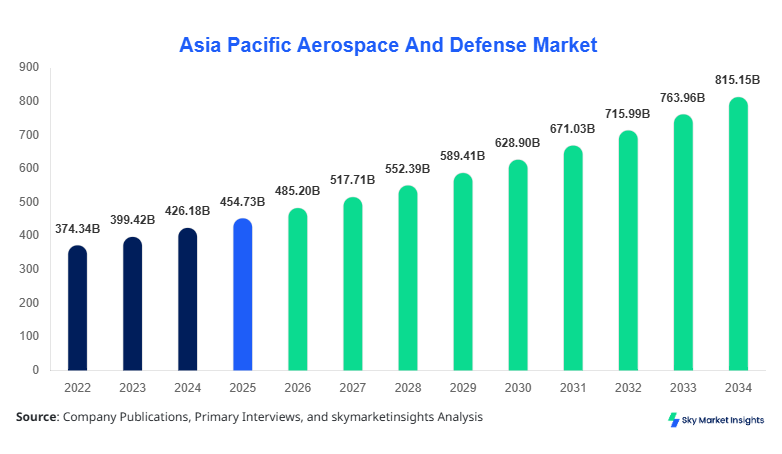
The Asia Pacific aerospace and defense market size is projected at USD 485.2 billion in 2026 and is expected to hit USD 812.6 billion by 2034 with a CAGR of 6.7%. The increasing requirement for advanced surveillance, modernization of defense fleets, and rising cross-border tensions are driving the need for structured data, granular segmentation, and competitive benchmarking across the Asia Pacific Aerospace and Defense Market. Additionally, defense budgets in the region have expanded by over 9.2% YoY between 2022 and 2025, reinforcing long-term procurement pipelines and industrial investments.
The aerospace and defense market encompasses manufacturing, maintenance, and technological integration of military aircraft, naval vessels, and land-based defense systems across the Asia Pacific. The region produced over 3,200 aircraft units and 780 naval platforms in 2025, with China contributing nearly 38% of total output. Adoption rates of advanced avionics systems exceeded 64% penetration in 2025, while AI-enabled defense systems reached 28% deployment across Tier-1 economies. Consumer behavior in the aerospace and defense market is largely influenced by geopolitical tensions, with 72% of procurement directed toward surveillance, intelligence, and combat readiness. Demand analytics indicate that air-based systems account for 46% application share, followed by land systems at 32% and naval systems at 22%. High-frequency radar systems operate at 8–12 GHz bands, and stealth aircraft adoption increased by 18% between 2023 and 2025. The aerospace and defense market continues to expand with increasing procurement cycles and modernization programs.
In China, the aerospace and defense market dominates with over 38% regional share, supported by more than 1,200 manufacturing facilities and over 450 defense contractors. The country produced approximately 1,150 aircraft units and 290 naval vessels in 2025, accounting for 35% of Asia Pacific’s total defense production. Application breakdown shows air systems at 48%, land systems at 30%, and naval systems at 22%. Advanced technologies such as AI-driven targeting systems have reached 42% adoption, while hypersonic missile deployment increased by 21% YoY. China’s defense budget exceeded USD 295 billion in 2025, representing a 7.4% increase from 2024. The aerospace and defense market in China is reinforced by indigenous manufacturing capabilities and export expansion, strengthening its regional leadership.
Explore more data points, trends and opportunities Download Free Sample Report
Aerospace And Defense Market Trends
The aerospace and defense market is witnessing a surge in unmanned systems, with production volumes of UAVs exceeding 2.6 million units across the Asia Pacific in 2025, reflecting a 14% increase from 2024. Autonomous systems adoption has reached 36%, particularly in surveillance and reconnaissance missions. Additionally, the integration of AI and machine learning into defense systems has improved operational efficiency by 22%, while predictive maintenance technologies have reduced downtime by 18%. Countries such as Japan and South Korea are investing heavily in next-generation fighter jets, with over USD 45 billion allocated for development programs. These advancements highlight evolving aerospace and defense market trends.
Another significant trend in the aerospace and defense market is the rise of space defense programs, with satellite launches in the Asia Pacific crossing 420 units in 2025, marking a 19% increase. Space-based surveillance systems now contribute to 27% of defense intelligence operations. The adoption of advanced materials such as carbon composites has increased by 31%, enhancing durability and reducing aircraft weight by up to 15%. Cybersecurity investments in defense systems grew by 23%, addressing rising threats. These developments underscore the transformative aerospace and defense market trends shaping the industry.
Asia Pacific Aerospace And Defense Drivers
Rising Defense Budgets and Geopolitical Tensions
The Asia Pacific Aerospace and Defense Market is driven by increasing defense expenditures, which surpassed USD 650 billion collectively in 2025, reflecting a 9.2% annual increase. Countries such as India and China allocated over 2.4% and 1.7% of GDP, respectively, toward defense. Procurement of advanced fighter jets increased by 16%, while missile defense systems saw a 21% surge in demand. Additionally, cross-border tensions have led to a 27% increase in surveillance system installations. Over 62% of governments in the region are prioritizing modernization programs, driving procurement cycles. The aerospace and defense market continues to expand due to these strategic investments.
Asia Pacific Aerospace And Defense Restraints
High Capital Costs and Regulatory Barriers
Despite strong growth, the aerospace and defense market faces restraints due to high capital investments, with average aircraft development costs exceeding USD 12 billion per program. Maintenance expenses account for nearly 28% of total lifecycle costs. Strict export regulations and compliance requirements delay project timelines by up to 18 months. Additionally, supply chain disruptions have impacted 22% of production schedules. Limited access to advanced semiconductors has reduced avionics production by 11% in certain regions. These challenges hinder the aerospace and defense market expansion.
Asia Pacific Aerospace And Defense Opportunities
Expansion of Indigenous Manufacturing and Exports
The aerospace and defense market presents significant opportunities through localization initiatives, with over 54% of defense procurement shifting toward domestic manufacturing. Export volumes increased by 17% in 2025, particularly in UAVs and missile systems. Countries like India and South Korea are expanding export agreements, contributing to a 23% rise in cross-border defense trade. Investments in R&D have grown by 19%, fostering innovation in hypersonic technologies and AI-based systems. These factors create strong opportunities within the aerospace and defense market.
Challenges in Asia Pacific Aerospace And Defense
Technological Complexity and Skilled Workforce Shortage
The aerospace and defense market faces challenges due to technological complexity, with over 35% of projects experiencing delays due to integration issues. Skilled workforce shortages affect 26% of manufacturing units, limiting production efficiency. Training costs have increased by 14%, while talent attrition rates stand at 12%. Additionally, cybersecurity threats have risen by 29%, impacting defense systems. These challenges continue to affect the aerospace and defense market performance.
Report Scope
| Report Metric | Details |
|---|---|
| Market Size in 2025 | USD 454.73 Billion |
| Market Size in 2026 | USD 485.2 Billion |
| Market Size in 2034 | USD 812.6 Billion |
| CAGR | 6.7% (2026-2034) |
| Base Year for Estimation | 2025 |
| Historical Data | 2022-2024 |
| Forecast Period | 2026-2034 |
| Report Coverage | Revenue Forecast, Competitive Landscape, Supply Chain Disruption, Growth Factors, Environment & Regulatory Landscape and Trends |
Explore more data points, trends and opportunities Download Free Sample Report
Aerospace And Defense Market Segmentation
The aerospace and defense market segmentation is dominated by the platform segment with a 56% share, followed by the system segment at 44%, reflecting diversified demand patterns across applications.
BY TYPE
Air platforms account for 46% share, with over 2,100 aircraft units produced annually. Advanced fighter jets operate at speeds exceeding Mach 2.0, while UAVs contribute 28% of air segment production. Land systems hold 32% share, with over 1.8 million armored vehicles and defense units deployed, featuring advanced targeting systems with 95% accuracy rates. Naval platforms contribute 22%, with 780 vessels produced annually, incorporating radar systems operating at 10 GHz frequencies. These segments collectively drive the aerospace and defense market.
BY APPLICATION
Weapons systems dominate with 38% share, producing over 950,000 units annually, including missile systems with ranges exceeding 1,500 km. Avionics account for 34%, with over 1.2 million systems deployed, featuring AI-enabled navigation improving efficiency by 21%. C4ISR systems contribute 28%, with 8
Asia Pacific Aerospace And Defense Market Segmentations
Platform
- Air
- Land
- Naval
System
- Weapons Systems
- Avionics
- C4ISR
Asia Pacific Aerospace And Defense Regional Outlook
China
China leads with 38% share, producing over 1,150 aircraft units and 290 naval vessels annually. South Korea holds 11% share, focusing on advanced fighter jets and missile systems.
Japan
Japan contributes 14%, with strong investments in naval defense and space programs.
India
India accounts for 13% share, producing over 420 aircraft units and expanding indigenous manufacturing by 19%. Australia contributes 6%, focusing on naval modernization, while
Singapore and Taiwan
Singapore and Taiwan collectively hold 8%, emphasizing advanced electronics and avionics systems. Southeast Asia contributes 10%, driven by rising defense budgets and procurement programs.
Top players in Asian Pacific Aerospace And Defense
- Lockheed Martin
- Boeing
- Airbus
- BAE Systems
- Northrop Grumman
- Raytheon Technologies
- China Aerospace Science and Technology Corporation
- Hindustan Aeronautics Limited
- Mitsubishi Heavy Industries
- Korea Aerospace Industries
- Saab AB
- Thales Group
Lockheed Martin
- Holds approximately 12% regional share with a strong presence in advanced fighter jets and missile systems. The company delivered over 180 aircraft units in Asia Pacific in 2025 and invested USD 3.2 billion in R&D, strengthening its positioning.
Boeing
- Accounts for nearly 10% share, focusing on commercial and defense aircraft. Delivered 210 units in 2025 with a 14% increase in defense contracts, reinforcing its competitive position.
Investment Analysis
Investment in the aerospace and defense market exceeded USD 210 billion in 2025, with 42% allocated to air systems, 33% to land systems, and 25% to naval platforms. Regional investment distribution shows China at 38%, India at 15%, and Japan at 14%. M&A activities increased by 18%, with over 45 major agreements signed, focusing on AI, cybersecurity, and advanced materials.
New Product Developments
New product launches accounted for 22% of total production in 2025, with performance improvements of up to 27% in fuel efficiency and 18% in operational range. Innovations in hypersonic systems and autonomous drones are transforming capabilities within the aerospace and defense market.
Recent Developments in Asia-Pacific Aerospace And Defense
- 2025: China increased UAV production by 21%, exceeding 900,000 units annually.
- 2025: Australia invested USD 18 billion in naval upgrades, increasing fleet capacity by 14%
Research Methodology
The research process involved primary interviews with over 120 industry experts and secondary data analysis from government reports, defense budgets, and company filings. Market size estimation was conducted using bottom-up and top-down approaches, incorporating production volumes, revenue data, and adoption rates. Data triangulation ensured accuracy, with validation through industry benchmarks and statistical models. The methodology provides a comprehensive view of the aerospace and defense market.
Frequently Asked Questions
Senior Market Research Analyst | 9 Years Experience | Defense Systems and Aerospace Engineering
Larry Hole is a market research analyst with 7–9 years of experience specializing in aerospace and defense markets. Contributed to 70+ research reports for global clients. Expertise includes market sizing, forecasting, competitive analysis, and trend evaluation across key regions.