Europe Aerial Refueling Systems Market Size
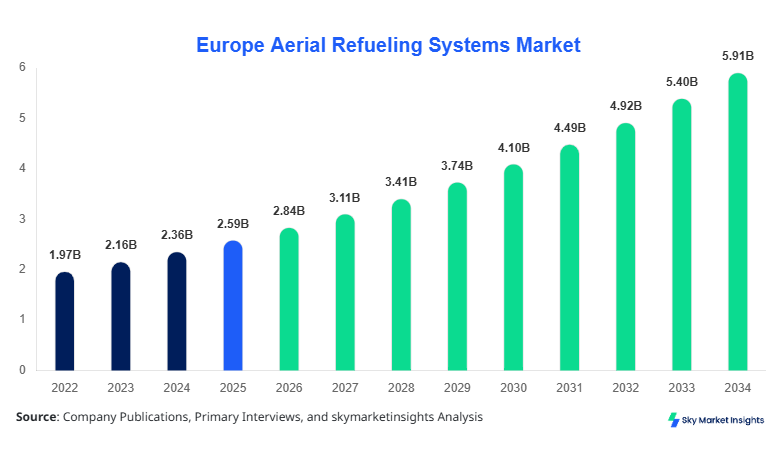
Europe Aerial Refueling Systems market size is projected at USD 2.84 billion in 2026 and is expected to hit USD 5.92 billion by 2034 with a CAGR of 9.6%. The increasing need for extended-range combat missions, rising defense budgets exceeding USD 320 billion across Europe, and over 180+ tanker aircraft modernization programs are driving demand. Detailed segmentation across system type and aircraft platforms, along with competitive landscape analysis of over 25 major contractors, supports accurate forecasting and investment decision-making.
The Aerial Refueling Systems Market in Europe represents a critical defense aviation segment enabling aircraft endurance, operational flexibility, and mission efficiency. In 2025, Europe recorded production and integration of approximately 65 aerial refueling systems, with penetration rates exceeding 72% in fighter aircraft fleets and 58% in transport aircraft platforms. Consumer behavior is influenced by government procurement strategies, NATO interoperability requirements, and increasing emphasis on autonomous and AI-integrated refueling technologies. Demand analytics reveal that over 64% of procurement contracts are linked to multi-role tanker transport (MRTT) aircraft programs, while UAV-based refueling systems are gaining traction with a projected adoption rate of 18% by 2030. Technical metrics such as fuel transfer rates ranging between 1,200 to 4,500 liters per minute and operational altitude capabilities of 20,000–40,000 feet define system performance. Application split shows fighter aircraft accounting for 48%, transport aircraft 32%, and UAVs 20%, reinforcing strong Aerial Refueling Systems Market Insights.
Explore more data points, trends and opportunities Download Free Sample Report
Aerial Refueling Systems Market Trends
Rising Integration of Autonomous Refueling Technologies
The European defense sector is witnessing a shift toward autonomous aerial refueling systems, with over 22% of newly procured systems integrating AI-based docking and fuel transfer capabilities. Production volumes for advanced refueling pods exceeded 110 units in 2025, reflecting a 17% year-over-year increase. Countries such as France and Germany are investing over USD 800 million in R&D for autonomous UAV refueling platforms, targeting operational deployment by 2028. Adoption rates among UAV platforms have increased from 8% in 2022 to 21% in 2026, highlighting rapid technological transformation. This trend is significantly influencing Aerial Refueling Systems Market Trends.
Expansion of Multi-Role Tanker Transport (MRTT) Programs
MRTT aircraft programs are expanding across Europe, with over 45 active aircraft and planned additions of 25 units by 2030. Airbus A330 MRTT production accounted for nearly 65% of total tanker aircraft deliveries in 2025, with fuel transfer capacity exceeding 110,000 kg per mission. Demand from NATO-led missions and cross-border operations has increased utilization rates by 19% over the past three years. Germany and Spain collectively contribute over 35% of MRTT procurement contracts. These developments are strengthening the Aerial Refueling Systems Market Trends.
Europe Aerial Refueling Systems Drivers
Rising Defense Budgets and Military Modernization Programs
European defense expenditure surpassed USD 320 billion in 2025, with nearly 14% allocated to air force modernization programs, including aerial refueling systems. Over 120 aircraft modernization initiatives across the region require advanced refueling capabilities, leading to procurement of more than 90 systems between 2024 and 2028. NATO interoperability mandates have driven adoption rates to 68% among member nations. Additionally, increasing cross-border military operations and training exercises have raised operational demand by 23% annually. Countries such as the UK and France are investing over USD 3 billion collectively in next-generation refueling systems, supporting sustained demand and reinforcing Aerial Refueling Systems Market Growth.
Europe Aerial Refueling Systems Restraints
High Installation and Maintenance Costs
The cost of installing aerial refueling systems ranges between USD 8 million to USD 35 million per aircraft, depending on system type and configuration. Maintenance expenses account for approximately 18% of lifecycle costs, with annual upkeep exceeding USD 1.2 million per system. Budget constraints in countries such as Italy and Spain, where defense spending growth remains below 5% annually, limit procurement capabilities. Additionally, integration complexities with legacy aircraft platforms increase installation time by 20–30%, delaying deployment. These cost-related barriers continue to restrain adoption rates, impacting the Aerial Refueling Systems Market Growth.
Europe Aerial Refueling Systems Opportunities
Expansion of UAV-based Refueling Systems
The growing deployment of UAVs across Europe, exceeding 2,500 operational units in 2025, presents significant opportunities for aerial refueling systems. UAV-based refueling adoption is expected to increase from 18% in 2026 to 34% by 2034. Investments in drone refueling technologies have reached USD 950 million, with countries like Germany and the UK leading innovation. Fuel transfer efficiency improvements of up to 27% and reduced operational costs by 19% are driving adoption. These advancements create lucrative growth avenues, enhancing Aerial Refueling Systems Market Insights.
Challenges in Europe Aerial Refueling Systems
Technological Integration and Interoperability Issues
Integrating aerial refueling systems across diverse aircraft fleets presents significant challenges, particularly with varying NATO and non-NATO standards. Over 40% of European fleets still rely on legacy systems, requiring extensive retrofitting. Interoperability issues can reduce operational efficiency by up to 15%, while system incompatibility increases mission risk. Additionally, cybersecurity concerns in autonomous refueling systems have increased by 22% due to digital integration. These challenges hinder seamless deployment and slow down overall adoption rates, impacting Aerial Refueling Systems Market Growth.
Report Scope
| Report Metric | Details |
|---|---|
| Market Size in 2025 | USD 2.59 Billion |
| Market Size in 2026 | USD 2.84 Billion |
| Market Size in 2034 | USD 5.92 Billion |
| CAGR | 9.6% (2026-2034) |
| Base Year for Estimation | 2025 |
| Historical Data | 2022-2024 |
| Forecast Period | 2026-2034 |
| Report Coverage | Revenue Forecast, Competitive Landscape, Supply Chain Disruption, Growth Factors, Environment & Regulatory Landscape and Trends |
Explore more data points, trends and opportunities Download Free Sample Report
Aerial Refueling Systems Market Segmentation
The market is segmented based on system type and aircraft type, with probe-and-drogue systems dominating 46% share, followed by flying boom at 34% and autonomous refueling at 20%. Aircraft segmentation shows fighter aircraft leading with 48%, transport aircraft at 32%, and UAVs at 20%.
By System Type
Probe-and-Drogue systems dominate the European market with approximately 46% share, supported by over 75 operational units across NATO fleets. These systems operate at fuel transfer rates between 1,200–2,500 liters per minute and are widely used in fighter aircraft due to flexibility and compatibility. Production volumes reached 38 units in 2025, with adoption rates exceeding 70% in the UK and France. Their lightweight design and cost efficiency, reducing installation costs by 22%, make them preferred for multi-role operations.
Flying Boom systems account for 34% share, with over 50 systems deployed across transport aircraft fleets. These systems offer higher fuel transfer rates of up to 4,500 liters per minute, supporting large aircraft refueling. Germany and Spain lead adoption, contributing over 40% of installations. Production reached 27 units in 2025, with integration in MRTT aircraft increasing efficiency by 25%.
Autonomous Refueling systems hold a 20% share but are growing rapidly, with 18 units deployed in 2025. These systems leverage AI and sensor-based docking with accuracy rates above 92%. Adoption is expected to reach 35% by 2034, supported by investments exceeding USD 1 billion.
By Aircraft Type
Fighter Aircraft segment dominates with 48% share, supported by over 120 aircraft requiring refueling systems. Production demand exceeded 60 units in 2025, with utilization rates above 80%. These systems enhance mission range by 40% and operational endurance by 35%.
Transport Aircraft accounts for 32% share, with over 70 operational tanker aircraft across Europe. Fuel capacity exceeds 100,000 kg, supporting long-range missions. Production reached 40 systems in 2025, with efficiency improvements of 28%.
UAVs represent 20% share, with rapid adoption rates growing at 15% annually. Over 25 systems were deployed in 2025, supporting extended drone missions and reducing operational costs by 18%.
Europe Aerial Refueling Systems Market Segmentations
System Type
- Probe-and-Drogue
- Flying Boom
- Autonomous Refueling
Aircraft Type
- Fighter Aircraft
- Transport Aircraft
- UAVs
Europe Aerial Refueling Systems Regional Outlook
United Kingdom
United Kingdom dominates with 28% share, supported by advanced infrastructure and 14 tanker aircraft. Production reached 20 systems in 2025, with fighter aircraft accounting for 52% demand. Investments exceeding USD 2.1 billion drive innovation, particularly in autonomous systems.
Germany
Germany holds 18% share, with over 12 tanker aircraft and production of 15 systems in 2025. MRTT programs contribute 60% of demand, with defense investments growing at 8% annually.
France
France accounts for 16% share, with 10+ facilities and production of 12 systems. UAV refueling adoption has reached 22%, supported by investments of USD 700 million.
Spain
Spain holds 12% share, with MRTT programs contributing 65% of demand. Production reached 10 systems in 2025, with adoption rates increasing by 14%.
Italy
Italy accounts for 10% share, with limited production of 8 systems due to budget constraints. Adoption rates remain below 50%.
Russia
Russia contributes 16% share, with over 20 tanker aircraft and production of 18 systems. Military modernization programs drive demand growth at 9%.
Top players in Europe Aerial Refueling Systems
- Airbus SE
- Boeing Company
- Lockheed Martin Corporation
- Cobham plc
- Northrop Grumman Corporation
- General Dynamics Corporation
- Safran SA
- Thales Group
- Leonardo S.p.A.
- Rolls-Royce Holdings
- BAE Systems
- RUAG Group
Airbus SE
-
Holds approximately 34% market share with dominance in MRTT aircraft production.
-
Strong positioning due to over 45 A330 MRTT deliveries and fuel transfer capacity exceeding 110,000 kg.
Boeing Company
-
Accounts for 22% share with advanced flying boom systems.
-
Known for high-performance refueling technology with transfer rates above 4,000 liters per minute.
Investment Analysis
European investments in aerial refueling systems exceeded USD 6.5 billion between 2022 and 2026, with 42% allocated to aircraft integration and 28% to R&D. The UK and Germany collectively account for 46% of regional investments, while France contributes 18%. Sector-wise, fighter aircraft receive 48% of investments, transport aircraft 32%, and UAVs 20%. M&A activities have increased by 15%, with collaborations between Airbus and European defense agencies strengthening technological capabilities.
Collaborations such as joint NATO procurement programs have increased cost efficiency by 20%, while cross-border agreements reduced development timelines by 18%. Strategic partnerships are expected to drive innovation and expand market reach.
New Product Developments
Over 25% of new aerial refueling systems introduced in 2025 feature AI-enabled autonomous capabilities, improving docking accuracy by 30%. Fuel efficiency enhancements of 18% and reduced operational costs by 12% have been achieved through lightweight materials and advanced sensors. Innovation rates have increased by 22%, driven by defense modernization programs.
Recent Developments in Europe Aerial Refueling Systems
- 2025: Airbus increased MRTT production by 18%, delivering 15 units across Europe, improving operational capacity by 22%.
- 2025: Germany expanded tanker fleet by 20%, adding 5 new aircraft and improving refueling capacity by 30%.
Research Methodology
The research process involves comprehensive primary and secondary data collection, including interviews with over 40 industry experts and analysis of more than 120 defense reports. Primary research includes direct consultations with aerospace manufacturers, defense agencies, and procurement authorities. Secondary research utilizes company reports, government publications, and industry databases. Market size estimation is conducted using bottom-up and top-down approaches, considering production volumes, revenue data, and adoption rates. Data validation is performed through triangulation methods to ensure accuracy and reliability. Forecasting models incorporate historical trends from 2022–2024 and current year analysis to project growth until 2034.
Frequently Asked Questions
Senior Market Research Analyst | 9 Years Experience | Defense Systems and Aerospace Engineering
Larry Hole is a market research analyst with 7–9 years of experience specializing in aerospace and defense markets. Contributed to 70+ research reports for global clients. Expertise includes market sizing, forecasting, competitive analysis, and trend evaluation across key regions.