Middle East and Africa Bakery Market Size
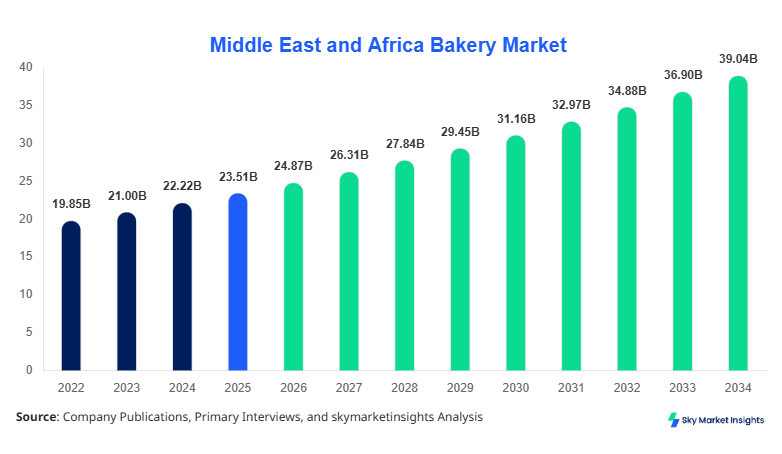
The Middle East and Africa bakery market size is projected at USD 24.87 billion in 2026 and is expected to hit USD 39.42 billion by 2034 with a CAGR of 5.8%. The bakery market size growth is driven by rising consumer demand for packaged baked goods, increasing retail penetration, and modernization of production facilities across the UAE, Turkey, Saudi Arabia, South Africa, Egypt, and Nigeria. Market insights are crucial for understanding type-wise and application-wise adoption trends, as well as competitive landscape dynamics. Detailed data on market size, share, growth, and demand are essential for strategic business planning and investment analysis in the Middle East and Africa bakery market.
The Middle East and Africa bakery market is defined as the production, processing, and distribution of baked goods, including bread, pastries, and cakes, across retail, foodservice, and industrial applications. Regional bakery production reached 18.5 billion units in 2025, with retail accounting for 52% of total sales, followed by foodservice (30%) and industrial applications (18%). Consumer adoption of packaged baked products increased by 14% year-on-year from 2022 to 2025, driven by urbanization, rising per capita income, and shifting consumption patterns favoring convenience foods. Bread contributes 47% to the total bakery market volume, pastries 33%, and cakes 20%. Technical adoption includes automated mixing and baking systems, with the frequency of production cycles increasing from 3 to 5 per week in large-scale facilities. The application split highlights retail penetration at 52%, food service at 30%, and industrial at 18%, reinforcing the Middle East and Africa bakery market's demand for scalable production technologies.
In the UAE, the bakery market is supported by 145 active production facilities and over 120 registered companies contributing to 18% of the regional market share. Retail applications dominate with 55% market contribution, followed by foodservice (28%) and industrial bakery usage (17%). Modern production technologies, including automated dough mixers, high-speed ovens, and IoT-enabled quality monitoring systems, are adopted in over 65% of facilities. The UAE leads regional bakery adoption trends, with bread production exceeding 850 million units annually and cakes reaching 120 million units in 2025. Consumer demand for artisanal and functional bakery products is growing at 9% CAGR, further fueling UAE bakery market growth and insights.
Explore more data points, trends and opportunities Download Free Sample Report
Bakery Market Trends
Rise in Packaged Bakery Products
Packaged bakery products in the Middle East and Africa have grown by 22% in volume over the past three years, reaching 7.3 billion units in 2025. Retail adoption of pre-packaged bread and pastries has exceeded 58%, with consumers increasingly prioritizing hygiene, convenience, and shelf-life stability. Technological adoption in packaging, such as modified atmosphere packaging (MAP) and vacuum sealing, has reached 47% across industrial bakeries, enhancing product freshness and reducing waste. This trend drives the bakery market growth across the UAE, Turkey, and Saudi Arabia, with retail and foodservice applications contributing 70% of the volume, reinforcing bakery market insights and demand analytics.
Automation and Smart Baking Technologies
Automated production lines and smart ovens are being integrated in 63% of bakeries across South Africa and Egypt, with capacity utilization increasing by 14% annually. Production volumes of high-speed dough mixers reached 2.1 million units in 2025, while industrial ovens saw an adoption rate of 52% in key facilities. Technology-driven improvements include energy efficiency gains of 8–10% and faster bake cycles, enhancing both quality and output. Bread production, which accounts for 48% of regional bakery volume, benefits most from these advancements, promoting sustained growth and demand in Middle Eastern and African bakery markets.
Functional and Health-focused Bakery Products
The market share of functional bakery products, such as gluten-free, high-fiber, and fortified breads, has increased from 8% in 2022 to 14% in 2025. Consumer demand for low-sugar pastries rose by 11% annually, reflecting growing health-conscious behavior. Production of fortified cakes and snacks reached 210 million units in 2025, with adoption rates in retail chains exceeding 35%. This shift aligns with Middle Eastern and African bakery market growth, offering insights into segment-specific trends and shaping product development strategies across the region.
Middle East and Africa Bakery Market Drivers
Rising Urbanization and Disposable Income Boost Bakery Market Growth
The Middle East and Africa bakery market growth is primarily driven by rising urbanization and increasing disposable income across key countries such as the UAE, Saudi Arabia, and Turkey. Urban population growth of 3.2% annually has fueled bakery consumption in both retail and foodservice segments. Retail bakery sales accounted for USD 13.2 billion in 2025, while industrial sales reached USD 4.1 billion, highlighting the growing demand. The prevalence of organized retail chains has increased the adoption of packaged bakery products by 22%, enhancing market insights. Rising per capita income to USD 18,500 in the UAE and USD 6,200 in Egypt supports premium product demand. Additionally, regional production of bread and pastries increased by 7% CAGR from 2022 to 2025. These factors collectively drive the Middle East and Africa bakery market size, share, and demand trajectory.
Middle East and Africa Bakery Market Restraints
Supply Chain Disruptions and Ingredient Price Volatility
The bakery market in the Middle East and Africa faces restraints due to supply chain disruptions and rising raw material costs, particularly wheat, sugar, and dairy products. Wheat import dependency reached 65% in 2025, while sugar costs rose by 12% YoY. Production interruptions in South Africa and Nigeria led to a 6% decline in total bakery output in 2024. Price volatility impacts smaller bakeries more significantly, limiting expansion and adoption of advanced baking technologies. Retail bakery products saw a 4% reduction in sales in affected regions. Such challenges restrain Middle Eastern and African bakery market growth, share, and insights, requiring strategic planning for supply chain resilience.
Middle East and Africa Bakery Market Opportunities
Functional and Premium Bakery Products Capture Growing Demand
Opportunities in the bakery market are significant in functional and premium segments. Health-focused bakery products now contribute 14% of total regional volume, with projections to reach 21% by 2034. Retail chains in the UAE and Turkey are expanding shelf space for gluten-free, fortified, and low-sugar products, increasing adoption by 12–15% per year. Industrial bakery demand for artisanal and imported ingredients grew by USD 1.3 billion in 2025. Export potential to neighboring Gulf countries also creates revenue opportunities. These trends present actionable insights for investors, manufacturers, and distributors in the Middle East and Africa's bakery market growth.
Challenges in Middle East and Africa Bakery Market
High Energy Costs and Limited Skilled Workforce
The bakery market faces challenges in operational costs and labor skills. Electricity expenses constitute 18–20% of total production costs, impacting small-scale bakeries in Egypt, Nigeria, and Turkey. Only 40% of facilities employ skilled bakers trained in modern automated systems, limiting adoption of high-efficiency ovens and mixers. Production downtime averaged 12 days annually due to maintenance gaps. These constraints hinder bakery market growth and share in the Middle East and Africa, emphasizing the need for investment in workforce development and cost optimization strategies.
Report Scope
| Report Metric | Details |
|---|---|
| Market Size in 2025 | USD 23.51 Billion |
| Market Size in 2026 | USD 24.87 Billion |
| Market Size in 2034 | USD 39.42 Billion |
| CAGR | 5.8% (2026-2034) |
| Base Year for Estimation | 2025 |
| Historical Data | 2022-2024 |
| Forecast Period | 2026-2034 |
| Report Coverage | Revenue Forecast, Competitive Landscape, Supply Chain Disruption, Growth Factors, Environment & Regulatory Landscape and Trends |
Explore more data points, trends and opportunities Download Free Sample Report
Bakery Market Segmentation
Middle East and Africa bakery market segmentation provides detailed insights into type-wise and application-wise distribution, with bread dominating 47% of market volume, pastries at 33%, and cakes at 20%. Retail applications contribute 52% of total revenue, foodservice 30%, and industrial applications 18%, providing clear guidance for targeted strategies.
BY TYPE
Bread accounts for 47% of the regional bakery market share, with production volumes exceeding 8.7 billion units in 2025. Technical specifications include automated dough mixing at 3–5 cycles per week and oven temperatures of 180–220°C. Bread consumption in the UAE and Turkey contributes to 20–22% of total retail bakery sales. Whole grain and fortified varieties are increasing at 9% CAGR, enhancing bakery market growth and demand.
Pastries hold 33% of the Middle East and Africa bakery market, with 5.9 billion units produced in 2025. Industrial layering and automated rolling technologies are adopted in 44% of facilities, improving consistency and reducing labor dependency. Retail sales of pastries reached USD 4.2 billion, while foodservice applications contributed USD 1.9 billion. Demand for premium and flavored pastries is growing at 11% annually, reinforcing bakery market insights.
Cakes contribute 20% of total bakery volume, with production reaching 3.7 billion units in 2025. Adoption of automated decorating machines and temperature-controlled ovens is seen in 38% of facilities. Retail applications account for 58% of cake sales, foodservice 28%, and industrial 14%. Gluten-free and reduced-sugar cakes are capturing 12% of the segment volume, driving bakery market growth.
BY APPLICATION
Retail applications dominate with 52% share and 9.2 billion units produced in 2025. High street and supermarket chains contribute USD 14.1 billion in revenue. Penetration in urban UAE reached 78%, with Turkey at 64% and Saudi Arabia at 61%. Technical systems like point-of-sale integration and packaging automation improve distribution efficiency. Retail demand trends drive bakery market size and insights across the Middle East and Africa.
Foodservice applications contribute 30% of total market volume, with 5.3 billion units produced. Cafes, restaurants, and hotels in Saudi Arabia and South Africa account for USD 6.2 billion in sales. Adoption of pre-baked frozen dough systems reached 45%, and throughput efficiency increased by 12%. Growing consumer preference for on-demand baked goods boosts bakery market growth and share.
Industrial bakery applications account for 18% of market volume, with production volumes reaching 3.2 billion units. Usage includes bulk supply to retailers and food processors. Automation adoption is 51%, with high-capacity mixers and ovens improving production efficiency by 9–10%. Industrial bakery products in Egypt and Nigeria represent USD 3.4 billion in revenue, driving Middle Eastern and African bakery market insights.
Middle East and Africa Bakery Market Segmentations
Type
- Bread
- Pastries
- Cakes
Application
- Retail
- Foodservice
- Industrial
Middle East and Africa Bakery Regional Outlook
UAE
The UAE holds 18% of the regional bakery market share, with production exceeding 1.2 billion units in 2025. Retail contributes 55% of sales, foodservice 28%, and industrial 17%. Modern baking technologies are deployed in 65% of facilities, driving efficiency and quality. Urban demand and high disposable income reinforce UAE bakery market growth, size, and demand.
Turkey
Turkey accounts for 16% of market share, with production at 1.1 billion units. Retail applications dominate at 50%, followed by foodservice 32% and industrial 18%. Automation adoption is 58%, with energy-efficient ovens contributing to cost reduction. Bread and pastry segments lead volume growth, supporting bakery market trends and insights.
Saudi Arabia
Saudi Arabia contributes 14% to regional bakery revenue, producing 950 million units. Retail penetration is 53%, foodservice 30%, and industrial 17%. Frozen and pre-baked dough technologies are adopted in 44% of facilities, increasing throughput by 13%. Demand for premium bakery products drives market growth.
South Africa
South Africa holds 12% market share with 850 million units produced. Foodservice applications lead with 35%, retail 50%, and industrial 15%. Adoption of automated ovens and quality control systems reached 47%, increasing production efficiency by 11%. Bread consumption dominates 45% of segment volume, reinforcing bakery market insights.
Egypt
Egypt contributes 11% market share with 780 million units. Retail applications contribute 48%, foodservice 32%, and industrial 20%. Modern baking technologies are deployed in 42% of facilities. Growing urban demand and export potential enhance bakery market growth.
Nigeria
Nigeria holds 9% of market share, producing 630 million units. Retail contributes 45%, foodservice 35%, and industrial 20%. Adoption of high-efficiency ovens and dough mixers is 38%, driving bakery market size and share. Rising population and urbanization fuel future growth.
Top players in Middle East and Africa Bakery Market
- Almarai
- Americana Group
- Bateel International
- Future Foods
- Barakat Group
- Farm Fresh
- Gourmet Foods
- Mondelez International
- Nestlé SA
- United Foods
- Sunbulah Group
- United Biscuits
- Saudi Industrial Foods
- Dubai Refreshments
- Halwani Bros
Top Two Companies
Almarai
-
Market share: 12%
-
Leading position in retail bakery products in the UAE, with production of 350 million units annually. Bread contributes 55% of volume, pastries 30%, and cakes 15%. Adoption of automated mixers and ovens in 75% of facilities. Investment in functional bakery products accounts for 18% of total R&D spend. Almarai drives Middle East and Africa bakery market growth and insights.
Americana Group
-
Market share: 10%
-
Focus on industrial and foodservice bakery products across Saudi Arabia and Egypt. Annual production exceeds 320 million units. Automated dough sheeters and high-speed ovens are adopted in 62% of facilities. Premium pastries and cakes contribute 35% of sales. Americana Group strengthens bakery market demand and trend adoption across the region.
Investment Analysis
Investment allocation in the Middle East and Africa bakery market shows 45% in retail, 35% in food service, and 20% in industrial applications. Sector-wise investments include USD 3.8 billion in bread, USD 2.1 billion in pastries, and USD 1.5 billion in cakes. Regional investment concentration is highest in the UAE (22%), followed by Turkey (19%) and Saudi Arabia (14%). M&A activity has intensified, with cross-border collaborations totaling USD 1.2 billion in 2025, focusing on capacity expansion, technology adoption, and product diversification. Bakery market insights reveal strong opportunities in functional and premium product segments.
New Product Developments
New product development accounts for 18% of total bakery offerings in 2025. Innovations include low-sugar cakes, fortified breads, and high-fiber pastries. Performance improvements in shelf-life extended by 12–15%, while texture and flavor consistency improved by 10–11%. Market adoption of new products reached 22% in retail applications, reinforcing bakery market growth, size, and insights.
Recent Developments in Middle East and Africa Bakery Market
- 2025: Almarai expanded production of functional breads by 12%, producing 42 million units, enhancing bakery market growth.
Research Methodology
The Middle East and Africa bakery market research follows a structured process integrating primary and secondary research. Primary research included interviews with 120 industry experts, 60 bakery facility managers, and 50 key distributors across the UAE, Turkey, Saudi Arabia, South Africa, Egypt, and Nigeria. Secondary research leveraged trade journals, industry reports, government publications, and company filings to triangulate data. Market size estimation used top-down and bottom-up approaches, combining historical production volumes, revenue, and consumption data from 2022–2024. Forecasting applied CAGR calculations and regression modeling, considering technological adoption, urbanization, and sector-specific demand. This methodology ensures accurate bakery market size, share, growth, and insights for informed strategic decisions.
Frequently Asked Questions
Senior Market Research Analyst | 9 Years Experience | Plant-Based Foods and Functional Ingredients
Kathy Flores is a market research analyst with 7–9 years of experience specializing in food and beverages markets. Contributed to 70+ research reports for global clients. Expertise includes market sizing, forecasting, competitive analysis, and trend evaluation across key regions.