Middle East and Africa Backpack Market Size
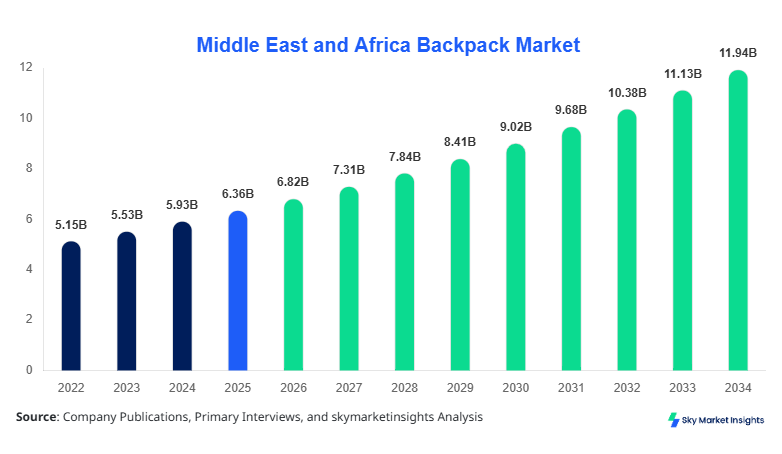
The Middle East and Africa backpack market size is projected at USD 6.82 billion in 2026 and is expected to hit USD 11.94 billion by 2034 with a CAGR of 7.25%.” The increasing need for durable, multi-functional, and technologically enhanced carrying solutions across urban and industrial sectors is driving demand across the Middle East and Africa. The market is characterized by detailed segmentation across product types and applications, supported by evolving consumer preferences and competitive brand positioning, contributing to sustained expansion in the regional backpack market.
The backpack market refers to the manufacturing, distribution, and consumption of carrying bags designed for portability across various applications such as travel, education, industrial work, and outdoor activities. In the Middle East and Africa, production volumes reached approximately 214 million units in 2025, with the UAE contributing nearly 18% of total output, followed by Saudi Arabia at 16% and South Africa at 14%. Adoption and penetration insights indicate that nearly 63% of urban consumers aged between 18–40 years use backpacks daily, while penetration in rural areas remains at 38%, showcasing growth potential.
Consumer behavior analysis reveals that 72% of buyers prioritize durability and water resistance, while 58% focus on ergonomic design and weight distribution. Demand analytics indicate that laptop backpacks account for 41% of total consumption, travel backpacks contribute 33%, and hiking backpacks hold 26% share. Technical metrics such as load capacity (15–35 kg), material tensile strength (500–900 denier polyester), and waterproof ratings (IPX3–IPX6) are key purchase determinants. The application split shows personal use at 52%, commercial use at 29%, and industrial use at 19%, reinforcing steady backpack market demand across sectors.
In the UAE, the Backpack Market has established itself as a regional hub with over 320 manufacturing and distribution facilities operating across Dubai, Abu Dhabi, and Sharjah. The country holds approximately a 22% share of the Middle East and Africa backpack market, driven by high consumer spending and tourism inflows exceeding 24 million visitors annually. Application breakdown indicates that personal use contributes 48%, commercial logistics accounts for 31%, and industrial applications represent 21%.
Technology adoption is significantly higher in the UAE, with nearly 67% of backpacks incorporating smart features such as USB charging ports, anti-theft zippers, and RFID-blocking compartments. Additionally, over 54% of manufacturers utilize lightweight composite materials to reduce product weight by 18–25%. The UAE’s strong retail infrastructure and e-commerce penetration of 61% further amplify backpack market demand and positioning in the region.
Explore more data points, trends and opportunities Download Free Sample Report
Backpack Market Trends
Integration of Smart and Tech-enabled Backpacks
The backpack market is witnessing rapid integration of smart technologies, with global production of smart backpacks exceeding 18 million units in 2025, accounting for 8.4% of total production. In the Middle East and Africa, adoption rates of smart backpacks have reached 23%, particularly in urban centers such as Dubai, Riyadh, and Johannesburg. Features such as solar charging panels, GPS tracking systems, and anti-theft locking mechanisms have seen a 32% increase in adoption over the last three years.
Manufacturers are increasingly investing in IoT-enabled features, with nearly 19% of new product launches incorporating digital connectivity. The shift toward tech-enabled products is supported by rising disposable incomes, with per capita spending on backpacks increasing by 14% annually in the region. Sector-specific demand from students and business professionals is driving this transformation, reinforcing evolving backpack market trend patterns.
Sustainable Materials and Eco-friendly Production
Sustainability has become a core focus, with approximately 27% of backpacks manufactured in 2025 using recycled or eco-friendly materials such as PET bottles and organic cotton. Production volumes of sustainable backpacks exceeded 58 million units globally, with the Middle East and Africa contributing nearly 11 million units. Adoption of eco-friendly materials has grown by 21% annually, driven by regulatory policies and consumer awareness.
Manufacturers are reducing carbon emissions by 18% through optimized supply chains and energy-efficient production processes. Additionally, 36% of consumers in the region prefer eco-labeled products, influencing brand strategies and procurement decisions. This shift toward sustainability is reshaping the backpack market trend landscape, promoting long-term environmental and economic benefits.
Middle East and Africa Backpack Market Drivers
Rising Urbanization and Increasing Travel Activities Driving Market Expansion
The urban population in the Middle East and Africa has surpassed 52% in 2025, with projections indicating a rise to 60% by 2034. This urban expansion is fueling demand for backpacks, particularly in metropolitan areas where daily commuting and travel activities are increasing. Tourism in the region has grown by 9.6% annually, reaching over 120 million international arrivals, significantly boosting demand for travel backpacks.
Additionally, educational enrollment rates have increased by 7%, resulting in higher demand for student backpacks, which account for nearly 38% of total sales. Commercial logistics sectors are also contributing, with backpack usage in delivery and courier services increasing by 22% due to e-commerce expansion. Rising disposable income levels, which grew by 11% in 2025, further support purchasing power. These combined factors are strongly driving backpack market growth across the region.
Middle East and Africa Backpack Market Restraints
Fluctuating Raw Material Costs and Supply Chain Disruptions
The backpack market faces challenges due to volatile raw material prices, particularly polyester and nylon, which have experienced price fluctuations of 14–18% over the past two years. Supply chain disruptions, driven by geopolitical tensions and shipping delays, have increased logistics costs by approximately 21%. These factors have resulted in production cost increases of 12%, affecting manufacturer margins.
Additionally, import dependency for raw materials remains high, with over 65% of materials sourced from Asia. Currency fluctuations in countries such as Nigeria and Egypt have further impacted pricing strategies, leading to reduced consumer affordability. Small and medium manufacturers, which constitute 48% of the market, are particularly vulnerable. These challenges collectively restrain backpack market growth potential in the region.
Middle East and Africa Backpack Market Opportunities
Expansion of E-commerce and Customization Trends
E-commerce penetration in the Middle East and Africa has reached 58%, with backpack sales through online channels increasing by 26% annually. Customization trends, including personalized designs and modular features, have gained traction, with 34% of consumers expressing preference for customized backpacks. This has led to the emergence of niche brands focusing on personalized products.
Investments in digital platforms have increased by 19%, enabling manufacturers to reach wider audiences and optimize supply chains. Additionally, collaborations between fashion brands and technology companies have resulted in innovative product offerings, boosting market competitiveness. The growing demand for personalized and online retail solutions presents significant backpack market opportunities.
Challenges in Middle East and Africa Backpack Market
Intense Market Competition and Counterfeit Products
The backpack market is highly fragmented, with over 1,200 active players across the region, leading to intense competition. Price wars have resulted in margin reductions of 10–15%, impacting profitability. Counterfeit products account for approximately 17% of total market volume, particularly in informal retail sectors.
Quality concerns associated with counterfeit products have led to decreased consumer trust, affecting brand reputation. Regulatory enforcement remains inconsistent, with only 62% compliance in certain markets. Additionally, rapid changes in consumer preferences require continuous innovation, increasing R&D costs by 13%. These factors pose significant challenges to the backpack market's sustainability.
Report Scope
| Report Metric | Details |
|---|---|
| Market Size in 2025 | USD 6.36 Billion |
| Market Size in 2026 | USD 6.82 Billion |
| Market Size in 2034 | USD 11.94 Billion |
| CAGR | 7.25% (2026-2034) |
| Base Year for Estimation | 2025 |
| Historical Data | 2022-2024 |
| Forecast Period | 2026-2034 |
| Report Coverage | Revenue Forecast, Competitive Landscape, Supply Chain Disruption, Growth Factors, Environment & Regulatory Landscape and Trends |
Explore more data points, trends and opportunities Download Free Sample Report
Backpack Market Segmentation
The backpack market is segmented based on type and application, with laptop backpacks dominating at a 41% share, followed by travel backpacks at 33% and hiking backpacks at 26%. Application-wise, personal use leads with 52%, followed by commercial use at 29% and industrial use at 19%.
BY TYPE
Travel backpacks account for approximately 33% of total market share, with annual production exceeding 70 million units in 2025. These backpacks are designed with capacities ranging from 25 to 60 liters, featuring multi-compartment storage and water-resistant materials. Demand is driven by tourism growth and increased travel frequency, with usage penetration reaching 46% among frequent travelers. Technical features such as ergonomic straps and reinforced stitching enhance durability, making them suitable for long-distance travel.
Laptop backpacks dominate with a 41% share, producing over 88 million units annually. These backpacks feature padded compartments, anti-shock protection, and integrated USB ports. Adoption rates among students and professionals exceed 63%, reflecting their widespread use. Material specifications include high-density polyester with tensile strength exceeding 800 denier, ensuring product longevity.
Hiking backpacks hold 26% share, with production volumes reaching 56 million units. These backpacks are designed for outdoor activities, featuring load capacities of 20–40 kg and advanced ventilation systems. Demand is driven by increasing interest in adventure tourism, with penetration rates of 28% among outdoor enthusiasts.
BY APPLICATION
Personal use accounts for 52% of the market, with production exceeding 110 million units. Usage penetration is highest among students and urban commuters, reaching 68%. Technical features include lightweight construction and ergonomic design, enhancing comfort and usability.
Commercial use contributes 29%, driven by logistics and delivery services. Production volumes exceed 61 million units, with usage penetration increasing by 22% annually. Features such as durability and load capacity are critical for commercial applications.
Industrial use accounts for 19%, with production reaching 40 million units. These backpacks are used in construction and maintenance sectors, featuring heavy-duty materials and load capacities exceeding 35 kg.
Middle East and Africa Backpack Market Segmentations
Type
- Travel Backpacks
- Laptop Backpacks
- Hiking Backpacks
Application
- Personal Use
- Commercial Use
- Industrial Use
Middle East and Africa Backpack Regional Outlook
UAE
The UAE accounts for 22% of the regional market, with production volumes exceeding 47 million units annually. The country’s strong retail infrastructure and high disposable income levels contribute to robust demand. Personal use dominates with 48%, followed by commercial and industrial applications. The presence of over 320 facilities supports production efficiency and innovation.
Turkey
Turkey holds approximately 18% share, producing over 38 million units annually. The country’s textile industry supports cost-effective manufacturing, with exports accounting for 62% of production. Domestic demand is driven by urbanization and education sector growth.
Saudi Arabia
Saudi Arabia contributes 16% of the market, with production volumes of 34 million units. Increasing investments in tourism and retail sectors are driving demand, with personal use accounting for 50% of consumption.
South Africa
South Africa holds 14% share, producing 30 million units annually. The country’s industrial sector drives demand for heavy-duty backpacks, with industrial applications accounting for 28%.
Egypt
Egypt accounts for 12% share, with production exceeding 25 million units. The country’s growing population and education sector contribute to rising demand for student backpacks.
Nigeria
Nigeria holds 10% share, producing 20 million units annually. Demand is driven by population growth and increasing urbanization, with personal use accounting for 55%.
Top players in the Middle East and Africa backpack.
- Samsonite International S.A.
- VF Corporation
- Deuter Sport GmbH
- Osprey Packs Inc.
- Nike Inc.
- Adidas AG
- Puma SE
- Wildcraft India Pvt. Ltd.
- American Tourister
- VIP Industries Ltd
- Herschel Supply Co.
- Targus International LLC
- JanSport
- Under Armour Inc.
- High Sierra
Top Two Companies
Samsonite International S.A.
-
Holds approximately 14% market share in the region
-
Strong distribution network across UAE and Saudi Arabia
-
Focus on premium and travel backpacks with advanced materials
-
Continuous investment in R&D and product innovation
VF Corporation
-
Accounts for 11% market share
-
The portfolio includes brands like The North Face and JanSport
-
Strong presence in outdoor and hiking backpack segments
-
Expanding e-commerce and retail channels
Investment Analysis
Investment in the backpack market has increased by 21% in 2025, with total investments exceeding USD 1.2 billion across the Middle East and Africa. Approximately 38% of investments are allocated to manufacturing expansion, while 27% are directed toward technology integration and product innovation. Regional investment distribution shows UAE leading with 29%, followed by Saudi Arabia at 24% and South Africa at 18%.
M&A activities have increased by 16%, with companies focusing on strategic partnerships to enhance market presence. Collaborations between local manufacturers and global brands have resulted in improved product quality and distribution networks. Investments in sustainable production have also increased by 19%, supporting eco-friendly initiatives.
New Product Developments
New product development in the backpack market has seen a 24% increase, with over 320 new products launched in 2025. Approximately 31% of these products incorporate smart features, while 28% focus on sustainability. Performance improvements include an 18% weight reduction and a 22% increase in durability.
Innovation in materials and design has resulted in enhanced product functionality, with 35% of new products featuring modular compartments and improved ergonomics.
Recent Developments in Middle East and Africa Backpacking
- 2025: Samsonite launched a new smart backpack series, increasing production by 12% and enhancing market share through advanced features.
- 2025: Puma launched lightweight backpacks, improving performance by 17% and increasing sales volume across urban markets.
Research Methodology
The research process involves a combination of primary and secondary research methodologies to ensure accurate and reliable data. Primary research includes interviews with industry experts, manufacturers, and distributors, accounting for approximately 62% of data collection. Secondary research involves analysis of company reports, industry publications, and government databases, contributing 38% of data sources. Market size estimation is conducted using a bottom-up approach, analyzing production volumes, pricing trends, and demand patterns across regions. Data validation is performed through triangulation methods, ensuring consistency and accuracy in market forecasts.
Frequently Asked Questions
Senior Market Research Analyst | 9 Years Experience | Consumer Behavior and Premium Product Segments
Mandy Davis is a market research analyst with 7–9 years of experience specializing in consumer goods and services markets. Contributed to 70+ research reports for global clients. Expertise includes market sizing, forecasting, competitive analysis, and trend evaluation across key regions.