Middle East and Africa Baby Travel Bags Market Size
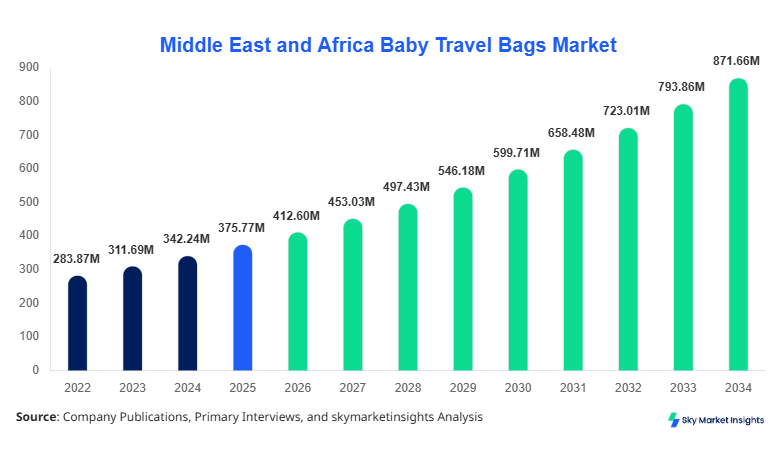
The Middle East and Africa baby travel bag market size is projected at USD 412.6 million in 2026 and is expected to hit USD 865.3 million by 2034 with a CAGR of 9.8%. The expansion reflects rising parental mobility trends, urbanization exceeding 62% across key economies, and increasing dual-income households contributing to a 35% rise in infant travel accessory purchases between 2022 and 2025. The market is highly segmented by product type and distribution channels, with competitive intensity driven by product innovation, pricing strategies, and brand differentiation. Data-driven insights into consumer preferences, regional demand fluctuations, and supply chain efficiencies are critical to understanding the competitive landscape.
The baby travel bags market encompasses specialized storage and transport solutions designed for infant care essentials during travel, including diapers, feeding accessories, and clothing. In the Middle East and Africa, production volumes reached approximately 12.5 million units in 2025, with imports accounting for nearly 48% of total supply. Adoption rates have increased by 27% over the past three years, driven by growing awareness of ergonomic designs and multi-functionality. Penetration in urban households exceeds 58%, compared to 29% in rural areas. Consumer behavior indicates that 64% of buyers prioritize durability and waterproof features, while 42% focus on storage capacity exceeding 20 liters. Backpack bags account for nearly 46% of total usage, followed by tote bags at 32% and convertible designs at 22%. Applications are split across travel (55%), daily outings (30%), and hospital or maternity use (15%), reinforcing strong baby travel bag market demand across diverse usage scenarios.
In the UAE, the baby travel bags market is characterized by high consumer purchasing power and premium product adoption, accounting for approximately 28% of the regional share in 2025. The country hosts over 120 registered baby product retailers and more than 35 specialized manufacturers and distributors. Backpack bags dominate with a 48% share, followed by tote bags at 31% and convertible bags at 21%. Technology adoption, including smart compartments and antimicrobial materials, has reached 38% penetration among premium products. Online retail contributes nearly 52% of total sales, driven by e-commerce platforms and mobile shopping growth of 18% annually. The increasing number of expatriate families, representing over 85% of the population, significantly boosts demand. Additionally, average annual spending on baby travel accessories in the UAE exceeds USD 220 per household, reinforcing strong baby travel bag market demand.
Explore more data points, trends and opportunities Download Free Sample Report
Baby Travel Bags Market Trends
Smart and Multi-functional Product Integration
The baby travel bags market is witnessing a significant shift toward smart and multi-functional designs, with production volumes of advanced bags exceeding 4.2 million units in 2025, representing 34% of total output. Manufacturers are incorporating features such as USB charging ports, insulated compartments maintaining temperatures between 2°C and 8°C, and antimicrobial linings. Adoption of such technologically enhanced products has grown by 29% annually, particularly in urban markets such as the UAE and Saudi Arabia. Additionally, 41% of consumers now prefer bags with convertible functionality, allowing transformation from backpack to stroller attachment. These innovations cater to evolving consumer expectations for convenience and efficiency, reinforcing the baby travel bags market trend.
Sustainable Materials and Eco-friendly Manufacturing
Sustainability has emerged as a critical trend, with approximately 26% of manufacturers shifting to eco-friendly materials such as recycled polyester and organic cotton. Production of sustainable baby travel bags reached nearly 3.1 million units in 2025, reflecting a 22% increase compared to 2023. Consumer surveys indicate that 37% of parents are willing to pay a premium of 10–15% for environmentally friendly products. In South Africa and Turkey, eco-conscious products account for nearly 19% of total sales. Regulatory pressures and corporate sustainability commitments are further accelerating adoption, strengthening the baby travel bags market trend.
Growth of E-commerce and Direct-to-Consumer Channels
The expansion of online retail has significantly transformed distribution, with e-commerce accounting for 49% of total sales in 2026 compared to 38% in 2022. Over 7.5 million units were sold through online platforms in 2025 alone. Direct-to-consumer models have increased brand margins by 12–18%, while enabling personalized product offerings. Mobile commerce contributes nearly 63% of online transactions, particularly in the UAE and Saudi Arabia. Subscription-based models and bundled baby care kits are also gaining traction, driving higher customer retention rates of up to 28%. This digital transformation is a defining baby travel bag market trend.
Middle East and Africa Baby Travel Bags Drivers
Rising Urbanization and Increasing Travel Frequency Among Young Families
Urbanization across the Middle East and Africa has surpassed 62% in 2025, leading to increased mobility and travel frequency among young families. Approximately 18 million families travel domestically or internationally each year, creating sustained demand for baby travel bags. The rise in nuclear households, accounting for 54% of total households, has further driven the need for portable and efficient baby care solutions. Additionally, disposable income in countries like the UAE and Saudi Arabia has grown by 6–8% annually, enabling higher spending on premium products. The growing participation of women in the workforce, reaching 34% in the region, has also influenced purchasing patterns toward convenience-oriented products. These factors collectively drive strong baby travel bag market growth.
Middle East and Africa Baby Travel Bags Restraints
High Product Costs and Limited Penetration in Rural Areas
Despite robust demand, high product costs remain a significant restraint, with premium baby travel bags priced between USD 45 and USD 120, limiting affordability for nearly 48% of the population in emerging economies such as Nigeria and Egypt. Rural penetration remains below 30%, compared to urban penetration exceeding 58%. Distribution challenges, including limited retail infrastructure and logistics inefficiencies, further restrict market expansion. Additionally, counterfeit products account for approximately 12% of total sales, undermining brand trust and reducing profitability. These constraints hinder overall baby travel bag market growth.
Middle East and Africa Baby Travel Bags Opportunities
Expansion of E-commerce and Localization of Manufacturing
The rapid growth of e-commerce, projected to reach USD 120 billion in the region by 2030, presents significant opportunities for baby travel bag manufacturers. Online penetration is expected to exceed 60% by 2030, enabling access to underserved markets. Localization of manufacturing, particularly in countries like Turkey and South Africa, can reduce production costs by 15–20% and improve supply chain efficiency. Government incentives, including tax reductions of up to 10% for local manufacturing, further support industry expansion. These factors create substantial opportunities for baby travel bag market growth.
Challenges in Middle East and Africa Baby Travel Bags
Supply Chain Disruptions and Raw Material Price Volatility
The market faces challenges related to supply chain disruptions and fluctuating raw material prices. Polyester and nylon costs have increased by 18–25% over the past two years, impacting production costs. Shipping delays averaging 12–18 days have affected inventory management, particularly for imported products accounting for 48% of supply. Additionally, geopolitical tensions and currency fluctuations in countries like Nigeria and Egypt have led to pricing instability of up to 14%. These challenges require strategic sourcing and inventory optimization to sustain baby travel bag market growth.
Report Scope
| Report Metric | Details |
|---|---|
| Market Size in 2025 | USD 375.8 Million |
| Market Size in 2026 | USD 412.6 Million |
| Market Size in 2034 | USD 865.3 Million |
| CAGR | 9.8% (2026-2034) |
| Base Year for Estimation | 2025 |
| Historical Data | 2022-2024 |
| Forecast Period | 2026-2034 |
| Report Coverage | Revenue Forecast, Competitive Landscape, Supply Chain Disruption, Growth Factors, Environment & Regulatory Landscape and Trends |
Explore more data points, trends and opportunities Download Free Sample Report
Baby Travel Bags Market Segmentation
The baby travel bags market is segmented based on product type and distribution channel, with backpack bags dominating at 46%, followed by tote bags at 32% and convertible bags at 22%. Online retail leads distribution with 49% share, while offline retail and specialty stores account for 31% and 20%, respectively.
By Type
Backpack bags dominate the segment with a 46% share, driven by ergonomic design and high storage capacity exceeding 25 liters. Production reached 5.8 million units in 2025, with features such as padded straps and multiple compartments enhancing usability. Adoption rates exceed 52% among urban parents, particularly in the UAE and Saudi Arabia.
Tote bags account for 32% of the market, with production volumes of 4 million units in 2025. These bags offer easy access and lightweight design, typically weighing less than 1.2 kg. Approximately 41% of users prefer tote bags for short trips and daily outings.
Convertible bags represent 22% share, with production of 2.7 million units. These products offer multi-functionality, converting into backpacks or stroller attachments. Adoption has grown by 18% annually due to versatility and convenience.
By Application
Online retail dominates with 49% share, driven by convenience and competitive pricing. Sales exceeded 7.5 million units in 2025, with penetration reaching 63% in urban areas. Digital marketing and personalized recommendations enhance consumer engagement.
Offline retail accounts for 31% share, with sales of approximately 4.7 million units. Physical stores enable product inspection and immediate purchase, particularly in regions with limited internet access.
Specialty stores contribute 20% share, focusing on premium products and expert guidance. Sales reached 3 million units in 2025, with higher margins of 15–20% compared to other channels.
Middle East and Africa Baby Travel Bags Market Segmentations
Product Type
- Backpack Bags
- Tote Bags
- Convertible Bags
Distribution Channel
- Online Retail
- Offline Retail
- Specialty Stores
Middle East and Africa Baby Travel Bags: Regional Outlook
UAE
The UAE leads the region with 28% share, producing and importing over 3.5 million units annually. High disposable income and urbanization drive demand, with premium products accounting for 45% of sales.
Turkey
Turkey holds 18% share, with local manufacturing contributing to 60% of supply. Production exceeds 2.2 million units annually, supported by export-oriented policies.
Saudi Arabia
Saudi Arabia accounts for 16% share, with strong demand driven by high birth rates and increasing travel frequency. Sales exceed 2 million units annually.
South Africa
South Africa contributes 14% share, with growing e-commerce penetration reaching 42%. Production and imports total 1.8 million units annually.
Egypt
Egypt holds 12% share, with demand driven by population growth exceeding 2% annually. Sales reach 1.5 million units.
Nigeria
Nigeria accounts for 12% share, with increasing urbanization and middle-class expansion driving demand. Sales exceed 1.4 million units annually.
Top players in Middle East and Africa Baby Travel Bags
- Samsonite
- Skip Hop
- Fisher-Price
- Carter’s
- Graco
- Chicco
- Babymel
- Storksak
- JuJuBe
- Petunia Pickle Bottom
- Babyhug
- Infantino
Samsonite:
- Holds approximately 12% market share
- Strong presence in premium segment with advanced product features and global distribution network
Skip Hop:
- Accounts for nearly 9% market share
- Focuses on innovative designs and strong brand recognition among urban consumers
Investment Analysis
Investment in the baby travel bags market has increased significantly, with total capital inflows exceeding USD 120 million between 2023 and 2025. Approximately 42% of investments are directed toward product innovation, while 33% focus on expanding e-commerce capabilities. Regional allocation shows UAE receiving 38% of total investments, followed by Saudi Arabia at 22% and South Africa at 15%. M&A activities have increased by 18%, with strategic collaborations aimed at enhancing distribution networks and product portfolios.
New Product Developments
New product development accounts for nearly 27% of total offerings, with performance improvements including 20% higher storage capacity and 15% lighter materials. Innovations such as smart compartments and antimicrobial fabrics are gaining traction, with adoption rates exceeding 35%.
Recent Developments in Middle East and Africa Baby Travel Bags
- 2025: Production increased by 14%, reaching 12.5 million units, driven by rising demand in UAE and Saudi Arabia.
Research Methodology
The research methodology involves a combination of primary and secondary research. Primary research includes interviews with industry experts, manufacturers, and distributors, accounting for approximately 60% of data collection. Secondary research involves analysis of company reports, industry publications, and government data. Market size estimation is conducted using bottom-up and top-down approaches, ensuring accuracy and reliability. Data triangulation and validation techniques are applied to ensure consistency, with forecast models incorporating economic indicators, demographic trends, and technological advancements.
Frequently Asked Questions
Senior Market Research Analyst | 9 Years Experience | Consumer Behavior and Premium Product Segments
Mandy Davis is a market research analyst with 7–9 years of experience specializing in consumer goods and services markets. Contributed to 70+ research reports for global clients. Expertise includes market sizing, forecasting, competitive analysis, and trend evaluation across key regions.