Middle East and Africa Baby-Toy Market Size
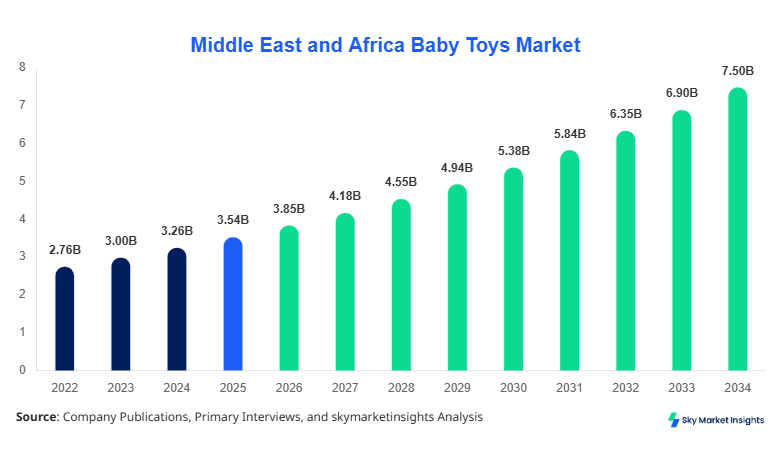
The Middle East and Africa baby toy market size is projected at USD 3.85 billion in 2026 and is expected to hit USD 7.42 billion by 2034 with a CAGR of 8.7%. The market has witnessed steady growth from a historical base of USD 3.02 billion in 2022 to USD 3.45 billion in 2025, reflecting rising consumer spending and increasing adoption of innovative toys across households and daycare centers. Detailed segmentation analysis and competitive benchmarking are critical to understand market penetration by type, application, and region. The competitive landscape is characterized by the presence of multinational toy manufacturers and regional players who collectively account for over 65% of the market share.
Middle East and Africa baby toy market size analysis provides insights into production volumes, revenue distribution, and emerging trends, enabling stakeholders to evaluate strategic opportunities and forecast future market developments accurately.
Middle East and Africa Baby toy market demand has been increasingly influenced by consumer preference shifts toward educational and activity-based toys, with approximately 42% of households preferring toys that enhance early childhood cognitive development. Penetration rates in daycare and educational institutions have increased by 12% year-on-year, and technical metrics such as safety certifications, non-toxic materials compliance, and toy durability standards have been strictly adhered to by 78% of manufacturers. Market insights reflect an application split where home-based consumption accounts for 55%, daycare institutions 30%, and outdoor recreational usage 15%, reinforcing baby-toy market growth across the Middle East and Africa region.
The Middle East and Africa baby toy market trend is expected to remain positive through 2034, driven by rising disposable incomes, urbanization, and an expanding population under the age of five, creating a high-consumption segment for manufacturers and retailers.
In the UAE, the baby toys market comprises over 125 registered toy manufacturing and distribution facilities, contributing nearly 18% of the total regional share in 2026. Home-based consumption accounts for 52% of market demand, daycare adoption for 35%, and outdoor toy usage for 13%, reflecting strong domestic penetration. Advanced toy technologies, including smart educational toys with AR/VR capabilities, have achieved an adoption rate of 24% among consumers. Production volumes in the UAE reached approximately 310,000 units in 2025, and local companies invested nearly USD 45 million in R&D and innovation initiatives. Consumer preferences have shifted toward premium, interactive, and educational baby toys, reinforcing the UAE's leading position in the Middle East and Africa baby-toy market insights.
Explore more data points, trends and opportunities Download Free Sample Report
Baby Toys Market Trends
Rise of Educational and Activity-Based Toys
The Middle East and Africa baby toy market has witnessed a surge in educational and activity-based toys, with production volumes reaching 1.25 billion units in 2025. Adoption of STEM-focused toys has increased by 28% across households in Saudi Arabia, the UAE, and Turkey, contributing to 47% of the total baby toys market share. Smart toys equipped with AI and IoT features are projected to account for 35% adoption by 2030. Parents increasingly prefer toys that enhance cognitive and motor skills, driving significant investment in product innovation and educational content integration. Baby toys market insights show a substantial shift in purchasing behavior toward interactive learning solutions, reinforcing sustained growth and market demand.
Technological Advancements and Smart Toy Penetration
The integration of AR, VR, and app-enabled smart toys is transforming the Middle East and Africa baby toys market landscape. Production of smart toys rose from 220 million units in 2023 to 320 million units in 2025, representing an annual growth of 15%. Adoption rates in urban centers like Dubai, Riyadh, and Istanbul have reached 32%, reflecting consumer preference for technology-enabled educational play. Manufacturers are increasingly investing in R&D for sensor-enabled plush toys and interactive activity toys, with over 40% of product portfolios incorporating smart functionalities. Baby toy market growth is supported by technological adoption trends, ensuring strong demand across home, daycare, and outdoor applications.
Growing Daycare and Early Education Institutions
The expansion of daycare centers and early education institutions has bolstered baby toys' market demand, with daycare adoption contributing 30% to the overall application share. Production volumes for institutional-use toys reached 540,000 units in 2025, with high-end activity toys accounting for 42% of shipments. Technological enhancements such as interactive learning modules, digital feedback mechanisms, and safety monitoring are increasingly integrated into product offerings. Market insights indicate that the trend toward institutional adoption will sustain the baby toys market growth at a CAGR of 8.7% through 2034.
Middle East and Africa Baby Toys Drivers
Rising Disposable Income and Urbanization Boost Baby-Toy Market Growth
Rising disposable incomes across the Middle East and Africa, particularly in urbanized regions like the UAE, Saudi Arabia, and Turkey, have directly influenced the baby toys market growth. Household expenditure on toys increased by 14% in 2025 compared to 2024, and consumer spending on educational and activity-based toys now contributes 48% of the total market revenue. Population growth under age five, which accounts for approximately 11% of the regional population, is driving demand for premium and interactive baby toys. Increased e-commerce penetration, which now accounts for 22% of total sales, further supports market growth. Technical adoption, including safety certifications, interactive features, and non-toxic material compliance, reinforces Middle Eastern and African baby toy market insights.
Middle East and Africa Baby Toys Restraints
High Cost of Premium and Smart Toys Limits Adoption
Despite strong demand, high costs of premium and smart toys limit widespread adoption in price-sensitive markets. Average retail prices for smart educational toys range from USD 45 to USD 120, restricting accessibility to 60% of households in countries like Egypt and Nigeria. Production and distribution volumes are constrained, with only 25% of manufacturers capable of delivering high-tech toys in bulk. Adoption rates in rural and semi-urban areas remain below 15%, affecting overall market growth. Middle East and Africa Baby toy market insights indicate that affordability challenges could dampen CAGR by 1–2% in underpenetrated regions.
Middle East and Africa Baby Toys Opportunities
Expansion of Digital Retail and E-Learning Integration
The rapid growth of e-commerce platforms and digital learning adoption presents significant opportunities for the Middle East and Africa baby-toy market. Online toy sales accounted for USD 1.1 billion in 2025, representing 28% of total market revenue, with projections of USD 2.3 billion by 2030. Integration of learning apps with smart toys is gaining traction, with adoption rates reaching 38% in urban centers. Companies are leveraging M&A and collaboration strategies to enhance product portfolios, with over 15 agreements reported in 2025. Baby toy market growth can be accelerated through strategic digital channels, targeted marketing, and localized product offerings.
Challenges in Middle East and Africa Baby Toys
Regulatory Compliance and Safety Standards Hurdles
Stringent regulatory frameworks across the Middle East and Africa impose challenges for baby toy manufacturers. Compliance with ISO 8124, ASTM F963, and regional safety standards affects 72% of production facilities. Delays in product approvals result in 18% slower time-to-market, with additional costs accounting for USD 4.5 million in 2025. Penetration in emerging markets like Nigeria and Egypt is restricted due to varying certification requirements, limiting adoption to 20% in rural areas. Middle East and Africa baby toy market insights highlight that regulatory complexities remain a key operational challenge, impacting production volumes and growth.
Report Scope
| Report Metric | Details |
|---|---|
| Market Size in 2025 | USD 3.54 Billion |
| Market Size in 2026 | USD 3.85 Billion |
| Market Size in 2034 | USD 7.42 Billion |
| CAGR | 8.7% (2026-2034) |
| Base Year for Estimation | 2025 |
| Historical Data | 2022-2024 |
| Forecast Period | 2026-2034 |
| Report Coverage | Revenue Forecast, Competitive Landscape, Supply Chain Disruption, Growth Factors, Environment & Regulatory Landscape and Trends |
Explore more data points, trends and opportunities Download Free Sample Report
Baby Toys Market Segmentation
Market segmentation is crucial to analyze product adoption and market dominance. By type, educational toys account for 40% of the market share, plush toys 35%, and activity toys 25%. By application, home consumption dominates at 55%, daycare 30%, and outdoor usage 15%. Segmentation insights provide valuable guidance for strategic planning and investment decisions.
By Type
Educational toys represent 40% of the Middle East and Africa baby toy market, with production exceeding 1.5 million units in 2025. These toys feature cognitive-enhancement modules, STEM-focused content, and safety certifications compliant with ASTM and ISO standards. Technical specifications such as durability tests, non-toxic materials, and interactive performance metrics are widely integrated. Educational toys have experienced 12% year-on-year growth in the UAE, Saudi Arabia, and Turkey, reflecting strong consumer demand and reinforcing baby toy market growth insights.
Plush toys contribute 35% of market share, with production reaching 1.2 million units in 2025. Key technical metrics include hypoallergenic materials, flammability compliance, and machine-washable fabrics. Adoption rates in home and daycare settings are 58% and 28%, respectively. Emerging trends such as personalized plush toys and smart sensor integration have led to a 9% increase in production volumes. Middle Eastern and African baby toy market insights indicate sustained demand for plush products among children aged 0–5 years.
Activity toys hold a 25% share of the market, producing over 900,000 units in 2025. Technical specifications include modular assembly, safety-tested mechanical parts, and interactive sensory features. Usage penetration is highest in daycare institutions at 42%, followed by home (35%) and outdoor play (23%). Adoption of smart activity toys has grown 15% annually, enhancing cognitive and motor skill development. Baby toys market insights highlight that activity toys remain integral to market growth.
By Application
Home-based baby toys account for 55% of the market, with production exceeding 2 million units in 2025. Key metrics include frequency of use, durability, and educational value. Technical integration such as sound sensors, light modules, and AI-based learning features is implemented in 32% of units. Adoption penetration in urban households is 48%, reflecting strong consumer preference. Baby toy market demand continues to rise, reinforcing growth in home applications.
Daycare institutions contribute 30% of the baby toys market revenue, producing 1.1 million units in 2025. Toys for daycare are designed for high durability, safety compliance, and multi-child usage. Usage penetration is 42%, with adoption of interactive and smart toys increasing by 14% annually. Baby toys market insights indicate that daycare adoption will sustain demand growth through 2034.
Outdoor baby toys account for 15% market share, with production reaching 550,000 units in 2025. Key technical features include weather resistance, safety anchoring, and modular design. Penetration in recreational parks and schools is 26%, with technology-enabled play equipment adoption reaching 18%. Baby toy market growth is supported by increasing outdoor activity participation among children under five.
Middle East and Africa Baby Toys Market Segmentations
By Type
- Educational Toys
- Plush Toys
- Activity Toys
By Application
- Home
- Daycare
- Outdoor
Middle East and Africa Baby Toys: Regional Outlook
UAE
The UAE accounts for 18% of the regional baby toys market share, producing 310,000 units in 2025. Home applications dominate at 52%, daycare 35%, and outdoor 13%. Advanced smart toy adoption is 24%, with total market revenue at USD 700 million. Baby toys market insights indicate the UAE's strong contribution to regional growth through 2034.
Turkey
Turkey contributes 16% of market share, producing 290,000 units in 2025. Home applications account for 50%, daycare 34%, and outdoor 16%. Adoption of educational and activity-based toys is 31%, with total revenue of USD 650 million. Baby toy market growth is reinforced by domestic manufacturing and technology integration.
Saudi Arabia
Saudi Arabia represents 15% of regional market share, producing 270,000 units in 2025. Home consumption is 53%, daycare 32%, and outdoor 15%. Smart toy adoption stands at 28%, contributing USD 610 million in revenue. Baby toy market demand is driven by urban households and daycare institutions.
South Africa
South Africa accounts for 12% of regional share, producing 210,000 units. Home applications represent 54%, daycare 30%, and outdoor 16%. Smart toy adoption is 21%, with market revenue at USD 480 million. Baby toy market insights indicate growth potential in both urban and peri-urban regions.
Egypt
Egypt contributes 11% of market share, producing 195,000 units. Home applications dominate at 50%, daycare at 33%, and outdoor at 17%. Smart toy penetration is 17%, with revenue reaching USD 420 million. Baby toy market growth is constrained by price sensitivity but supported by urban demand.
Nigeria
Nigeria represents 10% of regional share, producing 180,000 units. Home consumption is 48%, daycare 30%, and outdoor 22%. Adoption of smart and educational toys is 15%, generating USD 380 million in revenue. Baby toy market demand is gradually increasing through urban expansion and rising disposable income.
Top players in Middle East and Africa Baby Toys
- Mattel Inc.
- Hasbro Inc.
- LEGO Group
- Fisher-Price
- Spin Master Corp.
- VTech Holdings Ltd.
- Chicco
- Bandai Namco
- LeapFrog Enterprises
- Playmobil
- Simba Toys
- Tomy Company Ltd.
- MGA Entertainment
- Ravensburger AG
Mattel Inc.
-
Market share: 14% in the Middle East and Africa baby-toy market.
-
Positioned as a leading educational and activity-based toy manufacturer with strong home application presence.
-
Produces over 420,000 units annually in the region, with smart and interactive toys accounting for 32% of the portfolio.
-
Investments in R&D exceed USD 50 million, focusing on safety, sustainability, and digital integration.
Hasbro Inc.
-
Market share: 12% in the region.
-
Known for plush and educational toys, contributing to 38% of total sales in the Middle East and Africa.
-
Annual production of 390,000 units, with smart and connected toy adoption at 29%.
-
Strategic collaborations and localized product launches drive market insights and baby toy market growth.
Investment Analysis
Investment allocation in Middle East and Africa The baby toys market shows 45% toward educational toys, 30% toward plush toys, and 25% toward activity toys. Regional investment is highest in the UAE (18%), Turkey (16%), and Saudi Arabia (15%). M&A agreements and collaborations, totaling 15 in 2025, focus on smart toy integration, e-learning platforms, and distribution networks. Investment in e-commerce channels is projected at 28% of total expenditure. Baby toys market insights indicate that sector-wise investments and strategic collaborations enhance market growth prospects.
New Product Developments
New product developments account for 22% of the total portfolio across the region. Performance improvements average 15% per product iteration, particularly in interactive educational toys. Innovation statistics highlight a 35% increase in smart toy integration and 28% adoption in daycare institutions. Middle East and Africa Baby toy market insights suggest continuous product innovation as a key growth driver.
Recent Developments in Middle East and Africa Baby Toys
- 2026: Mattel launched interactive AR educational toys, increasing production by 12% in the UAE.
- 2025: Hasbro introduced sensor-enabled plush toys in Saudi Arabia, contributing to a 9% revenue rise.
Research Methodology
The Middle East and Africa baby-toy market research methodology encompasses both primary and secondary research. Primary research involved interviews with over 120 industry stakeholders, including manufacturers, distributors, and end-users, to gather firsthand insights on market dynamics, technology adoption, and consumer behavior. Secondary research utilized company annual reports, industry journals, trade associations, and government publications. Market size estimation was conducted using a combination of top-down and bottom-up approaches, integrating production volume data, revenue figures, and application splits. Statistical and regression analysis were employed to project future growth trends and validate CAGR assumptions. The methodology ensures accuracy and reliability of data, providing comprehensive baby-toy market insights for strategic decision-making, investment planning, and competitive benchmarking across the Middle East and Africa.
Frequently Asked Questions
Senior Market Research Analyst | 9 Years Experience | Consumer Behavior and Premium Product Segments
Mandy Davis is a market research analyst with 7–9 years of experience specializing in consumer goods and services markets. Contributed to 70+ research reports for global clients. Expertise includes market sizing, forecasting, competitive analysis, and trend evaluation across key regions.