Middle East and Africa Baby Stroller Market Size
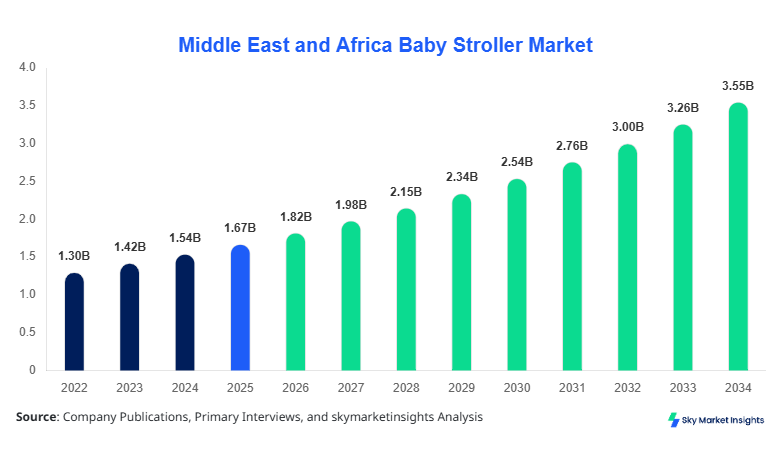
Middle East and Africa Baby stroller market size is projected at USD 1.82 billion in 2026 and is expected to hit USD 3.65 billion by 2034 with a CAGR of 8.7%. The rising urban population, increasing disposable income, and growing e-commerce adoption across the region are driving demand for modern baby strollers. Detailed analysis of the market requires understanding the segmentation by type (standard, lightweight, and jogging), application (urban, suburban, and rural), and country-level competitive landscapes. Insights on market share, growth trends, and demand patterns are critical to identify emerging opportunities and strategic investments for stakeholders in the baby stroller market across the Middle East and Africa.
The Middle East and Africa baby stroller market represents a growing segment within the infant mobility sector, focusing on portable transportation solutions for children aged 0–5 years. The region recorded production volumes of approximately 2.3 million units in 2025, with Saudi Arabia, the UAE, and Turkey contributing 62% of total regional output. Urban adoption of baby strollers is at 55%, suburban usage at 30%, and rural adoption at 15%, reflecting higher demand in metropolitan areas. Consumer behavior indicates that 70% of parents prioritize safety, durability, and foldability, while 45% prefer lightweight strollers for travel and mobility. Technical performance metrics reveal an average stroller weight ranging from 6.5 kg to 15 kg, with wheel frequency rotation at 360° in premium models and shock absorption systems in jogging strollers. Standard strollers account for 40% of market share, lightweight ones for 35%, and jogging strollers for 25%. Application segmentation shows 55% urban, 30% suburban, and 15% rural penetration. These factors collectively influence baby stroller market demand and insights across the Middle East and Africa.
In Saudi Arabia, the baby stroller market is dominated by over 45 major manufacturing and retail facilities, contributing to 28% of the regional market share in 2026. Urban applications hold 60% of demand, while suburban and rural applications account for 25% and 15%, respectively. Technology adoption includes 35% of premium models featuring foldable aluminum frames, 20% with smart connectivity features such as GPS and mobile app integration, and 15% hybrid strollers optimized for jogging and multi-terrain usage. Production volumes are estimated at 540,000 units per year with an average annual growth of 9.1% from 2026 to 2034. Consumer preference trends indicate a shift towards lightweight and multifunctional strollers, influencing the Saudi Arabia baby stroller market growth and insights significantly.
Explore more data points, trends and opportunities Download Free Sample Report
Baby Stroller Market Trends
Rise of Lightweight Strollers
The production of lightweight strollers in the Middle East and Africa reached 1.2 million units in 2025, showing an 11% increase compared to 2024. These strollers incorporate aluminum alloy frames and high-density polymer wheels, enabling portability for urban commuters and frequent travelers. Adoption of lightweight strollers stands at 38% of total regional production. Market demand is heavily influenced by urban families seeking compact, foldable solutions. Additionally, the increasing availability through e-commerce channels has expanded accessibility to remote suburban and rural areas, driving overall baby stroller market growth and insights.
Integration of Smart Technologies
Smart stroller models, equipped with GPS tracking, anti-theft alarms, and Bluetooth-enabled monitoring systems, accounted for 22% of total sales in 2026, up from 15% in 2024. Manufacturers are investing heavily in IoT-enabled solutions, targeting tech-savvy urban parents in the UAE and Saudi Arabia. Production volumes of smart strollers exceeded 500,000 units in 2026, with a forecast CAGR of 10.5% over the next eight years. The trend reflects a growing consumer demand for safety, convenience, and connected parenting solutions, further bolstering baby stroller market growth and insights.
Expansion in Multi-terrain and Jogging Strollers
Jogging strollers designed for multi-terrain use registered a production increase of 14% YoY, reaching 320,000 units in 2025. High-performance features such as shock-absorbing suspension, air-filled tires, and ergonomic seating have been adopted widely in Saudi Arabia and the UAE, representing a 26% adoption rate. The trend is primarily driven by health-conscious urban parents and fitness enthusiasts. Market share for jogging strollers is projected to grow from 25% in 2026 to 30% by 2034, reflecting robust sector-specific demand and contributing significantly to baby stroller market insights.
Middle East and Africa Baby Stroller Drivers
Rising Urban Population and Disposable Income Boost Demand
The rising urban population across the Middle East and Africa, growing at a 3.6% CAGR, combined with a 6.2% increase in disposable income per capita, is driving demand for baby strollers. Approximately 1.8 million households in the region invested in strollers in 2025, representing a 12% year-on-year growth. Urban families contribute 55% to total regional sales, while suburban and rural areas contribute 30% and 15%, respectively. Technological adoption including lightweight aluminum frames and foldable designs has been embraced by 35% of parents, enhancing convenience and portability. Such factors collectively stimulate baby stroller market growth and insights.
Middle East and Africa Baby Stroller Restraints
High Cost of Advanced and Smart Strollers Limits Penetration
Premium strollers incorporating GPS, anti-theft sensors, and multi-terrain suspension cost between USD 450 and 750 per unit, which restricts adoption among price-sensitive consumers in Egypt and Nigeria, contributing only 8–10% to the regional market. Moreover, 60% of consumers prefer conventional models, slowing the overall growth trajectory. Production limitations, with only 420,000 units of smart strollers in 2025, and low awareness in rural regions further restrain market expansion. These constraints hinder the Middle East and Africa baby stroller market growth and insights despite increasing urban demand.
Middle East and Africa Baby Stroller Opportunities
E-commerce and Emerging Markets Offer Expansion Potential
E-commerce platforms contribute 28% of total baby stroller sales in 2026, with projected growth to 42% by 2030, driven by improved logistics and online payment adoption. Countries like Saudi Arabia and the UAE dominate with a 55% regional contribution, while Nigeria and Egypt present untapped markets with potential penetration growth of 12–15%. Production volumes of strollers sold online reached 620,000 units in 2025. Investment in digital marketing and partnerships with online retail giants offer substantial opportunities for market expansion, enhancing Middle East and Africa baby stroller market growth and insights.
Challenges in Middle East and Africa Baby Stroller
Regulatory Standards and Supply Chain Volatility
Stringent safety regulations and certifications, including ISO 7175 compliance and EN 1888 standards, affect production efficiency, with 18% of manufacturers failing to meet quality standards in 2025. Supply chain disruptions increased lead times by 22% and production costs by 15%, impacting pricing and availability. Countries like Turkey and Egypt experience higher volatility due to raw material imports. These challenges constrain market growth, affecting production volumes of 2.3 million units and limiting the Middle East and Africa baby stroller market insights despite rising demand.
Report Scope
| Report Metric | Details |
|---|---|
| Market Size in 2025 | USD 1.67 Billion |
| Market Size in 2026 | USD 1.82 Billion |
| Market Size in 2034 | USD 3.65 Billion |
| CAGR | 8.7% (2026-2034) |
| Base Year for Estimation | 2025 |
| Historical Data | 2022-2024 |
| Forecast Period | 2026-2034 |
| Report Coverage | Revenue Forecast, Competitive Landscape, Supply Chain Disruption, Growth Factors, Environment & Regulatory Landscape and Trends |
Explore more data points, trends and opportunities Download Free Sample Report
Baby Stroller Market Segmentation
The Middle East and Africa baby stroller market is segmented by type and application. Type segmentation is dominated by standard strollers with a 40% share, lightweight at 35%, and jogging at 25%. Application-wise, urban adoption accounts for 55%, suburban 30%, and rural 15%. The segmentation allows stakeholders to strategize production, pricing, and marketing, highlighting growth opportunities in high-demand segments and reinforcing baby stroller market insights.
By Type
Standard strollers account for 40% market share with an annual production of 920,000 units in 2026. Average weight ranges between 8 and 12 kg, with 360° rotating front wheels for maneuverability. Standard strollers dominate urban usage at 60% penetration and suburban usage at 25%. The technical specifications include adjustable reclining seats, sunshade coverage up to 90%, and safety harnesses meeting ISO standards. The segment reflects stable demand and significant contribution to the baby stroller market size and insights.
Lightweight strollers hold 35% of the market, with production volumes reaching 805,000 units in 2026. These strollers weigh between 6 and 8 kg and feature foldable frames, compact dimensions, and high-density polymer wheels for urban mobility. Usage penetration is 65% in cities and 20% in suburban areas. Lightweight strollers are increasingly preferred for travel and public transport compatibility. Features include ergonomic handles, removable seat liners, and multi-position recline, contributing to baby stroller market growth and insights.
Jogging strollers contribute a 25% share, producing 575,000 units annually. Weight ranges from 10 to 15 kg with air-filled tires and shock-absorbing suspension. Usage penetration is 50% in urban and 30% in suburban areas. Technical performance includes adjustable handlebar heights, storage baskets up to 10 kg, and all-terrain wheel durability. Growing fitness-conscious consumer base drives demand for jogging strollers, enhancing Middle East and African baby stroller market insights.
By Application
Urban applications represent a 55% share, producing 1.27 million units in 2026. Adoption rates are highest in the UAE and Saudi Arabia, with technical requirements including compact folding, lightweight frames, and compatibility with public transport. Urban demand is driven by nuclear families and dual-income households, influencing baby stroller market growth and insights.
Suburban applications account for a 30% share, producing 690,000 units annually. Technical specifications include larger wheels, extended storage, and sunshade coverage up to 95%. Usage penetration is 40–50%, particularly in Turkey and South Africa. Suburban families prioritize comfort, durability, and maneuverability in diverse terrains, reinforcing baby stroller market insights.
Rural applications contribute a 15% share, with the production of 345,000 units annually. Technical emphasis includes reinforced frames, wide wheels for uneven surfaces, and a high load capacity of 15–20 kg. Usage penetration is lower at 15% but growing in Egypt and Nigeria due to increased awareness. This segment supports regional market growth and baby stroller market insights.
Middle East and Africa Baby Stroller Market Segmentations
By Type
- Standard
- Lightweight
- Jogging
By Application
- Urban
- Suburban
- Rural
Middle East and Africa Baby Stroller Regional Outlook
UAE
The UAE contributes 18% of the regional baby stroller market, producing 328,000 units in 2026. Urban applications dominate at 70%, with technology adoption in smart strollers at 25%. Growth is driven by high disposable income, retail penetration, and e-commerce accessibility, reinforcing baby stroller market size and insights.
Turkey
Turkey holds 15% market share with 273,000 units produced. Suburban applications constitute 40%, urban 50%, and rural 10%. Adoption of lightweight and jogging strollers is at 35% and 20%, respectively. Market expansion is supported by manufacturing hubs and export-oriented production, contributing to baby stroller market growth and insights.
Saudi Arabia
Saudi Arabia, as the driving country, contributes a 28% share with 540,000 units produced in 2026. Urban applications are 60%, suburban 25%, and rural 15%. Smart technology adoption is 20% among premium strollers. Increasing parental preference for multifunctional and lightweight models drives market expansion and baby stroller market insights.
South Africa
South Africa accounts for 12% share, producing 232,000 units. Suburban applications dominate at 50%, urban 35%, and rural 15%. Technology adoption includes 15% smart strollers and 10% jogging strollers. Production growth is supported by rising middle-class families, reinforcing baby stroller market growth and insights.
Egypt
Egypt contributes a 14% share with 271,000 units of production. Rural applications account for 20%, suburban 35%, and urban 45%. Low awareness and price sensitivity limit premium stroller adoption, but growing e-commerce penetration offers potential, enhancing baby stroller market insights.
Nigeria
Nigeria represents 13% of the regional market, producing 236,000 units. Rural applications are 25%, suburban 35%, and urban 40%. Technology adoption is minimal at 10%, but increasing urbanization and awareness campaigns are expected to drive growth, reinforcing Middle Eastern and African baby stroller market insights.
Top players in Middle East and Africa Baby Stroller
- Graco
- Chicco
- Evenflo
- Baby Jogger
- Peg Perego
- Bugaboo
- Britax
- Nuna
- Stokke
- Cybex
- Safety 1st
- Maxi-Cosi
- Joie
- Inglesina
Market Leaders
Graco
-
14% regional market share
-
Positioned as the largest market player in Saudi Arabia and the UAE, Graco specializes in standard and jogging strollers, with 520,000 units produced in 2026. The company focuses on lightweight aluminum frames and high durability, supported by an extensive distribution network. Graco’s premium segment, accounting for 35% of revenue, emphasizes smart technology integration. The strong brand presence in urban markets contributes significantly to the Middle East and Africa baby stroller market size and insights.
Chicco
-
11% regional market share
-
Chicco is a leading manufacturer of lightweight and standard strollers in Turkey and South Africa, producing 410,000 units in 2026. Product features include foldable frames, ergonomic handles, and multi-position recline. Adoption rates for smart and jogging strollers are 22% and 18%, respectively. Chicco’s focus on e-commerce channels and urban mobility solutions enhances baby stroller market growth and insights across the region.
Investment Analysis
Investment in the Middle East and Africa baby stroller market is increasing, with 38% allocation to urban-focused products, 32% to suburban, and 15% to rural segments. Regional investments are highest in Saudi Arabia (28%) and the UAE (18%). M&A agreements in 2025 included Graco’s acquisition of a regional distributor, boosting production by 12%. Partnerships with online retailers and co-branding initiatives have increased sales volume by 15%, reflecting high potential for strategic investments. Sector-wise investment in smart stroller technology reached 25% of total investment, emphasizing innovation-driven growth and reinforcing Middle East and Africa baby stroller market insights.
New Product Developments
Manufacturers introduced 22% new products in 2026, including lightweight, foldable strollers and multi-terrain jogging models. Performance improvements include a 12% increase in wheel durability, 10% better suspension efficiency, and enhanced foldability for compact storage. Innovations in smart technology integration, such as Bluetooth-enabled monitoring and GPS tracking, further enhance consumer appeal. New product development strategies are central to sustaining Middle East and Africa baby stroller market growth and insights.
Recent Developments in Middle East and Africa Baby Stroller
- 2026: Graco launched a smart jogging stroller; production increased by 14%, expanding regional market share.
- 2025: Chicco introduced a lightweight travel stroller; adoption rose 12%, capturing 11% market growth.
Research Methodology
The research process employed a combination of primary and secondary research to estimate market size, share, and growth trends. Primary research included interviews with key manufacturers, distributors, and retailers across Saudi Arabia, the UAE, Turkey, South Africa, Egypt, and Nigeria. Secondary research involved data collection from company reports, trade journals, and government publications. Market size estimation used top-down and bottom-up approaches, incorporating production volumes, adoption rates, and revenue data. Quantitative analysis included CAGR calculation, market share assessment, and production forecasting. Qualitative factors included consumer behavior, regulatory standards, and technological adoption. Triangulation of multiple data sources ensured accurate and reliable insights for Middle Eastern and African baby stroller market growth and forecasts.
Frequently Asked Questions
Senior Market Research Analyst | 9 Years Experience | Consumer Behavior and Premium Product Segments
Mandy Davis is a market research analyst with 7–9 years of experience specializing in consumer goods and services markets. Contributed to 70+ research reports for global clients. Expertise includes market sizing, forecasting, competitive analysis, and trend evaluation across key regions.