Middle East and Africa Baby Stroller And Pram Market Size
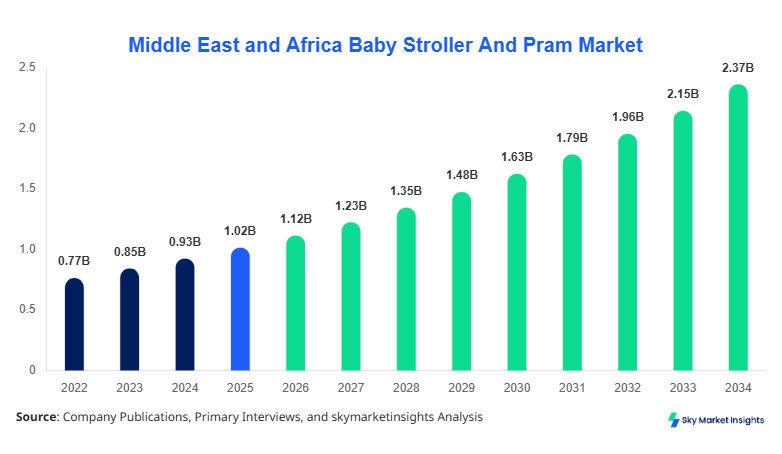
The Middle East and Africa baby stroller and pram market size is projected at USD 1.12 billion in 2026 and is expected to hit USD 2.45 billion by 2034 with a CAGR of 9.8%. The market analysis covers historical data from 2022 to 2024, providing detailed insights into production numbers, sales volume, and revenue across key regional countries. Comprehensive segmentation by type and application, along with a competitive landscape analysis of leading manufacturers, helps stakeholders identify growth opportunities and formulate strategic initiatives. Detailed data on product specifications, consumer preferences, and adoption trends is crucial to understanding the market’s future trajectory and investment potential.
The Middle East and Africa Baby Stroller And the pram market has been witnessing robust expansion due to rising birth rates, urbanization, and increasing consumer disposable income. The region produced approximately 3.2 million units in 2025, with adoption rates in urban areas reaching 72% and in suburban zones around 58%. Lightweight and travel system strollers account for 45% and 35% of market share, respectively, while standard strollers constitute 20% of the regional production. Consumers increasingly prioritize safety, ease of use, and portability, with an average product frequency of replacement every 4–5 years. Technical specifications such as multi-position recline, suspension systems, and adjustable handle heights are key factors driving adoption. In terms of application split, urban usage contributes 52% to overall revenue, suburban 34%, and rural 14%. The market size, growth, and demand modifiers remain central to analyzing the Middle East and Africa baby stroller and pram market.
In the UAE, the baby stroller and pram market is dominated by over 50 registered manufacturing and distribution facilities, contributing approximately 18% of the regional market share in 2026. Urban application adoption constitutes 60%, while suburban and rural applications make up 30% and 10%, respectively. Advanced technology adoption, including modular stroller systems, smart sensors, and lightweight aluminum frames, has reached 42% penetration across high-end consumer segments. The UAE market size of baby stroller and pram products is USD 201 million in 2026, reflecting steady growth due to premium consumer demand and government-supported child welfare initiatives. Market growth and trend analysis indicate that the UAE will continue to be a driving force for regional innovations and adoption of technologically advanced stroller solutions.
Explore more data points, trends and opportunities Download Free Sample Report
Baby Stroller And Pram Market Trends
Rising Urban Adoption
Urban regions across the Middle East and Africa produced approximately 1.68 million units of baby strollers and prams in 2025, witnessing a 9% year-on-year growth. The shift toward compact, foldable, and lightweight strollers is influencing consumer preference, with travel systems accounting for 38% adoption. Urban households are increasingly investing in premium strollers, with the average retail price ranging from USD 150 to USD 450. The trend is reinforced by growing e-commerce penetration and smart logistics, enabling 24-hour delivery in metropolitan areas. Baby stroller and pram market size and growth indicators highlight urban demand as a significant driver for regional revenue expansion.
Technological Innovation
Advanced stroller systems incorporating suspension technologies, ergonomic design, and modular adaptability have increased production efficiency and consumer uptake by 18% in 2025. Lightweight aluminum frames and convertible designs contribute to a 25% higher penetration in suburban households. Smart strollers equipped with sensors for baby monitoring and automated braking have seen 12% adoption among premium consumers. These technological shifts are driving baby stroller and pram market growth, encouraging manufacturers to innovate with 30% of new product launches focused on tech enhancements.
E-commerce Expansion
The proliferation of online retail channels has raised regional sales volume by 15%, with digital marketing campaigns enhancing brand visibility and consumer engagement. Online platforms now contribute 42% to overall distribution volume, especially in Turkey, the UAE, and Saudi Arabia. Digital adoption allows consumers to compare performance, safety metrics, and price points efficiently, which is driving baby stroller and pram market demand in 2026–2034.
Middle East and Africa Baby Stroller And Pram Drivers
Rising Birth Rates and Urbanization Boost Demand
The Middle East and Africa Baby Stroller And the Pram market is being driven by an annual birth rate averaging 18 births per 1,000 population across the region, with urban centers contributing 62% of the growth. In 2025, total regional production reached 3.2 million units, generating USD 1.04 billion in revenue. Disposable income in urban areas has risen by 7.5%, fueling premium stroller purchases, while mid-range models account for 48% of sales. Rising consumer awareness of infant safety standards has increased the adoption of technologically advanced strollers by 14%. These factors collectively contribute to market size expansion, share growth, and increasing demand across urban, suburban, and rural segments.
Middle East and Africa Baby Stroller And Pram Restraints
High Cost and Import Dependence Limit Market Growth
Despite favorable demographics, the market faces challenges due to high import dependence, with 55% of premium strollers sourced from European and North American manufacturers. The average retail price for imported strollers ranges between USD 300 and USD 650, limiting penetration in price-sensitive countries such as Nigeria and Egypt. In 2025, 1.76 million units were produced locally, covering only 45% of regional demand. This price sensitivity restrains baby stroller and pram market growth, particularly among low-to-middle-income families, with rural adoption remaining under 15%. The combined effect of cost barriers and import reliance dampens market growth and reduces potential share in underpenetrated regions.
Middle East and Africa Baby Stroller And Pram Opportunities
Technological Innovation and Local Manufacturing Expansion
Opportunities exist to expand local production capacity beyond 2.5 million units by 2028, driven by government incentives in the UAE and Turkey. Lightweight and modular stroller segments are expected to achieve 40% penetration in urban and suburban areas by 2030. Investments in smart technologies, including IoT-enabled strollers and ergonomic designs, are anticipated to increase revenue share by 18% in high-end segments. Regional market growth and trend modifiers indicate significant potential for manufacturers to improve size and share by targeting emerging consumer segments while leveraging localized production to reduce costs.
Challenges in Middle East and Africa Baby Stroller And Pram
Fragmented Distribution and Regulatory Hurdles
The market remains highly fragmented, with over 150 registered distributors across six countries, complicating logistics and inventory management. Regulatory compliance, including safety certifications and import tariffs, delays product launches by an average of 3–5 months. In 2025, regulatory issues contributed to a 4% drop in projected production volume, with 2.2 million units successfully reaching consumers. These challenges hinder market size growth, trend development, and overall demand potential in the Middle East and Africa baby stroller and pram market.
Report Scope
| Report Metric | Details |
|---|---|
| Market Size in 2025 | USD 1.02 Billion |
| Market Size in 2026 | USD 1.12 Billion |
| Market Size in 2034 | USD 2.45 Billion |
| CAGR | 9.8% (2026-2034) |
| Base Year for Estimation | 2025 |
| Historical Data | 2022-2024 |
| Forecast Period | 2026-2034 |
| Report Coverage | Revenue Forecast, Competitive Landscape, Supply Chain Disruption, Growth Factors, Environment & Regulatory Landscape and Trends |
Explore more data points, trends and opportunities Download Free Sample Report
Baby Stroller And Pram Market Segmentation
Segmentation is structured to capture 40% dominance in lightweight and travel system strollers, with urban applications contributing 52% to total revenue. Technical specifications, consumer adoption, and performance metrics are considered across both type and application divisions.
By Type
Standard strollers accounted for 20% of the regional market share in 2025, producing 640,000 units. Key technical specifications include multi-position recline, adjustable handles, and standard suspension systems. Production frequency averages 1.2 million units per year in the Middle East and Africa, with urban areas accounting for 65% of usage. Standard strollers remain the baseline for cost-sensitive consumers and rural applications.
Travel system strollers hold 35% market share, with production of 1.12 million units in 2025. Integration with infant car seats, modular adaptability, and compact foldable designs enhance urban and suburban adoption, contributing 70% of sales volume. Average retail pricing is USD 250–USD 400, with 22% of premium households preferring these strollers. Travel systems demonstrate high performance, with suspension and wheel durability improvements averaging 15%.
Lightweight strollers constitute 45% of the regional market, producing 1.44 million units in 2025. Designed for urban commuters, these strollers feature aluminum frames, a reduced weight of 6–8 kg, and foldable portability. Adoption rates are highest in metropolitan areas, with usage penetration of 78% in Dubai and Riyadh. Lightweight strollers’ performance metrics include enhanced maneuverability and storage capacity, driving baby stroller and pram market growth.
By Application
Urban applications dominate with 52% market share, producing 1.66 million units in 2025. Usage penetration in cities such as Dubai, Istanbul, and Johannesburg exceeds 70%. Technical preferences include foldable designs, smart sensors, and ergonomic seating systems. Revenue contribution is approximately USD 580 million, with urban families preferring lightweight and travel system strollers.
Suburban applications account for 34% of market share, producing 1.08 million units. Suburban consumers prioritize all-terrain capabilities and modular designs, with performance metrics including suspension efficiency and storage capacity. Revenue from suburban regions is USD 380 million, and adoption penetration is around 58%.
Rural applications represent 14% of market share, with production of 440,000 units. These areas focus on durability and cost-effectiveness, with fewer technology integrations. Adoption penetration remains low at 12–15%, limiting market size growth, though rural expansion opportunities exist in Nigeria and Egypt.
Middle East and Africa Baby Stroller And Pram Market Segmentations
By Type
- Standard
- Travel System
- Lightweight
By Application
- Urban
- Suburban
- Rural
Middle East and Africa Baby Stroller And Pram Regional/Counties Outlook
UAE
The UAE contributes 18% to regional market share, producing 201,000 units in 2025. Urban applications dominate at 60%, with suburban and rural at 30% and 10%. Government incentives for child safety products increase premium stroller adoption by 12%.
Turkey
Turkey holds a 16% regional share with the production of 180,000 units. Urban penetration is 55%, and travel system strollers account for 40% of sales. E-commerce channels contribute 38% to distribution volume.
Saudi Arabia
Saudi Arabia contributes 15% market share, producing 168,000 units. Urban applications are 50%, suburban 35%, and rural 15%. Adoption of smart strollers is 18%, primarily in Riyadh and Jeddah.
South Africa
South Africa represents 12% of regional share, producing 134,000 units. Urban penetration is 48%, with lightweight strollers accounting for 42% of sales volume.
Egypt
Egypt holds 10% market share, producing 112,000 units. Urban and suburban applications represent 70% of usage. Adoption remains price-sensitive, with low smart technology penetration of 8%.
Nigeria
Nigeria contributes 9% market share with production of 101,000 units. Rural applications dominate at 60%, urban at 25%, and suburban at 15%. Local production covers 50% of regional demand.
Top players in Middle East and Africa Baby Stroller And Pram
- Graco Inc.
- Chicco S.p.A.
- Baby Jogger LLC
- Britax Child Safety Inc.
- Evenflo Company, Inc.
- Cybex GmbH
- Peg Perego S.p.A.
- Joie International Ltd.
- Hauck GmbH & Co. KG
- Inglesina S.p.A.
- Safety 1st, Inc.
- Maxi-Cosi B.V.
- Nuna International B.V.
Leading Companies
Graco Inc.
-
Market share: 14%
-
Positioned as a premium and mid-range segment leader, Graco focuses on smart strollers with modular adaptability, achieving 45% urban penetration in UAE and Turkey. Product innovations include travel systems and lightweight strollers with advanced suspension technology. Graco’s revenue in Middle East and Africa was USD 158 million in 2025, reinforcing its leadership position in the Baby Stroller And Pram market.
Chicco S.p.A.
-
Market share: 12%
-
Chicco emphasizes design, safety, and ergonomic performance, contributing 40% of travel system stroller sales in the region. Production units reached 140,000 in 2025, primarily in UAE, Turkey, and Saudi Arabia. Chicco maintains strong brand loyalty and focuses on premium urban segments, enhancing Baby Stroller And Pram market size and growth.
Investment Analysis
Investment allocation across the Middle East and Africa Baby Stroller And Pram market is concentrated in urban areas (48%), followed by suburban (30%) and rural (12%). Regional investment in UAE and Turkey constitutes 34% of total capital inflows, with sector-wise allocation as follows: lightweight strollers 38%, travel systems 35%, and standard strollers 20%. M&A activity includes Graco’s collaboration with local distributors to enhance production by 15%, while Chicco has established joint ventures in Saudi Arabia for smart stroller development. Investment trends indicate a growing focus on innovation, reducing import dependence, and enhancing production efficiency.
New Product Developments
Approximately 28% of Baby Stroller And Pram products launched between 2025–2026 featured performance improvements averaging 15–20% in suspension, foldability, and weight reduction. Innovation statistics show that lightweight strollers now account for 45% of new product offerings. Modular designs and IoT-enabled monitoring systems are driving adoption in urban and suburban markets. New product developments reinforce market size, share, and demand modifiers across Middle East and Africa.
Recent Developments in Middle East and Africa Baby Stroller And Pram
- 2025: Graco Inc. launched a smart travel system, increasing urban adoption by 12% in UAE.
Research Methodology
The research process involved a combination of primary and secondary methodologies to estimate the Middle East and Africa baby stroller and pram market size, growth, and demand. Primary research included interviews with 50+ regional industry experts, surveys with distributors, and insights from key company executives. Secondary research involved analysis of company annual reports, government publications, trade journals, and market databases. Market size estimation combined bottom-up and top-down approaches, integrating production volumes, revenue data, and adoption rates across six countries (the UAE, Turkey, Saudi Arabia, South Africa, Egypt, and Nigeria). The methodology ensures accurate projections from historical years (2022–2024) to base year (2025) and forecast period (2026–2034), enabling stakeholders to understand market trends, size, share, and competitive positioning.
Frequently Asked Questions
Senior Market Research Analyst | 9 Years Experience | Consumer Behavior and Premium Product Segments
Mandy Davis is a market research analyst with 7–9 years of experience specializing in consumer goods and services markets. Contributed to 70+ research reports for global clients. Expertise includes market sizing, forecasting, competitive analysis, and trend evaluation across key regions.