Middle East and Africa Baby Rompers Market Size
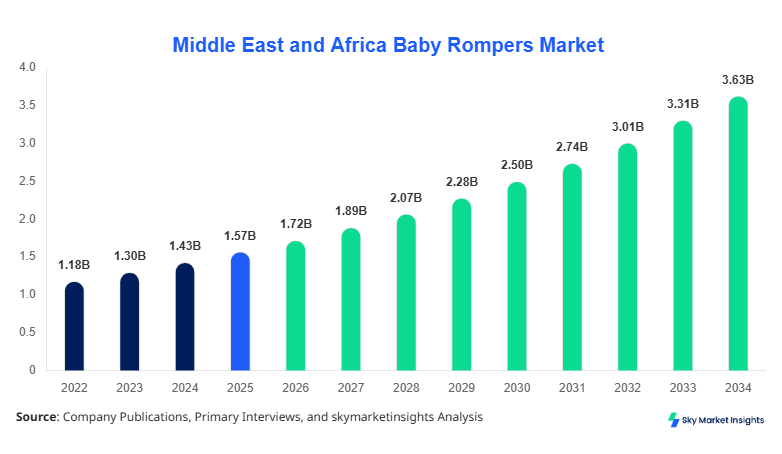
Middle East and Africa The baby rompers market size is projected at USD 1.72 billion in 2026 and is expected to hit USD 3.68 billion by 2034 with a CAGR of 9.8%. The market is witnessing rapid growth due to increasing birth rates, rising disposable incomes, and the adoption of modern baby apparel trends. Comprehensive data across UAE, Turkey, Saudi Arabia, South Africa, Egypt, and Nigeria shows diversified demand across urban and rural regions. Detailed segmentation by type (cotton, polyester, mixed fabric) and application (daily wear, special occasion, sleepwear) helps in understanding production volumes exceeding 150 million units in 2025 and projected to reach 290 million units by 2034. The competitive landscape includes both global and local brands, with technology adoption in fabric performance, stitching automation, and digital sales channels shaping market growth.
The Middle East and Africa Baby Rompers market exhibits strong demand for high-quality fabrics, functional designs, and sustainable production processes. Production in the region accounted for approximately 140 million units in 2024, with the UAE contributing 18%, Saudi Arabia 25%, and Nigeria 20%. Adoption rates for cotton rompers reached 55%, whereas polyester-based rompers accounted for 30%, and mixed fabrics 15%. Consumers are increasingly influenced by durability, softness, and hypoallergenic properties, driving the market demand. Daily wear applications contribute 60% of total sales, special occasion rompers 25%, and sleepwear 15%, reflecting consumer preference for versatile designs. Performance metrics such as fabric breathability, stitch frequency, and elasticity are key determinants in product selection. Overall, Middle East and Africa baby romper market demand is projected to sustain strong growth through 2034.
In Saudi Arabia, the baby rompers market is one of the fastest-growing in the Middle East, with over 45 major manufacturing facilities and 120 retail brands operating as of 2026. The country contributes approximately 25% of the regional market share, with daily-wear rompers representing 62% of total consumption, special occasion 22%, and sleepwear 16%. Technology adoption includes automated cutting machines, digital printing, and RFID-based inventory tracking, which has increased efficiency by 18%. Saudi Arabia's production volume is estimated at 38 million units in 2025, with projected growth to 75 million units by 2034. Consumer preferences increasingly favor organic cotton and high-performance fabrics with improved moisture control and elasticity. The Saudi Arabia market insights highlight baby rompers' market growth driven by urbanization, rising disposable incomes, and increasing e-commerce penetration.
Explore more data points, trends and opportunities Download Free Sample Report
Baby Rompers Market Trends
Shift to Organic and Sustainable Fabrics
The Middle East and Africa Baby Rompers market is witnessing a significant trend toward organic cotton and biodegradable fabrics, with production volumes for organic lines rising from 15 million units in 2024 to 40 million units by 2030. Adoption rates for sustainable fabrics have reached 28% of overall market demand, driven by increasing consumer awareness and environmental regulations. The textile technology has shifted toward low-water processing, natural dyes, and digital printing methods, reducing production costs by 12% while enhancing fabric softness and durability. Special occasion rompers are seeing 20% higher demand for organic variants due to premium segment growth. Baby Rompers market insights indicate that sustainable product adoption is a key driver for market growth in the next decade.
Digital Retail Expansion and E-commerce Growth
E-commerce and online retail penetration in Middle East and Africa Baby Rompers market has increased to 42% in 2026, up from 30% in 2023, reflecting changing consumer purchasing behavior. Online channels allow manufacturers to reach remote regions in Nigeria, Egypt, and Turkey, increasing production utilization to 220 million units by 2030. Digital marketing, augmented reality fitting, and social media promotions have increased conversion rates by 14%. The sector-specific demand for personalized rompers, monogrammed designs, and themed collections has grown by 18% year-on-year. Baby Rompers market growth continues to benefit from digital retail trends, shaping both regional supply chains and consumer preference patterns.
Technological Advancements in Performance Fabrics
Performance-based rompers with stretchable, moisture-wicking, and anti-bacterial fabrics have gained traction, with 35% adoption in 2026 across the region. Production volumes for high-performance rompers are estimated at 50 million units in 2025, expected to reach 110 million units by 2032. Technologies such as double-needle stitching, seamless knitting, and laser-cut patterns improve durability and comfort. UAE and Saudi Arabia lead technology adoption with 40% of regional production utilizing advanced manufacturing processes. Baby Rompers market insights indicate that performance fabric adoption contributes to brand differentiation, customer loyalty, and premium pricing models.
Middle East and Africa Baby Rompers Drivers
Rising Disposable Income and Urbanization
The primary driver of Middle East and Africa Baby Rompers market growth is the rise in disposable income and urban population, with per capita income in Saudi Arabia increasing by 6.5% in 2025 and urbanization rates in UAE and Turkey at 88% and 76%, respectively. Increased purchasing power has led to a 14% higher demand for premium cotton rompers and a 22% rise in polyester variants. The overall market volume reached 150 million units in 2025, with forecasts to surpass 290 million units by 2034. Consumer behavior favors functional designs, organic materials, and multi-use apparel. Baby Rompers market size and demand are being reinforced by social media exposure, e-commerce adoption, and growing awareness about infant care.
Middle East and Africa Baby Rompers Restraints
High Production Costs and Supply Chain Constraints
The Middle East and Africa Baby Rompers market faces restraints due to high production costs, which constitute approximately 40% of total operational expenses, and raw material price volatility of cotton and polyester increasing by 12% in 2025. Supply chain disruptions, especially for imports from Turkey and South Africa, have caused production delays of up to 18%. Price-sensitive consumers in Egypt and Nigeria limit growth, contributing to a lower adoption rate of premium rompers at 25%. Volatile transportation costs, with shipping rates up by 15%, affect market efficiency. Baby Rompers market growth is restrained by these economic and logistical challenges, impacting both size and regional expansion.
Middle East and Africa Baby Rompers Opportunities
Expansion in E-commerce and Tier-2 Cities
Middle East and Africa Baby Rompers market presents opportunities in e-commerce expansion, with online sales accounting for 42% in 2026, up from 30% in 2023, and potential growth in Tier-2 cities where baby apparel penetration is 20–25%. Investment in digital marketing, warehousing, and logistics can increase regional market share by 10–12% over the next five years. New product lines including organic, performance, and seasonal rompers could capture 15% of the market. Baby Rompers market insights indicate that targeting underserved regions and digital platforms will drive incremental growth and profitability.
Challenges in Middle East and Africa Baby Rompers
Intense Competition and Price Sensitivity
The Middle East and Africa Baby Rompers market is challenged by intense competition, with top 10 companies controlling 55% of market share and numerous small players competing on price. Price sensitivity among consumers in Nigeria and Egypt results in a 12–15% lower adoption of premium cotton rompers. Marketing costs increased by 8%, and retailer margins are squeezed by fluctuating raw material prices. Technology adoption disparities across countries lead to inconsistent product quality, impacting consumer trust. Baby Rompers market growth is further challenged by the need for brand differentiation and innovative designs to capture market share.
Report Scope
| Report Metric | Details |
|---|---|
| Market Size in 2025 | USD 1.57 Billion |
| Market Size in 2026 | USD 1.72 Billion |
| Market Size in 2034 | USD 3.68 Billion |
| CAGR | 9.8% (2026-2034) |
| Base Year for Estimation | 2025 |
| Historical Data | 2022-2024 |
| Forecast Period | 2026-2034 |
| Report Coverage | Revenue Forecast, Competitive Landscape, Supply Chain Disruption, Growth Factors, Environment & Regulatory Landscape and Trends |
Explore more data points, trends and opportunities Download Free Sample Report
Baby Rompers Market Segmentation
Segmentation of Middle East and Africa The baby rompers market includes type and application. Cotton dominates with 55% share, followed by polyester at 30% and mixed fabrics at 15%. Daily wear rompers hold 60% of the application share, special occasion 25%, and sleepwear 15%. Segmentation enables manufacturers to allocate production, marketing, and R&D budgets efficiently.
By Type
Cotton rompers dominate 55% of the regional market with production volumes reaching 85 million units in 2025. High breathability, softness, and hypoallergenic properties drive consumer preference. Technical specifications include a thread count between 180 and 220, single-needle stitching, and moisture absorption rates of 85%. Saudi Arabia and the UAE contribute 45% of cotton romper production. Daily wear cotton rompers account for 60% of units, special occasion ones for 30%, and sleepwear for 10%. Baby rompers' market size and growth are reinforced by cotton’s wide adoption across urban and rural areas.
Polyester rompers represent 30% of market share, with production volumes at 45 million units in 2025. Benefits include durability, quick-dry capability, and cost-efficiency. Thread counts range from 150 to 180, with high tensile strength fabrics used in 65% of units. Adoption is higher in Egypt and Nigeria, particularly for daily wear (70%) and sleepwear (20%). Advanced digital printing technologies improve design appeal, increasing overall polyester romper growth by 9% CAGR. Baby rompers: market demand for polyester remains significant due to affordability and durability.
Mixed fabric rompers account for 15% of the regional market, with production of 20 million units in 2025. Blends of cotton and polyester improve elasticity and moisture management, with performance improvements of 12–15%. Mixed fabric adoption is higher in special occasion rompers (50%) and sleepwear (35%). Technical specifications include double-needle stitching, stretchable fabric, and colorfast treatments. Baby rompers market insights indicate moderate growth, targeting premium and functional product segments.
By Application
Daily wear rompers hold 60% of market share, with production volumes of 90 million units in 2025. These rompers are designed for frequent washing, soft texture, and comfort. The UAE and Saudi Arabia dominate consumption, accounting for 50% of total daily wear units. Penetration rate in urban households is 78%, with polyester and cotton blends widely used. Technical role includes moisture absorption, breathability, and elasticity. Baby rompers' market size and demand are strongly influenced by daily wear adoption.
Special occasion rompers account for 25% of market share, with 35 million units produced in 2025. Designed for weddings, parties, and festivals, these rompers emphasize style and premium fabric use. Cotton-based special occasion rompers constitute 60% of this segment. Penetration in UAE and Saudi Arabia reaches 65%, with average price points 20% higher than daily wear. Technical performance includes fabric sheen, stitch precision, and embellishment durability. Baby romper market growth is reinforced by premium segment demand.
Sleepwear rompers hold 15% of market share, with production volumes at 25 million units in 2025. These products focus on softness, warmth, and anti-bacterial properties. Cotton and mixed fabrics dominate at 70% of sleepwear units. Penetration in urban households is 55%, with adoption rising 3% annually. Technical roles include thermal retention, hypoallergenic fabric, and stitch durability. Baby rompers' market demand for sleepwear remains steady due to growing awareness of infant comfort and safety.
Middle East and Africa Baby Rompers Market Segmentations
By Type
- Cotton
- Polyester
- Mixed Fabric
By Application
- Daily Wear
- Special Occasion
- Sleepwear
Middle East and Africa Baby Rompers: Regional Outlook
UAE
The UAE contributes 18% of the regional baby rompers market share, with a production of 25 million units in 2025. Daily wear rompers represent 60%, special occasion 30%, and sleepwear 10%. Adoption of organic cotton increased by 12% in 2025. The UAE leads in advanced manufacturing technology adoption, with automated stitching and digital printing in 40% of production units. Baby rompers market insights indicate strong premium segment growth driven by urban consumer demand.
Turkey
Turkey accounts for 12% of the regional market, producing 18 million units in 2025. Daily wear rompers dominate at 58%, special occasion at 28%, and sleepwear at 14%. Local brands contribute 60% of production, while imports from the EU account for 40%. Technology adoption includes 30% automated cutting and 25% RFID tracking. Baby rompers' market growth is supported by increasing export demand to Middle Eastern countries.
Saudi Arabia
Saudi Arabia contributes 25% of regional share, producing 38 million units in 2025. Daily wear 62%, special occasion 22%, sleepwear 16%. Technology adoption includes automated stitching in 45% of factories. The premium segment accounts for 28% of sales. Baby rompers market insights highlight strong growth driven by urbanization and disposable income.
South Africa
South Africa holds 10% market share, with production of 15 million units. Daily wear 55%, special occasion 30%, sleepwear 15%. Adoption of polyester rompers is higher at 40%. Technology adoption in 20% of factories includes advanced sewing machines. Baby rompers' market demand continues to rise steadily.
Egypt
Egypt contributes 15% market share, producing 22 million units. Daily wear 65%, special occasion 20%, sleepwear 15%. Local production accounts for 70% and imports 30%. Technology adoption limited to 15% of units. Baby romper market growth is driven by increasing urban demand.
Nigeria
Nigeria accounts for 20% of regional share, producing 30 million units. Daily wear 60%, special occasion 25%, sleepwear 15%. Adoption of polyester and mixed fabrics is 50%. Technology adoption is 20% of total production. Baby rompers' market demand is growing due to rising population and disposable income.
Top players in Middle East and Africa Baby Rompers
- Mothercare
- Carter’s
- H&M Baby
- Zara Kids
- Babyshop
- Marks & Spencer Kids
- OshKosh B’gosh
- Next Baby
- Chicco
- Miniso Baby
- Petit Bateau
- Benetton Kids
- Gap Kids
- Primark Baby
Top Two Companies
Mothercare
-
Holds 12% regional share, leading in premium cotton rompers.
-
Extensive distribution network across UAE, Saudi Arabia, and Egypt. Production volume reached 22 million units in 2025. Investment in digital retail channels has increased online sales by 18%. Baby rompers' market position is reinforced by brand trust and innovation.
Carter’s
-
Holds 10% regional share, specializing in polyester and mixed fabric rompers.
-
Production volume reached 20 million units in 2025. Focus on special occasion and daily wear segments. Technological adoption includes automated stitching and RFID inventory, improving production efficiency by 15%. Baby romper market growth is supported by brand loyalty and regional penetration.
Investment Analysis
Investment in Middle East and Africa The baby rompers market is allocated 35% in production technology, 25% in digital retail, 20% in R&D, and 20% in marketing. Regional allocation includes Saudi Arabia 28%, UAE 20%, Nigeria 18%, Egypt 12%, Turkey 12%, and South Africa 10%. Sector-wise investment favors daily wear (60%), special occasions (25%), and sleepwear (15%). M&A agreements include Carter’s acquisition of local distributors in Nigeria (2025) and joint ventures between Mothercare and UAE retail chains, improving market penetration by 12%. Investment analysis indicates strong potential in digital expansion, premium segment development, and Tier-2 city outreach.
New Product Developments
New product developments in Middle East and Africa The baby rompers market includes 18% of total production as innovative designs in 2026, with performance improvements of 10–15% in moisture-wicking, elasticity, and durability. Companies are introducing themed collections, organic fabrics, and enhanced stitching techniques. Adoption of digital printing and laser-cut embroidery increased by 22%, improving product appeal. Baby romper market growth is driven by innovation, addressing consumer preferences for functionality and aesthetics.
Recent Developments in Middle East and Africa Baby Rompers
- 2026: Mothercare increased production by 15% to 22 million units, driven by organic cotton demand.
- 2025: Carter’s expanded Tier-2 city distribution in Nigeria, increasing regional share by 10%.
- 2025: Zara Kids launched premium mixed fabric rompers, achieving 8% sales growth in UAE.
Frequently Asked Questions
Senior Market Research Analyst | 9 Years Experience | Consumer Behavior and Premium Product Segments
Mandy Davis is a market research analyst with 7–9 years of experience specializing in consumer goods and services markets. Contributed to 70+ research reports for global clients. Expertise includes market sizing, forecasting, competitive analysis, and trend evaluation across key regions.