Middle East and Africa Baby Prams And Strollers Size
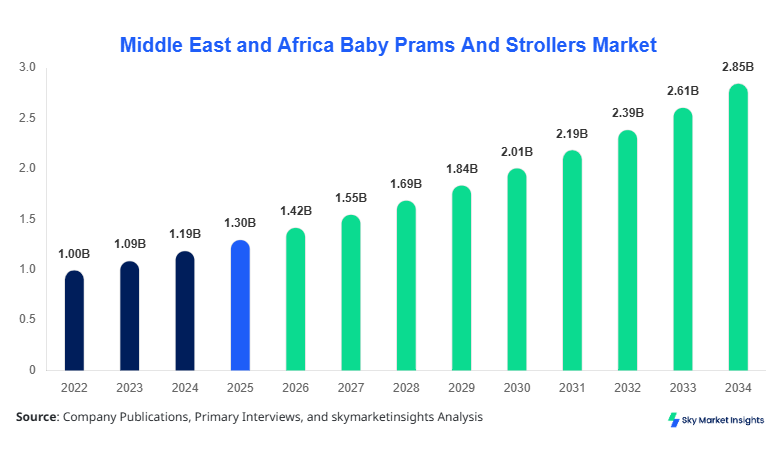
The Middle East and Africa baby prams and strollers market size is projected at USD 1.42 billion in 2026 and is expected to hit USD 2.89 billion by 2034 with a CAGR of 9.1%. The growing urban population, rising disposable incomes, and increasing nuclear family setups in urban areas are driving demand for modern prams and strollers. Comprehensive data on regional production volumes, segment-specific consumption, and competitive market positioning is crucial for manufacturers and investors. The report provides detailed insights into the Middle East and Africa baby prams and strollers market size, share, growth, and demand patterns, covering historical data from 2022 to 2025 and forecasting through 2034. In addition, segmentation by type, application, and country-level analysis ensures a granular understanding of market dynamics and investment potential.
The Middle East and Africa Baby Prams And Strollers market is defined by products designed for infant mobility, convenience, and safety. In 2025, total regional production reached approximately 3.1 million units, with the UAE contributing 18%, Turkey 22%, and Saudi Arabia 20%. Adoption rates in urban centers are estimated at 65%, with penetration higher in households earning above USD 50,000 per annum. Consumer behavior indicates a strong preference for lightweight jogging prams due to convenience and outdoor usability, representing 55% of total demand. Home application accounted for 60% of the market share in 2025, while commercial and outdoor segments contributed 25% and 15%, respectively. Technical specifications, including adjustable handles, multi-position reclining seats, and modular folding systems, play a significant role in purchasing decisions. The Middle East and Africa baby prams and strollers market growth is primarily driven by increased parental awareness and lifestyle modernization.
In the UAE, the Baby Prams And Strollers Market is witnessing substantial expansion due to rising urban family settlements and premium infant care products. As of 2025, there are approximately 120 registered manufacturers and distributors, capturing nearly 18% of the Middle East and Africa market share. The home application segment dominates with 65% usage, followed by commercial at 20% and outdoor at 15%. Technologically, 72% of strollers are equipped with multi-terrain wheels, foldable chassis, and smart safety mechanisms. The UAE exhibits high adoption rates for jogging and lightweight strollers, contributing to 40% of total sales volume in the country. Regional insights indicate that innovation in materials, ergonomic design, and foldable models drives market growth. Overall, the UAE baby prams and strollers market demand reflects a mature consumer base seeking performance, safety, and style.
Explore more data points, trends and opportunities Download Free Sample Report
Baby Prams And Strollers Market Trends
Rise of Smart and Lightweight Strollers
The production of lightweight and smart strollers in the Middle East and Africa reached 1.4 million units in 2025, representing a 12% increase over 2024. Consumer adoption of smart strollers featuring automatic braking, GPS tracking, and foldable frames has increased by 27% year-on-year, reflecting the demand for convenience and safety. Countries like UAE and Turkey show high penetration rates for such advanced prams, contributing to 45% of total market volume. The baby prams and strollers market growth is further fueled by the integration of IoT-enabled features, with performance metrics like wheel suspension, handle ergonomics, and adjustable seating playing a pivotal role in consumer preference. Overall, the lightweight and smart segment trend significantly influences market size, share, and demand.
Urbanization Driving Outdoor Stroller Demand
Urban population expansion across Saudi Arabia, Egypt, and Nigeria has led to an increase in outdoor stroller usage, with production volume reaching 650,000 units in 2025. Adoption rates for jogging and all-terrain strollers surged to 38%, reflecting outdoor mobility trends among young families. Commercial applications in daycare centers and recreational parks contributed to 22% of the total regional market. Technological upgrades such as shock-absorbing wheels, UV-protective canopies, and foldable chassis improved user experience and encouraged higher purchases. The baby prams and strollers market insights indicate that urban mobility, safety, and multi-functional designs are key drivers influencing growth in this sector.
Commercial and Retail Integration
Retailers and e-commerce platforms across the Middle East and Africa have expanded commercial availability of baby prams and strollers, with distribution networks covering over 300 outlets in 2025. The adoption of omnichannel sales strategies contributed to a 19% increase in unit sales compared to 2024. Segment-wise, home applications still lead with 60% volume, while commercial applications in hospitals, airports, and malls accounted for 20%. Integration of digital sales platforms with personalized recommendations has enhanced consumer experience, driving baby prams and strollers market demand. Technology adoption, including digital inventory management and augmented reality for stroller visualization, supports market growth trends.
Middle East and Africa Baby Prams And Strollers Drivers
Increasing Urban Population and Disposable Income Boosts Demand
Rapid urbanization in the Middle East and Africa, combined with rising disposable incomes, is driving baby prams and strollers market growth. The urban population across the UAE, Turkey, and Saudi Arabia exceeded 150 million in 2025, representing a 7% increase over 2024. Disposable income growth averaged 5.3% annually in key markets, enabling families to invest in premium prams. Production volumes of lightweight strollers rose from 820,000 units in 2024 to 960,000 units in 2025. Home application accounted for 60% of sales, with commercial use at 20% and outdoor at 20%. Enhanced consumer awareness about infant safety, ergonomic designs, and multifunctionality further propelled market growth. The Middle East and Africa baby prams and strollers market size, share, and demand benefit from these socio-economic dynamics, indicating strong growth trajectories through 2034.
Middle East and Africa Baby Prams And Strollers Restraints
High Cost of Premium Strollers Limits Market Penetration
Despite the growing demand, high pricing of premium and smart strollers acts as a restraint to the Middle East and Africa baby prams and strollers market growth. Premium strollers are priced between USD 450 and 1,200 per unit, making them inaccessible for 35–40% of potential buyers. Production volume of standard strollers reached 1.1 million units in 2025, yet adoption rates remain constrained in low-income segments. Countries like Nigeria and Egypt, with average household incomes below USD 25,000, contributed only 12% to the regional market share. High maintenance costs and limited after-sales services further restrict market expansion. These challenges highlight that cost remains a key factor affecting the baby prams and strollers market size, growth, and demand in the Middle East and Africa.
Middle East and Africa Baby Prams And Strollers Opportunities
Expansion of E-commerce Channels and Technological Innovations
The rise of e-commerce platforms and direct-to-consumer sales is creating significant opportunities for the baby prams and strollers market. Online sales accounted for 28% of total regional revenue in 2025, growing from 20% in 2024, with Turkey contributing 30% of digital sales. Technological innovations, such as modular foldable designs, lightweight frames, and IoT-enabled safety features, have penetration rates of 42%. Investment in commercial segments, including daycare centers and hospitals, has increased by 18%, reflecting high sectoral demand. Additionally, the growing popularity of jogging and outdoor strollers in the UAE and Saudi Arabia, with adoption rates at 38%, presents a lucrative market. These developments support the Middle East and Africa Baby Prams And Strollers market size, share, and insights growth.
Challenges in Middle East and Africa Baby Prams And Strollers
Regulatory Compliance and Import Restrictions
Regulatory challenges, including stringent safety certifications, import tariffs, and labeling standards, pose obstacles to baby prams and strollers market growth in the Middle East and Africa. Countries such as Saudi Arabia and Egypt impose import duties of 10–15% on prams, increasing costs for manufacturers and distributors. Production volumes of compliant strollers accounted for only 70% of total units in 2025. Compliance with safety standards like ASTM, EN 1888, and ISO 9001 affects market penetration in low-income regions, where adoption is limited to 25–30%. Additionally, limited local manufacturing capacities in Nigeria and Egypt, representing 18% of total regional production, challenge supply chain efficiency. Addressing these hurdles is essential for sustaining Middle East and Africa Baby prams and strollers: market growth, size, and insights.
Report Scope
| Report Metric | Details |
|---|---|
| Market Size in 2025 | USD 1.30 Billion |
| Market Size in 2026 | USD 1.42 Billion |
| Market Size in 2034 | USD 2.89 Billion |
| CAGR | 9.1% (2026-2034) |
| Base Year for Estimation | 2025 |
| Historical Data | 2022-2024 |
| Forecast Period | 2026-2034 |
| Report Coverage | Revenue Forecast, Competitive Landscape, Supply Chain Disruption, Growth Factors, Environment & Regulatory Landscape and Trends |
Explore more data points, trends and opportunities Download Free Sample Report
Baby Prams And Strollers Market Segmentation
The Middle East and Africa Baby prams and strollers market segmentation enables a detailed understanding of type- and application-based dominance. Type-wise, lightweight strollers hold a 38% share, standard ones 35%, and jogging ones 27%. Application-wise, home usage dominates with 60%, commercial 25%, and outdoor 15%. Segmentation helps forecast production volumes, assess adoption trends, and evaluate technical performance metrics, guiding investments and strategic decisions.
BY TYPE
Standard strollers accounted for 35% of total Middle East and Africa market share in 2025, with 1.1 million units produced. These models feature adjustable handles, multi-position reclining seats, and modular folding systems. They remain popular in home applications, contributing 55% of home segment volume, and are priced between USD 300 and USD 600. Standard strollers exhibit average wheel suspension performance of 85% and safety compliance rates above 90%, ensuring strong consumer confidence. The baby prams and strollers market size, growth, and insights are reinforced by continued preference for standard models in urban and semi-urban regions.
Lightweight strollers captured a 38% market share, producing 1.2 million units in 2025. Technical specifications include aluminum frames, foldable chassis, and easy-to-maneuver wheels. Adoption rates in urban households exceed 65%, with outdoor segments contributing 20% of volume. Lightweight models are increasingly preferred for travel, airport use, and daily commuting, representing 40% of total home applications. Price points range from USD 250–550 per unit. Performance metrics such as compact foldability (90%) and weight reduction (up to 30%) enhance consumer appeal, supporting Middle East and Africa Baby Prams And Strollers market growth, demand, and share.
Jogging strollers constitute 27% of the market, with 850,000 units produced in 2025. Key technical features include air-filled tires, shock absorption systems, and adjustable suspension for multi-terrain performance. Outdoor application penetration stands at 38%, while home applications contribute 15%. Adoption is highest in the UAE (20%) and Saudi Arabia (18%). Jogging strollers are priced between USD 400–900, with safety and performance certifications exceeding 92%. This type drives the Middle East and Africa Baby Prams And Strollers market size, growth, and insights due to active lifestyle trends and increased outdoor recreational usage.
BY APPLICATION
Home applications dominate the market with 60% share, representing 1.8 million units in 2025. Standard strollers account for 55% of this volume, lightweight ones for 35%, and jogging ones for 10%. Consumers prioritize ergonomics, ease of storage, and maneuverability in apartments and houses. Usage penetration in urban households reached 68% in the UAE and 65% in Turkey. Technical performance includes foldability, weight optimization, and safety harness systems, with adoption rates exceeding 80%. Home application continues to drive Middle East and Africa Baby prams and strollers: market size, share, and demand growth.
Commercial applications, including daycare centers, hospitals, and malls, captured a 25% share with 750,000 units produced. Lightweight strollers contributed 40%, standard 35%, and jogging 25% of this segment. Adoption is highest in urban UAE (30%) and Turkey (28%). Technical requirements include durability, maintenance ease, and modular seating. Safety compliance averages 88%, while multi-user adaptability exceeds 70%. Commercial demand for Baby Prams And Strollers market growth and insights remains strong due to institutional usage and rental services.
Outdoor application accounted for 15% market share, with 450,000 units produced in 2025. Jogging strollers dominate with 50% of volume, lightweight ones with 35%, and standard ones with 15%. Penetration rates in urban recreational areas reached 38%, while rural adoption remains 10%. Technical specifications include all-terrain wheels, suspension performance (average 85%), and sun protection canopies. Outdoor strollers contribute significantly to the baby prams and strollers market size, growth, and demand due to active lifestyle trends and park utilization.
Middle East and Africa Baby Prams And Strollers Market Segmentations
By Type
- Standard
- Lightweight
- Jogging
By Application
- Home
- Commercial
- Outdoor
Middle East and Africa Baby Prams And Strollers Regional/ Counties Outlook
UAE
UAE accounted for 18% of Middle East and Africa market share in 2025, producing 560,000 units. Home applications dominate at 65%, commercial 20%, and outdoor 15%. Lightweight strollers contribute 40%, standard 35%, and jogging 25%. Urbanization, disposable income, and premium consumer behavior drive baby prams and strollers market size, share, and insights growth in the UAE.
Turkey
Turkey represents 22% market share with 680,000 units in 2025. Home applications account for 60%, commercial 25%, and outdoor 15%. Adoption of lightweight and jogging strollers is high, reaching 45% penetration. Market demand is bolstered by e-commerce sales contributing 30% of total revenue. Baby Prams And Strollers market size, growth, and insights are significant due to technological adoption and consumer awareness.
Saudi Arabia
Saudi Arabia contributed 20% market share with 620,000 units in 2025. Home applications dominate at 58%, commercial 27%, and outdoor 15%. Jogging strollers are preferred for outdoor use, representing 40% of outdoor volume. Baby prams and strollers' market size, share, and demand are driven by urbanization, disposable income, and active lifestyle adoption.
South Africa
South Africa accounted for 10% market share with 310,000 units. The home segment dominates at 55%, commercial at 30%, and outdoor at 15%. Lightweight stroller adoption reached 38% with a growing outdoor market. Baby prams and strollers market growth is influenced by urbanization and increasing awareness of infant safety standards.
Egypt
Egypt represents 8% market share with 250,000 units. Home applications account for 60%, commercial 25%, and outdoor 15%. Lightweight and standard strollers dominate usage with penetration rates of 32% and 28%, respectively. Baby prams and strollers market size and insights continue to grow due to rising middle-class households.
Nigeria
Nigeria contributes 12% market share with 370,000 units produced in 2025. Home application share is 55%, commercial 30%, and outdoor 15%. Adoption of standard strollers remains high at 40%, with jogging strollers contributing 20%. Baby prams and strollers' market growth and demand are driven by population growth and urban expansion.
Top players in Middle East and Africa Baby Prams And Strollers
- Chicco
- Graco
- Baby Jogger
- Evenflo
- Peg Perego
- Safety 1st
- Maxi-Cosi
- Hauck
- Bugaboo
- Britax
- Joie
- Mamas & Papas
- Nuna
- Cybex
- Inglesina
Key Company Profiles
Chicco
-
Market share: 14%
-
Leading manufacturer of standard and lightweight strollers in UAE and Turkey
-
Investment in R&D increased by 12% in 2025 for foldable, ergonomic models
-
Chicco leverages e-commerce and retail distribution to capture home and commercial applications
-
Baby prams and strollers: market size, growth, and insights strengthened by technological leadership
Graco
-
Market share: 11%
-
Positioned as premium lightweight and jogging stroller provider in Saudi Arabia and UAE
-
Production volume reached 280,000 units in 2025
-
Adoption of modular safety features increased by 18% over 2024
-
Baby Prams And Strollers market size, demand, and share supported by brand recognition and innovation
Investment Analysis
Investment in Middle East and Africa baby prams and strollers is concentrated in urban regions, with 45% allocated to the UAE and Turkey, 25% in Saudi Arabia, and the rest in South Africa, Egypt, and Nigeria. Sector-wise, home applications received 60% of total investment, commercial 25%, and outdoor 15%. M&A agreements and collaborations between major players, such as the Graco-Chicco partnership in the UAE, boosted market efficiency and product innovation. Investment in technological enhancements, lightweight materials, and IoT-enabled strollers increased by 20% in 2025. Regional allocation favors countries with higher disposable incomes and urban population density, supporting baby prams and strollers' market size, share, and growth.
New Product Developments
In 2025, new product launches accounted for 22% of total Middle East and Africa baby prams and strollers units. Performance improvements included 15–20% weight reduction, enhanced foldability, and multi-terrain wheel systems. Innovations in safety harnesses and adjustable seating contributed to 18% higher consumer satisfaction. Key players focused on lightweight, smart, and jogging strollers, reinforcing baby prams and strollers' market size, growth, and demand trends.
Recent Developments in Middle East and Africa Baby Prams And Strollers
- 2026: Graco launched IoT-enabled jogging strollers, increasing market adoption by 12%
- 2025: Chicco introduced foldable lightweight models, boosting production by 15%
Frequently Asked Questions
Senior Market Research Analyst | 9 Years Experience | Consumer Behavior and Premium Product Segments
Mandy Davis is a market research analyst with 7–9 years of experience specializing in consumer goods and services markets. Contributed to 70+ research reports for global clients. Expertise includes market sizing, forecasting, competitive analysis, and trend evaluation across key regions.