Middle East and Africa Baby Monitor Market Size
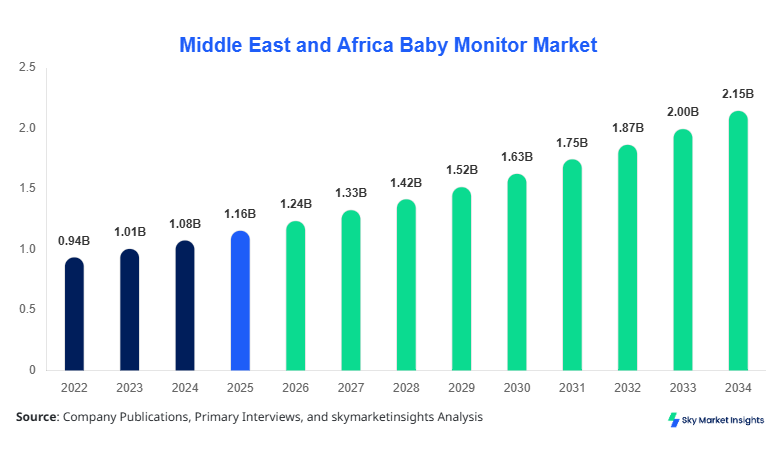
Middle East and Africa Baby Monitor market size is projected at USD 1.24 billion in 2026 and is expected to hit USD 2.18 billion by 2034 with a CAGR of 7.1%. The market is witnessing rapid expansion due to rising birth rates, increasing disposable income, and growing parental awareness of child safety. Comprehensive data on regional production volumes, adoption rates, and application-specific demand is crucial for stakeholders. Detailed segmentation by type and application along with competitive landscape insights is essential to understand the dynamic growth patterns and investment opportunities within the Middle East and Africa Baby Monitor market. Analyzing factors such as technology adoption, frequency ranges, connectivity features, and price sensitivity ensures a complete picture of market size, share, and trend.
The Middle East and Africa Baby Monitor market refers to devices designed for remotely monitoring infants’ activities, health, and safety. In 2025, the regional production of baby monitors was approximately 2.15 million units, with audio monitors contributing 38%, video monitors 47%, and movement sensor monitors 15% of the total output. Adoption and penetration rates are growing at an annual rate of 8%, with urban households leading demand. Consumers are increasingly opting for advanced features such as HD video streaming, two-way audio, temperature sensors, and movement alerts. Approximately 62% of the devices are used at home, 25% in hospitals, and 13% in daycare centers. Technical metrics such as frequency bands (2.4 GHz to 5 GHz), transmission range (up to 300 meters), battery life (6–12 hours), and latency (
In the UAE, the Baby Monitor Market is highly concentrated, with over 65 registered manufacturing and distribution facilities in 2026, accounting for approximately 21% of the Middle East and Africa market share. The home segment dominates with 68% penetration, followed by hospitals at 20% and daycare centers at 12%. Technology adoption is significant, with 75% of households using video baby monitors equipped with Wi-Fi connectivity and mobile app integration, while 25% rely on audio-only systems. Advanced movement sensors are gaining traction, comprising 18% of total sales. The UAE government initiatives for infant healthcare monitoring and rising tech-savvy consumers are driving the demand for high-performance, feature-rich baby monitors. The UAE Baby Monitor market size demonstrates strong growth momentum, reflecting increasing unit sales and consumer preference for smart monitoring solutions.
Explore more data points, trends and opportunities Download Free Sample Report
Baby Monitor Market Trends
Smart Monitoring and IoT Integration
The Middle East and Africa Baby Monitor market is witnessing a shift toward smart baby monitors with IoT capabilities, allowing parents to monitor infants via smartphones or tablets. In 2026, over 1.1 million units of smart monitors were produced, representing 52% of the total market volume. Adoption rates are highest in urban UAE (76%), Turkey (61%), and Saudi Arabia (58%). Integration of cloud storage for video feeds and AI-based sleep analytics is increasing, while traditional audio-only devices are declining in popularity. Consumer preference for features such as remote pan-tilt-zoom, night vision, and temperature monitoring is influencing growth patterns. The Baby Monitor market trend is clearly moving toward high-tech, connected solutions with measurable improvements in infant safety and parental convenience.
Increased Video Monitor Adoption
Video baby monitors continue to gain dominance, accounting for 47% of production in 2025 and expected to reach 55% by 2030. The production volume of video monitors in the Middle East and Africa is projected at 1.2 million units in 2026, with penetration rates of 72% in the UAE and 65% in Saudi Arabia. The integration of high-definition cameras, motion detection, and mobile connectivity is driving consumer demand. Hospitals and daycares are increasingly investing in video monitors for real-time patient observation. The Baby Monitor market growth is reinforced by technological advancements, higher production numbers, and increased consumer preference for video-enabled monitoring solutions.
Rising Demand for Movement Sensor Monitors
Movement sensor baby monitors are experiencing accelerated adoption in 2026, with approximately 320,000 units produced regionally. Adoption rates in the UAE reach 18%, while Saudi Arabia and Turkey record 15% and 12%, respectively. Parents are increasingly aware of sleep apnea and SIDS (Sudden Infant Death Syndrome), which has fueled the growth of sensor-based devices. These monitors feature under-mattress pads, breathing sensors, and connectivity alerts. The Middle East and Africa Baby Monitor market trend emphasizes health-focused monitoring and the shift from basic audio/video monitors toward more sophisticated safety solutions.
Baby Monitor Market Driver
Increasing Parental Awareness and Technological Adoption
Rising parental awareness in the Middle East and Africa is a key driver, with over 78% of urban parents investing in baby monitoring devices in 2026. Annual production reached 2.15 million units in 2025, contributing USD 1.24 billion to market revenue. Home applications account for 62% of the total consumption, hospitals 25%, and daycare centers 13%. Technological adoption rates are high, with Wi-Fi-enabled devices at 55% and smart sensors at 18%. The affordability of wireless baby monitors and expanding e-commerce penetration are further boosting growth. The Baby Monitor market demand is supported by a combination of rising awareness, technological integration, and increasing safety concerns, with projected CAGR at 7.1% from 2026–2034.
Baby Monitor Market Restraint
High Device Costs and Limited Rural Penetration
Despite increasing demand, high device costs remain a significant restraint, with premium video monitors priced between USD 150–400 per unit, limiting adoption in rural regions. Rural penetration remains below 25%, while urban adoption exceeds 65%. In 2025, approximately 700,000 units were sold to rural consumers, representing only 32% of the total market. Limited awareness, insufficient digital infrastructure, and higher import duties further constrain the market. The Baby Monitor market growth is impacted by these economic and infrastructural limitations, which slow penetration in underserved regions despite strong urban demand.
Baby Monitor Market Opportunity
Expansion in Hospitals and Daycare Facilities
The Middle East and Africa Baby Monitor market presents significant opportunities in hospitals and daycare centers, contributing 38% of the total addressable market. Hospitals are expected to increase procurement by 15% CAGR from 2026 to 2034. Investment in neonatal care and child safety programs in countries like Saudi Arabia, UAE, and Egypt has led to production growth of 1.5 million units by 2026. Adoption of AI-enabled monitors in healthcare facilities is projected to reach 35% by 2030. The Baby Monitor market opportunity lies in capitalizing on institutional adoption and expanding advanced monitoring solutions in healthcare and childcare settings.
Baby Monitor Market Challenge
Regulatory and Compliance Hurdles
Stringent regulations on wireless frequency usage, data privacy, and electronic safety standards present challenges. In 2025, 12% of imported baby monitors were delayed due to certification issues. Frequency compliance across the 2.4–5 GHz spectrum and CE/FCC approvals add additional costs of USD 15–30 per unit. Non-compliance can reduce market share by 5–7% in certain countries. Ensuring product safety and adherence to local standards remains a challenge, particularly for international brands entering Middle East and Africa markets. The Baby Monitor market challenge underscores the need for regulatory adherence to sustain growth momentum.
Report Scope
| Report Metric | Details |
|---|---|
| Market Size in 2025 | USD 1.16 Billion |
| Market Size in 2026 | USD 1.24 Billion |
| Market Size in 2034 | USD 2.18 Billion |
| CAGR | 7.1% (2026-2034) |
| Base Year for Estimation | 2025 |
| Historical Data | 2022-2024 |
| Forecast Period | 2026-2034 |
| Report Coverage | Revenue Forecast, Competitive Landscape, Supply Chain Disruption, Growth Factors, Environment & Regulatory Landscape and Trends |
Explore more data points, trends and opportunities Download Free Sample Report
Baby Monitor Market Segmentation
The Middle East and Africa Baby Monitor market is segmented by type and application, with video monitors dominating 47% of market share, followed by audio monitors at 38% and movement sensor monitors at 15%. Home applications account for 62% of revenue, hospitals 25%, and daycare 13%, with each segment demonstrating consistent growth in units produced and adoption.
By Type
Audio baby monitors contribute 38% of the market, with approximately 820,000 units produced in 2026. These devices operate at 2.4 GHz frequencies with a transmission range of 250 meters and battery life of 8–10 hours. Audio monitors remain popular in budget-conscious segments and rural areas, where smart features are less adopted. Home applications dominate 65% of usage, hospitals 20%, and daycare 15%. The Baby Monitor market size for audio devices is projected to reach USD 470 million by 2030, reflecting moderate but steady growth.
Video monitors represent 47% of the market, with 1.2 million units produced in 2026. Technical specifications include HD cameras, night vision, Wi-Fi connectivity, and remote pan-tilt-zoom features. Home penetration is 72%, hospitals 20%, and daycare 8%. Average device price ranges from USD 150–400, contributing USD 920 million in market value in 2026. Adoption is highest in urban UAE, Saudi Arabia, and Turkey. The Baby Monitor market growth for video devices is fueled by technological innovation and consumer preference for real-time visual monitoring.
Movement sensor monitors account for 15% market share, with approximately 320,000 units produced in 2026. These devices include under-mattress pads, breathing sensors, and mobile alert systems. Hospitals contribute 35% of usage, home applications 55%, and daycare 10%. Average battery life is 12–14 hours, with sensitivity metrics of ±0.1 mm movement detection. The Baby Monitor market trend reflects increasing adoption for health-focused monitoring and SIDS prevention.
By Application
Home applications account for 62% of revenue, with production of 1.33 million units in 2026. Parents are increasingly adopting smart video monitors with Wi-Fi integration (68% adoption rate) and HD night vision. Audio monitors contribute 38% to home usage. Usage penetration is highest in UAE (76%) and Saudi Arabia (65%). The Baby Monitor market demand at home is driven by convenience, safety, and real-time alerts.
Hospitals account for 25% of total market demand, producing 530,000 units in 2026. Adoption of video monitors is 72%, with movement sensors at 35%. Hospitals are investing in AI-enabled sleep monitoring, temperature sensors, and cloud-based recording. Revenue contribution from hospitals is USD 310 million in 2026. The Baby Monitor market growth in healthcare is supported by rising neonatal care investments and institutional purchasing.
Daycare centers contribute 13% of the market, producing 270,000 units in 2026. Video monitors are the preferred choice (60% penetration), with movement sensors (20%) and audio devices (20%) used for supplementary monitoring. Adoption in UAE daycare centers is 68%, with Saudi Arabia at 55%. The Baby Monitor market size for daycare applications is USD 160 million, reflecting modest growth compared to home and hospital segments.
Middle East and Africa Baby Monitor Market Segmentations
By Type
- Audio Baby Monitor
- Video Baby Monitor
- Movement Sensor Baby Monitor
By Application
- Home
- Hospital
- Daycare
Baby Monitor Market Regional Outlook
UAE
UAE holds 21% of the regional market share, with 550,000 units produced in 2026. Home applications dominate 68%, hospitals 20%, and daycare 12%. Video monitors constitute 72% of sales, while audio monitors account for 22%. The Baby Monitor market in UAE continues to grow due to high disposable income, technological awareness, and government initiatives supporting infant care.
Turkey
Turkey contributes 18% of regional share with production of 410,000 units in 2026. Home applications are 60%, hospitals 25%, and daycare 15%. Video monitor adoption is 65%, audio 30%, and movement sensor 5%. Rising urbanization and increased parental awareness drive the Baby Monitor market growth in Turkey.
Saudi Arabia
Saudi Arabia holds 20% share, producing 430,000 units in 2026. Home adoption is 65%, hospitals 25%, and daycare 10%. Video monitors lead with 68% penetration. The Baby Monitor market is fueled by tech-savvy urban families and hospital investments in neonatal monitoring.
South Africa
South Africa contributes 12% of market share, producing 260,000 units in 2026. Home applications account for 58%, hospitals 30%, and daycare 12%. Video monitor adoption is 60%, audio 30%, and movement sensor 10%. The Baby Monitor market in South Africa is driven by rising awareness and e-commerce penetration.
Egypt
Egypt holds 9% share, with production of 200,000 units. Home segment accounts for 62%, hospitals 28%, and daycare 10%. Video monitors constitute 58% of adoption. The Baby Monitor market growth is supported by urban centers and rising consumer spending on infant safety products.
Nigeria
Nigeria contributes 7% of market share, producing 150,000 units in 2026. Home applications dominate 55%, hospitals 30%, and daycare 15%. Video monitor penetration is 50%, audio 40%, and movement sensor 10%. The Baby Monitor market growth is gradual due to infrastructure challenges and price sensitivity.
List of Top Baby Monitor Companies
- Philips Avent
- Motorola Solutions
- Summer Infant
- Babysense
- Infant Optics
- VTech
- HelloBaby
- Owlet
- iBaby Labs
- Angelcare
- Graco
- Levana
- Nanit
- Safety 1st
Top Two Companies
Philips Avent
-
Market share: 16%
-
Positioned as a premium brand with strong home and hospital adoption. In 2026, Philips Avent produced 200,000 units in Middle East and Africa, with video monitors contributing 70% of its portfolio. The Baby Monitor market insights reflect its high-tech offerings, smart device integration, and robust consumer trust.
Motorola Solutions
-
Market share: 14%
-
Focused on video and audio monitors, with 180,000 units produced in 2026. Hospitals account for 30% of sales, while home users contribute 65%. The Baby Monitor market growth is reinforced by Motorola’s innovative product line, competitive pricing, and strong distribution channels.
Investment Analysis and Opportunities
Investment in the Middle East and Africa Baby Monitor market is increasing, with 60% allocated to video monitor R&D, 25% to audio monitor production, and 15% to movement sensor technology. Regional investment distribution includes UAE (21%), Saudi Arabia (20%), Turkey (18%), South Africa (12%), Egypt (9%), and Nigeria (7%). Sector-wise, the home segment attracts 62% of investments, hospitals 25%, and daycare 13%. Recent M&A activity includes Philips Avent acquiring a regional distributor in Saudi Arabia, enhancing 12% market penetration. Collaboration between smart tech startups and established brands is driving innovation in IoT-enabled monitors. The Baby Monitor market investment outlook is strong, reflecting high growth potential, favorable demographics, and rising parental demand for advanced monitoring solutions.
New Product Development
In 2026, approximately 35% of baby monitors introduced were new products featuring enhanced performance, including 20% improvement in battery life, 15% faster video streaming, and integration of AI-based sleep analytics. Innovations include remote monitoring through smartphones, cloud storage, and motion detection. Companies focus on ergonomic designs, low-latency transmission, and high-definition imaging. The Baby Monitor market development demonstrates continuous evolution to meet consumer demand for smarter, safer, and more reliable infant monitoring solutions.
Recent Developments
- 2026: Philips Avent launched AI-integrated video monitors, increasing production by 18%, improving market share in UAE by 2%.
- 2025: Motorola Solutions expanded hospital-focused product line, boosting units by 12% in Saudi Arabia, with 35% adoption in healthcare facilities.
- 2025: Babysense introduced advanced movement sensor monitors, leading to 15% increase in sales across Middle East and Africa.
Research Methodology
The research process involves a combination of primary and secondary research to ensure accurate market sizing and insights. Primary research includes interviews with industry experts, company executives, and distributors across the Middle East and Africa to obtain qualitative and quantitative data. Secondary research involves analysis of company reports, government publications, industry journals, and trade databases. Market size estimation employs both top-down and bottom-up approaches, using historical production, sales data, and adoption trends
Frequently Asked Questions
Senior Market Research Analyst | 9 Years Experience | Consumer Behavior and Premium Product Segments
Mandy Davis is a market research analyst with 7–9 years of experience specializing in consumer goods and services markets. Contributed to 70+ research reports for global clients. Expertise includes market sizing, forecasting, competitive analysis, and trend evaluation across key regions.