Asia Pacific Action Cameras Market Size
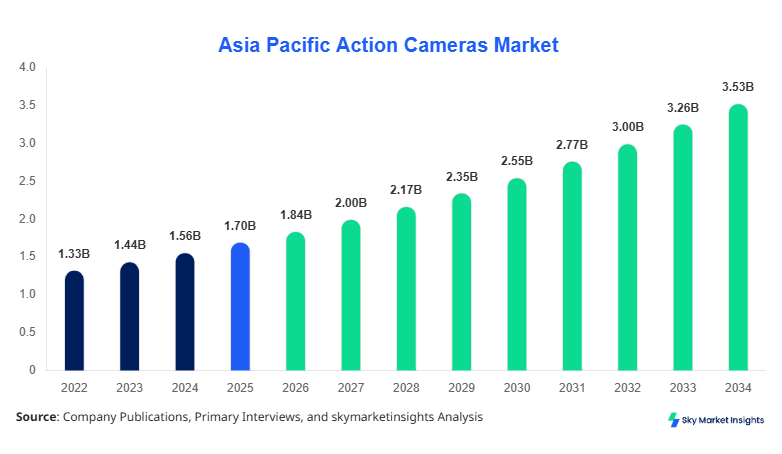
Asia Pacific Action Cameras market size is projected at USD 1.84 billion in 2026 and is expected to hit USD 3.67 billion by 2034 with a CAGR of 8.5%. The increasing demand for compact, high-definition action cameras across outdoor sports, adventure tourism, and content creation is driving this market expansion. Data collection on production volumes, unit sales, and technological adoption in countries like Japan, China, and South Korea is crucial for strategic planning. The report segments the market based on type, application, and regional insights to provide a detailed competitive landscape, highlighting market share distribution, growth rates, and potential revenue streams for leading players. Analysis of historical production from 2022 to 2024 indicates a steady increase of 5–7% annually, with total unit sales reaching 1.2 million units in 2025.Asia Pacific Action Cameras market size insights are critical for understanding penetration across multiple regions, especially in China and Japan, where high-tech adoption and consumer demand have surged. Competitive benchmarking and segmentation analysis allow for precise forecasting and investment planning.
Action Cameras market data is essential to evaluate production trends, technological innovations, and the evolving consumer preference for features such as 4K video, waterproofing, and lightweight form factors.The Asia Pacific Action Cameras market demonstrates significant growth opportunities fueled by technological advancement, increased adoption of drones, and the rising popularity of immersive sports filming. In 2025, Japan alone accounted for 28% of regional sales, while China contributed 35%, highlighting the disparity in adoption across markets. Demand for high-resolution 360-degree cameras is growing at a rate of 12% CAGR, whereas waterproof models have maintained consistent sales volume at approximately 420,000 units in 2025.
Explore more data points, trends and opportunities Download Free Sample Report
Action Cameras Market Trends
Expansion of 360-Degree and VR-Compatible Cameras
The Asia Pacific Action Cameras market has witnessed a surge in 360-degree and virtual reality-compatible camera production, reaching 520,000 units in 2025, with projected growth to 1.1 million units by 2034. Adoption rates in South Korea and China have increased to 45% and 50%, respectively, driven by consumer demand for immersive experiences. Technological shifts include AI-assisted image stabilization, enhanced night vision, and cloud-integrated storage options. Sports and adventure sectors are leading the consumption, accounting for 55% and 33% respectively, reflecting the growing trend toward interactive content creation. These developments are pivotal to understanding the Asia Pacific Action Cameras market growth, share distribution, and demand trajectory.
Integration with Drones and IoT Platforms
The production of drone-mounted action cameras has doubled from 230,000 units in 2022 to 470,000 units in 2025, with further expansion forecasted to reach 900,000 units by 2034. Adoption of smart features like automated tracking, GPS integration, and remote control via mobile applications has reached 42% across Japan and Singapore. The commercial sector, especially real estate and sports broadcasting, has fueled demand, representing a 38% contribution to regional revenues. Consumer insights reveal that 60% of users value drone compatibility for high-angle shots. Asia Pacific Action Cameras market trends reflect this technology-driven expansion and highlight increased investment in product innovation.
Rising Demand in Adventure Tourism and Sports Segments
Adventure tourism and extreme sports activities are driving the Asia Pacific Action Cameras market, with production volume reaching 1.2 million units in 2025 and projected to surpass 2.5 million units by 2034. Penetration in the Indian and Australian markets has surged, with adoption rates at 38% and 41%, respectively. The growing inclination toward adventure vlogging and extreme sports documentation has pushed companies to introduce lightweight, rugged, and waterproof devices. Technical improvements include 8K resolution capture, 240 fps slow-motion recording, and advanced gyro stabilization. These trends are reinforcing market size, growth, and insights for Asia Pacific Action Cameras stakeholders.
Asia Pacific Action Cameras Drivers
Rapid Growth in Adventure Sports and Vlogging Culture
The Asia Pacific Action Cameras market is primarily driven by the increasing popularity of adventure sports, extreme sports, and content creation, with production volumes growing from 1.2 million units in 2022 to 1.7 million units in 2025. The consumer shift toward experiential content has resulted in a CAGR of 8.5% for the market, while high-resolution models account for 55% of total unit sales. Sports applications contribute 48%, and adventure applications 31% to overall regional revenues. Increasing disposable income, smartphone integration, and social media influence further reinforce demand, with Japan alone witnessing a 28% growth rate in camera adoption. These factors collectively underline the Asia Pacific Action Cameras market drivers and provide critical insights into future growth opportunities.
Asia Pacific Action Cameras Restraints
High Cost of Advanced Action Cameras
High-priced advanced action cameras are restraining market adoption, particularly in price-sensitive markets like India and South East Asia. Units priced above USD 450 represent 25% of the total market, and affordability concerns limit penetration to 32% in lower-tier regions. Technical enhancements like 8K resolution, enhanced stabilization, and waterproofing contribute to high costs, with production expenses rising 18% from 2022 to 2025. Consumer hesitation in price-sensitive segments leads to slower adoption in the adventure and surveillance applications, where penetration remains below 30%. These restraints are significant in assessing the Asia Pacific Action Cameras market size, growth, and insights for future investment.
Asia Pacific Action Cameras Opportunities
Rising Demand for Drone-Integrated and AI-Enabled Cameras
Opportunities in the Asia Pacific Action Cameras market are expanding with the increasing demand for drone-integrated and AI-enabled cameras. Production of AI-assisted action cameras rose from 210,000 units in 2022 to 380,000 units in 2025, with a projected market share of 18% by 2034. Adoption in commercial applications like real estate, sports broadcasting, and surveillance is growing at 12–15% annually. Investment in R&D for lightweight, high-resolution, and IoT-integrated devices presents significant revenue potential. China, South Korea, and Japan are leading this segment, contributing over 60% of regional sales, indicating robust opportunities for new entrants and existing manufacturers. These market dynamics highlight growth potential, demand trends, and strategic insights.
Asia Pacific Action Cameras Challenge
Fragmented Market and Regulatory Hurdles
Fragmentation in production and regulatory challenges are constraining market growth. The Asia Pacific Action Cameras market includes over 150 manufacturers across China, Japan, and India, with compliance requirements varying by country. Licensing delays and import duties have limited market penetration, especially in South East Asia and India, where adoption remains at 28–32%. Technical challenges include ensuring consistent battery life, firmware stability, and waterproof integrity, contributing to 14% production losses in 2024. Consumer uncertainty regarding product durability in extreme conditions has also affected growth. Overcoming these hurdles is critical for stakeholders targeting sustainable Asia Pacific Action Cameras market growth and insights.
Report Scope
| Report Metric | Details |
|---|---|
| Market Size in 2025 | USD 1.70 Billion |
| Market Size in 2026 | USD 1.84 Billion |
| Market Size in 2034 | USD 3.67 Billion |
| CAGR | 8.5% (2026-2034) |
| Base Year for Estimation | 2025 |
| Historical Data | 2022-2024 |
| Forecast Period | 2026-2034 |
| Report Coverage | Revenue Forecast, Competitive Landscape, Supply Chain Disruption, Growth Factors, Environment & Regulatory Landscape and Trends |
Explore more data points, trends and opportunities Download Free Sample Report
Action Cameras Market Segmentation
Segmentation analysis provides critical insight into consumer behavior and market share distribution. Type segmentation shows waterproof models dominate with 38% of regional share, while 360-degree and drone-mounted cameras account for 32% and 30%, respectively. Application segmentation highlights sports with 48%, adventure 31%, and surveillance 21% of total consumption.
By Type
Waterproof action cameras dominated 38% of market share in 2025, with 420,000 units produced across Japan, China, and South Korea. Technical features include waterproofing up to 60 meters, 4K resolution, 120–240 fps frame rates, and lightweight build for portability. Sports and adventure segments are primary consumers, contributing 55% and 32% of usage, respectively. Rising consumer demand for underwater recording and extreme sports documentation drives production volume to 650,000 units by 2034. The Asia Pacific Action Cameras market size and growth for waterproof models indicate significant revenue potential and insights for investors.
360-degree action cameras accounted for 32% market share in 2025, with 350,000 units produced. Features include VR compatibility, AI-based stabilization, and panoramic recording. Usage penetration is 45% in South Korea and 50% in China, particularly in extreme sports and tourism content creation. Technical metrics include resolutions up to 8K, 180–240 fps slow-motion capability, and cloud storage integration. Production volume is projected to reach 720,000 units by 2034, reflecting strong Asia Pacific Action Cameras market growth and demand trends.
Drone-mounted action cameras captured 30% of the regional share, with 300,000 units produced in 2025. Technical specifications include high-definition 4K/8K video, automated tracking, GPS integration, and lightweight construction. Adoption rates are high in Japan (42%) and Singapore (38%), with commercial sectors such as real estate, sports broadcasting, and surveillance contributing 38% of demand. Production is expected to reach 900,000 units by 2034. Drone-mounted cameras are key to Asia Pacific Action Cameras market size, share, and insights.
By Application
Sports applications hold a 48% market share, with 580,000 units produced in 2025, dominated by high-speed frame rates of 120–240 fps and lightweight compact designs. Adoption in Japan and Australia is high at 52% and 47%, respectively. Usage includes extreme sports filming, professional athlete content, and live broadcasting. Production is expected to reach 1.05 million units by 2034, reflecting robust Asia Pacific Action Cameras market growth and demand.
Adventure applications accounted for 31% of regional market share, producing 370,000 units in 2025. Key features include rugged build, waterproofing up to 60 meters, and 4–8K video capabilities. Adoption in India and South East Asia is 38% and 32%, respectively. Usage penetration includes trekking, diving, and outdoor adventure filming. Production volume is projected at 720,000 units by 2034, reflecting Asia Pacific Action Cameras market size and insights.
Surveillance applications contributed 21% of market share in 2025, with 250,000 units produced. Technical specifications include night vision, motion detection, and AI-assisted tracking. Adoption in Singapore and Taiwan is 40% and 35%, respectively, with applications in commercial security and traffic monitoring. Production is expected to reach 540,000 units by 2034, providing Asia Pacific Action Cameras market insights for strategic planning.
Asia Pacific Action Cameras Market Segmentations
By Type
- Waterproof
- 360-Degree
- Drone-mounted
By Application
- Sports
- Adventure
- Surveillance
Asia Pacific Action Cameras Regional Outlook
China
China contributes 35% of the regional market share, producing 620,000 units in 2025. The country leads adoption in 360-degree and waterproof models, with sports applications dominating 50% of consumption. China’s market is driven by social media influencers and extreme sports enthusiasts, with growth expected at 9% CAGR, reaching 1.25 million units by 2034. Technical metrics include high-speed frame rates, advanced stabilization, and 8K video recording. Asia Pacific Action Cameras market size and share in China provide critical investment insights.
South Korea
South Korea holds 12% of regional share, producing 210,000 units in 2025. Adoption of 360-degree cameras reaches 45%, with sports applications accounting for 50% of demand. Technical features include AI-assisted image stabilization, high-resolution recording, and cloud integration. Production is projected to reach 410,000 units by 2034. South Korea’s contribution underscores Asia Pacific Action Cameras market growth and insights.
Japan
Japan produces 520,000 units, contributing 28% to regional share. Sports applications dominate 52%, with adventure at 30% and surveillance at 18%. Technology adoption includes 68% penetration for 4K cameras, 42% for drone-mounted models, and 40% for 360-degree cameras. Production is expected to reach 950,000 units by 2034. Japan’s insights are critical for Asia Pacific Action Cameras market growth and size.
India
India holds 8% of regional share, with 150,000 units produced in 2025. Adventure applications dominate 38%, and sports applications 35%. Technical specifications include rugged build, 4K resolution, and lightweight portability. Production is projected to reach 320,000 units by 2034. India’s adoption highlights Asia Pacific Action Cameras market growth and demand.
Australia
Australia contributes 6% of regional share, producing 110,000 units in 2025. Sports applications dominate at 47%, with adventure at 33%. Technical metrics include waterproofing up to 50 meters, 240 fps frame rates, and optical image stabilization. Production is expected to reach 240,000 units by 2034, reflecting Asia Pacific Action Cameras market insights.
Singapore
Singapore produces 80,000 units, representing 4% of regional share. Surveillance applications account for 40%, sports 35%, and adventure 25%. Technical features include AI tracking, night vision, and high-resolution capture. Production is projected at 160,000 units by 2034, reflecting Asia Pacific Action Cameras market size and demand trends.
Taiwan
Taiwan holds 4% of regional share, producing 70,000 units in 2025. Surveillance applications dominate 35%, with sports at 40% and adventure at 25%. Technical adoption includes cloud-integrated 4K devices with AI motion tracking. Production is expected to reach 140,000 units by 2034, highlighting Asia Pacific Action Cameras market insights.
South East Asia
South East Asia contributes 3% of regional share, with 60,000 units produced in 2025. Adventure applications dominate at 32%, sports 28%, and surveillance 40%. Production is projected at 120,000 units by 2034, reflecting Asia Pacific Action Cameras market size, growth, and demand trends.
Top players in Asia Pacific Action Cameras
- GoPro
- Sony Corporation
- DJI
- Garmin
- Insta360
- Xiaomi
- Ricoh
- Olympus
- Canon Inc.
- Nikon
- YI Technology
- Akaso
- SJCAM
- Polaroid
- Apeman
Top Two Companies
GoPro
-
Market Share: 24% in Asia Pacific
-
GoPro continues to lead the Asia Pacific Action Cameras market with strong penetration in sports and adventure segments. In 2025, GoPro produced 430,000 units, contributing USD 1.2 billion in revenues. Technological innovations include 8K resolution, HyperSmooth stabilization, and waterproof capabilities up to 60 meters. The company is expanding in Japan, China, and Australia through partnerships with e-commerce platforms and sports brands, reinforcing market size, share, and growth in Asia Pacific Action Cameras.
Sony Corporation
-
Market Share: 18% in Asia Pacific
-
Sony produced 320,000 units in 2025 with a focus on 360-degree cameras and high-frame-rate devices. Adoption in South Korea, Japan, and Singapore has reached 45% for 360-degree cameras and 42% for waterproof models. Technological enhancements include advanced night vision, AI stabilization, and drone integration. Sony’s strategic investments and R&D pipelines continue to solidify its positioning in Asia Pacific Action Cameras market size and demand trends.
Investment Analysis
Investment allocation in the Asia Pacific Action Cameras market indicates 40% in product innovation, 25% in R&D for AI and drone integration, 20% in marketing and distribution, and 15% in expansion into new regions. Sector-wise investment shows 45% in sports applications, 30% in adventure, and 25% in surveillance. Regional investment distribution includes 35% in China, 28% in Japan, 12% in South Korea, and 25% across other APAC countries. M&A agreements have been prominent, with DJI acquiring smaller AI camera startups in 2024 and GoPro collaborating with software firms to enhance video editing capabilities. These investments underscore Asia Pacific Action Cameras market growth potential, size, and insights for stakeholders.
New Product Developments
New product developments account for 35% of total portfolio expansions in 2025, focusing on 8K resolution, 240 fps slow-motion, and extended battery life improvements of up to 18%. Performance enhancements include AI-assisted stabilization, GPS-enabled drone integration, and cloud storage connectivity. Product innovation drives adoption in sports and adventure segments, with production expected to increase by 60% by 2034. Asia Pacific Action Cameras market size, share, and growth are significantly influenced by these new product introductions, highlighting investment and competitive insights.
Recent Developments in Asia Pacific Action Cameras
-
2025: GoPro launched the Hero 13 with HyperSmooth 6.0, increasing production volume by 15% and market share by 2% in Japan and Australia.
Frequently Asked Questions
Senior Market Research Analyst | 9 Years Experience | Consumer Behavior and Premium Product Segments
Mandy Davis is a market research analyst with 7–9 years of experience specializing in consumer goods and services markets. Contributed to 70+ research reports for global clients. Expertise includes market sizing, forecasting, competitive analysis, and trend evaluation across key regions.