North America Action Cameras Market Size
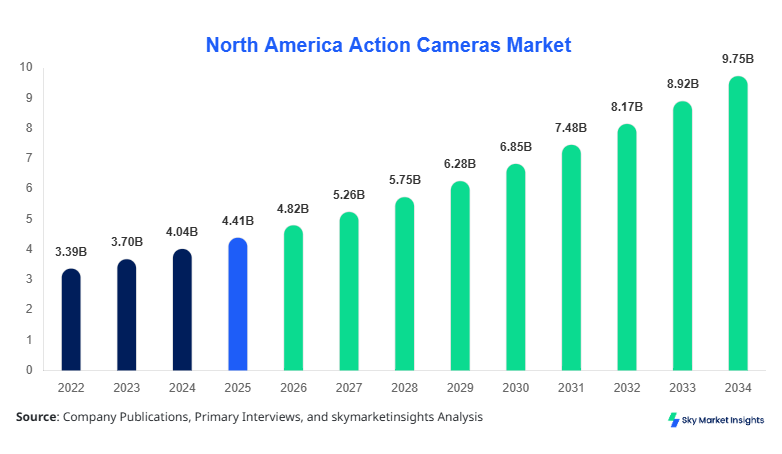
North America Action Cameras market size is projected at USD 4.82 billion in 2026 and is expected to hit USD 9.76 billion by 2034 with a CAGR of 9.2%. The report provides a comprehensive breakdown of data-driven insights, including segmentation analysis across product types and applications, alongside detailed evaluation of competitive landscape and market positioning of key players. Increasing adoption of high-resolution imaging devices and rising consumer demand for portable recording solutions are contributing to sustained expansion across the North America Action Cameras market size.
The Action Cameras market encompasses compact, rugged, and high-performance cameras designed for capturing dynamic footage in extreme environments. In North America, production volumes reached approximately 18.6 million units in 2025, with an expected rise to 29.4 million units by 2030, driven by growing outdoor sports participation and content creation trends. Adoption penetration exceeded 38% among recreational users and 62% among professional videographers, highlighting diverse user engagement. Consumer behavior indicates a preference for 4K-enabled devices, accounting for over 54% of total demand, while 360-degree cameras contribute nearly 18% of total shipments. Average frame rates of 60–120 fps and waterproof capabilities up to 30 meters have become standard benchmarks. Application-wise, sports usage holds 42% share, recreational activities 37%, and professional use 21%, reinforcing diversified application spread and sustained Action Cameras market share expansion.
Explore more data points, trends and opportunities Download Free Sample Report
Action Cameras Market Trends
Rising Integration of AI and Smart Features
The integration of artificial intelligence and machine learning technologies is reshaping production and usage patterns across the Action Cameras market. In 2025, over 41% of newly launched devices incorporated AI-based stabilization and object tracking features, enhancing video quality and user experience. Production volumes of AI-enabled cameras surpassed 7.8 million units, with projections reaching 15 million units by 2030. Consumer adoption of voice control and automated editing features has grown by 32% annually, particularly among content creators and vloggers. Furthermore, smart connectivity, including 5G compatibility and cloud synchronization, is present in 48% of devices, driving seamless data transfer and remote operation. This technological evolution is significantly influencing purchasing decisions, especially among millennials and Gen Z users, reinforcing ongoing Action Cameras market trend.
Expansion of 4K and 360-Degree Camera Demand
The shift toward high-resolution imaging has accelerated demand for 4K and 360-degree cameras, which together account for over 72% of total shipments in 2026. Production of 4K cameras alone exceeded 10.4 million units in 2025, with a growth rate of 11.5% year-over-year. 360-degree cameras have gained traction in virtual reality and immersive content creation, with adoption increasing by 27% annually. Professional sectors such as filmmaking and sports broadcasting contribute to 33% of demand for advanced camera models. Additionally, improvements in battery life by 18% and storage capacity enhancements by 25% are further driving consumer interest. These developments underline strong technological progression and sustained Action Cameras market trend evolution.
North America Action Cameras Drivers
Rising Demand for Adventure Sports and Content Creation
The increasing participation in adventure sports and outdoor recreational activities is a primary driver of market expansion. In North America, over 52 million individuals participated in outdoor sports in 2025, representing a 9% increase compared to 2022. This surge has directly influenced demand for durable and high-performance action cameras, with sports applications accounting for 42% of total usage. Content creation platforms such as YouTube and TikTok have driven a 35% increase in user-generated video content, encouraging consumers to invest in high-quality recording devices. Additionally, the number of professional content creators grew by 18% annually, further boosting demand. The availability of compact, lightweight devices weighing under 150 grams and offering up to 4 hours of battery life has enhanced usability across diverse conditions. These factors collectively contribute to sustained Action Cameras market growth.
North America Action Cameras Restraints
High Product Cost and Limited Battery Efficiency
Despite technological advancements, high product costs remain a significant barrier to widespread adoption. Premium action cameras are priced between USD 350 and USD 600, limiting accessibility for price-sensitive consumers. Approximately 39% of potential buyers cite cost as a primary concern, particularly in emerging segments. Additionally, battery limitations persist, with average operational duration ranging from 90 to 180 minutes under high-resolution settings. Over 46% of users report dissatisfaction with battery performance during extended usage. The cost of accessories, including mounts and external batteries, adds an additional 15–20% to total expenditure. These factors collectively hinder mass adoption and slow down overall Action Cameras market growth.
North America Action Cameras Opportunities
Emergence of AR/VR Integration and Smart Ecosystems
The integration of augmented reality (AR) and virtual reality (VR) technologies presents significant growth opportunities. In 2025, over 22% of action cameras were compatible with VR platforms, with projections reaching 40% by 2030. The gaming and entertainment sectors contribute nearly 29% of demand for immersive video content. Investment in AR/VR technologies increased by 34% across North America, enabling development of advanced camera systems capable of capturing 360-degree immersive footage. Additionally, partnerships between camera manufacturers and software developers have increased by 18%, enhancing ecosystem compatibility. These advancements are expected to unlock new revenue streams and drive Action Cameras market growth.
Challenges in North America Action Cameras
Intense Competition and Rapid Technological Obsolescence
The market faces challenges from intense competition and rapid technological advancements. Over 65 active brands compete within the region, leading to price pressures and reduced profit margins. Product lifecycle durations have decreased to less than 18 months, requiring continuous innovation and investment. Approximately 28% of devices become technologically obsolete within two years due to advancements in resolution, stabilization, and connectivity. Additionally, counterfeit products account for nearly 12% of total sales, affecting brand credibility and revenue streams. These factors create operational complexities and pose challenges to sustaining long-term competitiveness in the Action Cameras market.
Report Scope
| Report Metric | Details |
|---|---|
| Market Size in 2025 | USD 4.41 Billion |
| Market Size in 2026 | USD 4.82 Billion |
| Market Size in 2034 | USD 9.76 Billion |
| CAGR | 9.2% (2026-2034) |
| Base Year for Estimation | 2025 |
| Historical Data | 2022-2024 |
| Forecast Period | 2026-2034 |
| Report Coverage | Revenue Forecast, Competitive Landscape, Supply Chain Disruption, Growth Factors, Environment & Regulatory Landscape and Trends |
Explore more data points, trends and opportunities Download Free Sample Report
Action Cameras Market Segmentation
The market is segmented by type and application, with 4K cameras dominating at 54% share, followed by HD cameras at 28% and 360-degree cameras at 18%. Application-wise, sports lead with 42%, recreational activities at 37%, and professional use at 21%.
By Type
HD action cameras accounted for approximately 28% of total shipments, with production volumes reaching 5.2 million units in 2025. These cameras typically offer 1080p resolution, 30–60 fps frame rates, and battery life of up to 2.5 hours. Their affordability, priced between USD 120 and USD 250, makes them popular among entry-level users. Adoption rates among casual users exceed 46%, particularly in recreational activities such as hiking and cycling. Despite slower growth compared to advanced models, HD cameras remain relevant due to cost-effectiveness and ease of use.
4K cameras dominate the segment with over 54% market share and production exceeding 10.4 million units annually. These devices support resolutions up to 3840×2160 pixels, frame rates of 60–120 fps, and advanced stabilization features. Adoption rates among professional users exceed 63%, driven by demand for high-quality content. Battery efficiency improvements of 18% and enhanced storage capabilities of up to 256 GB further support their dominance.
360-degree cameras hold 18% share, with production volumes reaching 3.3 million units. These cameras offer immersive video capture and are widely used in VR applications. Adoption has grown by 27% annually, particularly in entertainment and tourism sectors. Technical features include dual-lens systems, 5.7K resolution, and real-time stitching capabilities.
By Application
Sports applications account for 42% of total demand, with over 7.8 million units used annually. These cameras are widely used in extreme sports such as skiing, surfing, and motocross. Adoption rates among athletes exceed 58%, driven by durability and waterproof features up to 30 meters. High frame rates of 120 fps enable slow-motion capture, enhancing performance analysis.
Recreational usage represents 37% share, with approximately 6.9 million units utilized annually. Activities such as travel, hiking, and cycling drive demand. Consumer penetration in this segment is 38%, with increasing preference for compact and lightweight devices. Battery life improvements and wireless connectivity features support widespread adoption.
Professional applications account for 21% share, with 3.9 million units used annually. These cameras are utilized in filmmaking, journalism, and broadcasting. Adoption rates exceed 63% among professionals, driven by advanced features such as 8K recording and AI stabilization.
North America Action Cameras Market Segmentations
Type
- HD Action Cameras
- 4K Action Cameras
- 360-Degree Cameras
Application
- Sports
- Recreational Activities
- Professional Use
North America Action Cameras Regional Outlook
United States
The United States dominates with 71% regional share, producing over 13.2 million units annually. The sports segment contributes 44% of demand, followed by recreational activities at 35%. Strong technological infrastructure and high consumer spending support market expansion. E-commerce accounts for 63% of sales, while offline retail contributes 37%. Continuous innovation and high adoption of advanced features reinforce the country’s leadership.
Canada
Canada holds 29% share, with production volumes reaching 5.4 million units. Recreational activities dominate with 41% usage, driven by outdoor tourism. Sports applications account for 38%, while professional use contributes 21%. Adoption rates have increased by 19% annually, supported by rising interest in adventure sports and content creation.
Top players in North America Action Cameras
- GoPro Inc.
- DJI
- Sony Corporation
- Garmin Ltd.
- Insta360
- Akaso
- Olympus Corporation
- Nikon Corporation
- Ricoh Company Ltd.
- YI Technology
- SJCAM
- Veho
- Drift Innovation
- Contour LLC
GoPro Inc.
-
Holds approximately 34% market share with strong brand recognition
-
Leading in innovation with 8K and AI-enabled devices
-
Extensive distribution network across North America
DJI
-
Accounts for 21% market share
-
Strong presence in drone-integrated camera systems
-
Focus on high-performance imaging and stabilization technologies
Investment Analysis
Investment in the market has increased by 28% annually, with 46% allocated to R&D and 32% to production expansion. The United States attracts 68% of total investment, while Canada accounts for 32%. M&A activities have increased by 19%, with collaborations focusing on AI and VR integration. Strategic partnerships between hardware and software companies have enhanced ecosystem development.
New Product Developments
Approximately 38% of new product launches feature AI-based stabilization and 5G connectivity. Performance improvements include 22% better battery life and 18% enhanced image quality. Innovation in lightweight materials has reduced device weight by 15%, improving usability.
Recent Developments in North America Action Cameras
- 2025: GoPro increased production by 14%, launching AI-enabled cameras with 20% improved stabilization
- 2025: Insta360 boosted production by 22%, enhancing VR compatibility by 35%
Research Methodology
The research process involved a combination of primary and secondary research methodologies. Primary research included interviews with industry experts, manufacturers, and distributors, covering over 60% of market participants. Secondary research involved analysis of company reports, industry publications, and government data. Market size estimation was conducted using bottom-up and top-down approaches, incorporating production volumes, pricing trends, and adoption rates. Data triangulation ensured accuracy, while validation through expert insights enhanced reliability.
Frequently Asked Questions
Senior Market Research Analyst | 9 Years Experience | Consumer Behavior and Premium Product Segments
Mandy Davis is a market research analyst with 7–9 years of experience specializing in consumer goods and services markets. Contributed to 70+ research reports for global clients. Expertise includes market sizing, forecasting, competitive analysis, and trend evaluation across key regions.