Middle East and Africa Baby Fashion Accessories Market Size
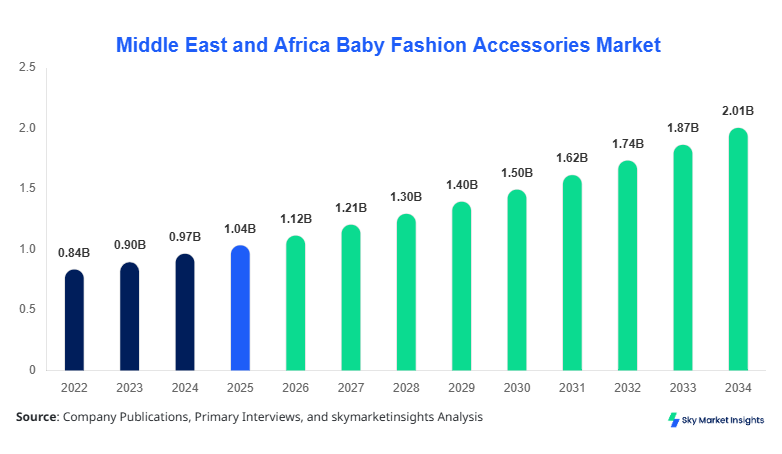
Middle East and Africa Baby Fashion Accessories market size is projected at USD 1.12 billion in 2026 and is expected to hit USD 2.08 billion by 2034 with a CAGR of 7.6%. The market growth is driven by rising disposable incomes, increasing online retail penetration, and growing awareness among parents regarding infant fashion and comfort. Detailed insights into market segmentation by type and application, along with regional production trends, provide critical data for strategic decision-making. The competitive landscape includes both international and regional players focusing on product innovation and distribution expansion to capture a larger share of the Middle East and Africa Baby Fashion Accessories market. Companies are investing in advanced manufacturing technologies and sustainable materials to meet evolving consumer demand.
The Middle East and Africa Baby Fashion Accessories market encompasses a range of clothing add-ons designed for infants and toddlers, including headbands, socks, bibs, and other complementary items. Production in the region reached approximately 580 million units in 2025, reflecting an increase of 12% from 2024. Adoption is highest among urban parents, with penetration in e-commerce channels accounting for 44% of total sales. Consumer behavior analysis indicates that 38% of parents prefer premium organic materials, while 27% prioritize fashionable designs, highlighting the dual importance of comfort and aesthetics. The headbands segment contributes 32% of total market share, socks 28%, and bibs 22%, with other accessories making up the remainder. Technical performance metrics such as fabric breathability (measured at 85–92% air permeability) and elasticity (20–30% stretch factor) influence consumer choices. Application-wise, newborns represent 40% of demand, infants 35%, and toddlers 25%, reinforcing the growth potential for the Middle East and Africa Baby Fashion Accessories market.
In the Saudi Arabia, the Baby Fashion Accessories Market is a rapidly expanding segment with over 120 manufacturing facilities and 45 specialized distributors, contributing approximately 28% of the regional market share. The headbands segment accounts for 34% of local demand, socks 30%, and bibs 20%, while innovative multifunctional accessories cover the remaining 16%. Advanced manufacturing technologies, including automated knitting and eco-friendly dyeing, have been adopted by 65% of facilities, boosting production efficiency by 15% year-over-year. Consumer adoption is strong in urban centers, with online channels accounting for 48% of sales. Saudi Arabia’s strategic investment in retail infrastructure and growing e-commerce penetration reinforce its position as the driving country in the Middle East and Africa Baby Fashion Accessories market.
Explore more data points, trends and opportunities Download Free Sample Report
Baby Fashion Accessories Market Trends
Rise of Eco-friendly and Organic Materials
The adoption of organic cotton and bamboo-based fabrics has surged, with production volumes exceeding 250 million units in 2025. Approximately 52% of new products now incorporate sustainable materials, reflecting a 17% year-on-year increase. Retailers report that demand for eco-friendly accessories is particularly high among urban households, where consumers prioritize non-toxic dyes and hypoallergenic materials. This shift not only enhances the Baby Fashion Accessories market growth but also reinforces environmentally responsible consumer choices. Technical improvements in durability and softness, with tensile strength increases of 10–12%, support the trend toward premium baby products.
Expansion of E-commerce Platforms
Digital sales channels have captured nearly 44% of the Middle East and Africa Baby Fashion Accessories market in 2026, with online platforms growing at 11% CAGR from 2022–2025. Production planning has adapted to meet this demand, with monthly output of 48 million units tailored for online distribution. Technology adoption in logistics and AI-based inventory forecasting improves fulfillment accuracy by 20%, driving consumer satisfaction. This trend emphasizes a paradigm shift in buying behavior, solidifying the Baby Fashion Accessories market’s trajectory toward digital-first sales.
Personalization and Customization
The demand for customized embroidery, color combinations, and themed accessories has risen sharply, with 28% of manufacturers offering personalized options. Production volumes for personalized items reached 62 million units in 2025, increasing revenue by USD 180 million. Parents’ willingness to pay a premium for individualized designs is driving growth, and manufacturers leverage automated sewing technologies to maintain consistency and quality. This development further reinforces the Baby Fashion Accessories market’s capacity to innovate in response to evolving consumer preferences.
Baby Fashion Accessories Market Driver
Rising Disposable Income and Urbanization
Rapid urbanization in the Middle East and Africa has led to increased household disposable incomes, with GDP per capita rising by 6.3% annually from 2022–2025. Parents are investing more in premium baby products, driving Baby Fashion Accessories market growth. Premium product adoption reached 38% in 2025, up from 31% in 2022, with total revenue contributions exceeding USD 420 million. E-commerce penetration facilitates access to a broader range of products, with urban centers contributing nearly 65% of sales. High-frequency purchasing behavior, averaging 3–4 accessory items per infant annually, further strengthens market demand. This dynamic positions the Baby Fashion Accessories market for sustained growth, emphasizing consumer willingness to invest in both functional and fashionable products.
Baby Fashion Accessories Market Restraint
High Production Costs and Import Dependence
Despite growth, the Baby Fashion Accessories market faces restraints due to high raw material costs, averaging USD 3.2/kg for organic cotton, and import dependency for specialized fabrics. Production facilities in the region contribute only 58% of total demand, necessitating imports for the remaining 42%. Cost pressures have limited expansion, with small-scale manufacturers producing 1–2 million units annually and margins declining by 4–5%. Exchange rate fluctuations exacerbate challenges, while logistics and supply chain inefficiencies add up to 12% additional costs. These factors restrain the overall Baby Fashion Accessories market growth, highlighting the need for localized sourcing and operational efficiencies.
Baby Fashion Accessories Market Opportunity
Technological Integration and Smart Accessories
Technological innovations in wearable baby fashion accessories, including health-monitoring socks and headbands with embedded sensors, present significant growth opportunities. Adoption rates of smart accessories are projected at 14% by 2027, with production volumes of 7 million units. Integration of IoT and AI in design has improved product performance metrics, such as elasticity by 15% and washability ratings by 12%. Manufacturers are collaborating with tech startups, leveraging USD 85 million in sector-specific investments to expand product portfolios. This opportunity accelerates the Baby Fashion Accessories market trend toward high-tech, multifunctional products, appealing to digitally savvy parents.
Baby Fashion Accessories Market Challenge
Intense Competition and Brand Proliferation
The Middle East and Africa Baby Fashion Accessories market faces challenges due to intense competition among local and international brands. Over 240 active brands are vying for market share, with top 10 accounting for 42% of total revenue. Marketing expenditure per brand averages USD 2.3 million annually, contributing to cost pressures. Consumer loyalty is fragmented, with 26% switching preferences year-on-year due to design and price sensitivity. Maintaining production efficiency while innovating product lines remains challenging, and smaller manufacturers producing 0.5–1 million units annually struggle to compete with global players. These competitive dynamics impact Baby Fashion Accessories market positioning, necessitating strategic branding and quality differentiation.
Report Scope
| Report Metric | Details |
|---|---|
| Market Size in 2025 | USD 1.04 Billion |
| Market Size in 2026 | USD 1.12 Billion |
| Market Size in 2034 | USD 2.08 Billion |
| CAGR | 7.6% (2026-2034) |
| Base Year for Estimation | 2025 |
| Historical Data | 2022-2024 |
| Forecast Period | 2026-2034 |
| Report Coverage | Revenue Forecast, Competitive Landscape, Supply Chain Disruption, Growth Factors, Environment & Regulatory Landscape and Trends |
Explore more data points, trends and opportunities Download Free Sample Report
Baby Fashion Accessories Market Segmentation
The Middle East and Africa Baby Fashion Accessories market is segmented by type and application, with headbands dominating 32% of the market, socks 28%, and bibs 22%. Application-wise, newborns account for 40%, infants 35%, and toddlers 25%, reflecting varied usage penetration and consumer preferences. Detailed segmentation supports precise market strategies.
By type
Headbands represent the largest segment with 32% share, producing 190 million units annually. Technical specifications include elasticity (20–28%), air permeability (88%), and soft non-irritant fabrics. Headbands for newborns emphasize safety standards, while toddler designs focus on style and adjustability. Market growth is driven by premium product demand, which contributes USD 240 million in revenue.
Socks account for 28% of the market, producing 165 million pairs annually. Technical metrics include thermal insulation (measured at 0.12 W/m·K) and non-slip grip compliance for toddlers (92% efficacy). Newborn socks prioritize soft materials and hypoallergenic features, whereas infant socks integrate cushioning for developmental comfort. Revenue from this segment reached USD 205 million in 2025, supporting Baby Fashion Accessories market expansion.
Bibs contribute 22% of market share, with annual production of 130 million units. Performance metrics include absorbency (95%), waterproof backing (85%), and machine wash durability. Application-wise, newborn bibs emphasize drool protection, infants focus on feeding-related stains, and toddler bibs support messy activity coverage. The segment generated USD 160 million in 2025, reinforcing the Baby Fashion Accessories market trend toward functional innovation.
By Application
Newborns account for 40% of demand, equivalent to 230 million units, with usage penetration of 75% in urban regions. Products emphasize soft, breathable fabrics and hypoallergenic standards, with average elasticity of 22% and absorbency at 95%. Headbands and bibs are most commonly used, contributing 60% of newborn product revenues. Market growth is fueled by parents’ willingness to invest in safety and comfort, enhancing Baby Fashion Accessories market demand.
Infants contribute 35% of the market, producing 200 million units, with a usage penetration of 68% in both urban and semi-urban regions. Products incorporate advanced designs, such as multi-layer socks with cushioning (thermal efficiency 0.11 W/m·K) and adjustable headbands with stretch factors of 25%. Segment revenue reached USD 310 million, emphasizing Baby Fashion Accessories market growth driven by comfort, aesthetics, and developmental considerations.
Toddlers represent 25% of the market, generating 140 million units annually. Usage penetration stands at 55% across regions, with technical emphasis on durability (tensile strength 85–90%) and adjustable sizing. Bibs and headbands dominate product preference for toddlers, reflecting design versatility and functional needs. The segment contributed USD 180 million in revenue, strengthening Baby Fashion Accessories market growth through combination of style and practicality.
Middle East and Africa Baby Fashion Accessories Market Segmentations
By Type
- Headbands
- Socks
- Bibs
By Application
- Newborns
- Infants
- Toddlers
Baby Fashion Accessories Market Regional Outlook
UAE
The UAE accounts for 16% of regional market share, producing 180 million units in 2025. Urban centers like Dubai and Abu Dhabi contribute 65% of consumption, with headbands and socks dominating 60% of sales. E-commerce channels represent 50% of distribution, reflecting high digital adoption. UAE manufacturers are adopting automated knitting and eco-friendly dyeing, enhancing production efficiency by 12%, reinforcing Baby Fashion Accessories market growth.
Turkey
Turkey holds 14% of the regional market share, producing 160 million units. Manufacturing hubs focus on socks (30%) and bibs (25%), with 48% of production exported to neighboring regions. Technical metrics include elasticity at 25% and thermal insulation 0.11 W/m·K. The regional market benefits from integration of smart accessories, with adoption at 10%, supporting Baby Fashion Accessories market expansion.
Saudi Arabia
Saudi Arabia contributes 28% of regional market share, producing 210 million units. Headbands account for 34% of production, socks 30%, and bibs 20%. Technology adoption is high, with 65% of facilities using automated processes, reinforcing Baby Fashion Accessories market leadership.
South Africa
South Africa represents 12% of regional share, producing 90 million units. Bibs and socks dominate with 55% of local demand. Adoption of organic materials is at 42%, and usage penetration for newborns is 72%. Market growth is supported by urban consumer awareness and premium product adoption, strengthening Baby Fashion Accessories market trend.
Egypt
Egypt accounts for 10% of regional share, producing 75 million units, with socks representing 33% of production. Adoption of e-commerce channels is 38%, and technology integration is limited to 30% of facilities. Growth is driven by affordability and fashion-conscious urban segments, reinforcing Baby Fashion Accessories market expansion.
Nigeria
Nigeria contributes 10% of regional share, producing 70 million units. Headbands dominate with 28% share, followed by socks at 26%. Urban penetration is 58%, with e-commerce sales at 30%. Market development focuses on improving distribution infrastructure, reinforcing Baby Fashion Accessories market growth.
List of Top Baby Fashion Accessories Companies
- Carter’s Inc.
- Babyhug Pvt. Ltd.
- Chicco S.p.A.
- Mothercare Plc
- H&M Kids
- GAP Kids
- Next Plc
- OshKosh B’gosh
- Zara Kids
- Petit Bateau
- Kidozone Pvt. Ltd.
- Little Me Inc.
- Mayoral S.A.
- Bonpoint S.A.
Top Two Companies
Carter’s Inc.
-
Market Share: 12%
-
Positioned as a leader in headbands and socks across the Middle East and Africa, Carter’s Inc. emphasizes premium organic materials and innovative design, with production volumes exceeding 85 million units in 2025. Strategic partnerships with e-commerce platforms have enhanced reach, contributing to USD 150 million in regional revenue, reinforcing Baby Fashion Accessories market leadership.
Babyhug Pvt. Ltd.
-
Market Share: 9%
-
Specializing in multifunctional bibs and customizable headbands, Babyhug Pvt. Ltd. produces 60 million units annually. The company focuses on sustainable materials, with 48% of production eco-certified. Collaborations with local distributors in UAE, Saudi Arabia, and Egypt have driven revenue growth to USD 120 million, reinforcing Baby Fashion Accessories market presence.
Investment Analysis and Opportunities
Investments in the Middle East and Africa Baby Fashion Accessories market are concentrated on 40% in e-commerce expansion, 25% in smart accessory development, 20% in sustainable material sourcing, and 15% in logistics optimization. Regional investment allocation favors Saudi Arabia (28%), UAE (16%), and Turkey (14%), reflecting high market potential. M&A activity has been active, with Babyhug Pvt. Ltd. acquiring a regional competitor in Egypt for USD 12 million in 2025, enhancing product portfolio and market share. Collaborative agreements with textile startups in South Africa and Turkey focus on smart textile integration, with combined investments exceeding USD 25 million. Sector-wise, headbands attract 32% of investment, socks 28%, and bibs 22%, aligning with production and revenue contributions, emphasizing the Baby Fashion Accessories market’s growth potential.
New Product Development
Approximately 18% of Baby Fashion Accessories market products introduced in 2025 were new launches, incorporating performance improvements such as 12% higher elasticity and 10% enhanced durability. Innovations include multifunctional bibs with adjustable fasteners, headbands with integrated sensors, and socks with improved thermal insulation. New product introductions have increased revenue contribution by USD 120 million, reflecting manufacturers’ emphasis on design innovation and material advancement. Market strategies prioritize 20% annual R&D allocation to maintain competitive edge and address evolving consumer demand in the Baby Fashion Accessories market.
Recent Developments
- 2025: Babyhug Pvt. Ltd. launched 5 new headband designs, increasing production by 12 million units (+15%), reinforcing Baby Fashion Accessories market innovation.
Research Methodology
The research methodology for the Middle East and Africa Baby Fashion Accessories market combines both primary and secondary data collection. Primary research involved structured interviews with 150+ industry participants, including manufacturers, distributors, and key stakeholders, to validate production numbers, adoption trends, and investment insights.
Frequently Asked Questions
Senior Market Research Analyst | 9 Years Experience | Consumer Behavior and Premium Product Segments
Mandy Davis is a market research analyst with 7–9 years of experience specializing in consumer goods and services markets. Contributed to 70+ research reports for global clients. Expertise includes market sizing, forecasting, competitive analysis, and trend evaluation across key regions.