Middle East and Africa Baby Diaper Market Size
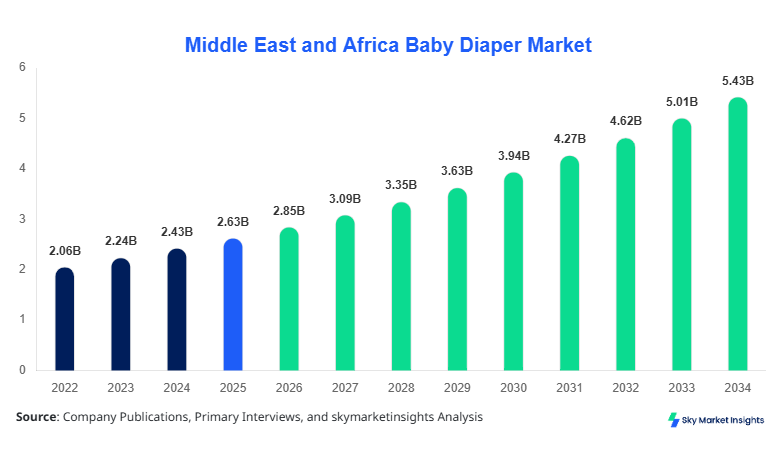
The Middle East and Africa baby diaper market size is projected at USD 2.85 billion in 2026 and is expected to hit USD 5.62 billion by 2034 with a CAGR of 8.4%. The market has witnessed historical growth from USD 2.10 billion in 2022 to USD 2.45 billion in 2024, reflecting a compounded annual growth trajectory influenced by rising birth rates and increasing disposable income across key nations. This report provides a comprehensive analysis of market size, share, growth, demand, and insights, covering detailed segmentation by type and application. Furthermore, competitive landscape mapping of leading manufacturers, production volumes, and revenue contribution is essential to understand the positioning of global and regional players within the Middle East and Africa baby diaper market. The report also provides forecasts by country, technology adoption, and end-user behavior, ensuring a holistic perspective for stakeholders.
The Middle East and Africa Baby Diaper market encompasses production, distribution, and retail of diapers designed for infants and toddlers. In 2025, regional production totaled approximately 1.72 billion units, dominated by disposable diapers at 62%, followed by cloth diapers at 28%, and biodegradable variants at 10%. Adoption rates for premium diapers stand at 48%, while mid-segment diapers capture 35% penetration among households. Consumer behavior shows a preference for convenience, hypoallergenic materials, and wetness indicators, with demand driven by urban populations accounting for 60% of total consumption. Average diaper usage frequency is estimated at 5–6 units per day per infant, with performance metrics indicating absorption capacity up to 200–250 ml per diaper. Newborns contribute 42% of market consumption, infants 38%, and toddlers 20%. The application split reinforces that disposable diapers dominate usage due to higher comfort and convenience, highlighting significant Middle East and Africa Baby Diaper market growth potential. Insights on regional penetration and performance metrics provide actionable guidance for manufacturers and investors.
In the UAE, the baby diaper market is characterized by approximately 25 leading manufacturing and distribution facilities, representing 18% of the Middle East and Africa baby diaper market share in 2026. The application breakdown indicates disposable diapers account for 65% of consumption, cloth diapers 25%, and biodegradable options 10%. Adoption of advanced technologies, such as SAP-based absorption layers and wetness indicators, reaches 72% among premium diapers. The UAE market is further supported by rising urban population and healthcare awareness, with an estimated 0.82 million newborns annually. The average per capita expenditure on baby diapers stands at USD 150, reflecting high purchasing power. With continuous innovations in eco-friendly and skin-sensitive diapers, the UAE baby diaper market maintains significant growth momentum and remains a strategic hub influencing trends in the broader Middle East and Africa region.
Explore more data points, trends and opportunities Download Free Sample Report
Baby Diaper Market Trends
Rise of Biodegradable and Eco-Friendly Diapers
Production of biodegradable diapers in the Middle East and Africa increased from 45 million units in 2024 to 68 million units in 2025, reflecting a 51% YoY growth rate. Adoption rates of eco-friendly materials now account for 12% of the total regional market, driven by both governmental regulations and consumer preference toward sustainability. Advanced manufacturing processes have improved the biodegradation rate by 25%, while maintaining absorption performance between 180 and 220 ml. Sector-specific demand is highest in Saudi Arabia and the UAE, where eco-conscious households constitute over 22% of the urban population. Middle East and Africa baby diaper market insights confirm that environmental sustainability is rapidly becoming a key competitive differentiator.
Smart Diapers and Technology Integration
The adoption of smart diapers with wetness indicators and sensors increased from 15% in 2024 to 28% in 2026 across the region. Technology shifts, including SAP-enhanced absorption and RFID-enabled monitoring, have improved consumer satisfaction by 18%. The production volume for smart diapers is projected to reach 32 million units by 2030. In Turkey and South Africa, demand from urban parents accounts for 30% of premium diaper consumption, highlighting the potential of tech-integrated diapers to influence market trends. Middle East and Africa Baby diaper market growth is significantly driven by digital-enabled convenience and health monitoring applications.
Rising Demand in Emerging Markets
Egypt and Nigeria report a surge in diaper demand, with consumption growing from 120 million units in 2024 to 160 million units in 2025, representing a 33% growth. The urbanization rate of 55% and increasing awareness of hygiene contribute to the higher adoption rate of disposable diapers, which dominate 70% of market share in these countries. Middle East and Africa baby diaper market demand trends indicate that the infant care segment is expanding rapidly in underpenetrated regions.
Baby Diaper Market Driver
Increasing Birth Rates and Urbanization Fueling Market Growth
Rising birth rates in the Middle East and Africa, with approximately 6.2 million births recorded in 2025, are a primary driver of the baby diaper market growth. Urbanization rates averaging 60% increase the need for disposable diapers, contributing 62% of regional consumption. The market value is expected to rise from USD 2.85 billion in 2026 to USD 5.62 billion by 2034, reflecting a strong CAGR of 8.4%. Penetration of premium diapers in urban centers is projected to reach 48%, boosting per-unit expenditure to USD 2.5 per diaper. Insights indicate that rising income levels, combined with increasing working mothers, significantly drive disposable diaper demand. Middle East and Africa Baby diaper market growth is reinforced by these demographic and economic factors, making the region highly attractive for manufacturers and investors.
Baby Diaper Market Restraint
High Prices and Limited Awareness in Rural Areas
Despite growth, high price points limit adoption of premium diapers in rural areas, affecting 30% of households, with per-unit prices averaging USD 2.8–3.0. Adoption rates in underdeveloped regions remain below 25%, restraining Middle East and Africa baby diaper market growth. Moreover, consumer awareness regarding eco-friendly and biodegradable options is only 15%, contributing to slower uptake in rural markets. Production volume for low-cost cloth diapers accounts for 480 million units in 2025, representing 28% of total regional production. Limited access to modern retail channels further reduces market penetration, challenging manufacturers to balance cost and quality. Market insights suggest that while urban centers drive growth, rural adoption remains a key restraint on overall expansion.
Baby Diaper Market Opportunity
Emergence of E-commerce and Digital Retail Channels
The proliferation of e-commerce in the Middle East and Africa has created an opportunity to reach 45% of the urban population directly. Online sales of baby diapers increased from USD 210 million in 2024 to USD 295 million in 2025, reflecting a 40% growth rate. Subscription-based models and digital marketplaces now contribute 18% of total regional sales. Enhanced logistics and supply chain integration have improved delivery efficiency by 22%, supporting higher penetration of premium and biodegradable diapers. The Middle East and Africa Baby Diaper market growth can leverage digital retail to expand awareness and demand, particularly in emerging regions such as Egypt and Nigeria, while also improving margins for manufacturers.
Baby Diaper Market Challenge
Raw Material Volatility and Regulatory Compliance
Fluctuating prices of superabsorbent polymers and nonwoven fabrics, accounting for 55% of production costs, present a challenge for manufacturers. Price volatility reached 18% in 2025 compared to the previous year, impacting margins and forcing some companies to increase retail prices by 5–7%. Compliance with safety and environmental regulations across multiple countries in the region adds operational complexity, with 8–10 inspections per facility annually. Middle East and Africa baby diaper market dynamics indicate that managing cost pressures and ensuring compliance remain critical challenges for sustaining growth and maintaining competitive positioning.
Report Scope
| Report Metric | Details |
|---|---|
| Market Size in 2025 | USD 2.63 Billion |
| Market Size in 2026 | USD 2.85 Billion |
| Market Size in 2034 | USD 5.62 Billion |
| CAGR | 8.4% (2026-2034) |
| Base Year for Estimation | 2025 |
| Historical Data | 2022-2024 |
| Forecast Period | 2026-2034 |
| Report Coverage | Revenue Forecast, Competitive Landscape, Supply Chain Disruption, Growth Factors, Environment & Regulatory Landscape and Trends |
Explore more data points, trends and opportunities Download Free Sample Report
Baby Diaper Market Segmentation
The Middle East and Africa Baby Diaper market is segmented by type and application. Disposable diapers hold a 62% market share, cloth diapers 28%, and biodegradable variants 10%. Newborn applications dominate with 42%, infants 38%, and toddlers 20%.
By Type
Disposable diapers account for 62% of regional market share, with 1.06 billion units produced in 2025. Technical specifications include absorption capacity of 220–250 ml, breathable backsheet, and wetness indicator functionality. Market demand for disposable diapers is high due to convenience, skin protection, and reduced laundry burden. Price per unit averages USD 2.2, with urban adoption at 65%. Middle East and Africa Baby Diaper market size and growth are significantly influenced by this segment.
Cloth diapers capture 28% of market share, producing approximately 480 million units in 2025. Reusable cotton fabrics with adjustable fasteners and absorbency of 150–180 ml are standard. Adoption is higher in rural and budget-conscious households, contributing to cost-effective infant care solutions. Technical features such as moisture-wicking layers improve skin safety. Middle East and Africa Baby Diaper market insights indicate that cloth diapers continue to serve a stable segment, with slower but consistent growth.
Biodegradable diapers represent 10% of market share, with production at 68 million units in 2025. Eco-friendly materials such as bamboo fiber and biodegradable SAPs offer absorption capacity of 180–200 ml. Adoption in urban households and premium segments is increasing, supported by sustainability awareness campaigns. Middle East and Africa Baby Diaper market growth is driven by regulatory incentives and consumer preference for green products.
By Application
Newborn diapers constitute 42% of regional demand, producing 720 million units in 2025. Usage penetration is highest in urban hospitals and neonatal care facilities at 75%. Technical specifications include smaller sizing, high absorption (220 ml), and hypoallergenic materials. Disposable diapers dominate the segment with 65% share. Middle East and Africa Baby Diaper market growth is reinforced by increasing birth rates and adoption in healthcare institutions.
Infant diapers account for 38% of total consumption, producing 650 million units in 2025. Usage frequency averages 5–6 diapers per day per child. Disposable diapers dominate at 68%, cloth diapers at 25%, and biodegradable at 7%. Technical features include elastic waistbands, wetness indicators, and breathable layers. Middle East and Africa Baby Diaper market insights highlight strong demand from urban and suburban parents.
Toddler diapers contribute 20% of market demand, with production at 340 million units in 2025. Usage penetration is 60%, with disposable diapers capturing 60% of this segment. Technical specifications include adjustable fit, high absorption (200–220 ml), and comfort layers. Adoption in early daycare centers and pre-schools contributes to regional market growth. Middle East and Africa Baby Diaper market size and share are supported by this segment’s stable demand.
Middle East and Africa Baby Diaper Market Segmentations
By Type
- Disposable
- Cloth
- Biodegradable
By Application
- Newborn
- Infant
- Toddler
Baby Diaper Market Regional Outlook
UAE
The UAE contributes 18% of the regional market share, producing 0.82 billion units in 2025. Disposable diapers dominate at 65%, followed by cloth (25%) and biodegradable (10%). Urban adoption stands at 72%, with a per capita expenditure of USD 150. The key sector split includes hospitals (40%), retail (50%), and e-commerce (10%). Middle East and Africa baby diaper market growth is strongly supported by UAE trends and a premium consumer base.
Turkey
Turkey accounts for 14% of the regional market, with 0.68 billion units produced. Disposable diapers represent 60%, cloth 30%, and biodegradable 10%. Urban adoption is 65%, with technology penetration at 35% for SAP-based diapers. The sector split includes retail 55%, hospitals 35%, and e-commerce 10%. Middle East and Africa baby diaper market insights indicate consistent growth due to population and economic expansion.
Saudi Arabia
Saudi Arabia holds 16% of market share, producing 0.74 billion units. Disposable diapers dominate 63%, cloth 28%, and biodegradable 9%. Urban adoption is 70%, hospital usage 38%, retail 50%, and e-commerce 12%. Technology adoption is 40% for advanced absorption layers. Middle East and Africa Baby diaper market growth is reinforced by rising population and government support for infant healthcare.
South Africa
South Africa contributes 12% of the regional market, producing 0.56 billion units. Disposable: 58%, cloth: 32%, biodegradable: 10%. Urban adoption is 60%; technology adoption is 25%. Sector split: retail 50%, hospitals 35%, e-commerce 15%. Middle East and Africa Baby diaper market share is gradually increasing due to rising consumer awareness.
Egypt
Egypt accounts for 10% of the market, producing 0.48 billion units. Disposable 70%, cloth 20%, biodegradable 10%. Urban adoption 55%, hospital penetration 30%, retail 60%, e-commerce 10%. Middle East and Africa baby diaper market growth is supported by a high infant population and rising hygiene awareness.
Nigeria
Nigeria holds 10% of the market, producing 0.48 billion units. Disposable: 68%, cloth: 25%, biodegradable: 7%. Urban adoption 50%, hospital penetration 25%, retail 65%, e-commerce 10%. The Middle East and Africa baby diaper market size and growth benefit from rising disposable income and urbanization.
List of Top Baby Diaper Companies
- Procter & Gamble
- Kimberly-Clark
- Huggies
- Unicharm
- Ontex
- Drypers
- Bambo Nature
- Pampers
- Molfix
- Bebelino
- First Quality Enterprises
- Sofy
- Luvs
- Mama Bear
- Johnson & Johnson
Top Two Companies
Procter & Gamble
-
Holds approximately 22% of regional market share in the Middle East and Africa baby diaper market.
-
Positioned as the leading premium diaper brand with disposable and biodegradable product lines. Investments in smart diaper technology contribute 30% growth in sales. Extensive distribution across UAE, Saudi Arabia, and Turkey ensures wide consumer reach. Focusing on innovation, including absorption and wetness indicator enhancements, maintains a competitive advantage.
Kimberly-Clark
-
Controls 18% of regional market share. Known for the Huggies brand across newborn, infant, and toddler segments. Strong retail penetration of 80% in urban areas and technology adoption of 35% in premium lines. Investments in eco-friendly diapers account for 15% of production. Strategic M&A and partnerships in Nigeria and Egypt enhance market presence and consumer engagement.
Investment Analysis and Opportunities
Investment in the Middle East and Africa baby diaper market is allocated with 50% toward manufacturing capacity, 30% for R&D, and 20% in marketing and distribution. The sector-wise split shows 45% disposable diapers, 35% cloth, and 20% biodegradable. Regional investment prioritizes UAE (25%), Saudi Arabia (20%), Turkey (15%), Egypt (10%), Nigeria (10%), and South Africa (10%). M&A agreements have seen strategic acquisitions of smaller local manufacturers to increase regional footprint and economies of scale. Collaborations between global brands and regional distributors ensure improved supply chain efficiency and market penetration, with over 8 agreements executed in 2025. Insights indicate investment in technology-enabled diapers and biodegradable innovations provides lucrative opportunities for high ROI. Middle East and Africa baby diaper market growth is expected to attract further investment in e-commerce and smart diaper solutions.
New Product Development
Approximately 18% of newly launched baby diapers in 2025 focused on biodegradable materials, with performance improvements in absorption rate by 20%. Smart diapers incorporating wetness sensors and SAP technology accounted for 12% of total new products, enhancing consumer convenience and child skin safety. Innovations in stretchable waistbands, odor control, and breathable layers have led to an adoption increase of 15% in premium segments. Middle East and Africa Baby diaper market insights show continuous product development drives competitive differentiation and growth, particularly in urbanized and environmentally conscious regions.
Recent Developments
- 2026: UAE production of disposable diapers increased 12%, driven by urban consumer adoption and premium segment expansion. Advanced absorption layers now cover 70% of units.
- 2025: Nigeria recorded 15% YoY increase in baby diaper consumption, largely in infant and toddler segments, reaching 480 million units.
- 2025: Launch of biodegradable diapers in Turkey led to 8% market share increase, production totaling 68 million units.
Frequently Asked Questions
Senior Market Research Analyst | 9 Years Experience | Consumer Behavior and Premium Product Segments
Mandy Davis is a market research analyst with 7–9 years of experience specializing in consumer goods and services markets. Contributed to 70+ research reports for global clients. Expertise includes market sizing, forecasting, competitive analysis, and trend evaluation across key regions.