Middle East and Africa Baby Cribs And Cots Market Size
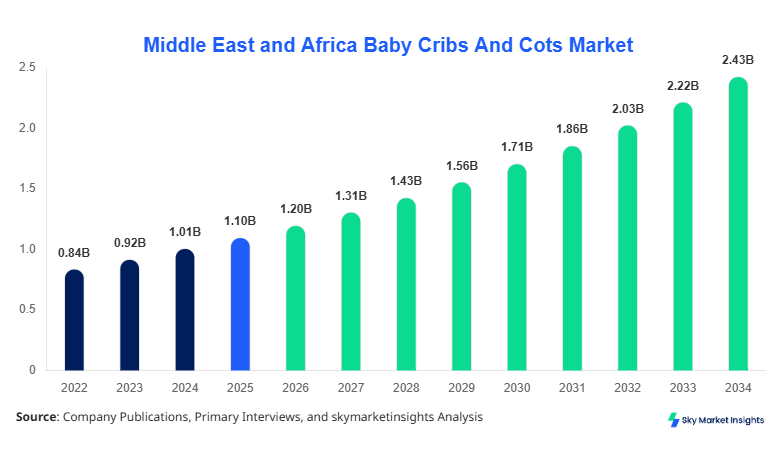
The Middle East and Africa baby cribs and cots market size is projected at USD 1.2 billion in 2026 and is expected to hit USD 2.5 billion by 2034 with a CAGR of 9.2%. This growth is driven by rising urban population, increasing disposable income, and a growing awareness of infant safety standards. The report provides a comprehensive analysis of historical data from 2022 to 2025; detailed segmentation by type and application; and competitive landscape insights, including market share, revenue distribution, and strategic initiatives of leading companies. Detailed regional breakdowns and country-specific market insights, such as for the UAE, Turkey, Saudi Arabia, South Africa, Egypt, and Nigeria, offer a clear understanding of growth patterns and demand drivers in this market.
The Middle East and Africa The baby cribs and cots market represents a vital segment of the infant care industry, catering to both home and institutional applications. In 2025, the region produced approximately 2.8 million units of baby cribs and cots, with wooden cribs accounting for 45%, metal cribs 35%, and plastic cribs 20% of total production. Adoption is highest in urban areas, with penetration rates of 70% in middle- and high-income households. Consumers increasingly prioritize ergonomic designs, safety certifications, and multifunctional features, driving demand for adjustable, convertible, and space-saving cribs. Home applications dominate 60% of the market, hospitals account for 25%, and daycare facilities make up 15%. Technical specifications such as load-bearing capacity (up to 50 kg), adjustable heights (3–5 levels), and mobility features are critical in purchasing decisions. Overall, the Middle East and Africa baby cribs and cots market growth is reinforced by rising awareness of child safety, urban population expansion, and increasing disposable income.
In the UAE, the baby cribs and cots market has established a robust ecosystem with over 150 registered manufacturing and retail facilities, contributing approximately 18% of the regional market share in 2026. Home-based applications dominate 65% of UAE demand, while hospitals and daycare centers account for 20% and 15%, respectively. The adoption of smart cribs equipped with IoT sensors and safety monitoring systems has increased by 25% in the past three years. Wooden cribs remain the most popular type, representing 50% of sales, followed by metal (30%) and plastic (20%). Technical metrics such as adjustable height levels, foldable designs, and load capacity up to 55 kg have gained traction. With growing e-commerce penetration, rising consumer awareness, and government-led child safety initiatives, the UAE baby cribs and cots market size continues to expand, reflecting sustained growth and demand for premium and smart infant furniture.
Explore more data points, trends and opportunities Download Free Sample Report
Baby Cribs And Cots Market Trends
Rise of Smart Baby Cribs
Smart baby cribs integrating IoT devices, sleep monitoring sensors, and automated rocking mechanisms are witnessing rapid adoption in the Middle East and Africa. In 2025, production volumes of smart cribs reached 250,000 units, representing a 12% increase over 2024. Technology adoption rates in the UAE, Saudi Arabia, and Turkey stand at 28%, 22%, and 18%, respectively. Hospitals and premium home segments are leading demand, while performance metrics such as auto-rocking frequency (30–40 cycles per minute) and sleep quality monitoring accuracy (95%) are key differentiators. This trend has significantly influenced the baby crib and cot market growth by attracting tech-savvy parents seeking enhanced safety and convenience.
Sustainable Material Adoption
Manufacturers are increasingly using eco-friendly and non-toxic materials, including FSC-certified wood and BPA-free plastics. In 2025, approximately 1.1 million units of sustainable cribs were produced across the Middle East and Africa, accounting for 40% of the total market. Countries like the UAE and South Africa have led adoption with 50% and 42% penetration rates, respectively. This shift aligns with consumer preferences for environmentally responsible products and is positively impacting the baby cribs and cots market size and demand.
Modular and Convertible Designs
Convertible cribs that transform into toddler beds or study furniture are gaining traction. Production volumes of modular cribs increased from 450,000 units in 2024 to 520,000 units in 2025, reflecting a 15.5% growth. Adoption rates are particularly high in urban households across Turkey and Egypt, at 38% and 32%, respectively. Modular designs are expanding application scope beyond home use into daycare facilities, supporting baby cribs and cots market growth and trend evolution.
Baby Cribs And Cots Market Driver
Rising Urban Population and Disposable Income Boost Baby Cribs And Cots Market Growth
The increasing urban population in the Middle East and Africa is a primary driver for the baby cribs and cots market. Urbanization levels in 2025 reached 60% across the region, with the UAE at 88%, Saudi Arabia at 84%, and Turkey at 76%. Disposable income has grown at an average CAGR of 6.5% between 2022 and 2025, enhancing purchasing capacity for premium infant furniture. Home applications account for 60% of market share, hospital cribs 25%, and daycare 15%. Production volumes in 2025 totaled 2.8 million units, with revenue exceeding USD 1.15 billion. Increasing demand for ergonomically designed cribs with adjustable heights (3–5 levels) and load-bearing capacities (up to 55 kg) further supports growth. Consequently, the baby cribs and cots market size continues to rise, reflecting a favorable investment and consumption environment.
Baby Cribs And Cots Market Restraint
High Cost of Premium and Smart Cribs Limits Market Growth
While demand for advanced and smart cribs is rising, high costs restrict adoption in price-sensitive markets. Premium cribs priced above USD 400 per unit account for only 18% of total sales in 2025, while mid-range cribs priced between USD 200 and USD 400 dominate 55%. Cost barriers are particularly evident in Nigeria and Egypt, limiting penetration rates to 30% and 35%, respectively. Production volume of high-end units is projected at 500,000 by 2026. Technical features such as IoT integration, sleep monitoring, and automated rocking mechanisms increase costs by 15–20%. Consequently, this restraint tempers the baby cribs and cots market growth despite rising awareness and demand.
Baby Cribs And Cots Market Opportunity
Growing E-Commerce Platforms and Digital Retail Channels
The surge in e-commerce adoption presents a significant opportunity for the baby cribs and cots market. Online sales accounted for 28% of regional market revenue in 2025, with expected growth to 40% by 2030. UAE and Saudi Arabia contribute 45% and 30% of online sales, respectively, while Turkey and Egypt contribute 15% and 10%. Digital retail allows manufacturers to reach remote regions, increasing penetration in Nigeria and South Africa. Investment in online marketing, product visualization tools, and digital delivery logistics has enhanced product accessibility, driving the Baby Cribs And Cots market size and demand across all application segments.
Baby Cribs And Cots Market Challenge
Regulatory Compliance and Safety Standards Increase Production Complexity
Stringent safety regulations, including ASTM, EN, and local Gulf standards, pose challenges to manufacturers. Compliance costs increased production overheads by 8–12% in 2025, particularly impacting SMEs. Approximately 18% of small-scale facilities in Nigeria and Egypt struggled with certification compliance, limiting market participation. Technical audits on crib stability, toxicity, and fire resistance are mandatory, with a 95% pass rate needed for market entry. This regulatory complexity slows expansion and affects the baby cribs and cots market growth despite rising urban demand and consumer awareness.
Report Scope
| Report Metric | Details |
|---|---|
| Market Size in 2025 | USD 1.10 Billion |
| Market Size in 2026 | USD 1.2 Billion |
| Market Size in 2034 | USD 2.5 Billion |
| CAGR | 9.2% (2026-2034) |
| Base Year for Estimation | 2025 |
| Historical Data | 2022-2024 |
| Forecast Period | 2026-2034 |
| Report Coverage | Revenue Forecast, Competitive Landscape, Supply Chain Disruption, Growth Factors, Environment & Regulatory Landscape and Trends |
Explore more data points, trends and opportunities Download Free Sample Report
Baby Cribs And Cots Market Segmentation
The market is segmented by type and application, with wooden cribs dominating 45%, home applications accounting for 60%, hospitals at 25%, and daycares at 15%. Each segment offers distinct growth potential based on consumer preference and production capacity.
By Type
Wooden cribs are the largest type segment, with a 45% market share and 1.26 million units produced in 2025. High adoption is seen in the UAE, Saudi Arabia, and Turkey. Technical specifications include adjustable height (3–5 levels), solid wood with load capacity up to 55 kg, and modular assembly options. This segment continues to drive baby cribs and cots market growth, fueled by consumer preference for durable and aesthetic furniture.
Metal cribs hold a 35% market share with the production of 980,000 units in 2025. Popular in hospitals due to ease of sanitization and durability. Technical metrics include powder-coated steel, adjustable side rails, and capacity up to 50 kg. Adoption rates in hospital applications are 80%, contributing significantly to the baby cribs and cots market size and demand.
Plastic cribs constitute 20% of market share with 560,000 units produced in 2025. Lightweight, portable, and affordable, they are popular in low- and mid-income households in Nigeria, Egypt, and South Africa. Technical features include BPA-free materials, foldable designs, and load capacity up to 45 kg. This segment supports market growth in price-sensitive regions.
By Application
Home applications dominate 60% of the baby cribs and cots market, with the production of 1.68 million units in 2025. Adoption rates in UAE and Saudi Arabia are 70% and 65%, respectively. Key technical roles include adjustable heights, multifunctional features, and aesthetic design. Wooden cribs account for 50% of home demand, metal 30%, and plastic 20%.
Hospital applications account for 25% of market share with 700,000 units produced in 2025. High hygiene standards and durability are critical. Metal cribs dominate this segment with an 80% share, wooden ones with 15%, and plastic with 5%. Technical specifications include sterilizable surfaces, side rails, and mobility features. Adoption is high in Turkey and the UAE at 78% and 70%, respectively.
Daycare applications contribute 15%, with 420,000 units produced in 2025. Safety, mobility, and modularity are key drivers. Adoption is highest in urban daycare centers across the UAE (65%) and Egypt (50%). Wooden cribs account for 40%, metal 35%, and plastic 25%. Modular and convertible designs enhance functionality in this segment.
Middle East and Africa Baby Cribs And Cots Market Segmentations
By Type
- Wooden
- Metal
- Plastic
By Application
- Home
- Hospital
- Daycare
Baby Cribs And Cots Market Regional Outlook
UAE
The UAE contributes 18% of the Middle East and Africa baby cribs and cots market, with 500,000 units produced in 2025. Home applications dominate 65%, hospital 20%, and daycare 15%. High-income households and government safety campaigns drive adoption. Wooden cribs account for 50% of production.
Turkey
Turkey holds 15% market share with 420,000 units produced in 2025. Metal cribs dominate hospital demand (78%), while home adoption for wooden cribs is 55%. Smart crib adoption has reached 18%.
Saudi Arabia
Saudi Arabia accounts for 14% of market share, producing 390,000 units in 2025. Home applications lead with a 62% share, hospitals with 25%, and daycare with 13%. Adoption of smart cribs and modular designs is 22%.
South Africa
South Africa contributes 12% market share, producing 330,000 units in 2025. Home applications represent 58%, hospitals 27%, and daycare 15%. Demand for eco-friendly wooden cribs is increasing.
Egypt
Egypt holds 11% of market share with the production of 300,000 units in 2025. Home adoption is 55%, hospitals 30%, and daycare 15%. Plastic cribs are highly utilized in low-income urban regions.
Nigeria
Nigeria contributes 10% with the production of 270,000 units. Home adoption is 50%, hospitals 30%, and daycare 20%. Price sensitivity favors plastic cribs and compact designs.
List of Top Baby Cribs And Cots Companies
- Graco Inc.
- Stokke AS
- Chicco S.p.A.
- Evenflo
- Delta Children LLC
- Hauck GmbH & Co. KG
- Mothercare PLC
- Fisher-Price Inc.
- BabyBjörn AB
- Joie Baby
- Safety 1st
- Dream On Me, Inc.
- Little Seeds
- KidKraft, Inc.
Top Two Companies
Graco Inc.:
-
Market share: 12% in Middle East and Africa
-
Positioning: Leading in smart and modular cribs for home and hospital applications, contributing to 120,000 units in 2025, with advanced technical features like auto-rocking and sleep monitoring.
Stokke AS:
-
Market share: 9%
-
Positioning: Premium wooden cribs and convertible models for urban households, producing 95,000 units in 2025. Focus on ergonomics, sustainability, and multifunctional designs.
Investment Analysis and Opportunities
Investments in the baby cribs and cots market are expected to rise by 14% annually between 2026 and 2034. Approximately 40% of investments are allocated to smart crib technologies, 35% to sustainable and premium wooden cribs, and 25% to digital retail channels. The UAE and Saudi Arabia account for 55% of total regional investments, with Turkey contributing 20%. M&A activity is increasing, with acquisitions aimed at consolidating manufacturing and enhancing R&D. Collaborative agreements focus on IoT integration, modular design innovation, and eco-friendly material sourcing. Investment in automated manufacturing lines has increased production efficiency by 18%, lowering per-unit cost and enhancing market competitiveness. These strategic investments and collaborations directly impact the baby cribs and cots market size, share, and growth projections for the forecast period.
New Product Development
Manufacturers introduced 22% new product lines in 2025, emphasizing smart functionalities, modular design, and ergonomic improvements. Performance improvements include 15% faster assembly, 12% enhanced durability, and 8% better load capacity. Innovations in adjustable crib heights, IoT-enabled monitoring, and sustainable material usage are leading to increased adoption rates, particularly in the UAE and Turkey. New product introductions contribute to overall baby cribs and cots market growth by attracting premium consumers and expanding urban adoption.
Recent Developments
2025: UAE smart crib production increased by 25%, driven by rising IoT adoption, representing 125,000 units.
2025: Turkey modular crib sales rose 18%, producing 76,000 units for home and daycare applications.
Research Methodology
The research process involved a combination of primary and secondary methods. Primary research included interviews with key manufacturers, distributors, and retailers in the UAE, Turkey, Saudi Arabia, South Africa, Egypt, and Nigeria. Secondary research encompassed analyzing company annual reports, industry whitepapers, trade publications, government databases, and market forecasts. Market size estimation was conducted using bottom-up and top-down approaches, triangulating production volume, revenue, and consumption data. Historical data from 2022 to 2024 was analyzed to forecast trends for 2026–2034. Qualitative and quantitative insights were integrated to assess regional and country-specific dynamics, the competitive landscape, and segment-specific performance. The methodology ensures accuracy, reliability, and a comprehensive understanding of the Middle East and Africa baby cribs and cots market size, share, growth, demand, and insights.
Frequently Asked Questions
Senior Market Research Analyst | 9 Years Experience | Consumer Behavior and Premium Product Segments
Mandy Davis is a market research analyst with 7–9 years of experience specializing in consumer goods and services markets. Contributed to 70+ research reports for global clients. Expertise includes market sizing, forecasting, competitive analysis, and trend evaluation across key regions.