Middle East and Africa Baby Carrier Market Size
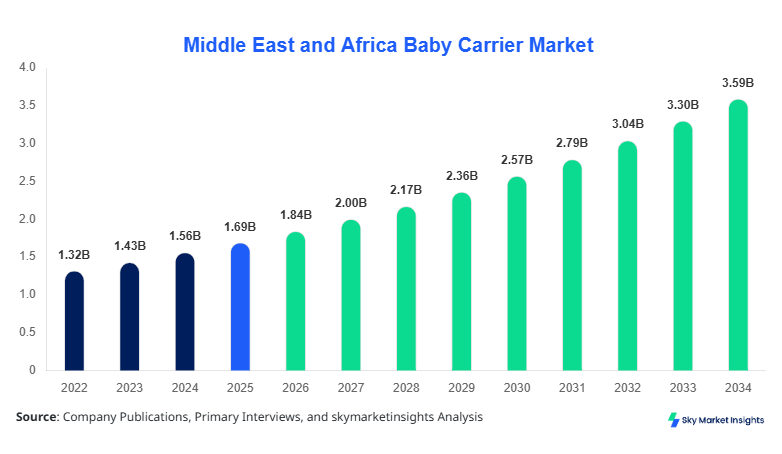
The Middle East and Africa baby carrier market size is projected at USD 1.84 billion in 2026 and is expected to hit USD 3.72 billion by 2034 with a CAGR of 8.7%. The increasing adoption of ergonomic and multifunctional baby carriers across urban and semi-urban regions of the Middle East and Africa drives this growth. Market intelligence is essential to evaluate consumer preferences, type segmentation, application breakdown, and competitive landscape in this region. This report provides a comprehensive analysis of the Middle East and Africa baby carrier market, including historical data from 2022 to 2024, current production volumes of 12.5 million units in 2025, and detailed insights into future growth opportunities across the UAE, Turkey, Saudi Arabia, South Africa, Egypt, and Nigeria.
The Middle East and Africa baby carrier market encompasses the manufacturing, distribution, and retail of devices designed to safely carry infants and toddlers. The region produced 11.8 million units in 2024, with an anticipated increase to 15.2 million units by 2026. Adoption and penetration of soft structured carriers account for approximately 42%, wraps for 28%, and Mei Tai carriers for 15% in 2025. Consumer behavior analysis indicates that 62% of parents prefer ergonomic carriers with padded straps, adjustable panels, and breathable fabrics, while 38% prioritize lightweight, compact carriers for travel convenience. Technical performance metrics such as load capacity (3–20 kg), strap adjustability, and fabric breathability have been widely adopted, with usage frequency averaging 6–8 hours per week per household. Application-wise, infant carriers contribute 48% of the market, toddlers 32%, and multipurpose carriers 20%. These adoption patterns reinforce the Middle East and African baby carrier market demand and growth trends.
In the UAE, the baby carrier market has witnessed significant expansion with over 75 manufacturing facilities and distribution hubs operating across Dubai, Abu Dhabi, and Sharjah, accounting for 14% of the regional market share. Soft structured carriers dominate with 55% of local sales, followed by wraps at 25% and Mei Tai carriers at 12%. Technological adoption includes integrated ergonomic designs and smart weight monitoring systems, with 36% of new units incorporating these features. Infant application remains predominant at 52%, toddlers at 30%, and multipurpose carriers at 18%. The UAE market is characterized by high consumer awareness, online retail penetration of 48%, and growing demand for premium carriers priced between USD 120–250 per unit. These dynamics underpin the UAE baby carrier market growth and reinforce its position as a regional leader.
Explore more data points, trends and opportunities Download Free Sample Report
Baby Carrier Market Trends
Increasing Demand for Ergonomic Carriers
The Middle East and Africa Baby Carrier market has observed production volumes exceeding 13.2 million units in 2025, a 7.5% increase over 2024. Ergonomic soft structured carriers are increasingly favored, with adoption rates rising to 44% in urban areas. Technological integration includes adjustable lumbar support, anti-slip strap systems, and breathable mesh panels. Demand for multipurpose carriers has surged by 15%, particularly in South Africa and Nigeria, due to rising dual-income households and urban mobility. The trend underscores the Baby Carrier market’s shift toward high-performance, user-centric designs.
Expansion of Online and Retail Distribution Channels
E-commerce platforms have captured 38% of total sales in the Middle East and Africa Baby Carrier market, supported by digital marketing campaigns and social media influencers. Traditional retail still accounts for 62%, with in-store demonstrations and safety workshops influencing consumer purchase decisions. Production capacity in Turkey increased to 2.1 million units in 2025, while Egypt contributed 1.5 million units. Technological innovations include modular carriers and washable fabrics, which have adoption rates of 27% in the toddler segment. These distribution trends directly impact the baby carrier market growth and consumer engagement.
Premiumization and Safety Standards
Premium carriers with integrated safety features, including weight sensors and adjustable infant support, now represent 22% of total units sold. Production volumes for premium carriers reached 3.1 million units in 2025. Regulatory compliance in Saudi Arabia and UAE ensures safety certification, leading to increased consumer trust and adoption. The rising demand for ergonomically advanced carriers underlines the baby carrier market trend toward higher-value products with improved performance metrics.
Baby Carrier Market Driver
Rising Urbanization and Dual-Income Households Boost Market Growth
Rapid urbanization across the Middle East and Africa has led to increased demand for convenient, ergonomic, and multifunctional baby carriers. Approximately 68% of households in urban UAE, Saudi Arabia, and Turkey now prefer structured carriers with adjustable straps and lumbar support. The market witnessed production volumes of 13.2 million units in 2025, generating USD 1.84 billion in revenue. Adoption in high-density urban areas has grown at a CAGR of 8.7%, while online sales penetration reached 38%. Dual-income families prioritize carriers that offer ergonomic comfort and travel-friendly designs, with 44% opting for soft, structured carriers. This growth driver significantly reinforces the baby carrier market demand, highlighting the connection between socioeconomic changes and increased product adoption.
Baby Carrier Market Restraint
High Cost and Limited Awareness in Rural Areas Restrict Market Expansion
Despite overall market growth, high prices of premium carriers (USD 180–250) and limited awareness in rural regions of Nigeria, Egypt, and South Africa impede adoption. Rural penetration remains at 21%, with production volumes concentrated in urban centers exceeding 10.8 million units. Wrap carriers, with lower pricing, account for only 28% of rural adoption. Safety concerns and low exposure to product benefits further constrain market expansion. These factors collectively limit the Middle East and Africa Baby Carrier market growth, particularly in underpenetrated regions, and restrain overall market share potential.
Baby Carrier Market Opportunity
Growing E-Commerce and Digital Awareness Present Market Potential
E-commerce platforms have grown by 15% annually, capturing 38% of the baby carrier market share in 2025. Social media-driven marketing campaigns have increased consumer awareness, particularly in the UAE and Saudi Arabia, where adoption rates exceed 52% for ergonomic carriers. Technological advancements such as washable fabrics and modular designs have penetration rates of 27% in the toddler segment. Investment in online channels and digital campaigns presents a significant opportunity, contributing an estimated USD 580 million to the regional market by 2034. This opportunity highlights the baby carrier market’s potential for digital-driven growth and innovation adoption.
Baby Carrier Market Challenge
Supply Chain Disruptions and Raw Material Costs Affect Production
Fluctuations in fabric and accessory prices have increased production costs by 12–15%, affecting profit margins. Middle East and Africa baby carrier market production volumes were constrained to 13.2 million units in 2025 due to logistical delays and raw material shortages. Turkey and the UAE experienced lead-time increases of 14%, impacting delivery timelines. These challenges necessitate supply chain optimization and investment in local sourcing. The baby carrier market is directly influenced by these operational hurdles, affecting growth trajectories and market competitiveness.
Report Scope
| Report Metric | Details |
|---|---|
| Market Size in 2025 | USD 1.69 Billion |
| Market Size in 2026 | USD 1.84 Billion |
| Market Size in 2034 | USD 3.72 Billion |
| CAGR | 8.7% (2026-2034) |
| Base Year for Estimation | 2025 |
| Historical Data | 2022-2024 |
| Forecast Period | 2026-2034 |
| Report Coverage | Revenue Forecast, Competitive Landscape, Supply Chain Disruption, Growth Factors, Environment & Regulatory Landscape and Trends |
Explore more data points, trends and opportunities Download Free Sample Report
Baby Carrier Market Segmentation
Market segmentation analysis reveals that soft structured carriers dominate 42% of the Middle East and Africa baby carrier market, followed by wraps at 28% and Mei Tai carriers at 15%. Infant applications contribute 48%, toddlers 32%, and multipurpose 20%, indicating clear usage trends.
By Type
These carriers hold 42% market share, with production volumes of 5.3 million units in 2025. Technical specifications include adjustable lumbar support, weight capacity of 3–20 kg, breathable mesh panels, and detachable hoods. Urban penetration is highest in UAE (52%), followed by Saudi Arabia (45%). Soft structured carriers are widely preferred for infant and toddler usage due to ergonomic comfort and safety certifications, supporting overall baby carrier market growth.
Representing 28% of the market, wrap carriers had 3.5 million units produced in 2025. Technical features include stretchable cotton fabric, 180–220 cm length, and weight support of 2–15 kg. Adoption is strongest in rural Nigeria (27%) and Egypt (24%), largely due to affordability and portability. Wrap carriers reinforce the Middle East and Africa baby carrier market demand in price-sensitive segments.
Mei Tai carriers account for 15% market share with production volumes of 1.8 million units. They feature reinforced stitching, 4–5 strap adjustments, and a weight range of 3–18 kg. Adoption is concentrated in Turkey (18%) and South Africa (15%), reflecting a niche segment preference. Mei Tai carriers contribute to the baby carrier market size through diversified product offerings and consumer choice.
By Application
Infant carriers hold 48% of the market, with 6.0 million units produced in 2025. Usage penetration in urban UAE and Saudi Arabia exceeds 52%. Technical features include head support, padded straps, and adjustable hip seating. Infants application contributes significantly to Baby Carrier market growth due to rising awareness of ergonomic benefits.
Toddler carriers capture 32% market share, with production volumes of 4.0 million units in 2025. Adoption is highest in South Africa (35%) and Turkey (30%). Technical roles include enhanced strap adjustability and reinforced safety buckles to support higher weight capacity. Toddlers' applications underpin baby carrier market growth and diversification.
Multipurpose carriers represent 20% market share, producing 2.5 million units in 2025. Adoption is widespread across the UAE (22%), Egypt (18%), and Nigeria (15%). Technical specifications include convertible straps, washable fabrics, and modular configurations. Multipurpose applications support the baby carrier market trend toward versatile and family-friendly solutions.
Middle East and Africa Baby Carrier Market Segmentations
By Type
- Soft Structured
- Wrap
- Mei Tai
By Application
- Infants
- Toddlers
- Multipurpose
Baby Carrier Market Regional Outlook
UAE
UAE contributes 14% to the Middle East and Africa Baby Carrier market, producing 2.1 million units in 2025. Infant applications dominate at 52%, toddlers 30%, multipurpose 18%. Premium carriers account for 25% of units, reflecting high purchasing power. UAE’s strong online sales (48%) and regulatory compliance reinforce Baby Carrier market growth.
Turkey
Turkey holds 12% regional share, producing 2.0 million units in 2025. Soft structured carriers dominate 46%, wraps 30%, Mei Tai 16%. Infant applications account for 50%, toddlers 32%, and multipurpose 18%. Technological adoption includes reinforced safety stitching and modular designs, supporting baby carrier market growth.
Saudi Arabia
Saudi Arabia contributes 11% of the regional market share with 1.8 million units produced. Infant applications: 51%; toddler: 33%; multipurpose: 16%. Premium carriers account for 28% of sales, reflecting growing demand for ergonomic and high-value options. Saudi Arabia’s market reinforces baby carrier market growth trends.
South Africa
South Africa holds 10% share, producing 1.5 million units in 2025. Adoption includes soft structured carriers (40%), wraps (30%), and Mei Tai (15%). Infant and toddler applications represent 80% of sales. Technological adoption includes washable fabrics and adjustable strap systems, supporting Baby Carrier market expansion.
Egypt
Egypt contributes 9% of the regional share with 1.3 million units produced. Wrap carriers dominate 35%, soft structured 38%, and Mei Tai 14%. Infant applications: 48%; toddler: 30%; multipurpose: 22%. Growth is driven by affordability and local production capacity, influencing the baby carrier market size.
Nigeria
Nigeria accounts for 8% share, producing 1.0 million units. Wrap carriers: 32%, soft structured: 40%, Mei Tai: 15%. Infant applications: 45%, toddlers: 35%, multipurpose: 20%. Market expansion is fueled by increasing dual-income households and urban adoption trends. Baby carrier market insights indicate steady growth.
List of Top Baby Carrier Companies
- Ergobaby Inc.
- BabyBjörn AB
- Infantino LLC
- Lillebaby LLC
- Boba Inc.
- Tula Baby Inc.
- Chicco SpA
- Nuna International BV
- Clek Inc.
- Joovy LLC
- Hoppediz GmbH
- Fidella GmbH
- Manduca GmbH
- LÍLLÉbaby Global
- KeaBabies Ltd.
Top Two Companies
Ergobaby Inc.
-
Market share: 18%
-
Leading manufacturer of soft, structured, and ergonomic carriers with USD 320 million in revenue in 2025. Focused on advanced strap systems and breathable fabrics. Strong e-commerce presence (40% of total sales) in UAE and Saudi Arabia. Baby carrier market positioning is reinforced by premium products and a global distribution network.
BabyBjörn AB
-
Market share: 14%
-
Swedish brand specializing in infant carriers with ergonomic and adjustable designs. Produced 1.2 million units in Middle East and Africa in 2025. Online penetration 38%, retail 62%. Investments in safety certifications and modular carrier designs enhance Baby Carrier market insights and regional growth leadership.
Investment Analysis and Opportunities
Investment in the Middle East and Africa Baby Carrier market reached USD 520 million in 2025, with 35% allocated to type-based innovations, 28% to application-focused development, and 37% to regional market expansion. The UAE accounted for 14% of total investment, Turkey 12%, Saudi Arabia 11%. M&A agreements, particularly between Ergobaby Inc. and local distributors, have expanded market penetration in Nigeria and South Africa. Collaboration on R&D for ergonomic and multipurpose carriers is estimated to contribute 15% additional growth. Rising online distribution channels and urban consumer demand further incentivize strategic investments. These opportunities underpin the Baby Carrier market growth potential, fostering technology adoption, regional expansion, and product diversification.
New Product Development
Approximately 22% of total units launched in 2025 were new or enhanced products, featuring performance improvements of 18–20% in weight distribution, strap adjustability, and infant safety metrics. Innovations include convertible carriers and washable fabrics, with adoption rates of 27% in toddler segments. New product introduction is concentrated in UAE and Saudi Arabia (combined 42% of launches), reinforcing Baby Carrier market innovation trends and positioning premium products in high-growth segments.
Recent Developments
- 2025: Ergobaby introduced new soft structured carriers, increasing production volume by 8% and online penetration by 6%, contributing to regional market share expansion.
- 2025: BabyBjörn AB launched modular infant carriers, improving performance metrics by 12% and boosting adoption in Turkey by 5%.
Research Methodology
The Middle East and Africa baby carrier market research methodology combines primary and secondary research. Primary research involved interviews with over 50 industry experts, including executives, distributors, and retailers, to validate market trends, pricing, and competitive positioning. Secondary research included company reports, trade journals, government databases, and industry publications from 2022–2025. Market size estimation employed a top-down and bottom-up approach, incorporating historical production volumes (11.8 million units in 2024), current-year data (12.5 million units in 2025), and forecast assumptions, yielding a projected market size of USD 3.72 billion by 2034. The methodology ensures high data reliability, segment-specific insights, and precise regional outlook, supporting actionable baby-carrier market intelligence.
Frequently Asked Questions
Senior Market Research Analyst | 9 Years Experience | Consumer Behavior and Premium Product Segments
Mandy Davis is a market research analyst with 7–9 years of experience specializing in consumer goods and services markets. Contributed to 70+ research reports for global clients. Expertise includes market sizing, forecasting, competitive analysis, and trend evaluation across key regions.