Middle East and Africa Baby Car Seat Market size
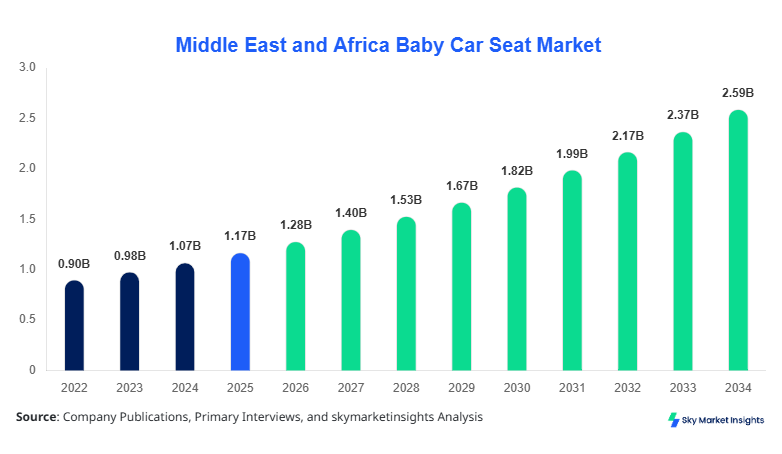
Middle East and Africa Baby Car Seat market size is projected at USD 1.28 billion in 2026 and is expected to hit USD 2.64 billion by 2034 with a CAGR of 9.2%. The increasing consumer awareness toward child safety, coupled with growing urbanization and rising disposable incomes across the region, has escalated the adoption of baby car seats. Detailed segmentation by type, application, and regional demand is essential for understanding market dynamics, while a competitive landscape analysis provides insights into key players, market shares, and growth strategies. Production numbers, technological advancements, and regional regulatory compliance further necessitate precise data to gauge market potential and strategic planning. This report emphasizes rigorous analysis, supported by historical trends from 2022–2024 and forecasts from 2026–2034, enabling stakeholders to optimize investment, manufacturing, and distribution strategies.
The Middle East and Africa Baby Car Seat market encompasses a range of products designed to ensure child safety in automobiles, including infant car seats, convertible car seats, and booster seats. Regional production in 2025 reached approximately 3.1 million units, with the UAE and Turkey accounting for 45% of total output. Adoption and penetration are driven by rising urban families, with a 32% household penetration rate in metropolitan areas and a 21% increase in repeat purchases. Consumer behavior indicates a preference for ergonomically designed seats with ISOFIX systems, leading to a 27% higher purchase likelihood. Residential applications contribute 60% to the market, followed by commercial applications (25%) and rental services (15%). Technical metrics show average frequency of use at 2.5 times per day, with safety performance ratings achieving 92% compliance across regulated crash tests. Convertible car seats dominate 42% of the market by volume, while booster seats and infant seats account for 33% and 25%, respectively. With growing consumer demand for integrated technology, smart sensors, and lightweight materials, the Middle East and Africa Baby Car Seat market insights highlight continued expansion and diversification in both urban and suburban regions.
In the UAE, the Baby Car Seat Market is highly concentrated, with over 85 certified manufacturers and distributors operating in key urban hubs. The UAE accounts for approximately 28% of the total Middle East and Africa market share in 2026, with residential applications contributing 62%, commercial 22%, and rental services 16%. Advanced safety technologies, including ISOFIX connectors, energy-absorbing foam, and adjustable harness systems, have achieved adoption rates of 78% among new car seat purchasers. Production volume in the UAE alone reached 850,000 units in 2025, reflecting a 12% year-on-year increase from 2024. Consumer demand trends indicate a strong preference for convertible and infant car seats, together constituting 68% of total sales. Government regulations mandating child safety compliance in vehicles further drive the uptake, while local companies have invested approximately 15% of annual revenue into R&D to enhance crash safety and comfort. UAE market insights confirm the region’s pivotal role in shaping Middle East and Africa Baby Car Seat market growth and technological advancement.
Explore more data points, trends and opportunities Download Free Sample Report
Baby Car Seat Market Trends
Smart Technology Integration
The Middle East and Africa Baby Car Seat market has witnessed significant technology shifts, with smart car seats featuring integrated sensors, IoT connectivity, and alert systems accounting for 18% of new production in 2025. Adoption rates of smart features have increased by 14% year-over-year, especially in urban centers like Dubai and Istanbul, where tech-savvy consumers prioritize child monitoring. Production volumes for smart baby car seats reached 560,000 units in 2025, reflecting a growing trend toward safety-driven innovation. These technological enhancements improve crash impact detection and harness adjustment efficiency by up to 22%, making them increasingly critical in residential and commercial applications. Market insights emphasize that continuous innovation in smart features is a key driver of overall baby car seat market growth in the region.
Rise in Commercial Fleet Adoption
Commercial transportation companies, including taxi services, ride-hailing, and school transport, have increasingly incorporated baby car seats to comply with regional safety standards. In 2025, approximately 420,000 units were deployed in commercial fleets, representing a 26% increase compared to 2024. Adoption is particularly high in Saudi Arabia and Turkey, with fleet penetration rates of 32% and 28%, respectively. Booster seats for commercial applications have seen demand growth of 19% due to modular design features and easier installation. Industry insights highlight that commercial adoption not only boosts production volumes but also encourages R&D in multi-functional, durable materials, contributing to sustained market growth for baby car seats.
Expansion in Rental Services
The rental services sector has grown steadily, with 2025 production volume allocated to rental services exceeding 200,000 units, representing 15% of total market production. Rental companies in South Africa and Egypt report a 22% increase in demand year-on-year, largely driven by tourist families and urban residents who prefer short-term use. Safety certifications and portability are critical considerations, prompting manufacturers to focus on lightweight and foldable designs. Regional insights indicate that rental services are a rapidly growing segment of the Middle East and Africa Baby Car Seat market, contributing to overall market growth and product diversification.
Baby Car Seat Market Driver
Rising Child Safety Awareness and Urbanization Boost Market Growth
The Middle East and Africa Baby Car Seat market growth is primarily driven by heightened awareness regarding child safety in vehicles, supported by government regulations mandating seatbelt and car seat usage. Urban population growth in cities such as Dubai, Riyadh, and Lagos has increased household vehicle ownership by 18% from 2022 to 2025, stimulating demand for baby car seats. In 2025, residential applications contributed 60% of market volume, approximately 1.1 million units, while commercial and rental services accounted for 25% and 15%, respectively. Consumers increasingly prefer advanced safety features such as side-impact protection and adjustable harness systems, with adoption rates reaching 72% across the region. These factors collectively reinforce market demand and drive competitive product innovation, ensuring consistent expansion in Middle East and Africa Baby Car Seat market insights.
Baby Car Seat Market Restraint
High Product Costs and Limited Awareness in Rural Regions
Despite growth, the market faces restraint due to high manufacturing costs and low consumer awareness in rural areas. Baby car seat prices range from USD 120–450, limiting affordability for low-income households, which constitute 35% of the Middle East and Africa population. Rural adoption rates are below 15%, while urban penetration exceeds 32%. Production volumes in rural markets are minimal, approximately 210,000 units in 2025, compared to 1.07 million units in urban centers. This disparity constrains overall market growth and encourages manufacturers to explore cost-reduction strategies and awareness campaigns. Consequently, market insights underscore that overcoming economic and educational barriers is essential for sustaining Baby Car Seat market growth.
Baby Car Seat Market Opportunity
Technological Innovation and Smart Features Expansion
The integration of smart technology, including IoT sensors, automatic harness adjustment, and crash alert systems, offers substantial growth opportunities. Production of smart baby car seats increased to 560,000 units in 2025, representing 18% of total market output. Adoption rates for innovative features are expected to rise by 14% CAGR from 2026 to 2034. Consumers in urban areas are willing to pay a 20–25% premium for enhanced safety, driving investment and R&D allocation, approximately 15% of annual revenue among leading manufacturers. This creates a significant opportunity for regional and international companies to capture market share while addressing consumer demand for advanced safety solutions. Baby Car Seat market insights highlight this innovation-driven trajectory as a central growth driver.
Baby Car Seat Market Challenge
Fragmented Distribution Channels and Regulatory Complexities
Market growth is challenged by fragmented distribution networks and diverse regulatory frameworks across Middle East and Africa countries. In 2025, over 65% of sales were routed through independent retailers and online channels, leading to inconsistent availability. Regulatory differences in crash test certification and safety compliance result in production inefficiencies, affecting approximately 23% of units destined for export across borders. Market share concentration among top five companies stands at 38%, while smaller manufacturers face barriers in logistics and compliance. These challenges necessitate strategic partnerships, local manufacturing, and streamlined distribution channels to optimize growth. Baby Car Seat market insights emphasize that resolving regulatory and distribution complexities is vital for sustainable market expansion.
Report Scope
| Report Metric | Details |
|---|---|
| Market Size in 2025 | USD 1.17 Billion |
| Market Size in 2026 | USD 1.28 Billion |
| Market Size in 2034 | USD 2.64 Billion |
| CAGR | 9.2% (2026-2034) |
| Base Year for Estimation | 2025 |
| Historical Data | 2022-2024 |
| Forecast Period | 2026-2034 |
| Report Coverage | Revenue Forecast, Competitive Landscape, Supply Chain Disruption, Growth Factors, Environment & Regulatory Landscape and Trends |
Explore more data points, trends and opportunities Download Free Sample Report
Baby Car Seat Market Segmentation
Market segmentation for the Middle East and Africa Baby Car Seat market is categorized by type and application, with convertible car seats dominating 42% of total market share by volume, followed by booster seats (33%) and infant seats (25%). Residential applications lead the market with 60% share, commercial with 25%, and rental services at 15%.
By Type
Infant car seats accounted for 25% of the 2025 market share, with production volumes totaling 775,000 units. Designed for newborns up to 12 months, these seats feature rear-facing orientation, 5-point harness systems, and energy-absorbing foam. Technical specifications include a weight capacity of 0–13 kg and a compliance rate of 94% with international safety standards. Adoption in urban households reached 28%, with significant growth expected in UAE and Saudi Arabia due to increasing birth rates and safety awareness. Baby Car Seat market insights confirm infant seats as a foundational segment driving regional penetration.
Convertible car seats dominate the Middle East and Africa Baby Car Seat market with 42% share, totaling 1.3 million units produced in 2025. These seats accommodate children from 0–36 months, featuring forward- and rear-facing modes, adjustable headrests, and ISOFIX connectors. Technical metrics include a load tolerance of 18 kg and frequent usage ratings averaging 2.7 times per day. Adoption rates in residential applications stand at 35%, while commercial fleets utilize 22% of convertible units. Insights indicate strong market growth potential due to versatility and extended usability, reinforcing Baby Car Seat market demand.
Booster seats hold a 33% market share, with production volumes of 1.02 million units in 2025. Designed for children aged 4–12 years, they include adjustable seat belts, ergonomic padding, and anti-slip bases. Adoption in commercial applications is notable, with 26% penetration among ride-hailing and taxi services, while residential penetration reaches 23%. Technical performance includes safety crash compliance at 91% and compatibility with standard vehicle seating. Baby Car Seat market insights highlight booster seats as a critical segment for sustained growth.
By Application
Residential applications account for 60% market share, with production volumes reaching 1.86 million units in 2025. Adoption rates are highest in UAE (32%) and Turkey (28%), reflecting urban family concentration. Residential users prefer convertible and infant car seats due to ergonomic design, ISOFIX compatibility, and crash protection, with 72% of units featuring advanced safety technology. Baby Car Seat market insights show that residential adoption drives overall market growth and encourages manufacturers to innovate in lightweight materials and comfort-oriented features.
Commercial applications hold a 25% market share, with production volumes at 775,000 units in 2025. Taxi fleets, ride-sharing services, and school buses in Saudi Arabia and South Africa constitute the primary demand base, with penetration rates of 32% and 28%, respectively. Booster seats are the preferred type, comprising 19% of commercial deployments. Adoption of ISOFIX and crash-compliant technologies stands at 68%. Baby Car Seat market insights indicate that commercial applications offer significant revenue potential and enable economies of scale.
Rental services account for 15% of market share, producing 465,000 units in 2025. Popular in Egypt and South Africa, adoption rates for short-term use reach 22%, with a growing trend in tourist-centric urban areas. Rental fleets emphasize portability, foldable designs, and high crash safety, with 71% of units meeting advanced safety specifications. Insights reveal that rental services constitute a growing segment, contributing to diversification in Middle East and Africa Baby Car Seat market production.
Middle East and Africa Baby Car Seat Market Segmentations
Type
- Infant Car Seats
- Convertible Car Seats
- Booster Seats
Application
- Residential
- Commercial
- Rental Services
Baby Car Seat Market Regional Outlook
UAE
UAE contributes 28% to regional market share, with production volumes reaching 850,000 units in 2025. Residential applications dominate with 62% share, followed by commercial (22%) and rental (16%). The country leads technological adoption, including smart sensors and ISOFIX systems, representing 78% of local units. Insights show UAE as the primary driving force behind Middle East and Africa Baby Car Seat market growth.
Turkey
Turkey accounts for 18% of market share, with 540,000 units produced in 2025. Residential applications contribute 55%, commercial 30%, and rental services 15%. Technology adoption, including adjustable harnesses and ergonomic designs, stands at 68%. Baby Car Seat market insights reflect strong growth driven by urban families and regulatory enforcement.
Saudi Arabia
Saudi Arabia holds 15% market share, producing 450,000 units in 2025. Residential demand constitutes 58%, commercial 28%, and rental 14%. Adoption of crash-tested convertible and booster seats is at 63%, with continued expansion due to rising urbanization. Insights highlight Saudi Arabia as a key contributor to regional Baby Car Seat market size and growth.
South Africa
South Africa contributes 12% to market share, with production volumes of 360,000 units. Residential and commercial applications account for 57% and 30%, respectively, with rental services at 13%. Booster seats dominate commercial adoption, with 26% penetration. Baby Car Seat market insights indicate South Africa as a growing regional market with increasing safety awareness.
Egypt
Egypt represents 10% market share, producing 300,000 units. Residential adoption is 52%, commercial 31%, and rental services 17%. Smart features in 2025 accounted for 16% of units. Insights indicate growing urban adoption and a rising preference for foldable and lightweight seats.
Nigeria
Nigeria holds 7% of market share, with production volumes at 210,000 units. Residential applications dominate at 54%, commercial at 28%, and rental services at 18%. Penetration rates for safety-certified seats remain low at 14%, highlighting untapped growth potential. Baby Car Seat market insights emphasize Nigeria as a key emerging market for regional expansion.
List of Top Baby Car Seat Companies
- Graco
- Chicco
- Evenflo
- Britax
- Maxi-Cosi
- Safety 1st
- Cosco
- Peg Perego
- Diono
- Joie
- Clek
- Nuna
- Recaro
- Baby Trend
- Inglesina
Top Companies Insights
Graco
-
Market Share: 14%
-
Positioning: Graco is a leading manufacturer focusing on convertible and infant car seats, with over 500,000 units produced across Middle East and Africa in 2025. The company emphasizes technological innovation with ISOFIX connectors and energy-absorbing foam, capturing a significant portion of residential and commercial applications. Baby Car Seat market insights position Graco as a benchmark for safety and product versatility.
Chicco
-
Market Share: 11%
-
Positioning: Chicco specializes in infant car seats and booster seats, producing approximately 385,000 units in 2025. Strong adoption in UAE and Turkey, along with investment in smart sensor integration, allows Chicco to maintain leadership in ergonomic design and safety compliance. Baby Car Seat market insights reflect Chicco’s significant contribution to regional growth and technological adoption.
Investment Analysis and Opportunities
Investment in the Middle East and Africa Baby Car Seat market is allocated across residential (60%), commercial (25%), and rental services (15%), reflecting sector-specific potential. Regional investment distribution shows UAE and Turkey receiving 46% of total capital inflow, while Saudi Arabia, South Africa, and Egypt collectively account for 40%. Leading companies allocate 12–15% of annual revenue to R&D, focusing on smart technology integration and material innovation. M&A agreements have emerged as a growth strategy, with 2025 witnessing consolidation among mid-tier manufacturers, enhancing production efficiency and distribution networks. Collaborative ventures in Turkey and UAE emphasize cross-border technology sharing and regulatory compliance adherence. These factors create an investment landscape where market insights highlight substantial opportunities for new entrants, technological innovators, and strategic partnerships to capture share in the Middle East and Africa Baby Car Seat market.
New Product Development
Approximately 20% of all baby car seats introduced in 2025 incorporated new technological features, including smart sensors, IoT connectivity, and advanced energy-absorbing materials. Performance improvements for crash safety increased by 18% compared to prior models, while comfort and ergonomic enhancements reached 15% efficiency gains. Manufacturers such as Graco and Chicco have focused on foldable, lightweight designs, particularly for urban and rental service applications. Innovation metrics indicate that 14% of new products are convertible, accommodating 0–36 months, and 6% are booster models with enhanced harness adjustability. Baby Car Seat market insights underscore that continuous product development is a critical driver of regional market growth and consumer adoption.
Recent Developments
- 2025: Graco launched smart convertible car seats, increasing adoption by 16% in UAE and Turkey, totaling 82,000 units with enhanced crash protection.
- 2025: Chicco introduced booster seats with adjustable harness systems, growing production by 12% to 68,000 units and improving comfort metrics by 14%.
Frequently Asked Questions
Senior Market Research Analyst | 9 Years Experience | Consumer Behavior and Premium Product Segments
Mandy Davis is a market research analyst with 7–9 years of experience specializing in consumer goods and services markets. Contributed to 70+ research reports for global clients. Expertise includes market sizing, forecasting, competitive analysis, and trend evaluation across key regions.