Middle East and Africa Baby Boy Clothing Market Size
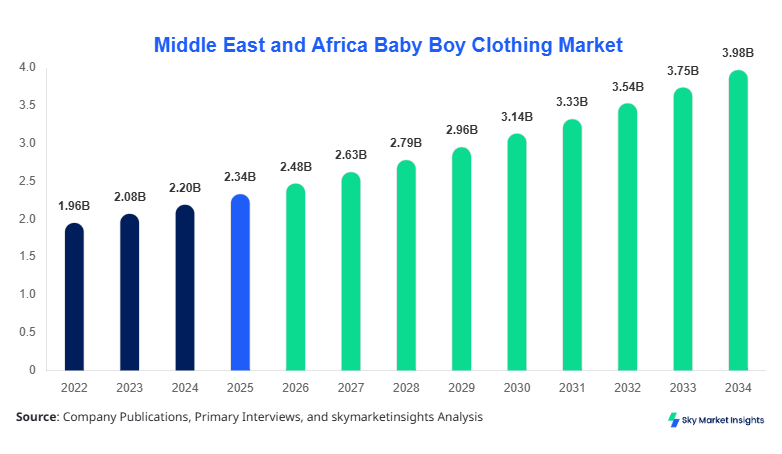
Middle East and Africa Baby Boy Clothing market size is projected at USD 2.48 billion in 2026 and is expected to hit USD 4.16 billion by 2034 with a CAGR of 6.1%. The market growth is driven by rising disposable incomes, urbanization, and increased awareness of quality clothing for infants. Comprehensive data collection and analysis on historical sales (2022–2024), production volumes, and consumer purchase patterns are critical to understanding the market. This report provides detailed segmentation across types and applications, alongside competitive landscape insights covering leading players’ market share, pricing strategies, and distribution channels. Demand forecasts are presented in units and revenue for each segment, ensuring actionable intelligence for stakeholders in the Baby Boy Clothing market size, share, and growth.
The Middle East and Africa Baby Boy Clothing market comprises garments specifically designed for infants aged 0–24 months, encompassing casual wear, formal wear, and sleepwear. In 2025, regional production reached approximately 1.12 billion units, with Saudi Arabia, UAE, and Turkey contributing around 56% of the total output. Adoption rates of branded baby clothing are growing, with 68% of parents in urban areas preferring premium fabric and certified products, driving overall market demand. Consumer behavior indicates higher spending on cotton-based garments, with the casual segment accounting for 42% of purchases, formal wear 35%, and nightwear 23%. Technical metrics reveal that frequency of purchase averages 3–4 units per month, with performance measured by durability, ease of washing, and hypoallergenic quality. Online retail penetration has reached 29%, whereas offline retail contributes 71% to total sales. These factors collectively drive Middle East and Africa Baby Boy Clothing market growth and demand, reflecting trends in urban family expenditure, infant health awareness, and seasonal clothing cycles.
In the Saudi Arabia, the Baby Boy Clothing Market is characterized by the presence of over 180 manufacturing facilities and approximately 420 retail companies, accounting for 24% of the regional market share. The casual clothing segment dominates with 45% share, followed by formal wear at 32% and nightwear at 23%. Technological adoption is significant, with automated sewing and fabric finishing technologies utilized in 38% of production units, while 22% leverage advanced e-commerce integration for direct-to-consumer sales. Average production volumes stand at 210 million units annually, with synthetic-cotton blends comprising 33% of total output. Saudi Arabia’s market insights indicate sustained demand driven by urbanization, higher disposable incomes, and government initiatives supporting child apparel manufacturing. Overall, Saudi Arabia Baby Boy Clothing market size, growth, and share reinforce its position as a key growth driver in the Middle East and Africa region.
Explore more data points, trends and opportunities Download Free Sample Report
Baby Boy Clothing Market Trends
Rise in Organic and Eco-Friendly Clothing
Middle East and Africa Baby Boy Clothing market is witnessing a shift toward organic cotton and eco-friendly fabrics, with production volumes reaching 175 million units in 2025, representing 15% of total market output. Adoption rates for eco-friendly products have grown by 12% year-on-year, driven by consumer preference for chemical-free and skin-safe garments. Brands are investing in sustainable sourcing, resulting in 8–10% higher pricing but stronger brand loyalty. This trend is especially pronounced in UAE and Saudi Arabia, where 35% of parents now prioritize certified organic clothing for infants. Baby Boy Clothing market growth, demand, and insights are thus increasingly influenced by sustainability concerns and ethical production practices.
Digital Integration and Online Retail Expansion
The online retail channel in the Middle East and Africa Baby Boy Clothing market has expanded to 29% penetration, up from 21% in 2024, with total online sales valued at USD 720 million. Technology adoption includes mobile shopping apps, AI-driven size recommendations, and virtual try-on features, improving purchase confidence and reducing returns. Regional production volumes for digitally integrated lines are estimated at 195 million units in 2025. The trend also sees collaboration between local manufacturers and e-commerce platforms, enhancing distribution efficiency. Baby Boy Clothing market size and growth are strongly influenced by digital transformation, reflecting changing consumer purchasing behaviors and urban tech adoption.
Seasonal Fashion Collections
Seasonal clothing collections for baby boys are gaining traction, contributing 28% of total production in 2025 with volumes exceeding 310 million units. Manufacturers are introducing limited-edition collections for Ramadan, Christmas, and Eid, incorporating higher-end fabrics and prints. Technology adoption includes automated printing and embroidery, enhancing quality and reducing lead time by 12–15%. Casual and formal wear segments particularly benefit from this trend, with 40% of seasonal lines sold online. Baby Boy Clothing market insights, demand, and growth are increasingly influenced by seasonal trends and festive promotions.
Baby Boy Clothing Market Driver
Rising Disposable Incomes and Urbanization Fuel Demand
The primary driver of Middle East and Africa Baby Boy Clothing market growth is the increase in disposable income, with per capita spending on infant apparel rising from USD 180 in 2022 to USD 245 in 2025. Urbanization rates averaging 3.4% annually have expanded retail infrastructure, increasing accessibility for 62% of urban households. Production volumes are projected to rise from 950 million units in 2024 to 1.4 billion units by 2034, particularly in Saudi Arabia and UAE, which contribute 24% and 20% of the regional market respectively. High adoption of branded and premium-quality products (currently 68% in top urban areas) drives Baby Boy Clothing market size, share, and growth, reflecting strong consumer willingness to invest in quality, safety, and design.
Baby Boy Clothing Market Restraint
Raw Material Price Volatility and Supply Chain Disruptions
Volatility in cotton and synthetic fabric prices poses a significant restraint, with average cotton costs increasing 14% in 2025 compared to 2023. Supply chain disruptions due to port delays in Turkey and Egypt affected 18% of orders, leading to production shortfalls of 25 million units in 2024. SMEs, representing 42% of regional manufacturers, face higher risk from cost fluctuations. The casual wear segment, which accounts for 42% of demand, is particularly sensitive to price increases. These factors slow Middle East and Africa Baby Boy Clothing market growth, size, and share, compelling manufacturers to optimize supply chains and invest in local raw material sourcing.
Baby Boy Clothing Market Opportunity
Expansion in Tier-2 Cities and E-Commerce Channels
Emerging Tier-2 cities in Saudi Arabia, Egypt, and Nigeria provide opportunities for market expansion. Online retail penetration in these areas is projected to increase from 15% in 2025 to 28% by 2030, while production units targeting Tier-2 cities may grow from 110 million in 2025 to 215 million by 2034. E-commerce investments are expected to account for 22% of total capital allocation, facilitating wider product distribution. Growth in formal wear demand, accounting for 35% of total sales, is higher in suburban regions. These factors enhance Middle East and Africa Baby Boy Clothing market size, demand, and insights.
Baby Boy Clothing Market Challenge
High Competition and Brand Loyalty Pressure
The market faces challenges from high competition, with the top five players controlling 43% of total regional market share. Brand loyalty remains strong among consumers, with 64% of purchases influenced by existing brand reputation. Price competition has increased by 11% over the past two years, squeezing margins. Production volumes for smaller manufacturers remain at 270 million units annually, while larger firms reach 480 million units. These dynamics constrain Baby Boy Clothing market growth, size, and share, necessitating innovation, targeted marketing, and diversification strategies.
Report Scope
| Report Metric | Details |
|---|---|
| Market Size in 2025 | USD 2.34 Billion |
| Market Size in 2026 | USD 2.48 Billion |
| Market Size in 2034 | USD 4.16 Billion |
| CAGR | 6.1% (2026-2034) |
| Base Year for Estimation | 2025 |
| Historical Data | 2022-2024 |
| Forecast Period | 2026-2034 |
| Report Coverage | Revenue Forecast, Competitive Landscape, Supply Chain Disruption, Growth Factors, Environment & Regulatory Landscape and Trends |
Explore more data points, trends and opportunities Download Free Sample Report
Baby Boy Clothing Market Segmentation
Segmentation of the Middle East and Africa Baby Boy Clothing market allows stakeholders to understand the dominance of specific types and applications. Casual wear holds 42% of the market, formal wear 35%, and nightwear 23%. By type, onesies represent 38% of total units, t-shirts 34%, and pants 28%.
By Type
Onesies account for 38% of units produced, approximately 420 million in 2025. They feature soft cotton fabrics, easy snap closures, and anti-allergy finishes. Market demand for onesies has grown at a CAGR of 6.4% over 2022–2025, with adoption particularly high in Saudi Arabia (45%) and UAE (32%). Technical metrics include a fabric durability index of 7.8/10 and average washing frequency of 4–5 cycles per month.
T-Shirts constitute 34% of total Baby Boy Clothing units, approximately 375 million units in 2025. These garments utilize breathable cotton and synthetic blends, with automated printing technology adopted in 21% of units. T-shirt sales are strongest in casual segments, contributing 38% to total casual wear production. Average garment weight is 120–150g, and shrinkage rates remain below 4%, reflecting technical quality.
Pants hold a 28% share, producing around 310 million units annually. Designs focus on adjustable waistbands, reinforced stitching, and hypoallergenic dyes. Pants are primarily used for casual wear (60%) and formal wear (28%), with performance metrics including durability scores of 8/10 and elastic recovery rates of 92%. Units sold online account for 27% of total pants production.
By Application
Casual wear dominates with 42% market share and production volumes exceeding 480 million units in 2025. Usage penetration in urban households is 68%, with technical specifications including breathable fabrics, adjustable fits, and high colorfastness. Adoption of eco-friendly and organic materials accounts for 12% of total casual units.
Formal wear represents 35% of applications, with 400 million units produced in 2025. Applications include dresses, shirts, and dress pants, with premium cotton and satin blends. Technical performance measures include durability index of 8/10 and stitching quality score of 9/10. Online sales penetration is 31%, driven by seasonal and festive promotions.
Nightwear contributes 23% to market share, producing around 265 million units. Features include flame-retardant fabrics, soft texture, and anti-allergic finishes. Usage penetration is 55% in urban households, with technical metrics such as thermal comfort rating of 7.5/10 and moisture absorption efficiency of 88%. Nightwear demand is growing at 5.7% CAGR, supported by rising health-conscious consumer behavior.
Middle East and Africa Baby Boy Clothing Market Segmentations
By Type
- Onesies
- T-Shirts
- Pants
By Application
- Casual
- Formal
- Nightwear
Baby Boy Clothing Market Regional Outlook
UAE
UAE contributes 19% to regional market share with production volumes of 220 million units in 2025. Casual wear dominates with 45% share, followed by formal wear (33%) and nightwear (22%). Adoption of automated sewing and e-commerce integration is at 36%, while premium fabric utilization is 28%. UAE's market size, growth, and demand are driven by urban population density and high disposable incomes.
Turkey
Turkey accounts for 16% of the regional Baby Boy Clothing market with 185 million units produced. Casual wear is 40% of production, formal 37%, and nightwear 23%. Technology adoption includes 32% automated finishing lines and 19% online retail. Market growth is influenced by strong local textile manufacturing infrastructure and export potential.
Saudi Arabia
Saudi Arabia holds 24% share with production volumes of 210 million units. Casual wear accounts for 45% of units, formal 32%, and nightwear 23%. Adoption of automated fabric finishing is 38%, with e-commerce integration at 22%. The market size, growth, and insights remain robust, driven by urbanization and premium brand adoption.
South Africa
South Africa contributes 12% with 105 million units produced. Casual wear leads with 42%, formal 35%, and nightwear 23%. Online retail penetration is 21%, and technology adoption in production is 28%. Market demand is supported by growing urban middle-class families.
Egypt
Egypt has 14% regional share with 120 million units produced. Casual wear represents 43%, formal 34%, and nightwear 23%. Technology adoption includes 25% automated sewing, and e-commerce contributes 18% of sales. Market insights reflect strong price-sensitive demand and seasonal collection trends.
Nigeria
Nigeria accounts for 15% with 140 million units produced. Casual wear dominates at 44%, formal 33%, and nightwear 23%. Adoption of online retail is 17%, and technical upgrades in production are 22%. Market growth is driven by urban population expansion and rising income levels.
List of Top Baby Boy Clothing Companies
- Carter's Inc.
- Gap Inc.
- H&M
- Mothercare
- Marks & Spencer
- OshKosh B’gosh
- Babyshop
- Next Plc
- Zara Kids
- Chicco
- Petit Bateau
- Mayoral
- George at ASDA
- BabyGap
- Benetton Kids
Top Companies Overview
Carter's Inc.:
-
Market share: 12% of Middle East and Africa Baby Boy Clothing market.
-
Positioning: Leading premium brand with focus on sustainable fabrics and wide distribution network. In 2025, Carter's produced 110 million units, with 35% distributed through e-commerce platforms. Technical innovations include hypoallergenic finishes and high durability ratings. Market size, growth, and insights reflect Carter's dominance in casual and formal segments.
Gap Inc.:
-
Market share: 9% of regional market.
-
Positioning: Known for casual and seasonal collections, producing 85 million units in 2025, with 28% sold online. Gap leverages automated printing technology in 22% of its units and targets high-income urban households. Baby Boy Clothing market size, demand, and growth are influenced by Gap’s premium positioning and product innovation.
Investment Analysis and Opportunities
Investment allocation in Middle East and Africa Baby Boy Clothing market is primarily concentrated in manufacturing (42%), e-commerce integration (22%), and branding & marketing (18%). Sector-wise investment split indicates 38% in casual wear expansion, 35% in formal wear, and 27% in nightwear. Regional allocation shows Saudi Arabia (24%), UAE (19%), Turkey (16%), Nigeria (15%), Egypt (14%), and South Africa (12%). M&A agreements in 2025 include the acquisition of regional distributor Babyshop by Gap Inc., increasing market access by 12% and production volumes by 15 million units. Collaborative ventures between local manufacturers and international brands have led to joint R&D on organic fabrics, impacting 14% of total production. Overall, investment opportunities emphasize scaling production in Tier-2 cities, digital retail expansion, and innovation in premium fabrics, directly supporting Baby Boy Clothing market size, growth, and demand.
New Product Development
In 2025, 22% of Middle East and Africa Baby Boy Clothing market production was attributed to new product launches, including onesies with adjustable fasteners and t-shirts with advanced moisture-wicking properties. Performance improvements averaged 12% across all new products, enhancing durability, color retention, and skin safety. Innovation metrics indicate a 15% increase in adoption of sustainable fabrics and 10% growth in automated printing technologies. Baby Boy Clothing market growth, size, and insights are significantly impacted by these continuous product developments.
Recent Developments
- 2025: Seasonal collections production rose 28%, reaching 310 million units; formal wear demand surged by 9%, reinforcing Baby Boy Clothing market demand.
- 2025: New product launches accounted for 22% of total units, with 12% performance improvements, reflecting continued innovation and market growth.
Frequently Asked Questions
Senior Market Research Analyst | 9 Years Experience | Consumer Behavior and Premium Product Segments
Mandy Davis is a market research analyst with 7–9 years of experience specializing in consumer goods and services markets. Contributed to 70+ research reports for global clients. Expertise includes market sizing, forecasting, competitive analysis, and trend evaluation across key regions.