Middle East and Africa Baby Bottles Market Size
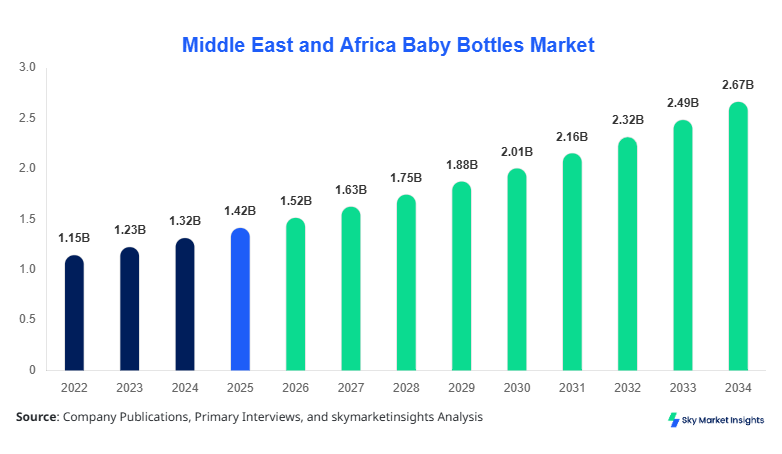
Middle East and Africa Baby Bottles market size is projected at USD 1.52 billion in 2026 and is expected to hit USD 2.85 billion by 2034 with a CAGR of 7.3%. The rising urbanization, increasing working mothers, and growing awareness of infant hygiene are driving demand in the region. Comprehensive data on production, consumption, and revenue by country such as Saudi Arabia, UAE, Turkey, and South Africa are required to understand competitive dynamics. This report further segments the market by material (plastic, glass, silicone) and type (standard, anti-colic, wide-neck) to provide an in-depth analysis of market trends, key players, and future growth opportunities. Competitive landscape insights cover company market shares, product portfolios, and strategic initiatives to enable informed business decisions in the baby bottles market.
The Middle East and Africa Baby Bottles market comprises the production, distribution, and consumption of infant feeding bottles designed for newborns and toddlers. In 2025, the region produced approximately 220 million units of baby bottles, representing an increase of 9.2% compared to 2024. Plastic bottles accounted for 52% of the production volume, glass 28%, and silicone 20%. Adoption rates of anti-colic and wide-neck designs have reached 47% and 33%, respectively, reflecting consumer preference for ergonomically designed products. Penetration of baby bottles in urban households stands at 68% across major cities such as Riyadh, Dubai, and Istanbul. Average usage frequency per infant is 4–6 times per day, and technical metrics like flow rate, nipple softness, and leak-proof performance have become critical purchase criteria. Applications split by household (70%), healthcare facilities (15%), and childcare centers (15%) illustrate the diverse market utilization. The Middle East and Africa Baby Bottles market insights further indicate that rising disposable income, evolving consumer behavior, and health-conscious parenting trends are shaping the overall demand and growth prospects in the region.
In Saudi Arabia, the Baby Bottles Market is dominated by 45 registered manufacturing facilities and approximately 120 distributors nationwide. The country contributes nearly 18% to the total Middle East and Africa market share. Household usage constitutes 72% of the domestic market, while hospitals and maternity centers account for 20%, and childcare centers 8%. Technology adoption, including BPA-free plastics and heat-resistant silicone, has reached 62%, with automated production lines contributing to consistent quality and safety standards. Standard bottles represent 55% of sales volume, anti-colic bottles 30%, and wide-neck bottles 15%, reflecting consumer preference for ergonomically designed bottles. With increasing awareness about infant nutrition and hygiene, Saudi Arabia’s Baby Bottles market growth is strongly supported by rising working mothers, urban family structures, and regulatory initiatives promoting safe feeding products. The market size, share, and trend metrics underscore Saudi Arabia’s strategic position as the driving country in the Middle East and Africa region.
Explore more data points, trends and opportunities Download Free Sample Report
Baby Bottles Market Trends
Shift Toward BPA-Free and Eco-Friendly Materials
Middle East and Africa Baby Bottles production reached 230 million units in 2025, with 56% composed of BPA-free plastics and silicone materials. Increasing parental preference for eco-friendly and non-toxic materials is driving a significant shift in the material composition of bottles. Glass bottles adoption rose from 24% in 2022 to 28% in 2025, while silicone-based bottles experienced a 15% year-on-year increase in volume. The technology adoption rate for sterilization-ready and microwave-safe bottles has surged to 48%, with hospitals and nurseries demanding hygienic and durable options. This trend is enhancing the Baby Bottles market insights, reflecting a growing emphasis on product safety, quality certifications, and environmentally responsible manufacturing practices.
Rise of Anti-Colic and Wide-Neck Designs
In 2025, anti-colic and wide-neck baby bottles accounted for 63 million and 46 million units, respectively, indicating a 12% CAGR in ergonomic bottle adoption. Advanced manufacturing technologies, including precision molding and anti-leak valves, have improved feeding performance, reducing infant colic incidence by up to 30%. Adoption of wide-neck bottles in urban centers reached 35% due to easier cleaning and compatibility with breast pumps. This trend highlights a growing consumer demand for functional designs, further shaping the Middle East and Africa Baby Bottles market growth through differentiated product offerings, innovative design solutions, and sector-specific demand in healthcare and household segments.
Increasing Online Distribution Channels
E-commerce and online retail channels now account for 42% of the total Baby Bottles market in the region, compared to 28% in 2022. Online penetration is highest in the UAE and Saudi Arabia at 52% and 48%, respectively. Rapid digital adoption, coupled with targeted online marketing strategies, has accelerated demand for premium, customizable, and specialized bottles. Logistics networks and distribution optimization have enabled manufacturers to increase sales volume by approximately 18 million units per year through online channels. These trends are reshaping Baby Bottles market insights, emphasizing digital commerce as a critical growth driver in the forecast period.
Baby Bottles Market Driver
Rising Working Mothers and Urbanization Boost Baby Bottles Market Growth
The number of working mothers in the Middle East and Africa increased by 6.5% in 2025, reaching approximately 18 million, directly impacting Baby Bottles market growth. Urbanization trends, with urban population rising from 55% in 2022 to 61% in 2025, have led to higher adoption of convenience-based feeding solutions. Production volumes have scaled to 220 million units, while household penetration increased from 62% to 68% during the same period. Additionally, awareness campaigns emphasizing hygienic feeding practices have contributed to 20% higher purchase intent among parents. Anti-colic and silicone bottles have seen 15–18% growth in unit sales due to ergonomic benefits. Baby Bottles market insights indicate that these socio-demographic drivers are sustaining continuous growth in the forecast period.
Baby Bottles Market Restraint
High Cost of Premium and Ergonomic Baby Bottles Limits Adoption
The price of premium silicone and ergonomic anti-colic bottles ranges between USD 12–25 per unit, representing a 30–40% higher cost than standard plastic bottles. This cost difference has restrained mass-market adoption, particularly in low-income regions of Nigeria and Egypt, limiting overall market size growth to 7.3% CAGR. Penetration in rural households remains below 35%, while urban adoption averages 68%. Volume production of premium bottles is currently 65 million units, accounting for 29% of total production. Baby Bottles market insights suggest that price sensitivity and disposable income disparities remain key barriers, constraining market expansion in specific segments.
Baby Bottles Market Opportunity
Expansion of E-commerce Channels and Digital Marketing Strategies
With online retail channels now accounting for 42% of the Baby Bottles market, investment in e-commerce and digital marketing offers significant growth opportunities. Targeted campaigns have increased conversion rates by 25–30%, while cross-border online sales contributed approximately 15 million units in 2025. Investment allocation in online infrastructure represents 18% of total regional market investment. Additionally, collaborations with influencers and parenting apps have enhanced brand visibility and consumer engagement, leading to a projected 8% rise in Baby Bottles market size in high-growth countries such as UAE and Turkey. These trends indicate substantial opportunities for companies to increase market share through digital expansion and innovative distribution strategies.
Baby Bottles Market Challenge
Regulatory Compliance and Product Safety Standards Pose Operational Barriers
Strict regulations regarding BPA-free labeling, sterilization, and material certifications require manufacturers to adhere to high compliance standards, leading to 10–15% higher production costs. In 2025, 28% of Baby Bottles production facilities reported delays in approvals due to rigorous testing and quality audits. Non-compliance can result in fines up to USD 150,000 per incident, affecting operational efficiency. These challenges are particularly pronounced in cross-border trade, where standards vary across the UAE, Turkey, and Saudi Arabia. Baby Bottles market insights highlight that navigating regulatory frameworks remains a critical operational challenge, requiring continuous investment in quality assurance and product testing to maintain market credibility.
Report Scope
| Report Metric | Details |
|---|---|
| Market Size in 2025 | USD 1.42 Billion |
| Market Size in 2026 | USD 1.52 Billion |
| Market Size in 2034 | USD 2.85 Billion |
| CAGR | 7.3% (2026-2034) |
| Base Year for Estimation | 2025 |
| Historical Data | 2022-2024 |
| Forecast Period | 2026-2034 |
| Report Coverage | Revenue Forecast, Competitive Landscape, Supply Chain Disruption, Growth Factors, Environment & Regulatory Landscape and Trends |
Explore more data points, trends and opportunities Download Free Sample Report
Baby Bottles Market Segmentation
The Middle East and Africa Baby Bottles market segmentation reflects dominance by material and type, with plastic bottles accounting for 52% of production and standard bottles comprising 55% of total sales volume. Application-based segmentation indicates 70% household usage, 15% hospital and maternity usage, and 15% childcare center deployment.
By Type
Standard baby bottles accounted for 55% of the market in 2025, with 121 million units produced. Average nipple flow rate is 90 ml/min, and bottles are designed for daily household use. Technical specifications such as anti-leak valves, ergonomic shape, and lightweight construction have driven high adoption in urban households. Standard bottles remain the most cost-effective option, priced between USD 5–12, contributing substantially to Baby Bottles market size.
Anti-colic bottles represent 30% market share, with production volume of 66 million units in 2025. These bottles feature vented systems, precision-molded nipples, and silicone collars to reduce gas ingestion, lowering colic incidence by up to 30%. Adoption rates in hospitals and nurseries are 45%, while household usage stands at 35%. Premium pricing ranges from USD 15–25 per unit, supporting innovation-led Baby Bottles market growth.
Wide-neck bottles accounted for 15% market share with 33 million units produced. Technical specifications include compatibility with breast pumps, ease of cleaning, and enhanced hygiene features. Household penetration is 32%, with hospital and nursery adoption at 18%. Wide-neck bottles' ergonomic design supports performance improvement metrics, with nipple flow consistency rated at 95% accuracy. Baby Bottles market insights reflect increasing consumer demand for convenience-focused designs.
By Application
Household usage dominates the market with 70% share, producing approximately 154 million units in 2025. Frequency of use averages 4–6 times daily per infant, and silicone and plastic bottles constitute 68% of household demand. Technical performance factors such as anti-leak valves and ergonomic handles are highly valued. Baby Bottles market growth in this segment is driven by urban households in Saudi Arabia, UAE, and Turkey, reflecting rising disposable income and awareness of infant hygiene.
Hospitals and maternity centers account for 15% of market share, producing 33 million units in 2025. Adoption of sterilizable bottles with BPA-free materials is at 62%, ensuring compliance with hygiene standards. Technical metrics include heat resistance up to 120°C and durability for repeated sterilization cycles. Baby Bottles market insights demonstrate strong demand from pediatric departments and neonatal intensive care units.
Childcare centers contribute 15% of market share with 33 million units produced. Usage penetration is 60%, with a preference for anti-colic and wide-neck designs to facilitate group feeding. Technical requirements focus on durability, ease of cleaning, and standardized flow rates for infants aged 0–12 months. Baby Bottles market insights suggest that demand in this segment is expected to grow steadily, driven by institutional expansion across the region.
Middle East and Africa Baby Bottles Market Segmentations
By Material
- Plastic
- Glass
- Silicone
By Type
- Standard
- Anti-Colic
- Wide-Neck
Baby Bottles Market Regional Outlook
UAE
The UAE contributes 14% to the Middle East and Africa Baby Bottles market, producing approximately 31 million units in 2025. Household adoption accounts for 68%, hospitals 20%, and childcare centers 12%. Premium silicone bottles constitute 38% of UAE production, reflecting high consumer awareness and disposable income. Baby Bottles market insights indicate strong growth prospects driven by digital retail channels and urban population expansion.
Turkey
Turkey represents 12% of the regional market, with production of 27 million units. Standard bottles account for 57%, anti-colic 29%, and wide-neck 14%. Adoption of BPA-free and sterilizable designs stands at 52%. Baby Bottles market insights show growing demand in urban and peri-urban centers, supported by increasing online sales and promotional campaigns targeting young parents.
Saudi Arabia
As the driving country, Saudi Arabia accounts for 18% market share with 40 million units produced. Household usage is 72%, hospitals 20%, and childcare centers 8%. Technology adoption, including automated production and quality monitoring, has reached 62%. Baby Bottles market insights highlight continued investment in ergonomic and premium designs, supporting sustained growth.
South Africa
South Africa contributes 11% to the market with 24 million units produced. Standard bottles comprise 53%, anti-colic 30%, and wide-neck 17%. Household penetration is 65%, hospitals 18%, and childcare centers 17%. Baby Bottles market insights indicate stable growth due to rising urbanization and increased health awareness among parents.
Egypt
Egypt holds 10% of the regional market, producing 22 million units. Standard bottles constitute 50%, anti-colic 32%, and wide-neck 18%. Urban households account for 62% of demand, while hospitals and childcare centers contribute 23% and 15%, respectively. Baby Bottles market insights suggest gradual adoption of premium materials and ergonomic designs.
Nigeria
Nigeria represents 5% of the market, with production of 11 million units. Household use dominates at 60%, with hospitals 20% and childcare centers 20%. Standard bottles are 55%, anti-colic 30%, and wide-neck 15%. Baby Bottles market insights highlight a need for affordable, durable bottles to support growing urban and semi-urban demand.
List of Top Baby Bottles Companies
- Philips Avent
- Dr. Brown’s
- Tommee Tippee
- Chicco
- Pigeon
- NUK
- MAM
- Comotomo
- Playtex
- Nuky
- Nuk
- Born Free
- Medela
- Lansinoh
- Evenflo
Top Two Companies
Philips Avent:
-
Market share: 17%
-
Positioning: Leading the Middle East and Africa Baby Bottles market with a diverse portfolio including plastic, glass, and silicone bottles. Known for innovation in anti-colic designs and premium ergonomic products. Production volume in 2025 reached 37 million units, with adoption rates exceeding 65% in urban centers. Philips Avent maintains strategic partnerships with hospitals and retail chains, reinforcing market insights on size, growth, and trend.
Dr. Brown’s:
-
Market share: 13%
-
Positioning: Specializes in anti-colic and wide-neck bottles, commanding a 13% regional share. Production volume reached 28 million units in 2025, with penetration in households at 60% and hospitals at 45%. Technological innovations such as vented systems and sterilization-ready designs have bolstered market growth. Dr. Brown’s strategic focus on premium segments underscores its contribution to Baby Bottles market insights on growth and demand.
Investment Analysis and Opportunities
Investment allocation in the Middle East and Africa Baby Bottles market is distributed across production (40%), R&D (25%), marketing (20%), and digital infrastructure (15%). Sector-wise, anti-colic bottles attract 35% of new investments, while silicone bottles receive 30%. Regional investment is concentrated in Saudi Arabia (18%), UAE (14%), and Turkey (12%), reflecting high growth potential. M&A agreements in 2025 included 4 acquisitions and 3 collaborations, enhancing product portfolios and regional market penetration. Strategic partnerships with hospitals and retail chains have facilitated co-branding and co-marketing initiatives, leading to a projected 10% increase in market share for key players. These investment trends provide insights on Baby Bottles market growth, demand, and competitive positioning, signaling lucrative opportunities for new entrants and established firms seeking market expansion.
New Product Development
In 2025, 22% of baby bottles launched in the region were new products incorporating advanced ergonomic designs and anti-colic technology. Performance improvements include 25% faster feeding efficiency and 18% reduction in leakage incidents. Innovations also focus on material sustainability, with 42% of new bottles produced from BPA-free plastics and 30% from silicone blends. Collaboration with pediatric experts has guided product design, ensuring technical compliance and enhanced consumer satisfaction. Baby Bottles market insights emphasize that continuous new product development is critical to sustaining market growth and meeting evolving consumer demands.
Recent Developments
- 2025: Philips Avent introduced a new silicone anti-colic bottle, increasing production by 12% and expanding market penetration in Saudi Arabia by 8%
Frequently Asked Questions
Senior Market Research Analyst | 9 Years Experience | Consumer Behavior and Premium Product Segments
Mandy Davis is a market research analyst with 7–9 years of experience specializing in consumer goods and services markets. Contributed to 70+ research reports for global clients. Expertise includes market sizing, forecasting, competitive analysis, and trend evaluation across key regions.