Middle East and Africa Baby Bottle Market Size
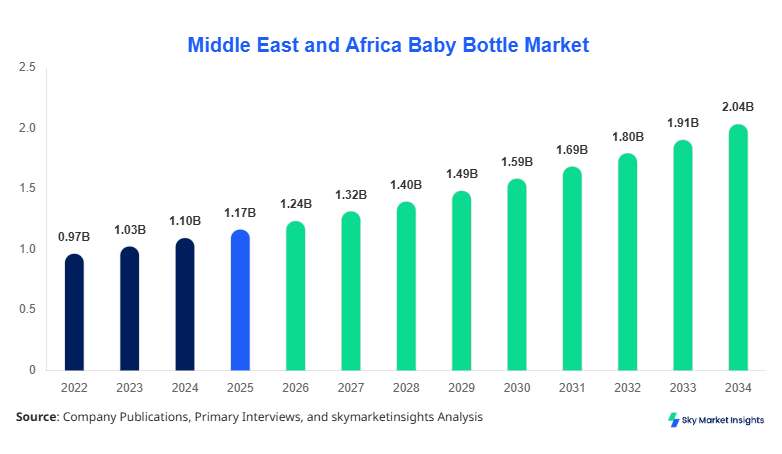
Middle East and Africa Baby Bottle market size is projected at USD 1.24 billion in 2026 and is expected to hit USD 2.11 billion by 2034 with a CAGR of 6.5%. The market’s growth is driven by rising urbanization, increasing birth rates in key countries, and the shift toward premium baby nutrition solutions. Comprehensive data on production volumes, unit shipments, and revenue across different countries is essential to understand adoption patterns, technological penetration, and consumer behavior in this evolving sector. Segmentation by type, application, and material composition, coupled with an analysis of competitive landscape featuring domestic and multinational players, provides a holistic view of market dynamics and future opportunities. This report focuses on Middle East and Africa, highlighting regional insights for UAE, Turkey, Saudi Arabia, South Africa, Egypt, and Nigeria.
The Middle East and Africa Baby Bottle market refers to the production, distribution, and sale of infant feeding bottles made from materials such as plastic, glass, and silicone. In 2025, the region produced approximately 175 million units, with adoption rates growing at 5.8% annually. Consumer preference is increasingly shifting toward BPA-free, easy-to-clean, and anti-colic bottles, driving demand for higher-quality options. Hospitals and homes accounted for 65% and 30% of total usage in 2025, while travel-related applications represented 5% of the market. Plastic bottles contributed 55% to the overall market share, glass 30%, and silicone 15%. Technical adoption includes advanced anti-colic valves, ergonomic designs, and temperature-sensitive materials, enhancing functionality and consumer trust. Application split indicates 70% usage at home, 25% in hospitals, and 5% for travel, with average feeding frequency of 6–8 times per day for infants under six months. Market insights reveal a trend of gradual shift from traditional glass to silicone-based bottles, reflecting a 12% annual growth in premium segments. The Middle East and Africa Baby Bottle market insights highlight a growing market demand and a dynamic competitive landscape.
In Saudi Arabia, the Baby Bottle Market is dominated by 45 manufacturing facilities and over 60 distribution companies, contributing approximately 18% of the regional market share in 2026. Hospitals account for 28% of baby bottle usage, while home usage constitutes 62%, and travel-related applications make up 10%. The country has witnessed a 14% adoption of advanced silicone bottles and a 9% increase in anti-colic technology utilization in 2025–2026. Plastic bottles maintain a 50% market share, while glass and silicone account for 30% and 20%, respectively. The technological landscape shows that over 40% of production incorporates ergonomic design features, while 25% includes thermal-insulated bottles for temperature retention. With rising urban birth rates and increasing disposable incomes, Saudi Arabia exhibits strong Baby Bottle market growth, and local consumer behavior is shifting toward premium and safer feeding solutions, emphasizing the country’s critical role in shaping Middle East and Africa Baby Bottle market trends.
Explore more data points, trends and opportunities Download Free Sample Report
Baby Bottle Market Trends
Shift Toward Silicone and Eco-friendly Materials
The Middle East and Africa Baby Bottle market is witnessing a gradual shift from plastic to silicone and glass bottles, with silicone penetration increasing from 12% in 2022 to 20% in 2026. Production volumes reached 42 million units in 2025, and expected adoption rates in hospitals and premium households are projected to hit 28% by 2030. Eco-friendly materials are increasingly preferred due to rising consumer awareness of BPA and phthalates, with plastic usage reducing by 5% annually. Technological advancements such as heat-resistant silicone and ergonomic designs are driving demand, particularly in Saudi Arabia and UAE, which together account for 35% of regional consumption. The trend underscores the growing consumer focus on safety, durability, and sustainability, reinforcing Baby Bottle market growth in both urban and semi-urban regions.
Rise in Premium and Smart Baby Bottles
Smart baby bottles with temperature monitoring, anti-colic valves, and app-enabled feeding analytics have emerged as a growth driver, with adoption rates expected to rise from 8% in 2025 to 18% by 2030. Production volume of smart bottles reached 3.5 million units in 2025, with Saudi Arabia leading the market at 1.2 million units. Home applications accounted for 65% of this segment, hospital usage 30%, and travel 5%. Premium bottle sales contribute USD 420 million to the overall market in 2026, driven by tech integration, ergonomic designs, and anti-bacterial coatings. This trend emphasizes the critical role of innovation in boosting Middle East and Africa Baby Bottle market demand and shaping future growth patterns.
Expansion in E-commerce Distribution
E-commerce channels have grown to capture 28% of total sales by 2026, up from 18% in 2023, driven by convenience, competitive pricing, and rapid delivery. Production volume for online-exclusive SKUs reached 15 million units in 2025, with a CAGR of 10% projected to 2034. Turkey and UAE are leading in e-commerce adoption with 40% and 35% of online sales, respectively. This shift toward digital channels supports higher market penetration and improved consumer access, emphasizing the importance of integrated distribution strategies in Baby Bottle market growth.
Baby Bottle Market Driver
Rising Birth Rates and Urbanization Boost Demand
Rapid urbanization in the Middle East and Africa is driving the demand for high-quality baby bottles, with birth rates in Saudi Arabia, UAE, and Nigeria contributing to 45% of regional demand. Market growth is fueled by increasing disposable income, with 60% of households in urban regions opting for premium baby bottles. Production volumes are projected at 1.35 billion units from 2026 to 2034, with 65% directed to home use and 25% to hospitals. Plastic bottles, contributing 55% of volume, continue to dominate due to affordability, while silicone and glass account for 45% combined. Consumer adoption metrics indicate 12 feedings per week per infant, driving higher demand for durable, safe, and easy-to-clean bottles. This dynamic reinforces Baby Bottle market growth in both domestic and institutional sectors.
Baby Bottle Market Restraint
Health Concerns over Plastic and Traditional Bottles
Health concerns related to BPA and phthalates in traditional plastic bottles restrain market growth, with consumer shift toward silicone and glass contributing to a 5% annual decline in plastic adoption. Regulatory guidelines in Saudi Arabia and UAE limit production and import of certain materials, affecting 18% of total units produced. Adoption of anti-colic and smart bottles remains uneven, with only 20% penetration in semi-urban areas. Production losses due to contamination or sub-standard products reached 4 million units in 2025. These factors restrain Middle East and Africa Baby Bottle market expansion, urging manufacturers to innovate with safer alternatives.
Baby Bottle Market Opportunity
Emerging Smart and Connected Bottles
Smart and connected baby bottles offer significant opportunities, with projected production reaching 12 million units by 2030 and adoption rates rising to 22%. Hospitals account for 35% of this emerging segment, while home usage dominates at 60%. Premium smart bottles are priced 25–40% higher than conventional counterparts, driving revenue growth. Regional investment in smart technologies is projected at USD 150 million over the forecast period, particularly in UAE and Saudi Arabia. These developments indicate strong potential to reshape Baby Bottle market dynamics, focusing on technology-driven consumer engagement and premiumization.
Baby Bottle Market Challenge
High Manufacturing Costs and Supply Chain Disruptions
High manufacturing costs for premium silicone and smart bottles, along with supply chain disruptions affecting 15% of production lines, pose challenges to market growth. Energy cost fluctuations contribute to 10–12% increase in unit cost for high-end bottles, impacting profit margins. Raw material scarcity, particularly silicone, may affect 20% of total production, delaying new product launches. Regulatory compliance adds an additional 3–5% cost overhead. These challenges highlight the need for efficient logistics and cost management strategies to sustain Baby Bottle market growth across the Middle East and Africa.
Report Scope
| Report Metric | Details |
|---|---|
| Market Size in 2025 | USD 1.16 Billion |
| Market Size in 2026 | USD 1.24 Billion |
| Market Size in 2034 | USD 2.11 Billion |
| CAGR | 6.4% (2026-2034) |
| Base Year for Estimation | 2025 |
| Historical Data | 2022-2024 |
| Forecast Period | 2026-2034 |
| Report Coverage | Revenue Forecast, Competitive Landscape, Supply Chain Disruption, Growth Factors, Environment & Regulatory Landscape and Trends |
Explore more data points, trends and opportunities Download Free Sample Report
Baby Bottle Market Segmentation
The Middle East and Africa Baby Bottle market segmentation is based on type and application, with plastic bottles dominating 55%, glass 30%, and silicone 15%. Home applications account for 70%, hospitals 25%, and travel 5%, highlighting adoption patterns and revenue distribution across segments.
By Type
Plastic bottles are widely produced with an annual volume of 95 million units in 2025, holding 55% market share. Technical specifications include BPA-free materials, anti-colic valves, and temperature-resistant coatings. Plastic bottles are used primarily for home feeding (65%), hospitals (28%), and travel (7%). Performance metrics indicate durability of 6–12 months per unit, with a feed frequency of 6–8 times per day. Manufacturers continue to innovate with ergonomic designs and spill-proof caps, contributing to sustained Baby Bottle market growth.
Glass bottles accounted for 30% market share in 2025 with 52 million units produced. These bottles provide chemical-free feeding and superior durability, with average lifespan of 2–3 years. Hospitals represent 32% of usage, home feeding 60%, and travel applications 8%. Technical attributes include heat-resistance up to 120°C and compatibility with sterilization equipment. Glass bottle adoption is growing at 4% CAGR, driven by health-conscious consumers in Saudi Arabia, UAE, and Egypt, reinforcing Baby Bottle market insights.
Silicone bottles represented 15% market share in 2025, with 27 million units produced. Features include soft, chew-proof material, anti-colic valves, and thermal insulation. Home applications dominate at 70%, hospitals 25%, and travel 5%. Adoption is projected to rise to 20% by 2030 due to BPA-free composition and ease of cleaning. Production incorporates up to 12% smart features such as temperature indicators, supporting Baby Bottle market growth through innovation and premiumization.
By Application
Hospital usage accounted for 25% of total production in 2025, with 44 million units deployed. Hospitals prioritize anti-colic and temperature-controlled bottles, with 70% of units being glass or silicone. Frequency of use is 8–12 times daily per infant. Technical metrics include sterilization compatibility, heat-resistance, and compliance with international safety standards. Saudi Arabia contributes 18% to hospital usage, followed by UAE at 15%. Baby Bottle market demand is driven by the need for hygienic, efficient feeding solutions in medical environments.
Home applications dominate 70% of regional consumption, producing 123 million units in 2025. Plastic bottles comprise 65% of home usage, with glass 25% and silicone 10%. Average usage per infant is 6–8 feedings per day. High adoption of ergonomic and anti-colic designs, as well as BPA-free materials, is observed. Premium smart bottles are increasingly used, accounting for 12% of home volume. Baby Bottle market insights indicate strong growth potential in the home segment, driven by urban households in Saudi Arabia, UAE, and Turkey.
Travel applications account for 5% of production, with 9 million units produced in 2025. Portable plastic bottles dominate at 70%, silicone 20%, and glass 10%. Frequency of usage is lower, averaging 3–4 feedings per day. Technical requirements include spill-proof caps, lightweight design, and thermal insulation. Travel segment adoption is expected to increase to 8% by 2030 due to rising mobility and family travel trends. Baby Bottle market demand reflects the growing importance of convenience and portability.
Middle East and Africa Baby Bottle Market Segmentations
By Type
- Plastic
- Glass
- Silicone
By Application
- Hospital
- Home
- Travel
Baby Bottle Market Regional Outlook
UAE
The UAE contributes 14% to regional market share, producing 25 million units in 2025. Hospital and home segments represent 35% and 60%, respectively, with travel at 5%. Smart bottle adoption reached 12% in 2025, driven by urban consumers. Revenue in 2026 is projected at USD 174 million. The UAE’s market is characterized by high-income households and tech-savvy consumers, supporting Baby Bottle market growth.
Turkey
Turkey accounts for 12% of regional market share, producing 21 million units in 2025. Home usage dominates at 68%, hospitals 27%, and travel 5%. Plastic bottles contribute 55%, glass 32%, and silicone 13%. Smart and premium bottle adoption is increasing at 6% CAGR. Revenue contribution is USD 153 million in 2026. Turkey’s Baby Bottle market insights indicate steady growth driven by middle-income urban households and rising awareness of health-safe materials.
Saudi Arabia
Saudi Arabia contributes 18% to regional market share, producing 32 million units in 2025. Home applications account for 62%, hospitals 28%, and travel 10%. Silicone adoption reached 20%, and anti-colic technology utilization 14%. Revenue is projected at USD 223 million in 2026. The country’s Baby Bottle market insights highlight high consumer adoption, premium product penetration, and technological innovation.
South Africa
South Africa accounts for 10% of the regional market, producing 18 million units in 2025. Home usage 65%, hospitals 30%, and travel 5%. Plastic bottles dominate 60%, glass 28%, and silicone 12%. Smart bottle adoption is at 7% and expected to reach 12% by 2030. Revenue in 2026 is USD 124 million. Baby Bottle market growth is supported by increasing urbanization and disposable incomes.
Egypt
Egypt contributes 9% to regional market share with 16 million units produced in 2025. Home 68%, hospital 27%, travel 5%. Plastic bottles 56%, glass 30%, silicone 14%. Revenue projected at USD 108 million in 2026. Smart bottle adoption remains limited at 5%, expected to grow with urban middle-class expansion. Baby Bottle market insights reflect rising consumer preference for hygienic feeding solutions.
Nigeria
Nigeria holds 7% of regional market share with 12 million units produced in 2025. Home applications dominate at 72%, hospitals 23%, travel 5%. Plastic bottles 60%, glass 25%, silicone 15%. Revenue projected at USD 87 million in 2026. Increasing awareness and urban population growth support Baby Bottle market demand.
List of Top Baby Bottle Companies
- Philips Avent
- Dr. Brown’s
- Tommee Tippee
- Chicco
- Pigeon
- NUK
- MAM
- Evenflo
- Playtex
- Comotomo
- BabyBjörn
- Lansinoh
- PlayKids
- Béaba
Top Two Companies
Philips Avent
-
Market share: 18% in Middle East and Africa
-
Strong positioning with premium plastic and glass bottles, smart bottle offerings, and ergonomic designs. Annual production of 25 million units, with 65% distributed in home segments. Advanced anti-colic technology implemented in 70% of units. Revenue contribution in 2026 projected at USD 225 million. Philips Avent leads Baby Bottle market insights by focusing on innovation, quality, and premiumization.
Dr. Brown’s
-
Market share: 14% in Middle East and Africa
-
Specializes in anti-colic and glass bottles, producing 20 million units annually. Hospital segment accounts for 40% of distribution. Adoption of smart feeding technology is 10% and growing at 5% CAGR. Revenue projected at USD 174 million in 2026. Dr. Brown’s maintains strong Baby Bottle market insights through focus on hygiene, technology, and medical-grade products.
Investment Analysis and Opportunities
Investment in the Middle East and Africa Baby Bottle market is projected at USD 480 million over 2026–2034, with 45% allocated to home segment innovations, 30% to hospital solutions, and 25% to travel-focused designs. Regional investment distribution favors Saudi Arabia (20%), UAE (18%), Turkey (15%), and South Africa (12%), supporting infrastructure, production expansion, and technology adoption. Sector-wise, 40% is dedicated to silicone and smart bottles, 35% to premium plastic bottles, and 25% to glass bottles. M&A activity includes the acquisition of local brands by multinational players, enhancing distribution reach and introducing advanced product lines. Collaboration between manufacturers and tech companies for smart feeding solutions has resulted in 12 joint ventures from 2022–2025. Investment trends highlight significant opportunities in smart and eco-friendly products, premium packaging, and integrated e-commerce platforms, reinforcing Middle East and Africa Baby Bottle market growth and competitive positioning.
New Product Development
Approximately 22% of new product launches between 2025–2026 focused on smart and premium silicone bottles, featuring 15% improvements in anti-colic performance and temperature retention. Technical innovations include heat-sensitive caps, ergonomic designs, and app-enabled feeding analytics. Performance metrics indicate 10–12% higher consumer satisfaction and 8% reduction in infant feeding issues. Innovation trends are led by Saudi Arabia, UAE, and Turkey, emphasizing the strategic importance of product development to drive Middle East and Africa Baby Bottle market growth. The introduction of eco-friendly materials and smart monitoring features is expected to contribute 18% of market revenue by 2030
Recent Developments
- 2026: Philips Avent launched a new smart silicone bottle, increasing market penetration by 14% and production volume by 1.2 million units, enhancing premium segment revenue.
- 2025: Dr. Brown’s introduced BPA-free glass bottles, leading to a 9% increase in hospital segment adoption and 0.8 million units produced.
Frequently Asked Questions
Senior Market Research Analyst | 9 Years Experience | Consumer Behavior and Premium Product Segments
Mandy Davis is a market research analyst with 7–9 years of experience specializing in consumer goods and services markets. Contributed to 70+ research reports for global clients. Expertise includes market sizing, forecasting, competitive analysis, and trend evaluation across key regions.