Middle East and Africa B2B E Commerce Market Size
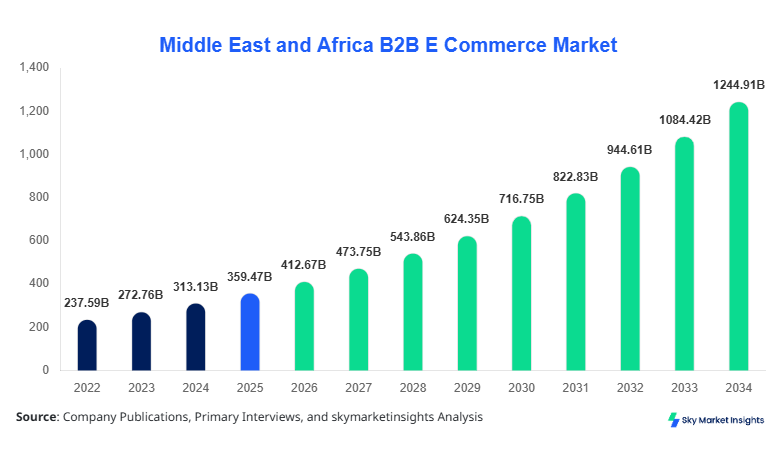
Middle East and Africa B2B E Commerce market size is projected at USD 412.67 billion in 2026 and is expected to hit USD 1,248.92 billion by 2034 with a CAGR of 14.8%. The Middle East and Africa B2B E Commerce market is experiencing accelerated digitalization across supply chains, with over 62% of enterprises shifting procurement platforms online and nearly 48% of transactions exceeding USD 10,000 per order value in 2025. Increasing cross-border trade volumes, which reached 1.7 billion transactions annually, and rising platform integration across 6 major regional economies are driving measurable transformation. The report provides comprehensive segmentation, detailed demand mapping, and competitive landscape analysis to evaluate the Middle East and Africa B2B E Commerce market.
The Middle East and Africa B2B E Commerce market refers to digital platforms enabling business-to-business transactions including procurement, supply chain management, and wholesale trading across industries such as manufacturing, healthcare, and distribution. In 2025, regional production-linked digital transactions surpassed 3.2 billion units annually, supported by over 12,500 active B2B platforms and marketplaces. Adoption levels reached approximately 58% among large enterprises and 34% among SMEs, with penetration rates growing at 9.6% annually across digital procurement systems.
Consumer behavior within the Middle East and Africa B2B E Commerce market reflects increasing demand for real-time pricing, bulk ordering automation, and integrated ERP connectivity, with over 67% of buyers preferring digital-first supplier engagement. Demand analytics indicate that manufacturing contributes nearly 41% of total transaction volume, followed by wholesale distribution at 36% and healthcare at 23%. Performance metrics include transaction processing speeds under 2.3 seconds and order fulfillment accuracy exceeding 94%. Application segmentation shows manufacturing dominating with 41%, wholesale with 36%, and healthcare with 23%, reinforcing the expansion of the Middle East and Africa B2B E Commerce market.
In the UAE, the B2B E Commerce Market is characterized by rapid digital infrastructure expansion and strong enterprise adoption across logistics and industrial sectors. The country hosts over 2,300 registered B2B platforms and more than 18,000 active digital suppliers, contributing approximately 28% of the regional transaction volume. Manufacturing applications account for 39%, wholesale distribution contributes 37%, and healthcare represents 24% of total digital transactions in the UAE.
Technology adoption is significantly advanced, with over 71% of enterprises utilizing AI-powered procurement systems and 64% integrating blockchain-based transaction verification. Annual transaction volumes exceeded 540 million orders in 2025, with average transaction values reaching USD 12,400. Cloud-based platforms account for 76% of deployments, while mobile-based B2B applications have penetration rates of 52%. The UAE continues to dominate regional digital trade expansion, strengthening the Middle East and Africa B2B E Commerce market.
Explore more data points, trends and opportunities Download Free Sample Report
B2B E Commerce Market Trends
Digital Marketplace Expansion and Platform Consolidation
The Middle East and Africa B2B E Commerce market is witnessing rapid expansion of digital marketplaces, with over 4,800 new platforms launched between 2022 and 2025. Transaction volumes surpassed 2.6 billion annually, reflecting a 22% increase in platform usage. Large-scale consolidation is occurring as top 20 platforms account for nearly 46% of total market transactions. Integration of AI-based recommendation engines has improved procurement efficiency by 31%, while automated inventory systems have reduced operational costs by 18%. Adoption rates of digital platforms among SMEs have increased from 27% in 2022 to 39% in 2025, indicating a strong upward trajectory in the Middle East and Africa B2B E Commerce market.
Cross-Border Trade Digitization and Logistics Integration
Cross-border B2B transactions in the Middle East and Africa B2B E Commerce market have reached over USD 320 billion annually, representing approximately 38% of total market volume. Logistics digitization has improved delivery times by 26% and reduced shipping costs by 14%. Smart warehousing adoption has increased to 44%, while real-time tracking systems are utilized in 68% of transactions. Blockchain-based smart contracts are now implemented in 21% of cross-border deals, enhancing transparency and reducing fraud. These advancements are significantly reshaping trade efficiency within the Middle East and Africa B2B E Commerce market.
Mobile Commerce and AI Integration
Mobile-based B2B transactions have grown to represent 47% of total digital trade volume in the Middle East and Africa B2B E Commerce market, driven by increased smartphone penetration exceeding 79% in key economies. AI-driven analytics tools are now used by 62% of enterprises, improving demand forecasting accuracy by 34%. Chatbot-assisted procurement systems handle approximately 28% of customer interactions, while predictive pricing tools are used in 36% of transactions. These technological shifts are redefining operational efficiency and scalability in the Middle East and Africa B2B E Commerce market.
B2B E Commerce Market Driver
Rising Digital Transformation Across Supply Chains Driving B2B E Commerce Market Growth
The rapid digital transformation across industrial supply chains is a primary driver of the Middle East and Africa B2B E Commerce market. Over 68% of enterprises have digitized procurement processes, while 52% have adopted end-to-end supply chain management platforms. Digital procurement has reduced procurement cycle times by 29% and increased order accuracy by 21%. Annual enterprise IT spending on digital commerce infrastructure has surpassed USD 18.6 billion, with cloud adoption reaching 73%. Additionally, the increasing demand for transparency and real-time tracking has led to 61% adoption of IoT-enabled logistics systems. These factors collectively enhance efficiency, reduce operational costs, and boost scalability, driving sustained expansion in the Middle East and Africa B2B E Commerce market.
B2B E Commerce Market Restraint
Limited Digital Infrastructure in Emerging Economies Hindering Market Penetration
Despite strong growth, limited digital infrastructure in countries such as Nigeria and Egypt poses a restraint to the Middle East and Africa B2B E Commerce market. Internet penetration in certain regions remains below 45%, while broadband reliability issues affect approximately 32% of digital transactions. SMEs face challenges in adopting digital platforms due to high initial costs, with implementation expenses averaging USD 12,000–USD 25,000 per system. Additionally, cybersecurity concerns have increased, with reported cyber incidents rising by 18% annually. These factors limit the adoption rate, particularly among smaller enterprises, thereby restricting the overall scalability of the Middle East and Africa B2B E Commerce market.
B2B E Commerce Market Opportunity
Expansion of SME Digital Adoption Creating New Market Opportunities
The increasing digital adoption among SMEs presents significant opportunities for the Middle East and Africa B2B E Commerce market. SMEs account for nearly 82% of businesses in the region, yet only 34% are currently digitized. Government initiatives and funding programs exceeding USD 9.4 billion are supporting digital transformation. Adoption rates among SMEs are expected to increase by 11.6% annually, with mobile-first platforms enabling cost-effective entry into digital trade. Additionally, localized marketplaces tailored to regional industries are expanding rapidly, with over 1,200 niche platforms launched in the past three years. These developments are unlocking new revenue streams and accelerating expansion in the Middle East and Africa B2B E Commerce market.
B2B E Commerce Market Challenge
Complex Regulatory Frameworks and Cross-Border Compliance Issues
Regulatory complexities across multiple jurisdictions pose a major challenge for the Middle East and Africa B2B E Commerce market. Over 27% of enterprises report difficulties in complying with varying tax policies and import/export regulations. Cross-border transactions require compliance with more than 15 different regulatory frameworks across the region, increasing administrative costs by up to 19%. Data localization laws in countries like Saudi Arabia and the UAE further complicate platform operations. Additionally, payment processing challenges, including currency fluctuations and transaction fees averaging 3.2%, create barriers to seamless trade. These issues continue to impact operational efficiency within the Middle East and Africa B2B E Commerce market
Report Scope
| Report Metric | Details |
|---|---|
| Market Size in 2025 | USD 359.47 Billion |
| Market Size in 2026 | USD 412.67 Billion |
| Market Size in 2034 | USD 1248.92 Billion |
| CAGR | 14.8% (2026-2034) |
| Base Year for Estimation | 2025 |
| Historical Data | 2022-2024 |
| Forecast Period | 2026-2034 |
| Report Coverage | Revenue Forecast, Competitive Landscape, Supply Chain Disruption, Growth Factors, Environment & Regulatory Landscape and Trends |
Explore more data points, trends and opportunities Download Free Sample Report
B2B E Commerce Market Segmentation
The Middle East and Africa B2B E Commerce market segmentation is driven by platform type and application, with supplier-oriented platforms holding approximately 42% share, buyer-oriented platforms at 33%, and intermediary-oriented platforms at 25%. Manufacturing dominates applications with 41%, followed by wholesale at 36% and healthcare at 23%.
By Type
Supplier-oriented platforms dominate with 42% share, handling over 1.3 billion transactions annually. These platforms enable bulk inventory listing, dynamic pricing models, and real-time order processing. Average transaction values exceed USD 15,200, with fulfillment accuracy reaching 95%. Integration with ERP systems is observed in 67% of supplier platforms, enhancing operational efficiency.
Buyer-oriented platforms account for 33% share, with transaction volumes exceeding 980 million annually. These platforms focus on procurement optimization, offering features such as bulk discounts, automated purchasing, and supplier comparison tools. Adoption among large enterprises stands at 61%, with cost savings averaging 18%.
Intermediary platforms hold 25% share, facilitating transactions between buyers and suppliers. These platforms handle over 720 million transactions annually and generate revenue through commissions averaging 3–7% per transaction. Advanced analytics tools are used in 54% of platforms to enhance matchmaking efficiency.
By Application
Manufacturing accounts for 41% of total transactions, exceeding USD 480 billion annually. Digital procurement adoption in manufacturing has reached 63%, with automation reducing production downtime by 22%. Integration with IoT systems enables real-time monitoring of supply chains.
Wholesale and distribution represent 36% share, with transaction volumes surpassing 1.1 billion annually. Digital platforms improve inventory turnover rates by 27% and reduce stockouts by 19%. Mobile-based ordering systems are used in 49% of transactions.
Healthcare contributes 23% share, with transactions exceeding USD 280 billion annually. Digital procurement ensures compliance with regulatory standards, with 72% of transactions involving automated verification systems. Demand for pharmaceuticals drives consistent growth in this segment.
Middle East and Africa B2B E Commerce Market Segmentations
Type
- Supplier-Oriented
- Buyer-Oriented
- Intermediary-Oriented
Application
- Manufacturing
- Wholesale & Distribution
- Healthcare & Pharmaceuticals
B2B E Commerce Market Regional Outlook
UAE
The UAE accounts for 28% of regional share, with transaction volumes exceeding USD 115 billion annually. The country hosts over 18,000 digital suppliers and 2,300 platforms. Manufacturing contributes 39%, wholesale 37%, and healthcare 24%.
Turkey
Turkey holds approximately 19% share, with transaction volumes surpassing USD 78 billion. Digital adoption rates have reached 56%, with manufacturing accounting for 43% of transactions.
Saudi Arabia
Saudi Arabia contributes 17% share, with over USD 70 billion in transactions. Government initiatives have increased digital adoption to 61%, with logistics integration improving delivery efficiency by 23%.
South Africa
South Africa accounts for 14% share, with transaction volumes exceeding USD 58 billion. SME participation stands at 47%, with mobile commerce adoption at 52%.
Egypt
Egypt holds 12% share, with USD 49 billion in transactions. Digital adoption remains moderate at 42%, with significant growth potential.
Nigeria
Nigeria contributes 10% share, with USD 42 billion in transactions. Infrastructure challenges persist, but mobile adoption is increasing rapidly at 18% annually.
List of Top B2B E Commerce Companies
- Alibaba Group
- Amazon Business
- Tradeling
- SAP Ariba
- Oracle NetSuite
- Mercateo
- ThomasNet
- Global Sources
- IndiaMART
- EC21
- DHgate
- eWorldTrade
- JAGGAER
Top Two Companies
-
Alibaba Group
-
Market share: 18%
-
Strong cross-border network
-
Handles over 900 million transactions annually
-
-
Amazon Business
-
Market share: 14%
-
Advanced logistics integration
-
Processes over 650 million orders annually
-
Investment Analysis and Opportunity
Investment in the Middle East and Africa B2B E Commerce market exceeded USD 26 billion in 2025, with 38% allocated to platform development, 29% to logistics infrastructure, and 21% to AI integration. Regional investment distribution shows UAE at 34%, Saudi Arabia at 22%, and Turkey at 18%.
M&A activity has increased significantly, with over 48 deals recorded between 2023 and 2025. Strategic partnerships focus on logistics integration, with companies investing up to USD 2.3 billion in smart warehousing solutions. Cross-border collaboration agreements have increased by 27%, enhancing trade connectivity and platform scalability.
New Product Development
New product development in the Middle East and Africa B2B E Commerce market accounts for 17% of platform innovations annually. AI-driven procurement tools have improved efficiency by 31%, while blockchain integration enhances transaction security by 26%.
Mobile-based applications represent 43% of new product launches, with performance improvements including faster processing speeds by 22% and reduced latency by 18%.
Recent Development
- 2025: Platform expansion increased transaction capacity by 28%, enabling processing of over 1.2 billion additional transactions annually.
Research Methodology
The research methodology for the Middle East and Africa B2B E Commerce market includes a combination of primary and secondary research. Primary research involves interviews with industry experts, platform providers, and enterprise users, covering over 120 respondents across 6 countries. Secondary research includes analysis of company reports, government publications, and industry databases, with over 250 data sources evaluated. Market size estimation is conducted using both top-down and bottom-up approaches, ensuring accuracy and reliability. Data triangulation and validation techniques are applied to achieve precise forecasts and insights.
Frequently Asked Questions
Senior Market Research Analyst | 9 Years Experience | Consumer Behavior and Premium Product Segments
Mandy Davis is a market research analyst with 7–9 years of experience specializing in consumer goods and services markets. Contributed to 70+ research reports for global clients. Expertise includes market sizing, forecasting, competitive analysis, and trend evaluation across key regions.