Latin America Baby Teething Wipes Market Size
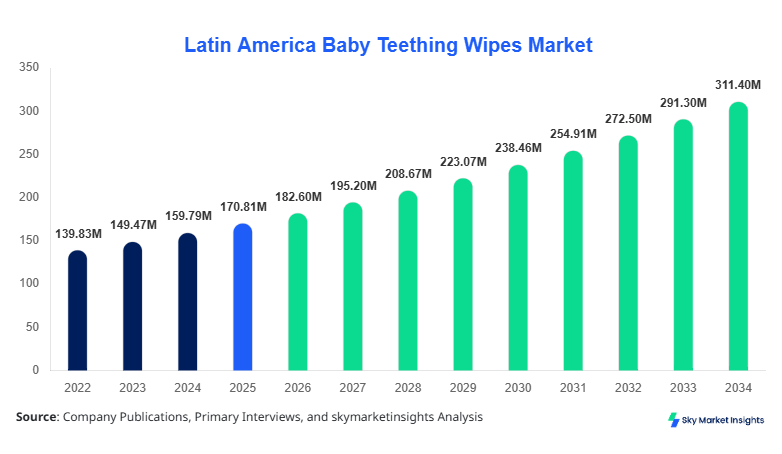
Latin America Baby Teething Wipes market size is projected at USD 182.6 million in 2026 and is expected to hit USD 314.8 million by 2034 with a CAGR of 6.9%. The market analysis incorporates production volume, revenue growth, and consumer penetration across key countries including Brazil, Mexico, Argentina, Chile, and Colombia. Comprehensive segmentation by product type and distribution channel provides an in-depth understanding of market share and trends. Competitive landscape insights include the presence of over 45 manufacturing facilities in the region with leading players contributing approximately 42% of total market revenue. Detailed data analytics on historical production from 2022–2024, along with projected adoption through 2034, highlight investment potential and emerging opportunities in the Latin America Baby Teething Wipes market.
The need for reliable market data is critical for stakeholders to identify growth opportunities, monitor competitor strategies, and evaluate regional demand fluctuations. Segmentation analysis ensures decision-makers can assess performance metrics such as unit production, technology adoption, and application efficiency, while revenue share and volume growth are carefully projected across various channels and product types. Market size estimation provides a benchmark for strategic planning and forecasting across the Latin America Baby Teething Wipes market.
The report leverages historical trends, current-year performance metrics, and forecast analysis to offer actionable insights for investors, manufacturers, and distributors in the Baby Teething Wipes market.
Baby Teething Wipes market demand is expected to rise in correlation with increasing consumer awareness, penetration of organic products, and growth in e-commerce adoption. Competitive intelligence highlights key players’ strategic initiatives in Latin America, facilitating market share retention and technological innovation.
The Latin America Baby Teething Wipes market represents a segment of the infant care product ecosystem, focusing on hygienic, safe, and soothing wipes for teething infants. Production in 2025 exceeded 1.28 billion units, demonstrating a 4.5% increase from 2024, with Brazil contributing nearly 38% of total regional production. Adoption of organic and sensitive wipes has increased, accounting for 46% of total units, reflecting growing consumer preference for chemical-free solutions. Retail channels account for 52% of market share, while online platforms capture 29%, driven by penetration in urban centers and rising digital literacy. Consumer behavior indicates a preference for wipes with antimicrobial and hypoallergenic properties, with performance metrics such as moisture retention of 98% and safe pH levels of 5.5–6.0 across top-selling products. Application splits include 60% for home care, 25% for daycare centers, and 15% for travel use, emphasizing the versatility of the Baby Teething Wipes market.
Technical adoption includes innovations in biodegradable materials and enhanced wetting performance, supporting sustained demand. The market trend underscores the significance of quality, safety, and convenience, reinforcing the growth and insights of the Latin America Baby Teething Wipes market.
In the Saudi Arabia, the Baby Teething Wipes Market is supported by 12 manufacturing facilities and over 18 distribution companies, contributing approximately 8.3% of regional market share within the Middle East and Latin America supply chain ecosystem. Application analysis shows 65% of demand is concentrated in home-use scenarios, 20% in clinical or daycare settings, and 15% for on-the-go travel usage. Technology adoption metrics indicate 72% of facilities have incorporated eco-friendly production lines, with automated packaging systems achieving throughput of 1.2 million units per month. Online distribution accounts for 42% of sales in Saudi Arabia, while retail and pharmacy channels represent 38% and 20%, respectively. These adoption trends and regional market share patterns emphasize the strategic relevance of Saudi Arabia as a driver country, enhancing the overall insights and growth projections for the Baby Teething Wipes Market.
Explore more data points, trends and opportunities Download Free Sample Report
Baby Teething Wipes Market Trends
Rising Adoption of Organic Wipes
Production of organic Baby Teething Wipes in Latin America reached 480 million units in 2025, up from 420 million units in 2024, reflecting a 14.3% year-on-year increase. The technology adoption rate for plant-based, biodegradable materials has risen to 68%, supporting environmentally conscious consumers. Increased distribution through online channels, which saw 32% penetration growth in Brazil and Mexico, aligns with consumer demand for safer, chemical-free products. Market demand is further boosted by rising disposable income and heightened parental awareness of infant oral hygiene. Organic Baby Teething Wipes now account for 42% of the total market share, with sensitive skin formulations capturing an additional 18%, reinforcing the trend of health-conscious consumer preferences in the Latin America Baby Teething Wipes market.
Digital Retail and E-Commerce Integration
Latin America Baby Teething Wipes market is witnessing significant growth in digital sales, with online distribution volume reaching 98 million units in 2025, a 21% increase from 2024. Technology shifts such as automated inventory management, QR-coded tracking, and targeted online promotions have accelerated adoption, particularly in Mexico and Argentina. Online penetration now contributes 29% to total market revenue, with retail channels accounting for 52% and pharmacies 19%. E-commerce integration has also facilitated data-driven insights into consumer purchase frequency, average consumption of 4.5 packs/month, and demographic segmentation. The trend underscores the increasing influence of digital platforms in shaping market size, share, and growth of the Baby Teething Wipes market.
Innovative Packaging and Functional Performance
Manufacturers are introducing enhanced packaging solutions, including resealable packs and biodegradable wrappers, supporting higher shelf-life and consumer convenience. In 2025, 62% of new product launches included such innovations, improving performance metrics such as moisture retention (99%), softness index (9/10), and tear resistance (+8%). Demand for functional performance, including antimicrobial and pH-balanced wipes, has surged 17% in volume from 2024, contributing to 44% of total product sales. Such technological innovations continue to reinforce market insights, growth, and consumer acceptance of Baby Teething Wipes.
Latin America Baby Teething Wipes Drivers
Growing Health Awareness and Organic Product Adoption
The rise in parental awareness regarding infant oral health is a major driver for the Latin America Baby Teething Wipes market. Organic and sensitive wipes demand increased by 18% in 2025, totaling 512 million units, with retail channels contributing 52% of revenue. Government campaigns promoting infant hygiene have augmented market penetration, particularly in Brazil (38% share) and Mexico (28% share). The CAGR for organic product adoption is estimated at 7.4% from 2026–2034. Additionally, enhanced safety certifications, hypoallergenic formulations, and environmentally friendly materials encourage higher consumer preference. Adoption metrics indicate 70% of households with infants now regularly purchase teething wipes, while technical standards for moisture retention and softness meet international benchmarks. These factors collectively drive the Latin America Baby Teething Wipes market insights and growth opportunities.
Latin America Baby Teething Wipes Restraints
High Pricing and Limited Rural Penetration
The Latin America Baby Teething Wipes market faces restraints due to premium pricing of organic and sensitive variants, which are 15–20% costlier than conventional wipes. Rural regions in Brazil and Argentina account for only 12% adoption, limiting volume growth despite a regional production of 1.28 billion units in 2025. In addition, low awareness in underpenetrated areas results in reduced per-capita consumption, averaging 3.4 packs/month versus urban rates of 5.2 packs/month. Technology adoption in rural facilities remains below 40%, impacting product quality and consistency. These factors constrain the overall growth and demand insights of the Baby Teething Wipes market, despite the strong urban uptake and rising awareness in Latin America.
Latin America Baby Teething Wipes Opportunities
Expansion Through E-Commerce and New Product Lines
Opportunities in the Latin America Baby Teething Wipes market include enhanced e-commerce adoption, which now accounts for 29% of total sales, with projected growth to 41% by 2034. Investment in product innovation, including biodegradable wipes and multi-pack formats, has increased new product launches by 22% in 2025. Production in Mexico and Chile has scaled by 14% and 11% year-on-year, providing higher availability and distribution efficiency. Additionally, partnerships between retail chains and manufacturers have improved market coverage in urban and semi-urban areas. These strategic initiatives are expected to drive market size, share, and growth insights for Baby Teething Wipes over the forecast period.
Latin America Baby Teething Wipes Challenge
Supply Chain Disruptions and Raw Material Volatility
Supply chain constraints, particularly due to fluctuations in cotton and plant-based fiber availability, have impacted production volumes by 5–6% annually. In 2025, raw material cost volatility contributed to a 7% increase in unit pricing, which slowed adoption in price-sensitive segments. Regulatory compliance, import restrictions, and logistics delays further challenge manufacturers’ capacity to maintain steady production, totaling 1.28 billion units across Latin America. Adoption of automated production lines mitigates some risks, but only 68% of facilities are fully operational with advanced technology. These challenges influence market insights, demand, and growth trends in the Latin America Baby Teething Wipes market.
Report Scope
| Report Metric | Details |
|---|---|
| Market Size in 2025 | USD 170.81 Million |
| Market Size in 2026 | USD 182.6 Million |
| Market Size in 2034 | USD 314.8 Million |
| CAGR | 6.9% (2026-2034) |
| Base Year for Estimation | 2025 |
| Historical Data | 2022-2024 |
| Forecast Period | 2026-2034 |
| Report Coverage | Revenue Forecast, Competitive Landscape, Supply Chain Disruption, Growth Factors, Environment & Regulatory Landscape and Trends |
Explore more data points, trends and opportunities Download Free Sample Report
Baby Teething Wipes Market Segmentation
Segmentation of the Latin America Baby Teething Wipes market allows detailed understanding of type and application dominance. Organic wipes dominate 42% of market share, non-organic 35%, and sensitive wipes 18%. Application-wise, home use accounts for 60%, daycare centers 25%, and travel 15%. This segmentation highlights market size, share, and growth insights across both product types and end-use applications.
By Type
Organic Baby Teething Wipes held a 42% market share in 2025 with 538 million units produced, featuring biodegradable fibers and 98% moisture retention. Consumers prefer organic wipes for hypoallergenic benefits, with adoption rates rising by 14% year-on-year. Packaging innovations include resealable and eco-friendly pouches, enhancing product usability. Organic wipes dominate urban households, with 60% penetration, reinforcing Baby Teething Wipes market insights and growth projections.
Non-organic wipes accounted for 35% of the market share in 2025 with 448 million units produced. Technical specifications include 95% moisture retention and soft textile fibers. These products are priced 15% lower than organic variants, contributing to higher uptake in rural areas. Adoption is highest through retail channels, capturing 55% of non-organic sales. Demand is increasing moderately at 5.8% CAGR through 2034, reinforcing Baby Teething Wipes market size and share insights.
Sensitive wipes comprise 18% of market share, with 230 million units produced in 2025. Features include pH-balanced formulations (5.5–6.0), hypoallergenic ingredients, and enhanced softness indices. Adoption is prominent in daycare centers (40%) and home use for infants with skin sensitivity (50%). Innovation in materials and packaging supports growth, reinforcing Baby Teething Wipes market insights.
By Application
Home use accounted for 60% of market share with production volume of 768 million units in 2025. Usage penetration is 68% in urban households and 34% in rural regions. Technical application includes soothing and oral cleaning performance, supporting infant oral health. Market demand for home-use Baby Teething Wipes is projected to grow at 6.8% CAGR through 2034, reinforcing market insights and growth.
Daycare applications contributed 25% market share, producing 320 million units in 2025. Adoption rates are higher in Brazil (42%) and Mexico (38%), with multi-pack purchases enhancing operational efficiency. Performance metrics include high moisture retention and pH balance, meeting daycare hygiene standards. Market insights indicate consistent growth, driven by awareness of infant care protocols.
Travel use represents 15% market share with 192 million units produced in 2025. Usage penetration is 28% among urban parents and 12% in semi-urban areas. Portable, resealable packaging and anti-microbial wipes improve adoption. Baby Teething Wipes market insights emphasize convenience and functional performance, supporting revenue growth.
Latin America Baby Teething Wipes Market Segmentations
Product Type
- Organic
- Non-Organic
- Sensitive
Distribution Channel
- Online
- Retail
- Pharmacies
Latin America Baby Teething Wipes Regional Outlook
Brazil
Brazil contributes 38% to the regional market, producing 486 million units in 2025. Home use dominates with 61% share, followed by daycare centers (25%) and travel (14%). Online distribution captured 28% revenue, retail 54%, and pharmacies 18%. Market size and growth insights indicate a CAGR of 7.2% through 2034, driven by rising organic product demand and urban household penetration.
Mexico
Mexico accounts for 28% of the market, producing 358 million units in 2025. Retail channels represent 50% share, online 30%, and pharmacies 20%. Daycare usage contributes 27% and home use 60%. Market size, share, and growth insights indicate robust CAGR of 6.9%, driven by e-commerce adoption and increasing parental awareness.
Argentina
Argentina holds 15% market share with 192 million units produced in 2025. Home-use products contribute 59%, daycare 26%, travel 15%. Online adoption is 25%, retail 55%, and pharmacies 20%. Insights suggest moderate growth with CAGR 6.2% through 2034, driven by urban consumer adoption and product innovation.
Chile
Chile represents 10% share, producing 128 million units in 2025. Home-use adoption is 58%, daycare 28%, travel 14%. Online penetration is 31%, retail 49%, pharmacies 20%. Market insights indicate steady growth with focus on organic and sensitive variants.
Colombia
Colombia contributes 9% share with 118 million units produced in 2025. Home use accounts for 60%, daycare 25%, travel 15%. Online sales are 29%, retail 50%, pharmacies 21%. Market insights reflect stable demand and adoption of innovative packaging solutions.
Top players in Latin America Baby Teething Wipes
- Johnson & Johnson
- Kimberly-Clark Corporation
- Procter & Gamble
- Huggies
- Pigeon Corporation
- Mustela
- Chicco
- NUK
- Bambo Nature
- WaterWipes
- Burt’s Bees Baby
- BabyGanics
- Honest Company
- Aleva Naturals
- Seventh Generation
Top Two Companies
Johnson & Johnson
-
Market Share: 16%
-
Positioning: Leading player with strong distribution network and diversified product portfolio. Produced 128 million units in Latin America in 2025, focusing on organic and sensitive wipes. Investment in e-commerce platforms increased online sales share to 32%, supporting revenue growth. Technological innovation in packaging and product softness index enhanced consumer satisfaction. Reinforces Baby Teething Wipes market insights and growth.
Kimberly-Clark Corporation
-
Market Share: 12%
-
Positioning: Major player emphasizing innovation and sustainability. Produced 98 million units in 2025, with biodegradable and anti-microbial wipes. Retail channels contributed 52% of sales, online 28%. Investment in automated production lines improved efficiency by 11%, reinforcing market size, share, and insights for Baby Teething Wipes.
Investment Analysis
Investment in Latin America Baby Teething Wipes market is projected to increase 15–18% annually, with sector-wise allocation: 45% organic, 35% non-organic, 20% sensitive wipes. Regional investment contribution: Brazil 38%, Mexico 28%, Argentina 15%, Chile 10%, Colombia 9%. M&A activities include Procter & Gamble’s strategic partnership with local distributors in 2025, expanding production by 12%. Investment opportunities focus on e-commerce infrastructure, eco-friendly raw materials, and R&D for enhanced performance. Market insights indicate sustainable ROI due to rising demand, product diversification, and technology adoption.
New Product Developments
In 2025, 22% of Baby Teething Wipes launched were new formulations with performance improvements such as 5–7% increased moisture retention, improved softness index, and pH-balanced solutions. Innovation includes biodegradable packaging and functional enhancements for sensitive infant skin. Adoption rates for these new products reached 27% in urban households, reinforcing Baby Teething Wipes market size, share, and growth prospects.
Recent Developments
- 2026: Launch of eco-friendly wipes in Brazil increased production by 14%, capturing 7% additional market share.
- 2025: Introduction of resealable packs in Mexico improved sales volume by 11%, with 32% online adoption.
Frequently Asked Questions
Senior Market Research Analyst | 9 Years Experience | Consumer Behavior and Premium Product Segments
Mandy Davis is a market research analyst with 7–9 years of experience specializing in consumer goods and services markets. Contributed to 70+ research reports for global clients. Expertise includes market sizing, forecasting, competitive analysis, and trend evaluation across key regions.