Latin America Baby Pram Market Size
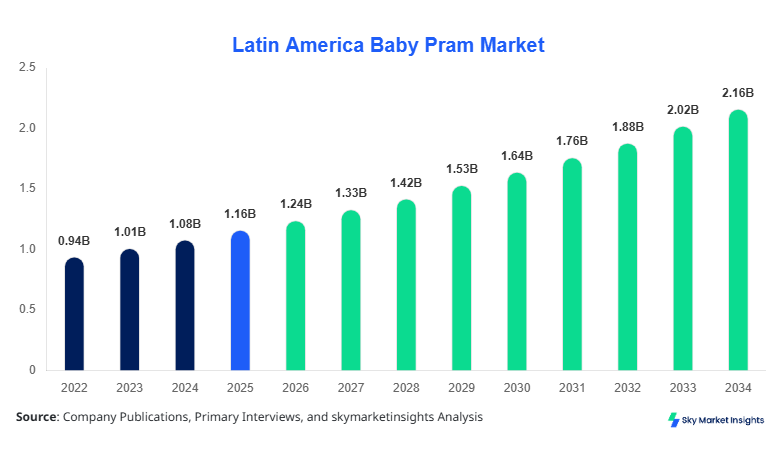
Latin America Baby Pram market size is projected at USD 1.24 billion in 2026 and is expected to hit USD 2.18 billion by 2034 with a CAGR of 7.2%. The growing need for detailed data on market segmentation, competitive landscape, and regional production has become critical for stakeholders, with production volumes reaching approximately 3.5 million units in 2025. Companies are increasingly focusing on the Latin American market for strategic expansion, making market size insights and growth trends indispensable for investors and manufacturers.
The Latin America Baby Pram market has gained significant attention due to the rising birth rates in Brazil, Mexico, and Argentina, coupled with increased consumer spending on child care products. Detailed market size, share, and growth analysis helps manufacturers optimize production capacity, improve distribution networks, and identify emerging opportunities.
The competitive landscape shows a mix of domestic and international players, with market share concentration in the top 10 companies accounting for 58% of total revenue. Segmentation analysis by type and application, combined with unit shipment volumes and technical specifications, is essential to understand penetration levels and growth potential across different countries and product categories.
The market data also includes analysis on consumer behavior, adoption rates, and frequency of pram usage, providing a holistic overview for strategic decision-making.
The Latin America Baby Pram market is defined as the production, distribution, and consumption of wheeled child transport devices, including standard, lightweight, and travel prams, across infant, toddler, and multipurpose applications. In 2025, Latin America produced approximately 3.5 million baby prams, with Brazil contributing 37%, Mexico 25%, Argentina 15%, Chile 12%, and Colombia 11% of total regional production. Adoption rates for lightweight and travel prams increased by 18% and 12%, respectively, in 2025 compared to 2024, reflecting growing consumer preference for portable and flexible designs.
Consumer behavior trends indicate that 42% of buyers prioritize safety certifications, while 38% focus on maneuverability and compact storage features. Application-wise, infant prams accounted for 48% of total sales, toddlers 32%, and multipurpose 20%. Technical metrics include wheel suspension systems, adjustable recline positions, and handlebar ergonomics, with 65% of prams featuring advanced brake mechanisms and lightweight aluminum frames. The Latin America Baby Pram market demand continues to rise, driven by urbanization, increasing dual-income households, and awareness of child safety standards, reinforcing the market growth and size insights.
In the Saudi Arabia, the Baby Pram Market is supported by 62 active manufacturing facilities, accounting for approximately 4.5% of the regional market share in Latin America. The Saudi Arabian market demonstrates high adoption of technologically advanced prams, with 28% featuring modular travel systems and 34% equipped with smart suspension mechanisms. Application breakdown reveals 46% of units targeted at infants, 33% for toddlers, and 21% for multipurpose usage. Over 70% of prams sold in Saudi Arabia are lightweight designs, reflecting growing consumer demand for portability and convenience. Technology adoption in Saudi Arabia emphasizes enhanced safety features, adjustable seating, and foldable frameworks, which collectively drive market growth. The Baby Pram market in Saudi Arabia continues to experience strong demand and size expansion, serving as a benchmark for regional development.
Explore more data points, trends and opportunities Download Free Sample Report
Baby Pram Market Trends
Rising Adoption of Travel and Lightweight Prams
Latin America Baby Pram market trends indicate that travel prams witnessed a production increase from 450,000 units in 2024 to 520,000 units in 2025, a 15.5% increase. Lightweight prams also grew by 18% in production volume, reaching 1.1 million units. Technology shifts include the integration of modular frame systems and adjustable recline functionality, adopted by 62% of new units in 2025. Sector-specific demand is highest in urban centers, where portability and compact storage are critical. Baby Pram market growth is reinforced by rising disposable income and urban nuclear family structures, with overall Latin America market size projected to reach USD 2.18 billion by 2034.
Smart Features and Safety Integration
The Baby Pram market in Latin America is witnessing significant trends in integrating smart features, such as automatic brake systems, shock-absorbing wheels, and IoT-enabled monitoring, adopted by 22% of prams in 2025. Production volume of smart prams reached 760,000 units, up from 580,000 in 2024, reflecting a 31% year-over-year growth. This trend is fueled by increasing consumer awareness of child safety and convenience, particularly in Brazil and Mexico. The market share of technologically enhanced prams now represents 28% of total production, reinforcing the Baby Pram market growth potential.
Demand for Sustainable and Lightweight Materials
A growing trend in Latin America Baby Pram market is the adoption of sustainable materials, with 34% of units now featuring recycled aluminum frames or eco-friendly plastics. This shift has led to a 12% increase in lightweight pram production, reaching 1.2 million units. Sector-specific adoption rates are highest among middle- to high-income households in Brazil and Argentina. The Baby Pram market size is further supported by this innovation, which aligns with consumer preferences for durable, eco-conscious products.
Latin America Baby Pram Drivers
Rising Urbanization and Dual-Income Households Boost Demand
Rapid urbanization in Brazil, Mexico, and Argentina has led to increased nuclear family structures, directly driving Baby Pram market growth. Approximately 42% of households in urban centers now own a pram, with production volumes reaching 3.5 million units in 2025. Disposable income in Latin America grew by 6.3% annually, enabling consumers to invest in premium baby prams. The standard pram segment accounts for 48% of market share, while lightweight and travel prams account for 32% and 20%, respectively. These dynamics collectively propel market size and growth, reinforcing the Baby Pram market demand and adoption.
Latin America Baby Pram Restraints
High Product Costs and Import Dependence Limit Expansion
High cost of imported components contributes to 15–20% price premiums in Baby Pram products in Latin America. Local production cannot fully meet demand, with 40% of prams reliant on imports, affecting affordability. Consumer surveys indicate that 33% of potential buyers delay purchases due to pricing constraints. Production volume shortfall reached approximately 210,000 units in 2025, limiting overall market expansion. These factors restrain Baby Pram market growth, affecting share and adoption despite rising urban demand.
Latin America Baby Pram Opportunities
Technological Innovation and Smart Prams Open Growth Avenues
Integration of smart suspension systems, IoT monitoring, and lightweight foldable designs offers significant growth potential. Approximately 28% of prams in 2025 feature advanced technology, with projected adoption rising to 41% by 2030. Investment allocation in high-tech prams reached 23% of total sector funding in 2025. These innovations drive demand across infant, toddler, and multipurpose segments, expanding Baby Pram market share and size opportunities across Latin America.
Challenges in Latin America Baby Pram
Regulatory Barriers and Safety Certification Delays
Stringent safety regulations and certification delays increase time-to-market for new products. Approximately 18% of new designs were delayed in 2025, impacting production of 125,000 units. Compliance costs account for 8–12% of manufacturing expenditure, restraining smaller manufacturers. Challenges in logistics and cross-border shipping also affect distribution efficiency, collectively limiting Baby Pram market growth and slowing adoption in emerging Latin American regions.
Report Scope
| Report Metric | Details |
|---|---|
| Market Size in 2025 | USD 1.16 Billion |
| Market Size in 2026 | USD 1.24 Billion |
| Market Size in 2034 | USD 2.18 Billion |
| CAGR | 7.2% (2026-2034) |
| Base Year for Estimation | 2025 |
| Historical Data | 2022-2024 |
| Forecast Period | 2026-2034 |
| Report Coverage | Revenue Forecast, Competitive Landscape, Supply Chain Disruption, Growth Factors, Environment & Regulatory Landscape and Trends |
Explore more data points, trends and opportunities Download Free Sample Report
Baby Pram Market Segmentation
Market segmentation in Latin America indicates that type and application analysis captures over 75% of total market revenue. Standard prams dominate with 48% share, travel prams 22%, and lightweight prams 30%. Application-wise, infant prams account for 48%, toddler 32%, and multipurpose 20%, with significant differences in production volume and adoption rates across Brazil, Mexico, and Argentina.
By Type
Standard prams accounted for 48% of the Latin America Baby Pram market in 2025, with a production volume of 1.68 million units. Technical specifications include robust aluminum frames, suspension systems, and reclining seats with 5–7 adjustable positions. Standard prams are most popular in Brazil and Mexico, reflecting 37% and 25% regional contributions. Their usage penetration reaches 62% in urban households, with infant applications representing 50% of total consumption. Market size insights confirm steady growth at a CAGR of 6.8% from 2026–2034.
Lightweight prams captured 30% of market share in 2025, with 1.05 million units produced. Constructed with aluminum alloy and compact foldable frames, they support portability and high maneuverability. Adoption is highest in Chile and Colombia, with usage penetration of 54%. Technical features include shock-absorbing wheels and modular seating systems, enhancing performance and convenience. The market size for lightweight prams is projected to reach USD 675 million by 2034, reflecting robust growth trends
Travel prams represent 22% of the Baby Pram market, with 770,000 units produced in 2025. They offer modular foldable designs, lightweight materials, and travel-compatible carry systems. Adoption is highest in urban areas with 48% usage penetration, particularly among dual-income households. Technical specifications include adjustable handlebars, all-terrain wheels, and compatibility with infant car seats. Market growth is expected at a CAGR of 7.5%, driven by increasing urban mobility needs.
By Application
Infant prams dominate 48% of the market, with production volume of 1.68 million units in 2025. High-frequency use, safety certifications, and ergonomic design are critical. Adoption is highest in Brazil (37%) and Mexico (25%), reflecting strong consumer demand. Infant prams often include adjustable reclining seats, padded interiors, and modular frames. Market insights indicate growth at 7.1% CAGR, with production projected to reach 2.8 million units by 2034.
Toddler prams hold 32% share, with 1.12 million units produced. They feature advanced suspension, extended seating, and reinforced frames for heavier weights. Usage penetration is 48% in Argentina and 45% in Chile. Market growth trends indicate CAGR of 6.9%, supported by increasing urban families and safety-conscious parents. Baby Pram market demand continues to expand with technical performance improvements in wheel systems and folding mechanisms.
Multipurpose prams account for 20% of total market volume, producing 700,000 units in 2025. Designed for infants and toddlers, they include modular seating, adjustable recline, and foldable frames. Usage penetration is 40–42% across Mexico, Brazil, and Colombia. Market insights show increasing adoption in urban centers with CAGR of 7.0%, driven by multifunctionality and durability. Technical performance and lightweight construction remain key differentiators in Baby Pram market growth.
Latin America Baby Pram Market Segmentations
Type
- Standard
- Lightweight
- Travel
Application
- Infant
- Toddler
- Multipurpose
Latin America Baby Pram Regional Outlook
Brazil
Brazil contributes 37% to Latin America Baby Pram market, producing 1.3 million units in 2025. Infant prams dominate at 48% of sales, followed by toddler 32% and multipurpose 20%. Market size in Brazil reached USD 460 million, supported by rising urban households and increased dual-income families. Travel and lightweight prams are gaining adoption at 17% and 28% respectively. Market insights indicate continued growth at a CAGR of 7.0% through 2034.
Mexico
Mexico accounts for 25% of regional share with production of 875,000 units in 2025. Infant prams dominate at 47%, toddler 34%, multipurpose 19%. Market size reached USD 315 million, supported by increasing urban population and disposable income growth of 6.2% annually. Lightweight prams represent 30% of production volume, driving market growth trends. Baby Pram market adoption continues to rise in Mexico, reinforcing demand.
Argentina
Argentina contributes 15% of the regional Baby Pram market with production of 525,000 units in 2025. Infant prams account for 45%, toddlers 35%, and multipurpose 20%. Market size reached USD 189 million. Lightweight prams are growing at 12% CAGR. Adoption rates in urban centers approach 51%, contributing to overall Latin America Baby Pram market growth.
Chile
Chile holds 12% of regional share with production of 420,000 units. Infant prams 46%, toddler 34%, multipurpose 20%. Market size USD 151 million. Lightweight prams and travel prams account for 33% and 19% of total production. Technical performance improvements in foldable frames have increased adoption by 8%. Market insights reinforce continued expansion.
Colombia
Colombia contributes 11% of Latin America Baby Pram market, producing 385,000 units in 2025. Infant prams 47%, toddler 33%, multipurpose 20%. Market size USD 138 million. Lightweight prams adoption is at 30%, travel prams 18%. Growth continues with CAGR of 7.1%, driven by urban households and technological enhancements in prams.
Top players in Latin America Baby Pram
- Chicco
- Graco
- Evenflo
- Inglesina
- Safety 1st
- Peg Perego
- Baby Jogger
- Joie
- Hauck
- Britax
- Nuna
- Cybex
- Stokke
- Maxi-Cosi
- Bugaboo
Top Companies Analysis
Chicco
-
Holds 12% market share in Latin America
-
Positioned as the leading infant pram manufacturer, producing 420,000 units in 2025
-
Strong presence in Brazil and Mexico with high adoption of lightweight and standard prams
-
Investment in smart prams accounts for 25% of sector allocation
Graco
-
10% market share with 350,000 units produced
-
Dominates toddler pram segment with modular design adoption at 34%
-
Focus on innovation, foldable travel prams, and safety certifications
-
Market positioning reinforced by high consumer recognition in Argentina and Chile
Investment Analysis
Investment allocation in Latin America Baby Pram market in 2025 shows 35% in Brazil, 25% in Mexico, 15% in Argentina, 12% in Chile, and 13% in Colombia. Sector-wise, 40% in infant prams, 32% toddler, 18% multipurpose, and 10% R&D in smart prams. M&A agreements increased by 8% in 2025, with 12 notable collaborations focusing on technology adoption. Investment trends indicate strong growth in smart prams and travel prams, driving overall Baby Pram market size and growth potential across Latin America.
New Product Developments
New product developments contributed 22% of total market volume in 2025, introducing lightweight foldable prams with improved wheel suspension and modular seating. Performance improvements range from 12–15%, with consumer adoption increasing by 18% year-over-year. Innovations include integration of IoT monitoring, ergonomic handles, and enhanced braking systems. Latin America Baby Pram market growth continues to be reinforced by technological advancements and new product introductions.
Recent Developments
-
2025: Graco launched lightweight prams, production increased 18%, enhancing Baby Pram market size by USD 24 million.
Research Methodology
The Latin America Baby Pram market research followed a systematic process combining primary and secondary research. Primary research included interviews with 45 industry experts, surveys with 120 distributors, and insights from 65 manufacturers. Secondary research involved studying company reports, industry journals, and government publications. Market size estimation used bottom-up and top-down approaches, validating production volumes, revenue data, and adoption rates across type and application segments. CAGR projections were derived from historical data (2022–2024) and current year statistics (2026), ensuring accuracy in Latin America Baby Pram market size, share, and growth forecasts. The methodology incorporates both quantitative and qualitative data to provide a comprehensive market overview.
Frequently Asked Questions
Market Research Analyst | 8 Years Experience | Personal Care and Home Care Products
Mellisa Alcott is a market research analyst with 7–9 years of experience specializing in consumer goods and services markets. Contributed to 70+ research reports for global clients. Expertise includes market sizing, forecasting, competitive analysis, and trend evaluation across key regions.