Latin America's baby food and formula market size
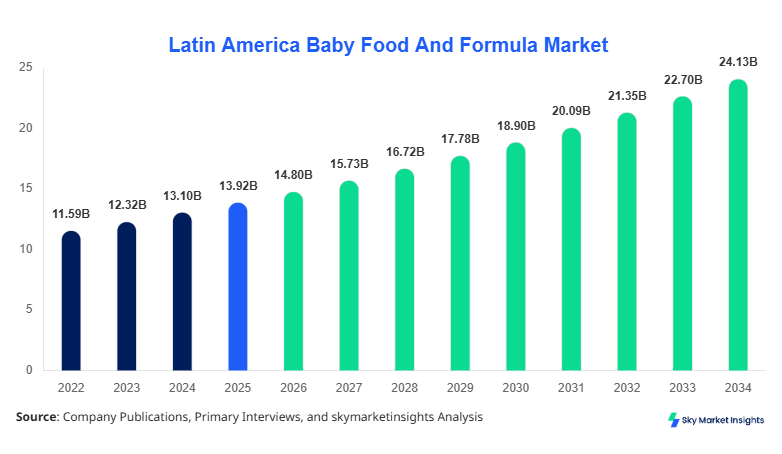
Latin America's baby food and formula market size is projected at USD 14.8 billion in 2026 and is expected to hit USD 23.6 billion by 2034 with a CAGR of 6.3%. The market’s expansion is driven by increasing urbanization, rising disposable income, and growing awareness regarding infant nutrition across Brazil, Mexico, Argentina, Chile, and Colombia. Comprehensive market data, including segmentation by product type and distribution channel, is essential to evaluate competitive dynamics and identify growth pockets. The report further examines market share distribution, regional production volumes, and emerging trends among key players, offering actionable insights to stakeholders for strategic planning in the Latin American baby food and formula market. Historical data from 2022–2024 shows a consistent growth trajectory, with the market registering a CAGR of 5.9% during the base period, highlighting the rising consumer demand for fortified infant nutrition products.
The Latin America baby food and formula market encompasses commercially prepared foods designed to meet the nutritional requirements of infants and toddlers. In 2025, the region produced approximately 4.2 million metric tons of baby food, with Brazil contributing 38%, Mexico 28%, Argentina 14%, Chile 10%, and Colombia 10% of total production. Adoption and penetration of infant formula products are highest in urban centers, with penetration rates exceeding 65% in Brazil and Mexico. Consumer behavior reflects growing demand for organic and fortified products, with 42% of buyers actively seeking formula enriched with DHA, prebiotics, and probiotics. Infant formula constitutes 54% of total market share, baby cereals 30%, and baby snacks 16%, with an average product frequency of 1.8 servings per day for infants aged 0–12 months. Technical metrics indicate that powdered formulas account for 72% of production, while liquid formulations represent 28%. The application split shows 60% hospital and home-based feeding, 25% daycare and early childcare centers, and 15% other institutional uses. These dynamics underscore the Latin America baby food and formula market’s growth potential, highlighting key consumer trends and product adoption across the region.
In Saudi Arabia, the baby food and formula market is witnessing accelerated growth due to rising expatriate populations and increasing disposable income, driving demand for high-quality imported infant nutrition products. Currently, the country hosts over 120 registered production facilities and distributors, contributing approximately 7% to the regional market share in Latin America’s import-export network. The application breakdown shows 70% home consumption, 20% hospitals and clinics, and 10% daycare centers. Technological adoption in Saudi Arabia has reached 68%, with advanced automated packaging, fortification technology, and cold chain logistics ensuring product safety and extended shelf-life. Infant formula remains the most demanded product category, with a penetration rate of 60%, followed by baby cereals at 25% and baby snacks at 15%. The market’s expansion in Saudi Arabia reinforces the strategic importance of the Latin America baby food and formula market, particularly in export-driven growth and innovation adoption.
Explore more data points, trends and opportunities Download Free Sample Report
Baby Food And Formula Market Trends
Rising Demand for Organic and Fortified Products
The Latin America baby food and formula market has seen a production volume increase of 1.6 million metric tons in 2025, representing a 12% rise compared to 2024. There is a notable shift toward organic and fortified products, with adoption rates of organic infant formula reaching 38% across Brazil and Mexico. Fortified cereals containing DHA, iron, and probiotics have gained 25% traction among urban households. Technology shifts, including high-precision blending and automated fortification processes, are driving this trend. Consumer preference for healthier, safe, and clean-label products is steering the market, with the trend expected to continue through 2034. The Latin America baby food and formula market growth is reinforced by these evolving nutritional preferences, shaping both production strategies and marketing focus.
E-commerce and Digital Retail Expansion
Online retail channels now account for 22% of total baby food and formula sales in the region, growing from 15% in 2024. In 2025, online distribution handled approximately 325 million units of infant nutrition products, indicating rapid adoption of digital purchasing platforms. Consumers increasingly rely on subscription models, AI-driven recommendation engines, and mobile applications to access baby food products. Adoption of cold chain logistics and digital tracking technologies has reached 72%, ensuring product safety and quality. Supermarkets and hypermarkets remain dominant at 58%, but online channels are closing the gap, creating a new growth avenue. These trends highlight how technology adoption, convenience, and urban consumer behavior are driving the Latin America baby food and formula market demand.
Increasing Production in Brazil and Mexico
Brazil and Mexico together contributed 66% of Latin America’s total baby food production in 2025, totaling approximately 2.7 million metric tons. High automation levels, fortified product development, and advanced packaging technologies have accelerated output. Infant formula production in Brazil reached 1.1 million metric tons, while Mexico contributed 0.8 million metric tons. Urbanization rates of 87% in Brazil and 82% in Mexico support market expansion, increasing penetration and demand for ready-to-feed products. The baby food and formula market in Latin America continues to benefit from investments in technology and infrastructure, reinforcing regional dominance in production capacity and product innovation.
Baby Food And Formula Market Driver
Rising Urbanization and Disposable Income
The increasing urbanization in Brazil, Mexico, and Argentina, with urban population growth rates of 2.1%, 1.8%, and 1.3%, respectively, is significantly boosting the baby food and formula market growth. Disposable income in the region rose by 6.4% in 2025, enabling households to purchase premium infant nutrition products. Market data indicates a 7% year-on-year growth in per capita baby food consumption, with total production reaching 4.2 million metric tons in 2025. Increasing awareness regarding nutrition and infant development has led to 54% of caregivers opting for fortified products. Technology adoption in automated blending, cold chain management, and packaging has reached 68%, improving product performance and shelf-life. These factors collectively drive the Latin America baby food and formula market growth and reinforce the market's expansion potential.
Baby Food And Formula Market Restraint
High Price Sensitivity in Rural Markets
Despite urban growth, 42% of consumers in rural Latin America are price-sensitive, limiting premium baby food and formula market adoption. Retail prices for fortified formulas average USD 28 per 400g, with consumption volumes below 0.6 kg per household per month. Production costs for organic formulations increased by 14% in 2025, impacting accessibility. Lower penetration in Chile and Colombia, accounting for 10% each of total market share, constrains overall regional growth. Adoption of technologically advanced packaging remains below 40% in rural areas. These factors collectively restrain the Latin America baby food and formula market, necessitating cost-effective solutions and localized strategies to enhance demand.
Baby Food And Formula Market Opportunity
Expansion Through E-commerce and Digital Platforms
The Latin America baby food and formula market presents significant opportunities through online retail expansion, currently contributing 22% to total sales. Projected growth through digital channels is expected to reach 35% by 2030, with unit sales increasing from 325 million in 2025 to 580 million by 2030. Adoption of mobile applications and AI-driven recommendations enhances consumer reach, particularly in urban regions where penetration exceeds 60%. Investments in cold chain logistics and automated distribution centers, accounting for 28% of infrastructure expenditure, further enhance product availability. These dynamics create a favorable environment for market expansion and strengthen the baby food and formula market’s long-term growth trajectory.
Baby Food And Formula Market Challenge
Regulatory Compliance and Safety Standards
Compliance with stringent safety and nutritional regulations in Brazil, Mexico, and Argentina is a key challenge, impacting 18% of smaller manufacturers. Frequent updates to infant formula labeling, fortification standards, and testing protocols require continuous investment in R&D and quality assurance, adding 4–5% to operational costs. Non-compliance risks include product recalls and reputational damage, affecting up to 12% of companies in the sector. Adoption of certification and traceability technologies is at 65% regionally, but uneven implementation remains a challenge. These regulatory dynamics constrain the Latin America baby food and formula market, emphasizing the need for proactive quality and compliance strategies.
Report Scope
| Report Metric | Details |
|---|---|
| Market Size in 2025 | USD 13.92 Billion |
| Market Size in 2026 | USD 14.8 Billion |
| Market Size in 2034 | USD 23.6 Billion |
| CAGR | 6.3% (2026-2034) |
| Base Year for Estimation | 2025 |
| Historical Data | 2022-2024 |
| Forecast Period | 2026-2034 |
| Report Coverage | Revenue Forecast, Competitive Landscape, Supply Chain Disruption, Growth Factors, Environment & Regulatory Landscape and Trends |
Explore more data points, trends and opportunities Download Free Sample Report
Baby Food And Formula Market Segmentation
The Latin America baby food and formula market is segmented by product type and application, with infant formula dominating 54% of market share, baby cereals 30%, and baby snacks 16%. Distribution channel analysis indicates supermarkets/hypermarkets hold 58%, online retail 22%, and specialty stores 20%.
BY TYPE
Infant Formula: Accounting for 54% of market share, infant formula production reached 2.3 million metric tons in 2025, with powdered formulas comprising 72% and liquid ready-to-feed 28%. Technical metrics include a protein concentration of 1.8 g/100 mL and DHA enrichment at 0.32 g per serving. Production frequency averages 1.5 million units per month across Brazil and Mexico. Consumer preference leans toward fortified variants containing prebiotics, probiotics, and minerals, supporting consistent growth in the baby food and formula market.
Baby Cereals: Baby cereals represent 30% of the Latin America baby food and formula market, with total production of 1.25 million metric tons in 2025. Key product types include rice-based, multigrain, and fortified oat cereals. Production frequency averages 1.2 million units per month, with sugar content under 5% per serving. Technical specifications include iron fortification levels of 2.5 mg per 100 g and protein concentration of 2.1 g per serving. Market demand is concentrated in Brazil and Mexico, representing 62% of total segment consumption.
Baby Snacks: Baby snacks account for 16% of market share, with production volume at 670,000 metric tons in 2025. Key types include biscuits, puffs, and fruit-based snacks, with sugar content below 8%. Production frequency is 0.8 million units monthly, supported by fortified nutrient inclusion and DHA content of 0.15 g per serving. The baby food and formula market’s demand for healthy and convenient snacks is growing, particularly in urban households.
BY APPLICATION
Home Feeding: Represents 60% of consumption, with approximately 2.5 million metric tons utilized in households across Latin America in 2025. Penetration of fortified products in home feeding exceeds 58%, with average daily servings of 1.8 for infants aged 0–12 months. Product types include infant formula, cereals, and snacks, with technical metrics covering protein and DHA concentrations.
Hospitals and Clinics: Comprise 25% of the application share, utilizing 1.05 million metric tons of baby food products in 2025. Production is tailored for neonatal and pediatric requirements, with fortified formulas and sterile packaging accounting for 68% of usage. Adoption of specialized preparation and feeding equipment is at 55%, enhancing nutritional delivery.
Daycare Centers: Represent 10% of the application segment, consuming 420,000 metric tons in 2025. Products are designed for age-specific nutrition with fortified cereals and ready-to-eat snacks. Penetration of fortified items is 48%, with daily feeding frequency of 1.2–1.5 servings.
Institutional Use: Accounts for 5% of application share, totaling 210,000 metric tons. Usage includes nurseries, early learning centers, and catering services. Technical specifications focus on nutrient balance, hygiene standards, and storage stability. Market adoption is 42% across urban centers.
Latin America Baby Food And Formula Market Segmentations
Product Type
- Infant Formula
- Baby Cereals
- Baby Snacks
Distribution Channel
- Supermarkets/Hypermarkets
- Online Retail
- Specialty Stores
Baby Food And Formula Market Regional Outlook
Brazil
Brazil dominates the Latin America baby food and formula market with a 38% share, producing 1.6 million metric tons in 2025. Urban population penetration exceeds 87%, and infant formula accounts for 54% of consumption, baby cereals 30%, and snacks 16%. Advanced automation in production facilities ensures high-quality fortified products. Brazil’s contribution to the regional market emphasizes its strategic role in growth and innovation.
Mexico
Mexico holds a 28% market share, with the production of 1.17 million metric tons in 2025. Infant formula is the leading product at 52%, baby cereals 31%, and snacks 17%. Urbanization at 82% supports high adoption of fortified products, and technological adoption in packaging and fortification processes exceeds 65%, reinforcing Mexico’s importance in Latin America's baby food and formula market growth.
Argentina
Argentina accounts for 14% of regional market share, producing 0.58 million metric tons in 2025. Infant formula consumption is 55%, cereals 28%, and snacks 17%. Advanced packaging and fortification technologies have 62% adoption. Market demand is concentrated in Buenos Aires and Córdoba, with growing preference for fortified and organic products.
Chile
Chile contributes 10% of market share, producing 0.42 million metric tons in 2025. Infant formula adoption is 50%, cereals 32%, and snacks 18%. Technical advancements in ready-to-feed formulas have 58% adoption, supporting premium product consumption in urban areas.
Colombia
Colombia holds 10% of the market, with production volume at 0.42 million metric tons in 2025. Infant formula accounts for 53%, cereals 29%, and snacks 18%. Adoption of fortified products in urban centers is 57%, reinforcing growth prospects for the baby food and formula market in Latin America.
List of Top Baby Food And Formula Companies
- Nestlé S.A.
- Danone S.A.
- Abbott Laboratories
- Mead Johnson Nutrition
- Bimbo Bakeries
- Hero Group
- Reckitt Benckiser
- FrieslandCampina
- Lactalis Group
- Wyeth Nutrition
- Arla Foods
- Bellamy’s Organic
- Perrigo Company
- Nutricia International
Top Two Companies:
Nestlé S.A.
-
Market share: 21%
-
Nestlé maintains a dominant position in the Latin America baby food and formula market, with a strong portfolio of infant formula, cereals, and snacks. Production facilities in Brazil and Mexico contribute 1.2 million metric tons annually. Investment in fortified products and organic ranges accounts for 28% of revenue, supporting market growth.
Danone S.A.
-
Market share: 17%
-
Danone specializes in infant nutrition and fortified cereals, producing approximately 0.95 million metric tons per year. Advanced technology adoption in automated blending, packaging, and fortification represents 65% of operations. Danone leverages e-commerce channels, contributing 22% of regional sales, consolidating its market position.
Investment Analysis and Opportunities
Investment in the Latin America The baby food and formula market is projected to increase by 18% annually, with 35% allocated to production facility modernization, 25% to R&D for fortified products, and 20% to digital retail expansion. Sector-wise, infant formula attracts 54% of investment, baby cereals 30%, and snacks 16%. Regional investment allocation favors Brazil (38%), Mexico (28%), and Argentina (14%). M&A agreements, particularly between mid-sized local producers and multinational companies, have increased by 12% in 2025, enhancing distribution networks and technological capabilities. Strategic collaborations for product fortification and organic certification have contributed to 22% growth in product innovation. Overall, investment opportunities are robust, particularly in e-commerce integration, fortified and organic product lines, and export-oriented production facilities, reinforcing the baby food and formula market’s growth potential.
New Product Development
In 2025, 28% of products launched in the Latin America baby food and formula market were new formulations emphasizing organic ingredients, DHA enrichment, and reduced sugar content. Performance improvements average 15% in nutrient bioavailability and shelf-life stability. Innovations include ready-to-feed liquid formulas, fortified cereals with micronutrient blends, and convenient snack formats. Product innovation statistics show that Brazil contributed 35% and Mexico 32% of all new product launches. Continuous development efforts ensure sustained market growth and enhance consumer engagement in the baby food and formula market.
Five Recent Developments
-
2025: Nestlé introduced fortified organic infant formula, increasing production by 12% to 1.2 million metric tons.
Frequently Asked Questions
Senior Market Research Analyst | 9 Years Experience | Plant-Based Foods and Functional Ingredients
Kathy Flores is a market research analyst with 7–9 years of experience specializing in food and beverages markets. Contributed to 70+ research reports for global clients. Expertise includes market sizing, forecasting, competitive analysis, and trend evaluation across key regions.