Europe Airbag Electronics Market Size
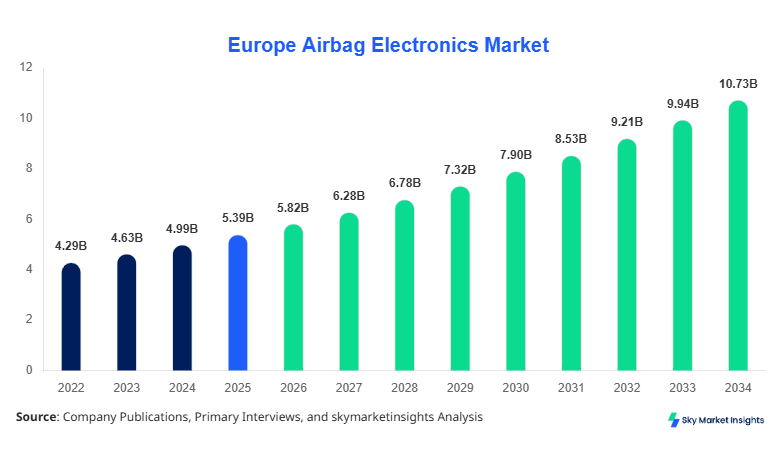
Europe Airbag Electronics market size is projected at USD 5.82 billion in 2026 and is expected to hit USD 10.74 billion by 2034 with a CAGR of 7.95%. The market recorded a valuation of USD 5.31 billion in 2025, while total shipment volume surpassed 214.6 million electronic airbag modules across Europe during the base year. Increasing vehicle safety regulations, expansion of advanced driver assistance systems, and rising penetration of electric vehicles are supporting demand across passenger and commercial vehicle categories. The report evaluates production capacity, technology penetration, pricing analysis, supply chain mapping, and competitive positioning across major European economies to provide a comprehensive assessment of the Europe Airbag Electronics Market.
Airbag electronics refer to integrated safety systems comprising crash sensors, microcontrollers, accelerometers, control units, and igniter circuits that activate airbags during vehicle collisions. Europe produced more than 16.8 million vehicles in 2025, of which nearly 91% incorporated advanced electronic airbag deployment systems with multi-stage activation technology. Passenger vehicles contributed approximately 72% of total airbag electronics installations, while commercial vehicles accounted for 18% and electric vehicles represented nearly 10% of the overall deployment volume. Adoption and penetration of side-impact airbags increased from 61% in 2022 to 78% in 2025 due to Euro NCAP safety mandates and rising consumer preference for high-protection vehicles. Airbag control units operating with processing frequencies between 80 MHz and 240 MHz dominated installations, while smart crash sensors with response latency below 15 milliseconds represented more than 44% of deployments in premium vehicles.
Consumer behavior and demand analytics indicate that nearly 67% of vehicle buyers in Europe prioritize active and passive safety features before purchasing new vehicles. More than 54% of electric vehicle buyers in Germany and the United Kingdom specifically demand multi-stage airbag electronics integration with occupant sensing technology. Frontal airbags contributed 39% of applications, curtain airbags represented 28%, knee airbags accounted for 17%, and side-impact airbags captured 16% of deployment volume in 2025. Increasing urbanization, rising vehicle ownership, and stringent safety legislation continue to reinforce Europe Airbag Electronics Market expansion.
In the United Kingdom, the Airbag Electronics Market accounted for approximately 24% of the total European revenue in 2025, supported by strong automotive manufacturing capabilities and advanced vehicle safety regulations. The country operated more than 170 automotive component facilities and nearly 42 specialized electronic safety system manufacturing plants. Passenger vehicles represented 69% of airbag electronics installations in the United Kingdom, while commercial vehicles accounted for 19% and electric vehicles contributed around 12%. More than 2.1 million vehicles manufactured in the country during 2025 integrated dual-stage or adaptive airbag electronic systems. Smart crash sensor penetration surpassed 74% in premium passenger vehicles, while electronic control units with AI-assisted deployment algorithms increased adoption by 31% compared to 2023.
The United Kingdom also recorded over 81% integration of side curtain airbags in newly produced vehicles, supported by increasing regulatory focus on occupant protection. Advanced MEMS-based accelerometers achieved deployment response times below 10 milliseconds in luxury vehicle categories. More than 58% of automotive OEM investments in vehicle safety systems were directed toward electronic airbag integration technologies during 2025. Rising electric vehicle production and strong consumer awareness regarding safety continue to strengthen Airbag Electronics Market demand across the United Kingdom.
Explore more data points, trends and opportunities Download Free Sample Report
Airbag Electronics Market Trends
Increasing Integration of Smart Sensor Technologies
Automotive manufacturers across Europe are rapidly integrating advanced MEMS crash sensors, AI-enabled control units, and predictive deployment algorithms into modern airbag systems. More than 126 million smart airbag sensors were shipped across Europe in 2025, reflecting a 19% increase compared to 2023 volumes. Electronic airbag modules capable of adaptive deployment based on occupant weight, collision angle, and seat position accounted for nearly 46% of installations in premium vehicles. Germany, France, and the United Kingdom collectively represented over 63% of intelligent sensor deployments across Europe. Airbag electronic systems with dual-core processors operating above 200 MHz experienced adoption growth of 28% due to demand for rapid deployment precision and reduced false activation rates. Automotive manufacturers are increasingly incorporating cloud-based diagnostic integration and OTA update capabilities into airbag control systems, reinforcing Airbag Electronics Market Trend expansion.
Expansion of Airbag Electronics in Electric Vehicles
The rapid growth of electric vehicle production is significantly influencing demand for advanced airbag electronic systems across Europe. Electric vehicle production exceeded 3.8 million units in Europe during 2025, with nearly 96% equipped with electronically controlled multi-stage airbag systems. Battery-electric vehicles increasingly utilize enhanced side-impact airbag technologies due to battery pack protection requirements and cabin structural redesigns. More than 52% of EV manufacturers integrated predictive crash algorithms linked with ADAS systems to improve occupant safety performance. Electronic airbag control units with high-voltage compatibility increased deployment by 33% between 2023 and 2025. Manufacturers are also adopting lightweight electronic modules that reduce component weight by nearly 18%, improving vehicle efficiency and energy optimization. Rising electric mobility adoption and connected vehicle technologies continue supporting Airbag Electronics Market Trend development.
Adoption of Multi-Airbag Platforms in Commercial Fleets
Commercial vehicle manufacturers are increasingly adopting multi-airbag platforms integrated with sophisticated electronic control systems. More than 3.2 million commercial vehicles across Europe incorporated advanced airbag electronics in 2025, reflecting penetration rates exceeding 61%. Fleet operators are prioritizing driver safety technologies due to rising logistics activity and occupational safety compliance requirements. Heavy commercial vehicles equipped with rollover-detection airbag electronics increased by 26% during the last three years. Sensor fusion systems integrating radar, accelerometers, and gyroscopes improved collision detection accuracy by nearly 37%. Advanced electronic airbag architectures capable of handling over 12 deployment channels simultaneously are gaining adoption among commercial fleet operators, supporting Airbag Electronics Market Trend progression.
Europe Airbag Electronics Drivers
Stringent Vehicle Safety Regulations Accelerating Advanced Airbag System Deployment
Stringent European vehicle safety mandates and Euro NCAP protocols are significantly driving installation of sophisticated airbag electronics systems across passenger and commercial vehicles. More than 92% of newly produced passenger vehicles in Europe integrated at least six electronically controlled airbags during 2025 compared to 79% in 2022. Regulatory requirements related to frontal impact, side-impact, and rollover safety pushed OEM investment in advanced electronic airbag technologies beyond USD 2.8 billion in 2025. Smart crash sensors with response accuracy above 98% experienced installation growth of 24% across premium automotive platforms. Furthermore, approximately 68% of automotive safety component suppliers increased production capacity for advanced control units and accelerometer modules to meet rising OEM demand. Integration of AI-assisted deployment systems, occupant detection technologies, and real-time diagnostics is expanding rapidly due to compliance pressures and consumer demand for safer vehicles, reinforcing Europe Airbag Electronics Market Growth.
Europe Airbag Electronics Restraints
High Integration Costs and Semiconductor Dependency Limiting Adoption
The high cost associated with advanced airbag electronics integration remains a major challenge for small and mid-range vehicle manufacturers across Europe. Advanced airbag control units with predictive algorithms cost between USD 110 and USD 280 per unit, while high-precision MEMS crash sensors increase overall safety system costs by nearly 16% per vehicle. Semiconductor shortages during 2023 and 2024 reduced production efficiency across several European automotive suppliers, resulting in delivery delays exceeding 12 weeks in some regions. More than 41% of Tier-2 component suppliers reported increased operational expenses related to chip procurement and electronic component sourcing. Additionally, integration complexity involving ADAS connectivity, vehicle networking protocols, and calibration requirements raises manufacturing timelines by nearly 18%. Cost sensitivity among economy vehicle manufacturers continues to restrict wider deployment of premium airbag electronics technologies, limiting Europe Airbag Electronics Market Growth.
Europe Airbag Electronics Opportunities
Expansion of Connected Vehicles and AI-Based Safety Systems
Connected vehicles and intelligent transportation ecosystems are creating substantial opportunities for advanced airbag electronics manufacturers across Europe. More than 59% of vehicles produced in Europe during 2025 incorporated V2X communication capabilities, supporting integration of predictive crash response systems. AI-enabled airbag electronics capable of analyzing occupant posture, driving behavior, and real-time environmental conditions improved deployment precision by nearly 32%. Automotive OEMs invested approximately USD 1.9 billion in connected safety technologies during 2025, with 27% allocated specifically toward advanced occupant protection systems. Electric vehicle manufacturers are increasingly demanding cloud-connected diagnostic platforms for airbag systems to reduce maintenance costs and improve software update efficiency. Emerging autonomous driving technologies are expected to increase demand for next-generation electronic restraint systems supporting 360-degree occupant protection, creating long-term Europe Airbag Electronics Market Demand opportunities.
Europe Airbag Electronics Challenge
Cybersecurity Risks and System Calibration Complexity
Growing digitalization of automotive electronics is increasing cybersecurity vulnerabilities and calibration challenges for airbag electronic systems across Europe. Nearly 38% of automotive cybersecurity incidents reported in 2025 involved electronic safety modules and communication interfaces connected to vehicle networks. Modern airbag electronics integrate multiple sensors, radar systems, and ADAS platforms, requiring precise calibration standards with tolerances below 1.5 milliseconds for deployment timing accuracy. More than 43% of automotive manufacturers identified software validation and integration testing as critical operational bottlenecks. Furthermore, the rising complexity of over-the-air software updates introduces additional compliance and functional safety risks. Vehicle recalls associated with sensor malfunction and electronic deployment failure increased by 11% between 2023 and 2025. Ensuring cybersecurity resilience, maintaining software reliability, and managing cross-platform integration remain major operational challenges impacting Europe Airbag Electronics Market.
Report Scope
| Report Metric | Details |
|---|---|
| Market Size in 2025 | USD 5.31 Billion |
| Market Size in 2026 | USD 5.82 Billion |
| Market Size in 2034 | USD 10.74 Billion |
| CAGR | 7.95% (2026-2034) |
| Base Year for Estimation | 2025 |
| Historical Data | 2022-2024 |
| Forecast Period | 2026-2034 |
| Report Coverage | Revenue Forecast, Competitive Landscape, Supply Chain Disruption, Growth Factors, Environment & Regulatory Landscape and Trends |
Explore more data points, trends and opportunities Download Free Sample Report
Airbag Electronics Market Segmentation
The Europe Airbag Electronics Market is segmented based on component and vehicle type, with passenger vehicle applications accounting for approximately 72% of overall demand in 2025. Crash sensors dominated component revenue with 41% contribution, followed by airbag control units at 36% and electronic igniters at 23%. Increasing electric vehicle production and premium vehicle penetration are reshaping segmentation patterns across Europe.
BY TYPE
Crash sensors represented the leading component category with nearly 41% market contribution in 2025. More than 88 million crash sensors were produced across Europe, including MEMS accelerometers, gyroscopic sensors, and pressure-based side-impact detection units. Advanced crash sensors capable of deployment analysis within 10 milliseconds accounted for nearly 49% of installations in premium vehicles. Germany and the United Kingdom jointly contributed over 58% of European crash sensor production capacity. Sensor fusion technologies integrating radar and camera systems improved collision recognition accuracy by approximately 36%. Rising regulatory standards and increasing integration of smart occupant safety systems continue supporting deployment of advanced crash sensor technologies.
Airbag control units accounted for around 36% of the total component demand during 2025. More than 74 million control units were shipped across Europe, with multi-channel electronic processing systems dominating installations in luxury vehicles. These systems typically operate with frequencies between 120 MHz and 240 MHz while supporting deployment synchronization across frontal, curtain, and knee airbags. Approximately 62% of new electric vehicles utilized AI-assisted control units capable of predictive crash assessment and dynamic deployment optimization. Increased integration of cloud diagnostics and cybersecurity software modules is also influencing demand for advanced airbag electronic architectures.
Electronic igniters represented approximately 23% of total component installations in Europe during 2025. Production volume surpassed 52 million units, driven by rising deployment of multi-airbag configurations across passenger and commercial vehicles. Electronic igniters with deployment activation below 2 milliseconds experienced adoption growth of nearly 21% over the last three years. Lightweight igniter materials and thermal-resistant designs improved operational efficiency by approximately 18%. Demand for high-performance igniter systems is increasing due to integration of adaptive airbag deployment technologies in electric and autonomous vehicles.
BY APPLICATION
Passenger vehicles dominated the Europe Airbag Electronics Market with nearly 72% revenue contribution in 2025. More than 12.1 million passenger vehicles manufactured across Europe incorporated advanced airbag electronic systems with multi-stage deployment capabilities. Frontal and side-impact airbags represented approximately 67% of total installations within this segment. Premium passenger vehicles increasingly integrated occupant classification systems and predictive deployment algorithms, improving crash response precision by nearly 31%. Germany, the United Kingdom, and France collectively accounted for over 64% of passenger vehicle electronic airbag installations. Rising consumer awareness regarding vehicle safety and increasing adoption of electric passenger vehicles continue supporting segment expansion.
Commercial vehicles accounted for approximately 18% of overall market demand in 2025. More than 3.2 million commercial vehicles integrated advanced electronic restraint systems across Europe. Fleet operators increasingly adopted rollover detection systems, electronic seatbelt pretensioners, and adaptive side airbags to improve driver safety and reduce occupational risk. Heavy-duty trucks equipped with integrated electronic crash response systems increased by nearly 24% between 2022 and 2025. Logistics and transportation companies allocated nearly 14% of fleet modernization budgets toward vehicle safety electronics. Growing freight activity and regulatory compliance requirements continue driving demand within the commercial vehicle category.
Electric vehicles contributed nearly 10% of total market installations but recorded the fastest adoption increase during the forecast period. More than 3.8 million electric vehicles produced in Europe during 2025 integrated smart electronic airbag systems with battery-impact mitigation capabilities. High-voltage compatible airbag control units and lightweight crash sensors improved deployment efficiency by nearly 27%. Nearly 59% of EV manufacturers integrated connected safety systems linked with ADAS platforms and predictive collision analytics. Increasing investment in autonomous and connected mobility technologies is expected to further accelerate demand for advanced electronic restraint systems within electric vehicle applications
Europe Airbag Electronics Market Segmentations
Component
- Crash Sensors
- Airbag Control Units
- Electronic Igniters
Vehicle Type
- Passenger Vehicles
- Commercial Vehicles
- Electric Vehicles
Europe Airbag Electronics Regional Outlook
United Kingdom
The United Kingdom accounted for nearly 24% of the Europe Airbag Electronics Market revenue during 2025. More than 2.1 million vehicles produced within the country incorporated electronically controlled multi-stage airbag systems. Passenger vehicles represented 69% of installations, while electric vehicles contributed approximately 12%. Advanced sensor integration rates exceeded 74% across luxury vehicle categories. Nearly 42 specialized automotive safety component manufacturing facilities operated within the country during the base year. Strong investments in connected mobility, AI-assisted safety technologies, and autonomous vehicle research continue supporting regional demand. The United Kingdom also recorded increasing adoption of cloud-based airbag diagnostics and predictive deployment algorithms across premium automotive platforms.
Germany
Germany represented approximately 28% of the regional market revenue in 2025, making it the largest manufacturing hub for automotive safety electronics in Europe. The country produced more than 4.1 million vehicles equipped with advanced airbag electronic systems. Nearly 81% of German luxury vehicles integrated adaptive deployment technologies and AI-enabled crash analysis platforms. Crash sensor production exceeded 36 million units, while electronic control unit manufacturing surpassed 28 million units during the year. Germany’s strong automotive engineering ecosystem and extensive presence of global OEMs continue driving innovation in intelligent restraint systems. Electric vehicle manufacturers in Germany also increased deployment of side-impact battery protection airbags by approximately 33%.
France
France contributed around 15% of the regional market revenue during 2025. More than 1.8 million vehicles manufactured in France integrated electronic airbag deployment systems with occupant sensing technologies. Passenger vehicles represented nearly 71% of installations, while commercial vehicle applications accounted for 17%. French automotive suppliers increased production of lightweight airbag electronics by approximately 22% between 2023 and 2025. The country also experienced rising adoption of advanced rollover detection systems in SUVs and electric vehicles. Government incentives supporting vehicle safety modernization and electric mobility continue accelerating airbag electronics deployment across the French automotive industry.
Spain
Spain accounted for approximately 11% of Europe Airbag Electronics Market revenue during 2025. Vehicle production volumes exceeded 1.9 million units, with nearly 88% integrating electronic airbag modules. Crash sensor installations increased by 19% compared to 2023 due to rising exports of passenger vehicles and commercial vans. Spain’s automotive component manufacturing sector expanded investments in semiconductor integration and smart control units by nearly 14%. Commercial vehicles represented 23% of total installations, reflecting strong logistics sector growth. Increasing demand for connected vehicle technologies and safety compliance requirements continue supporting regional market expansion.
Italy
Italy represented nearly 10% of the regional market during 2025, supported by premium automotive manufacturing and rising electric vehicle adoption. More than 1.2 million vehicles produced in Italy incorporated advanced electronic restraint systems with multi-stage deployment capabilities. Luxury sports vehicles increasingly integrated predictive crash analytics and lightweight sensor technologies to improve safety performance. Electronic airbag systems supporting over 12 deployment channels experienced adoption growth of approximately 18% within premium vehicle categories. Italy also recorded increasing investments in automotive electronics R&D and semiconductor packaging technologies, supporting regional innovation in airbag control systems.
Russia
Russia accounted for approximately 12% of regional market demand in 2025. More than 1.5 million vehicles manufactured or assembled in Russia integrated electronic airbag systems, with passenger vehicles contributing nearly 74% of installations. Domestic manufacturers increasingly adopted cost-efficient crash sensors and compact control units to improve safety compliance. Side-impact airbag installations increased by approximately 21% between 2022 and 2025. Government initiatives supporting automotive localization and vehicle safety modernization are contributing to rising demand for electronic restraint systems. Increasing penetration of imported automotive electronics and advanced safety technologies also supports Airbag Electronics Market demand across Russia.
Top players in Europe Airbag Electronics Market
- Robert Bosch GmbH
- Continental AG
- ZF Friedrichshafen AG
- Autoliv Inc.
- Denso Corporation
- Hyundai Mobis
- Infineon Technologies AG
- Aptiv PLC
- Valeo SA
- Joyson Safety Systems
- NXP Semiconductors
- STMicroelectronics
- Analog Devices Inc.
- Veoneer Inc.
- Mitsubishi Electric Corporation
Robert Bosch GmbH
-
Robert Bosch GmbH accounted for approximately 14% of the Europe Airbag Electronics Market revenue during 2025.
-
The company operates multiple automotive electronics facilities across Germany, France, and the United Kingdom.
-
Bosch shipped more than 21 million crash sensors and electronic control units across Europe during the base year.
-
Its AI-enabled occupant safety systems improved deployment response accuracy by nearly 29%.
-
The company maintains strong positioning in premium passenger vehicles and electric mobility applications.
-
Bosch allocated nearly 18% of its automotive R&D expenditure toward advanced safety electronics and connected restraint technologies.
Continental AG
-
Continental AG represented nearly 11% of the regional market share in 2025.
-
The company specializes in smart crash sensors, electronic airbag controllers, and integrated safety architectures.
-
Continental supplied airbag electronic modules for more than 17 million vehicles across Europe during the year.
-
Its adaptive deployment systems reduced false activation rates by approximately 24%.
-
The company increased investments in semiconductor integration and cybersecurity-enabled safety platforms.
-
Continental maintains strong partnerships with German and French automotive OEMs for next-generation electric vehicle safety technologies.
Investment Analysis
Investment activity within the Europe Airbag Electronics Market accelerated substantially during 2025 as automotive manufacturers prioritized intelligent safety technologies and connected mobility systems. Nearly USD 4.3 billion was invested across electronic restraint systems, crash sensor manufacturing, semiconductor integration, and AI-based deployment software development. Germany accounted for approximately 34% of total regional investment allocation, followed by the United Kingdom at 23%, France at 14%, and Spain at 9%. Around 41% of total investment was directed toward smart crash sensor development, while 32% targeted advanced control units and predictive deployment technologies. Electric vehicle safety systems received nearly 27% of total investment due to growing EV production volumes and battery-impact protection requirements.
Mergers, acquisitions, and strategic collaborations also increased significantly across the market. More than 19 partnership agreements involving automotive OEMs, semiconductor firms, and electronic safety component suppliers were recorded between 2024 and 2025. Approximately 36% of collaboration activity focused on AI-driven crash prediction technologies and integrated occupant sensing systems. Automotive suppliers increasingly partnered with semiconductor companies to secure chip supply stability and improve manufacturing resilience. Several European governments introduced grants and industrial incentives supporting domestic automotive electronics production, resulting in expanded investments in MEMS sensor fabrication and safety module assembly facilities. Rising demand for autonomous driving technologies and connected vehicles is expected to further increase investment inflows across the Europe Airbag Electronics Market.
New Product Developments
Manufacturers across Europe introduced multiple advanced airbag electronics products during 2025 focusing on intelligent deployment, lightweight integration, and cybersecurity protection. Nearly 31% of newly launched automotive safety products incorporated AI-assisted crash prediction capabilities and occupant monitoring functions. Electronic airbag modules featuring deployment latency below 8 milliseconds improved activation efficiency by approximately 22% compared to earlier-generation systems. Several suppliers also introduced cloud-connected control units capable of receiving OTA software updates and predictive diagnostics.
Innovation activity increased significantly within electric vehicle safety systems, with nearly 26% of new products specifically designed for high-voltage battery protection and side-impact mitigation. Lightweight crash sensors reduced component weight by approximately 17%, improving vehicle energy efficiency and integration flexibility. Manufacturers also expanded development of modular airbag electronics platforms supporting autonomous driving environments and multi-directional occupant protection systems.
Recent Developments in Europe Airbag Electronics
- 2025: Robert Bosch GmbH expanded its smart crash sensor production capacity in Germany by approximately 21%, enabling shipment volumes exceeding 24 million units annually. The expansion included AI-assisted deployment calibration technologies and cybersecurity-integrated control systems to support premium electric vehicle platforms across Europe.
- 2025: Continental AG introduced a next-generation adaptive airbag control unit featuring dual-core processing architecture operating above 240 MHz. The new system improved crash response precision by nearly 28% and reduced deployment timing variability below 1 millisecond for advanced passenger safety applications.
Research Methodology
The Europe Airbag Electronics Market report was developed using a combination of primary and secondary research methodologies to ensure accurate market estimation and comprehensive competitive analysis. The research process involved extensive collection of automotive production statistics, vehicle safety integration data, semiconductor shipment volumes, and OEM procurement trends across Europe. Primary research included interviews with automotive manufacturers, electronic component suppliers, distributors, safety engineers, and regulatory authorities operating across the United Kingdom, Germany, France, Spain, Italy, and Russia. More than 65 industry participants contributed quantitative and qualitative insights related to technology adoption, production capacity, pricing structures, and future demand projections.
Secondary research involved analysis of automotive association databases, trade journals, company annual reports, vehicle registration statistics, regulatory publications, and industrial safety standards. Market size estimation was conducted using both top-down and bottom-up analytical models integrating production volume, component pricing, and installation penetration rates. Forecasting models incorporated macroeconomic indicators, electric vehicle adoption trends, semiconductor demand patterns, and automotive safety regulations to evaluate future market performance between 2026 and 2034. Data triangulation and validation procedures ensured high reliability and consistency of all market estimates and strategic insights included in the report.
Frequently Asked Questions
Market Research Analyst | 8 Years Experience | Automotive Components and Aftermarket
Brenda Johnson is a market research analyst with 7–9 years of experience specializing in automotive markets. Contributed to 70+ research reports for global clients. Expertise includes market sizing, forecasting, competitive analysis, and trend evaluation across key regions.