Europe AI In Banking Market Size
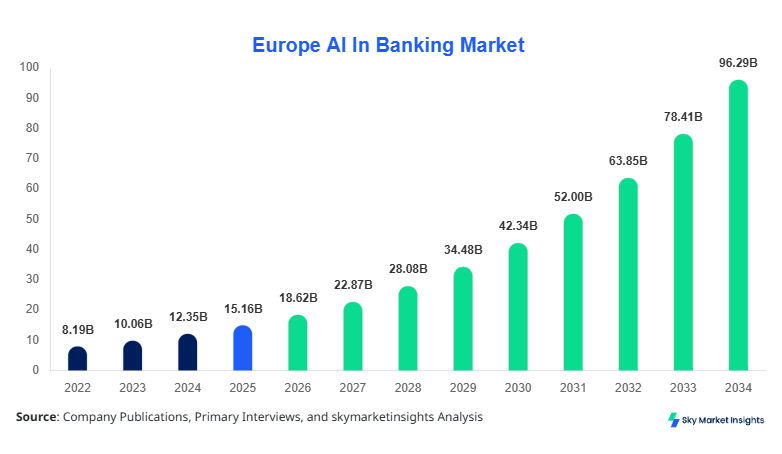
Europe AI In Banking market size is projected at USD 18.62 billion in 2026 and is expected to hit USD 96.44 billion by 2034 with a CAGR of 22.8%. The expansion is supported by rising digital banking penetration, increasing deployment of machine learning algorithms across banking operations, and rapid adoption of cloud-based financial analytics systems throughout Europe. More than 68% of European financial institutions are currently investing in predictive analytics, conversational AI, and automated compliance monitoring solutions. The report provides detailed segmentation analysis, investment trends, technological developments, and competitive landscape assessment across the Europe AI In Banking market.
The Europe AI In Banking market refers to the deployment of artificial intelligence technologies such as machine learning, natural language processing, robotic process automation, predictive analytics, and neural networks within banking and financial institutions. European banks processed more than 54 billion digital transactions in 2025, while AI-powered banking systems handled nearly 37% of customer interactions through virtual assistants and automated channels. The banking sector across Europe allocated over USD 11.3 billion toward AI infrastructure modernization during 2025, with the United Kingdom, Germany, and France accounting for nearly 64% of total spending. Adoption and penetration of AI technologies in banking accelerated significantly, with over 72% of large commercial banks integrating AI-driven fraud detection systems and 58% implementing AI-enabled credit risk assessment tools. Consumer behavior analytics indicate that nearly 74% of digital banking users in Europe prefer AI-supported personalized banking services, while 49% actively use chatbot-assisted financial services. Retail banking applications contributed 44% of deployments, followed by corporate banking at 31%, wealth management at 15%, and insurance-linked banking services at 10%. Technical performance benchmarks show AI fraud detection systems operating with 92% anomaly detection accuracy and transaction authentication latency below 1.8 seconds, reinforcing the Europe AI In Banking market.
In the United Kingdom, the AI In Banking Market accounted for approximately 29% of the regional revenue share in 2025 due to high fintech penetration and extensive digital banking infrastructure. The country hosts more than 320 AI-focused fintech firms and over 180 banking institutions actively deploying AI-enabled banking systems. Retail banking applications represented 46% of AI deployments, while fraud detection contributed 24%, customer analytics 18%, and wealth management 12%. More than 78% of banks in the United Kingdom adopted AI-powered customer service systems, and nearly 64% implemented machine learning-based loan approval frameworks during 2025. Cloud-integrated AI banking platforms processed over 11 billion financial transactions annually, while AI-driven anti-money laundering systems reduced fraudulent transaction processing time by 41%. The growing emphasis on open banking regulations, combined with increasing adoption of predictive customer engagement platforms, continues to strengthen the Europe AI In Banking market.
Explore more data points, trends and opportunities Download Free Sample Report
AI In Banking Market Trends
Rising Adoption of Generative AI and Predictive Analytics
European financial institutions are increasingly deploying generative AI technologies for customer engagement, operational automation, and predictive financial forecasting. During 2025, more than 46% of Tier-1 banks across Europe implemented generative AI platforms for customer support automation and intelligent financial advisory services. AI-powered chatbots handled over 18 billion banking interactions annually, reducing average customer response time by 38%. Predictive analytics systems processed more than 220 terabytes of transactional data monthly across major European banking networks. Germany and the United Kingdom collectively contributed over 52% of AI predictive banking deployments in the region. Financial institutions reported operational efficiency gains exceeding 27% following deployment of AI-enabled automation systems. Growing investments in natural language processing and real-time transaction intelligence continue to support the Europe AI In Banking market.
Expansion of AI-Powered Fraud Detection Systems
Fraud detection remains one of the fastest-growing application areas in the European banking sector. AI-enabled fraud prevention systems monitored more than 6.8 billion transactions monthly during 2025 and reduced financial fraud losses by approximately 34% across leading European banks. More than 71% of banks in France, Spain, and Italy integrated behavioral analytics engines for transaction verification and customer authentication. Biometric AI systems, including facial recognition and voice authentication, recorded adoption growth exceeding 29% annually. Real-time fraud monitoring platforms achieved transaction screening accuracy above 94%, while AI-based anti-money laundering platforms reduced compliance investigation workloads by nearly 44%. Increasing cyberattack frequency and stricter European banking regulations continue to accelerate the Europe AI In Banking market.
Growth of Cloud-Based Banking AI Infrastructure
Cloud computing integration within AI-enabled banking platforms has emerged as a major operational trend. Nearly 63% of European banks migrated at least one core AI application to cloud-based infrastructure during 2025. Cloud-hosted AI platforms reduced operational infrastructure costs by approximately 31% and enhanced transaction processing scalability by over 47%. Financial institutions across Russia, Germany, and France collectively invested more than USD 4.2 billion in cloud-native AI banking ecosystems. Hybrid cloud deployment models accounted for 49% of installations due to enhanced data governance and regulatory compliance advantages. Increased demand for scalable AI infrastructure and real-time financial analytics is strengthening the Europe AI In Banking market.
Europe AI In Banking Drivers
Increasing Digital Banking Transactions and Fraud Prevention Requirements
The rapid increase in digital banking transactions across Europe is significantly driving AI adoption within banking operations. European banks processed more than 54 billion online transactions during 2025, reflecting an annual increase of 18%. Simultaneously, financial fraud attempts increased by nearly 23%, forcing banking institutions to invest heavily in AI-enabled monitoring platforms. More than 72% of banks adopted machine learning-based fraud detection systems capable of processing over 8,000 transactions per second with anomaly detection accuracy exceeding 92%. Financial institutions implementing AI-driven compliance systems reduced false-positive fraud alerts by 37% and shortened investigation times by 42%. Furthermore, AI-supported predictive risk management platforms improved credit scoring precision by 29%, while automated customer verification systems reduced onboarding time from 48 hours to less than 7 minutes. Increasing regulatory compliance requirements and growing cybersecurity concerns are expected to continue accelerating the Europe AI In Banking market.
Europe AI In Banking Restraints
High Infrastructure Costs and Data Privacy Concerns
Despite strong adoption momentum, infrastructure complexity and strict data protection regulations remain significant barriers to AI implementation within the banking sector. European financial institutions spent nearly USD 5.8 billion on AI infrastructure integration and cybersecurity compliance during 2025. Smaller regional banks continue facing operational challenges due to high implementation costs, with average enterprise-scale AI deployment expenses exceeding USD 12 million per institution. Data localization regulations and GDPR compliance requirements increased AI operational management costs by approximately 19% across multinational banking groups. Nearly 41% of banks reported challenges related to AI model transparency and algorithmic bias management. Additionally, over 33% of financial institutions experienced delays in AI implementation due to integration difficulties with legacy banking systems. Concerns regarding customer data privacy, cyber risks, and governance frameworks continue to limit expansion opportunities within the Europe AI In Banking market.
Europe AI In Banking Opportunities
Expansion of Open Banking and Personalized Financial Services
The rapid growth of open banking ecosystems and personalized financial services creates substantial opportunities for AI deployment across Europe. More than 64 million consumers in Europe actively used open banking platforms during 2025, generating significant demand for AI-enabled customer intelligence systems. AI-driven recommendation engines improved customer retention rates by 22% and increased cross-selling conversion rates by 18% among leading banks. Personalized financial advisory systems processed over 14 million automated investment recommendations annually. Banks integrating AI-powered customer analytics platforms reported average revenue growth exceeding 16% from targeted financial product offerings. Additionally, the increasing adoption of embedded finance and digital wallets is generating demand for AI-based transaction optimization and fraud management systems. Expanding fintech partnerships and rising investment in personalized banking ecosystems continue to create long-term opportunities for the Europe AI In Banking market.
Europe AI In Banking Challenge
Shortage of Skilled AI Workforce and Integration Complexity
The shortage of AI-specialized talent and increasing complexity of enterprise integration remain major operational challenges across European banking institutions. More than 58% of banks reported difficulties recruiting qualified AI engineers, data scientists, and cybersecurity specialists during 2025. The average implementation timeline for enterprise-scale AI banking infrastructure exceeded 14 months due to integration with legacy core banking systems. Nearly 36% of financial institutions faced operational disruptions during AI migration phases, while model retraining and regulatory auditing increased operational expenditure by 21%. Furthermore, AI governance and explainability requirements under European financial regulations increased software testing workloads by 28%. Banking institutions processing more than 2 billion transactions annually require advanced computational infrastructure, increasing energy consumption and data center operational costs. These workforce and infrastructure-related limitations continue to challenge the Europe AI In Banking market.
Report Scope
| Report Metric | Details |
|---|---|
| Market Size in 2025 | USD 15.16 Billion |
| Market Size in 2026 | USD 18.62 Billion |
| Market Size in 2034 | USD 96.44 Billion |
| CAGR | 22.8% (2026-2034) |
| Base Year for Estimation | 2025 |
| Historical Data | 2022-2024 |
| Forecast Period | 2026-2034 |
| Report Coverage | Revenue Forecast, Competitive Landscape, Supply Chain Disruption, Growth Factors, Environment & Regulatory Landscape and Trends |
Explore more data points, trends and opportunities Download Free Sample Report
AI In Banking Market Segmentation
The Europe AI In Banking market is segmented based on component and application. Solutions accounted for nearly 48% of the total market revenue in 2025 due to rising deployment of fraud detection and predictive analytics systems. Services contributed approximately 31%, while platforms represented 21%. By application, fraud detection dominated with 39% share followed by risk management at 33% and customer analytics at 28%.
By Type
Solutions represented the largest component segment with approximately 48% revenue contribution during 2025. Banking institutions across Europe deployed over 12,400 AI-powered fraud monitoring systems and more than 8,600 predictive analytics engines during the year. AI-based transaction monitoring systems processed over 6.8 billion financial transactions monthly with average detection accuracy above 92%. Cloud-native banking AI solutions reduced processing latency by 34% while improving compliance efficiency by 28%. Retail banking institutions accounted for nearly 57% of solution deployments due to increased demand for automated customer support and fraud prevention capabilities. Germany and the United Kingdom collectively contributed more than 51% of total AI solution installations.
Services accounted for nearly 31% of the market due to increasing demand for consulting, deployment, maintenance, and AI governance management services. More than 4,200 European banking institutions outsourced AI integration and cybersecurity optimization services during 2025. Managed AI services reduced infrastructure management costs by approximately 24% and improved deployment efficiency by 19%. Consulting services represented 38% of the services segment, while deployment services contributed 34% and maintenance services 28%. Large commercial banks allocated over USD 2.4 billion toward AI consulting and compliance optimization projects during the year.
Platforms contributed approximately 21% of total revenue in 2025 due to rising demand for scalable AI operating environments and banking analytics frameworks. More than 3,800 banking institutions across Europe implemented centralized AI orchestration platforms for transaction analysis and customer intelligence operations. These platforms processed over 1.7 petabytes of financial data weekly while supporting more than 140 million digital banking users. Hybrid cloud AI platforms achieved average system uptime exceeding 99.7% and enabled real-time fraud analytics processing below 1.5 seconds. Platform deployments increased rapidly among multinational banks operating across multiple European jurisdictions.
By Application
Fraud detection remained the dominant application segment with approximately 39% share during 2025. AI-powered fraud management systems monitored more than 82 billion annual transactions across Europe. Behavioral analytics platforms identified suspicious financial activities with 94% accuracy and reduced fraudulent payment processing losses by nearly 34%. Biometric AI authentication technologies processed over 1.2 billion identity verification requests annually. Financial institutions in the United Kingdom and Germany collectively accounted for nearly 47% of fraud detection deployments. Rising cybercrime frequency and stringent anti-money laundering regulations continue supporting deployment expansion.
Risk management represented nearly 33% of the application share due to growing emphasis on predictive credit analytics and compliance monitoring. AI-enabled risk scoring systems processed more than 240 million loan applications annually across European banking institutions. Predictive credit analysis platforms improved loan default prediction accuracy by 31% while reducing approval processing time by 46%. Regulatory risk management systems automated nearly 52% of compliance verification tasks. France and Italy emerged as major adopters due to increasing enterprise lending activities and banking modernization programs.
Customer analytics accounted for approximately 28% of the market during 2025 due to increasing demand for personalized banking experiences. AI-based customer engagement platforms processed more than 18 billion customer interaction datasets annually. Recommendation engines improved customer retention by 22% and increased digital product adoption rates by 17%. Personalized financial advisory systems supported over 44 million active digital banking customers throughout Europe. Retail banking institutions represented nearly 61% of customer analytics deployments due to high demand for personalized financial planning services.
Europe AI In Banking Market Segmentations
Component
- Solutions
- Services
- Platforms
Application
- Fraud Detection
- Risk Management
- Customer Analytics
Europe AI In Banking Regional Outlook
United Kingdom
The United Kingdom dominated the regional landscape with approximately 29% share during 2025. More than 320 AI-focused fintech firms and 180 banking institutions actively invested in AI banking ecosystems. Digital banking users exceeded 52 million, while AI-powered fraud monitoring systems processed over 11 billion transactions annually. Retail banking applications contributed 46% of deployments followed by compliance analytics at 23%. Cloud-based AI banking infrastructure adoption exceeded 68%, driven by strong open banking regulations and fintech collaborations.
Germany
Germany accounted for nearly 22% of regional revenue due to strong industrial banking infrastructure and enterprise digitalization programs. More than 140 commercial banks implemented AI-enabled compliance and fraud management platforms during 2025. AI-supported lending systems processed over 37 million enterprise loan assessments annually. Manufacturing-linked banking services represented 31% of deployments, while retail banking contributed 41%. Germany invested over USD 2.1 billion toward AI-enabled financial infrastructure modernization and cloud-native banking systems.
France
France contributed approximately 17% of the regional market due to increasing deployment of AI-powered wealth management and customer analytics systems. More than 72% of large French banks integrated AI-driven chatbot platforms during 2025. Financial institutions processed over 6 billion digital banking transactions annually using AI-supported fraud analytics systems. Retail banking represented 43% of deployments, while insurance-linked banking services contributed 18%. France continued expanding AI investments in digital financial services and predictive customer engagement systems.
Spain
Spain accounted for nearly 11% of regional revenue during 2025. The country recorded over 29 million active digital banking users and more than 58% AI adoption among commercial banking institutions. AI-enabled risk management platforms processed approximately 19 million consumer loan assessments annually. Fraud detection applications contributed 36% of deployments while customer analytics represented 28%. Spanish financial institutions increasingly adopted AI-powered customer onboarding and compliance automation systems.
Italy
Italy represented approximately 10% of the Europe AI In Banking market due to increasing modernization of retail banking infrastructure. More than 61% of Italian banks implemented AI-supported compliance monitoring systems during 2025. AI-enabled customer engagement platforms processed over 2.8 billion interactions annually. Retail banking contributed nearly 48% of deployments, followed by corporate banking at 29%. Banking institutions invested significantly in predictive analytics and cloud-based financial intelligence platforms.
Russia
Russia contributed around 9% of regional revenue supported by rapid digital payment expansion and banking automation initiatives. More than 90 banking institutions deployed AI-driven fraud monitoring systems during 2025. AI-supported transaction analytics platforms processed over 8 billion digital payment transactions annually. Mobile banking applications represented 54% of deployments while AI-enabled cybersecurity systems contributed 21%. Domestic financial technology development and digital banking investments continued supporting market expansion.
Top players in Europe AI In Banking
- IBM Corporation
- Microsoft Corporation
- Google LLC
- Amazon Web Services Inc.
- SAP SE
- Oracle Corporation
- NVIDIA Corporation
- SAS Institute Inc.
- Infosys Limited
- Accenture PLC
- FICO
- HCL Technologies
- Tata Consultancy Services
- Capgemini SE
- Palantir Technologies
IBM Corporation
-
IBM Corporation accounted for approximately 11% of the regional market share during 2025 due to strong adoption of Watson AI banking platforms across Europe.
-
The company expanded partnerships with more than 90 banking institutions across the United Kingdom, Germany, and France.
-
IBM’s AI fraud analytics systems processed over 1.6 billion financial transactions monthly while maintaining fraud detection accuracy above 93%.
-
The company strengthened its positioning through hybrid cloud banking infrastructure and AI-driven regulatory compliance platforms.
Microsoft Corporation
-
Microsoft Corporation represented nearly 9% share of the Europe AI In Banking market during 2025 through extensive deployment of Azure AI banking solutions.
-
More than 120 financial institutions adopted Microsoft AI platforms for customer analytics, fraud prevention, and compliance management applications.
-
Azure AI banking infrastructure supported over 45 million digital banking users across Europe.
-
The company enhanced its regional position through strategic cloud partnerships, cybersecurity investments, and AI-powered banking automation platforms.
Investment Analysis
European financial institutions allocated more than USD 11.3 billion toward AI banking infrastructure modernization during 2025. Approximately 38% of investments targeted fraud detection systems, 29% focused on customer analytics, 21% supported cloud-native banking infrastructure, and 12% were directed toward compliance automation platforms. The United Kingdom accounted for nearly 31% of regional investment activity followed by Germany at 24% and France at 17%. Venture capital funding for AI banking startups exceeded USD 3.4 billion across Europe during the year.
Merger and acquisition activity increased substantially within the regional banking AI ecosystem. More than 42 strategic collaborations were recorded between fintech firms and commercial banks during 2025. Cloud technology providers partnered with major banking institutions to accelerate deployment of predictive analytics and AI-driven compliance frameworks. Financial institutions increasingly invested in AI cybersecurity platforms, with cybersecurity-focused banking AI startups receiving over 18% of total fintech investment funding. Cross-border acquisitions between European fintech firms and global technology providers expanded significantly, particularly in fraud detection and customer analytics solutions. Strategic investment in generative AI banking systems also accelerated as banks sought operational efficiency improvements exceeding 25%.
New Product Developments
European banking institutions and technology vendors introduced numerous AI-enabled banking platforms during 2025. More than 34% of newly launched banking software products integrated machine learning and predictive analytics capabilities. AI-driven financial advisory platforms improved customer response accuracy by 29% while reducing operational costs by approximately 24%. Cloud-native fraud monitoring systems enhanced transaction analysis speed by 37% and improved detection precision by 18%.
Several financial technology firms launched AI-powered conversational banking assistants capable of processing multilingual customer requests across more than 14 European languages. Biometric AI authentication systems improved customer verification efficiency by 32% and reduced identity fraud incidents by nearly 21%. Banks also introduced real-time AI credit scoring engines capable of processing loan approvals within less than five minutes for standard retail banking applications.
Recent Developments in Europe AI In Banking
- 2025: IBM expanded its AI banking partnership network across Europe by integrating Watson fraud analytics platforms into more than 35 commercial banking institutions. The deployment increased transaction monitoring capacity by approximately 28% and improved fraud detection accuracy above 93%. The collaboration supported processing of nearly 1.2 billion financial transactions monthly while reducing manual compliance workloads by 34%.
- 2025: Microsoft launched upgraded Azure AI banking compliance tools for European financial institutions. The platform reduced regulatory verification time by nearly 41% and improved real-time financial reporting efficiency by 26%. More than 70 banking organizations adopted the platform within the first year, strengthening enterprise AI deployment across Europe.
- 2025: Accenture partnered with multiple European commercial banks to deploy generative AI customer service platforms. The implementation reduced customer query response time by 39% and automated nearly 48% of routine banking interactions. More than 18 million digital banking customers interacted with the new AI-enabled systems during the initial deployment phase.
Research Methodology
The Europe AI In Banking market report was developed through a structured research methodology integrating both primary and secondary research approaches. The research process involved comprehensive data collection from financial institutions, technology vendors, regulatory databases, banking associations, and enterprise AI deployment reports across Europe. Primary research included interviews with banking executives, fintech providers, AI infrastructure developers, compliance specialists, and technology consultants operating within the European financial services sector. More than 85 industry participants contributed operational insights related to AI deployment trends, investment activity, infrastructure modernization, and banking automation strategies.
Secondary research involved analysis of company annual reports, financial statements, regulatory publications, trade journals, investor presentations, technology whitepapers, and government digital banking initiatives. Market size estimation was conducted using bottom-up and top-down analytical models supported by transaction volume analysis, banking infrastructure spending, cloud deployment statistics, and AI software adoption rates across the United Kingdom, Germany, France, Spain, Italy, and Russia. Quantitative forecasting models evaluated macroeconomic indicators, banking digitalization rates, enterprise AI investments, and transaction growth trends to ensure accurate long-term forecasting and regional market assessment.
Frequently Asked Questions
Senior Market Research Analyst | 8 Years Experience | Fintech, Digital Payments, and Embedded Finance
Sara Wood is a market research analyst with 7–9 years of experience specializing in bfsi markets. Contributed to 70+ research reports for global clients. Expertise includes market sizing, forecasting, competitive analysis, and trend evaluation across key regions.