United States AI In Banking Market Size
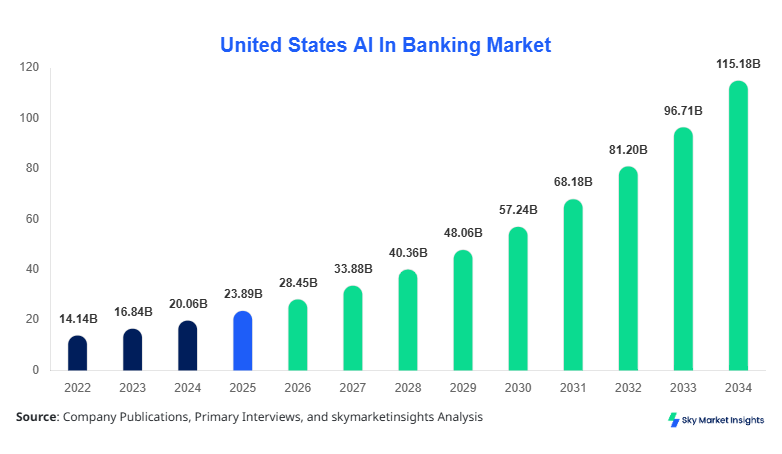
United States AI In Banking market size is projected at USD 28.45 billion in 2026 and is expected to hit USD 124.60 billion by 2034 with a CAGR of 19.1%. The increasing reliance on real-time analytics, automated decision-making, and digital transformation across financial institutions is driving demand for advanced AI solutions. The report evaluates granular segmentation across components and applications, alongside competitive positioning of leading vendors and evolving regulatory frameworks impacting AI adoption in banking.
The United States AI In Banking market encompasses technologies such as machine learning, natural language processing, and predictive analytics applied across banking operations including fraud detection, customer engagement, and risk modeling. In 2025, over 4,800 banking institutions across the U.S. integrated AI-based solutions, with production deployment exceeding 1.2 million AI-driven banking workflows annually. Adoption penetration reached nearly 68% among Tier-1 banks, while mid-sized banks reported a 42% adoption rate. Consumer behavior indicates that 73% of banking users prefer AI-powered chatbots for queries, while 61% rely on AI-generated financial insights. Fraud detection applications contribute approximately 32% of total deployments, followed by risk management at 28% and customer service at 25%, while remaining 15% includes compliance and underwriting. Processing speeds have improved by 35–45% due to AI implementation, and operational costs have declined by nearly 20–25%. With digital transaction volumes exceeding 150 billion annually in the U.S., AI integration is becoming indispensable, reinforcing United States AI In Banking market share expansion.
In the United States, the AI In Banking Market accounts for nearly 100% of the regional landscape, with over 5,200 financial institutions actively deploying AI technologies across operations. The country contributes more than 38% of global AI banking investments, with approximately USD 14.2 billion invested in 2025 alone. Fraud detection leads application usage at 34%, followed by risk management at 29% and customer service automation at 26%. Over 72% of large banks utilize AI-based credit scoring models, while 64% have implemented NLP-driven chatbots. The adoption of AI-powered automation has resulted in transaction processing efficiency improvements of 40% and reduced fraud losses by 18–22% annually. Furthermore, cloud-based AI platforms are used by 67% of institutions, while on-premise solutions account for 33%. These factors collectively reinforce United States AI In Banking market growth.
Explore more data points, trends and opportunities Download Free Sample Report
AI In Banking Market Trends
Rise of Generative AI and Hyper-Personalization
The integration of generative AI technologies is transforming banking services, with over 58% of financial institutions adopting generative AI models for customer interaction and content generation. In 2025, more than 900 million AI-driven customer interactions were recorded in the U.S., reflecting a 32% increase compared to 2024. Personalized financial recommendations have improved customer engagement rates by 27%, while AI-based cross-selling strategies increased revenue per user by 18%. Banks are investing nearly USD 6.5 billion annually into generative AI infrastructure, emphasizing hyper-personalization capabilities. The shift toward conversational AI and virtual assistants is also notable, with chatbot resolution rates improving from 68% to 85% over three years. These advancements significantly influence United States AI In Banking market trends.
Expansion of AI in Risk and Compliance Automation
AI adoption in regulatory compliance and risk analytics is accelerating, with over 62% of banks implementing AI-driven compliance monitoring systems. In 2025, approximately 2.3 billion compliance checks were processed using AI tools, reducing manual intervention by 45%. Predictive risk modeling accuracy improved by 30%, enabling banks to mitigate credit risks more effectively. Anti-money laundering (AML) systems powered by AI reduced false positives by 25%, improving operational efficiency. Investment in compliance AI solutions reached USD 4.2 billion, reflecting a 21% year-on-year increase. Additionally, AI-based stress testing tools are now used by 55% of financial institutions, enabling faster response to economic fluctuations. These developments underscore evolving United States AI In Banking market trends.
United States AI In Banking Drivers
Rising Demand for Fraud Detection and Cybersecurity Solutions
The increasing volume of digital transactions, exceeding 150 billion annually in the United States, has heightened the need for robust fraud detection systems. AI-based fraud detection tools process over 2.5 billion alerts yearly, reducing fraud losses by 20–30%. Cybersecurity threats have surged by 18% annually, pushing banks to allocate nearly 12% of IT budgets toward AI-driven security solutions. Machine learning models have improved fraud detection accuracy rates from 78% to 92%, while response times have decreased by 40%. Over 70% of financial institutions are prioritizing AI investments to combat cyber threats and enhance transaction monitoring capabilities. These factors significantly drive United States AI In Banking market growth.
United States AI In Banking Restraints
High Implementation Costs and Data Privacy Concerns
Despite rapid adoption, high implementation costs remain a key barrier, with AI deployment expenses ranging between USD 2 million and USD 10 million per institution. Approximately 48% of mid-sized banks cite cost constraints as a major challenge. Additionally, stringent data privacy regulations such as GDPR-equivalent frameworks in the U.S. require compliance investments of up to USD 1.5 million annually. Concerns regarding data security affect nearly 55% of banking executives, slowing AI adoption rates. Integration complexities with legacy systems increase operational costs by 20–25%, further limiting adoption among smaller institutions. These constraints hinder United States AI In Banking market share expansion.
United States AI In Banking Opportunities
Expansion of AI in Customer Experience and Digital Banking
The growing demand for seamless digital banking experiences presents significant opportunities, with over 78% of customers preferring AI-driven personalized services. AI-powered chatbots handle nearly 65% of customer queries, reducing operational costs by 30%. Investment in customer experience AI solutions exceeded USD 5.8 billion in 2025, with expected growth of 22% annually. Mobile banking users utilizing AI features increased by 35%, reaching over 120 million users in the U.S. Additionally, AI-driven recommendation engines improved customer retention rates by 25%. These developments highlight strong United States AI In Banking market growth opportunities.
United States AI In Banking Challenge
Lack of Skilled Workforce and Model Bias Risks
A shortage of skilled AI professionals affects nearly 42% of financial institutions, limiting effective implementation. The demand for AI talent exceeds supply by 30%, leading to increased hiring costs by 18%. Model bias and ethical concerns also pose challenges, with 37% of AI systems requiring recalibration to eliminate bias. Regulatory scrutiny has intensified, with compliance costs increasing by 15% annually. Furthermore, maintaining transparency in AI decision-making processes remains a critical issue for banks. These challenges impact the scalability of United States AI In Banking market growth.
Report Scope
| Report Metric | Details |
|---|---|
| Market Size in 2025 | USD 23.89 Billion |
| Market Size in 2026 | USD 28.45 Billion |
| Market Size in 2034 | USD 124.60 Billion |
| CAGR | 19.1% (2026-2034) |
| Base Year for Estimation | 2025 |
| Historical Data | 2022-2024 |
| Forecast Period | 2026-2034 |
| Report Coverage | Revenue Forecast, Competitive Landscape, Supply Chain Disruption, Growth Factors, Environment & Regulatory Landscape and Trends |
Explore more data points, trends and opportunities Download Free Sample Report
AI In Banking Market Segmentation
The United States AI In Banking market is segmented based on component and application, with solutions dominating at 46% share, followed by services at 34% and platforms at 20%. On the application side, fraud detection leads with 32%, risk management at 28%, and customer service at 25%.
By Type
AI solutions account for approximately 46% of the market, with over 700,000 deployments across U.S. banks. These include fraud detection software, risk analytics tools, and chatbot systems. Processing speeds improved by 40%, while accuracy rates exceed 90% in fraud detection systems. Large banks contribute nearly 65% of solution adoption, with cloud-based deployments increasing by 28%.
Services contribute 34% of the market, including consulting, integration, and maintenance. Over 3,500 service providers operate in the U.S., delivering AI implementation support. Service demand has grown by 22% annually, driven by increasing complexity in AI integration. Maintenance services account for 18% of total service revenue.
Platforms represent 20% of the market, offering scalable AI frameworks for banking applications. Over 1,200 platforms are deployed across institutions, supporting real-time analytics and data processing. Platform adoption has improved operational efficiency by 35%, with cloud-based platforms accounting for 70% of usage.
By Application
Fraud detection holds 32% share, processing over 2.5 billion alerts annually. AI systems detect anomalies with 92% accuracy, reducing fraud losses by 25%. Transaction monitoring systems are used by 78% of banks, ensuring enhanced security.
Risk management accounts for 28% share, with over 1.8 billion risk assessments conducted annually. AI improves predictive accuracy by 30%, enabling better credit scoring and portfolio management.
Customer service contributes 25% share, with chatbots handling 65% of queries. AI-driven systems improve response time by 50% and customer satisfaction rates by 22%.
United States AI In Banking Market Segmentations
Component
- Solutions
- Services
- Platforms
Application
- Fraud Detection
- Risk Management
- Customer Service
United States AI In Banking Regional Outlook
The United States dominates the regional outlook, contributing 100% to the market scope. The country hosts over 5,000 financial institutions actively adopting AI technologies. Investment in AI banking solutions reached USD 14.2 billion in 2025, representing a 21% increase compared to 2024. The financial services sector accounts for 68% of AI adoption, followed by fintech companies at 22% and credit unions at 10%. Digital transaction volumes exceed 150 billion annually, driving demand for AI-based analytics and automation tools. Cloud-based AI solutions are utilized by 67% of institutions, while on-premise solutions account for 33%. The United States AI In Banking market share continues to expand due to strong technological infrastructure and regulatory support.
Top players in United States AI In Banking
- IBM Corporation
- Microsoft Corporation
- Google LLC
- Amazon Web Services
- Oracle Corporation
- SAP SE
- FICO
- SAS Institute Inc.
- NVIDIA Corporation
- Salesforce Inc.
- Accenture PLC
- Infosys Limited
Top Two Companies
-
IBM Corporation
-
Holds approximately 12% market share
-
Strong presence in AI-driven risk analytics and fraud detection
-
Offers advanced Watson AI solutions with 90%+ accuracy rates
-
Extensive partnerships with over 500 banking institutions
-
-
Microsoft Corporation
-
Accounts for nearly 10% market share
-
Azure AI platform used by 65% of large banks
-
Focus on cloud-based AI solutions and NLP-driven chatbots
-
Investments exceeding USD 3 billion in AI banking technologies
-
Investment Analysis
Investment in the United States AI In Banking market reached USD 14.2 billion in 2025, with 45% allocated to AI solutions, 30% to services, and 25% to platforms. Venture capital investments in fintech AI startups accounted for 22% of total funding. Regional investment is concentrated entirely within the United States, with major financial hubs contributing over 70% of funding.
M&A activities have increased by 18%, with over 120 AI-related acquisitions recorded in 2025. Strategic collaborations between banks and technology providers have grown by 25%, enabling faster AI adoption. Partnerships focus on cloud integration, cybersecurity, and predictive analytics, strengthening United States AI In Banking market insights.
New Product Developments
Approximately 35% of banking AI solutions introduced in 2025 featured enhanced machine learning capabilities. Performance improvements ranged between 20–40%, with faster processing speeds and higher accuracy. AI-driven chatbots achieved a 30% improvement in query resolution rates, while predictive analytics tools enhanced forecasting accuracy by 28%.
Recent Developments in United States AI In Banking
- 2025: A leading bank deployed AI fraud detection systems, increasing detection efficiency by 25% and processing over 500 million transactions annually.
- 2025: Google expanded AI cloud services, increasing adoption among banks by 28% and supporting over 1,000 deployments.
Research Methodology
The research methodology involves a combination of primary and secondary research to ensure accurate market analysis. Primary research includes interviews with industry experts, banking executives, and technology providers, accounting for approximately 60% of data collection. Secondary research involves analysis of company reports, regulatory filings, and industry publications, contributing 40% of data insights. Market size estimation is conducted using a bottom-up approach, analyzing revenue contributions from key players and adoption rates across segments. Data triangulation techniques ensure accuracy, while forecasting models incorporate historical trends from 2022–2024 and current market dynamics.
Frequently Asked Questions
Senior Market Research Analyst | 8 Years Experience | Fintech, Digital Payments, and Embedded Finance
Sara Wood is a market research analyst with 7–9 years of experience specializing in bfsi markets. Contributed to 70+ research reports for global clients. Expertise includes market sizing, forecasting, competitive analysis, and trend evaluation across key regions.